Summary
In the previous lesson, What Is Cloud Computing? A Practical Multi-Cloud Guide for Engineers and Architects, we introduced the broader cloud computing mental model. In this lesson, we focus on one specific question: what really changed when enterprises moved from traditional data centers to cloud computing?
The answer is not simply “servers moved somewhere else.” The real change is the shift from
- hardware ownership to service consumption,
- manual provisioning to API-driven automation,
- fixed capacity to elastic capacity,
- infrastructure operations to platform engineering.
A traditional data center environment usually runs on long planning cycles. Teams estimate demand, buy hardware, rack servers, configure networks, allocate storage, request firewall rules, install operating systems, attach monitoring, and then hand the environment to application teams. This model works, but it is slow, capacity-heavy, and dependent on many manual handoffs.
Cloud changes the delivery model. Engineers can create compute, storage, network, database, identity, and monitoring resources using a console, CLI, API, SDK, or Infrastructure as Code. Environments can be created, updated, destroyed, and rebuilt repeatedly. But cloud speed comes with responsibility. If every team creates resources without standards, the result is not agility — it is chaos. You get inconsistent naming, weak identity boundaries, unplanned networks, missing logs, untagged resources, unclear ownership, and unexpected cost.
This lesson does not re-explain what cloud computing is. Here, we focus on the operating model shift from traditional IT to cloud.
After completing this lesson, you will be able to:
- Explain the operating model difference between traditional data centers and cloud platforms
- Compare hardware ownership with cloud service consumption
- Understand how provisioning changed from manual tickets to API-driven automation
- Identify how capacity planning changed from fixed sizing to elastic scaling
- Recognize why cloud increases the need for governance, security, and cost visibility
- Explain the shift from infrastructure operations to platform engineering
The Core Mental Model: Ownership vs Consumption
Traditional IT is built around ownership. You own or lease infrastructure. You manage the data center space, racks, servers, storage systems, network devices, virtualization platform, operating systems, patching, backup, monitoring, and hardware lifecycle.
Cloud is built around consumption. You consume provider-managed services through a cloud control plane. You still design and operate workloads, but you no longer manage most of the physical infrastructure directly.
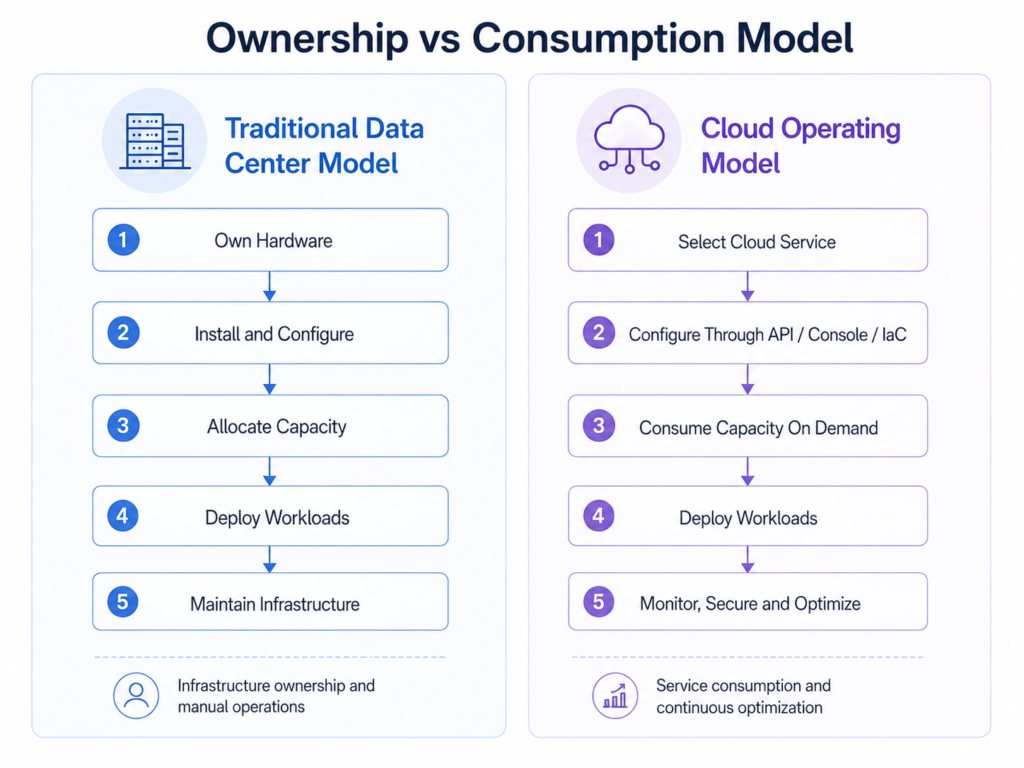
This is the most important shift. Cloud does not remove engineering. It changes the engineering focus from physical infrastructure management to architecture, automation, governance, security, observability, and cost control.
What Really Changed?
Procurement Changed
In traditional IT, infrastructure usually requires planning and purchasing before it can be used. Hardware may need budget approval, vendor quotes, procurement cycles, delivery, installation, and configuration.
In cloud, teams consume services on demand. This improves delivery speed, but it also changes financial control. Instead of approving only large upfront purchases, organizations must continuously monitor usage.
Capacity Planning Changed
Traditional infrastructure is often sized for peak demand. If a workload needs 20 servers during peak season, the organization may buy enough capacity for that peak even if average usage is much lower.
Cloud supports elastic capacity. Workloads can scale up, scale down, scale out, or scale in depending on demand. But elasticity is not automatic architecture.
Applications must be designed for scaling. Monitoring must detect demand. Automation must add and remove resources safely. Cost controls must prevent unnecessary scale.
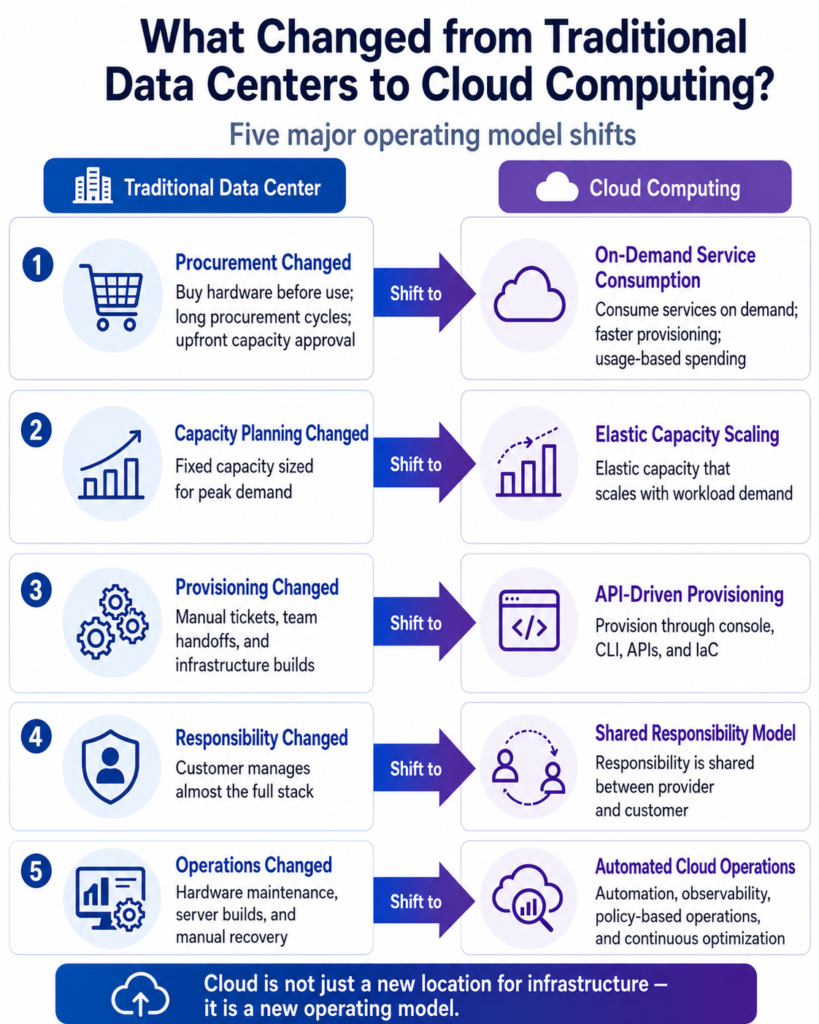
Provisioning Changed
Traditional provisioning often depends on tickets, handoffs, and manual work. A server request may involve separate teams for compute, storage, networking, firewall rules, backup, monitoring, and access.
Cloud provisioning is API-driven.
The console, CLI, SDKs, Terraform, Bicep, CloudFormation, and CI/CD pipelines all interact with cloud provider APIs. This means infrastructure can be created and managed like software.
Responsibility Changed
In a traditional data center, the organization owns almost every layer of responsibility: facilities, hardware, network devices, virtualization, operating systems, applications, data, backup, security, and operations.
In cloud, responsibility is shared.
The provider manages the underlying cloud platform. The customer remains responsible for how cloud services are configured and used.
This topic is covered in detail in Cloud Shared Responsibility Model Explained Across Cloud Providers, so the key point here is simple:
Cloud providers secure the cloud platform. You secure what you build, configure, deploy, expose, and store in the cloud.
Operations Changed
Traditional operations often focus on hardware lifecycle, server uptime, patching, backups, ticket handling, and infrastructure availability.
Cloud operations focus more on automation, observability, identity governance, policy enforcement, cost optimization, incident response, and service configuration.
The operational question changes from: “Is the server running?”
to:
“Is the workload secure, observable, resilient, compliant, cost-aware, and deployed through a repeatable process?”
Engineer vs Architect Perspective: What Changed?
In previous lesson, we introduced the general engineer vs architect perspective. In this article, the focus is narrower: how both roles change when an organization moves from traditional data centers to cloud.
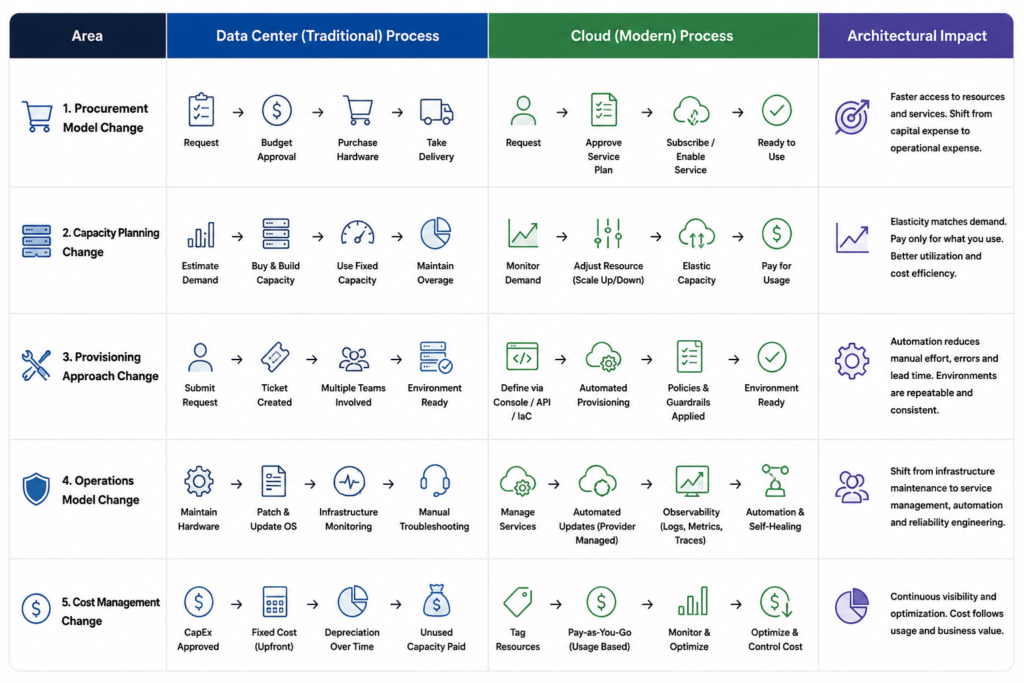
The key difference is this: in traditional IT, engineers often wait for infrastructure. In cloud, engineers can create infrastructure quickly — so architects must ensure the platform has guardrails, patterns, and governance before speed turns into risk.
Traditional Tooling vs Cloud Tooling
The previous Pillar article introduced multi-cloud service names across AWS, Azure, Google Cloud, OCI, and IBM Cloud. Here, the important comparison is not service naming — it is how the tooling model changed.
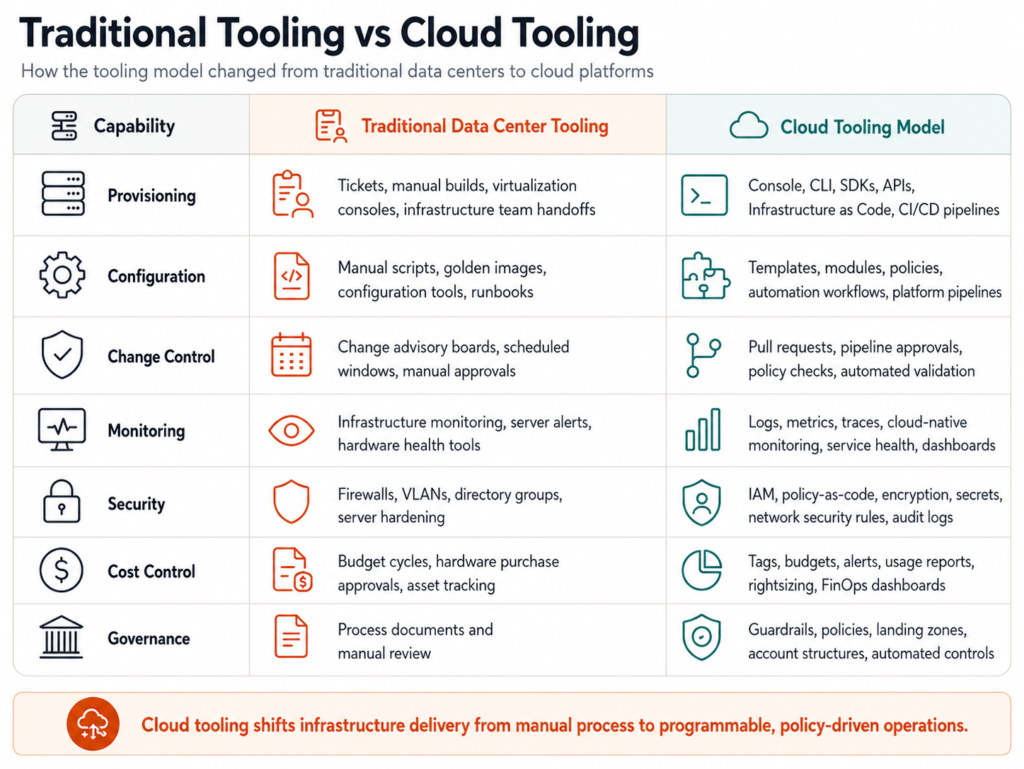
This shift is why cloud operating models depend heavily on automation and governance. Cloud does not only change where infrastructure runs; it changes how infrastructure decisions are requested, approved, deployed, monitored, and optimized.
How Multi-Cloud Changes the Data Center-to-Cloud Shift
Moving from a traditional data center to one cloud provider is already a major operating model change. Moving into a multi-cloud environment adds another layer of complexity.
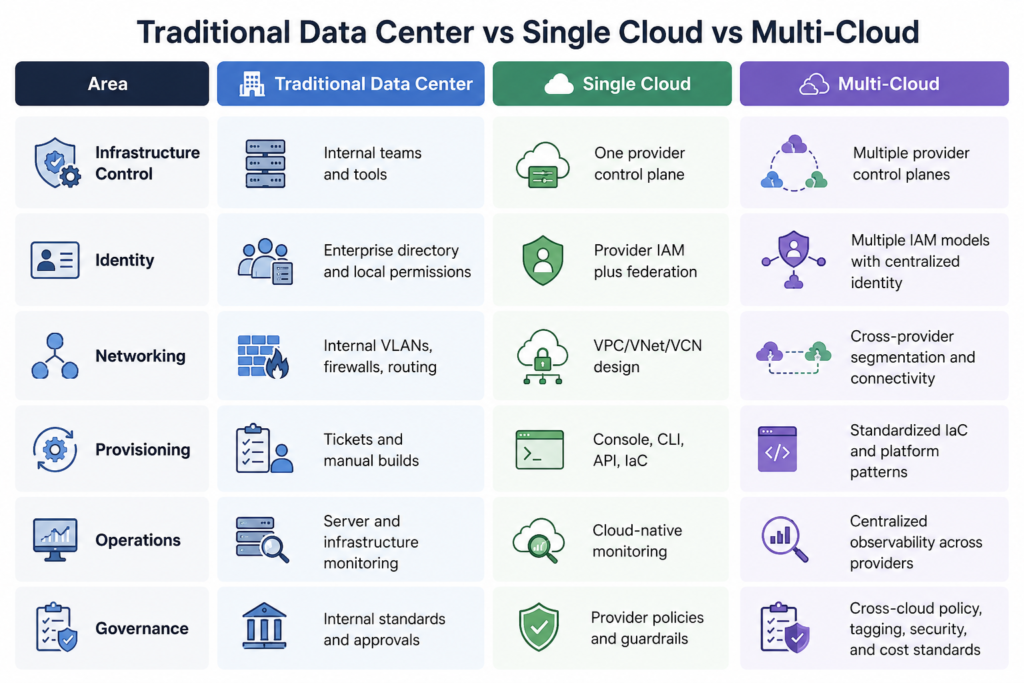
In a traditional data center, teams usually work with one internal infrastructure model: one network standard, one virtualization platform, one ticketing process, one security model, and one operations team. In multi-cloud, each provider has its own control plane, identity model, networking constructs, logging tools, cost model, and automation framework.
For example, a virtual network is not described the same way across AWS, Azure, Google Cloud, OCI, and IBM Cloud. Identity permissions, firewall rules, tagging models, monitoring services, and infrastructure templates also differ across providers.
This is why multi-cloud cannot be treated as “the same cloud repeated five times.” A multi-cloud operating model requires standardization above the providers.
From an architecture perspective, the biggest change is not the technology itself—it is the operating model. Servers, networks, storage, identity, and security continue to exist in every environment. What changes is who manages them, how they are provisioned, and how governance is applied at scale.
The following comparison provides a high-level view of how enterprise responsibilities evolve across traditional data centers, single-cloud environments, and multi-cloud architectures.
Well-Architected Lens: What Changes in Cloud?
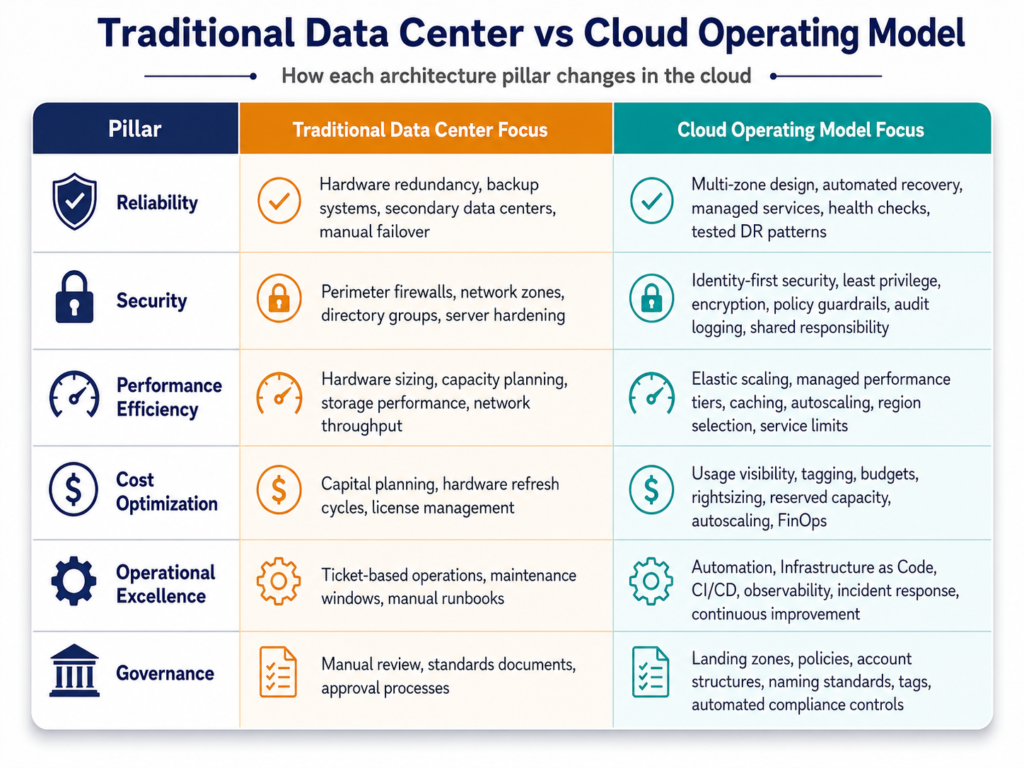
The broader Well-Architected mindset was introduced in previous lesson For this article, the key question is: how does each architecture pillar change when moving from data centers to cloud?
The major shift is that cloud architecture must be designed for continuous change. Resources can be created quickly, scaled quickly, and removed quickly. That speed is valuable only when reliability, security, cost, operations, and governance are built into the platform from the beginning.
Architect’s Note
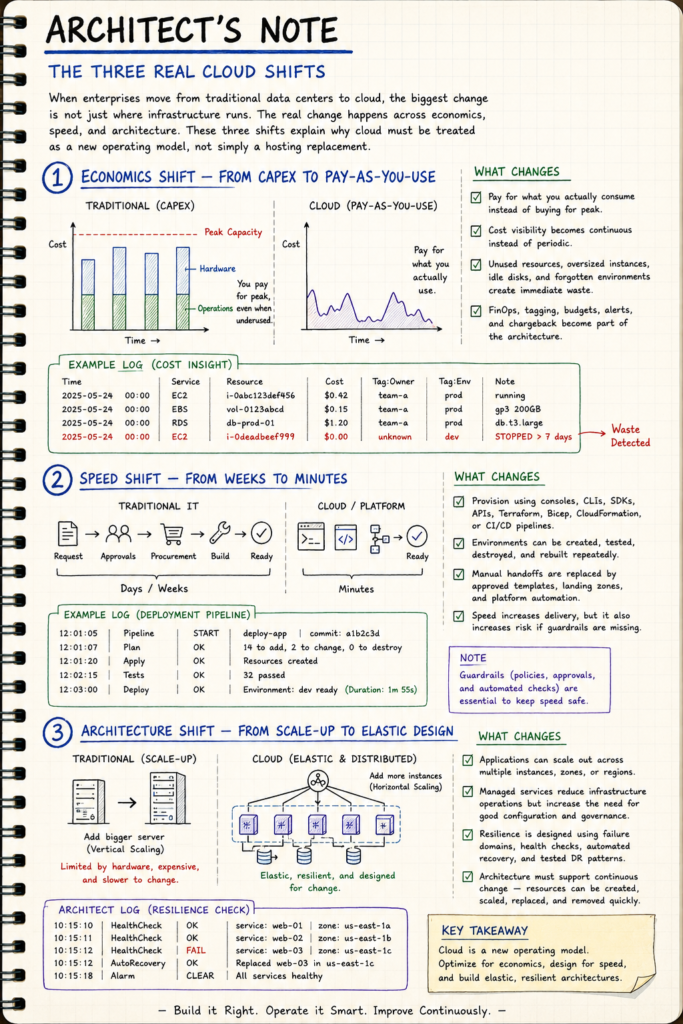
The cloud shift is powerful because economics become variable, delivery becomes faster, and architecture becomes elastic. But these benefits only work when cloud teams build strong foundations around identity, networking, automation, observability, security, governance, and cost control.
Cloud Adoption Risk
The biggest mistake I see in cloud adoption is assuming speed equals maturity. Cloud makes it easy to create infrastructure quickly, but that does not mean the environment is ready for enterprise workloads.
A team can create virtual machines, databases, public endpoints, and storage in minutes. But if identity is not controlled, logs are not centralized, networks are not planned, backups are unclear, and costs are not tagged, the platform becomes risky very quickly.
The best cloud environments are not the ones where everything is manually approved. They are the ones where good decisions are built into the platform. Engineers move fast because the architecture already provides safe patterns, automated guardrails, and clear operating standards.
Fast cloud adoption without a strong foundation can create hidden enterprise risk: uncontrolled accounts, weak IAM, unplanned networks, missing logs, poor tagging, and unexpected cost.
The infographic below shows why cloud teams need landing zones, identity standards, network guardrails, logging, policies, and cost controls before scaling cloud adoption.
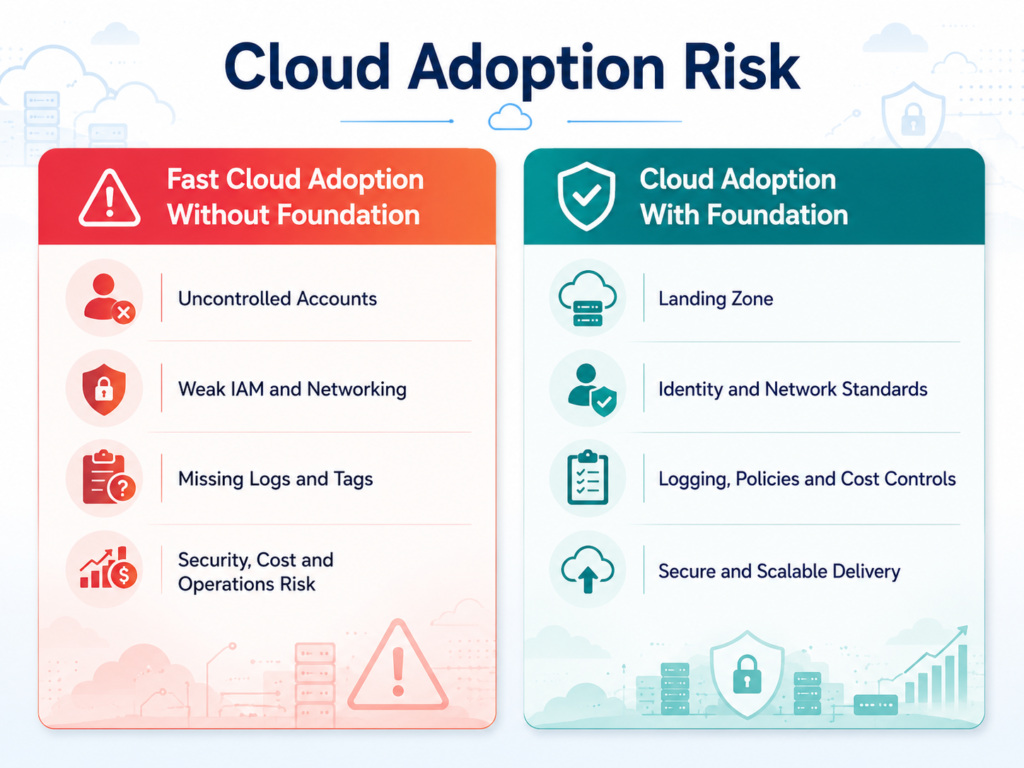
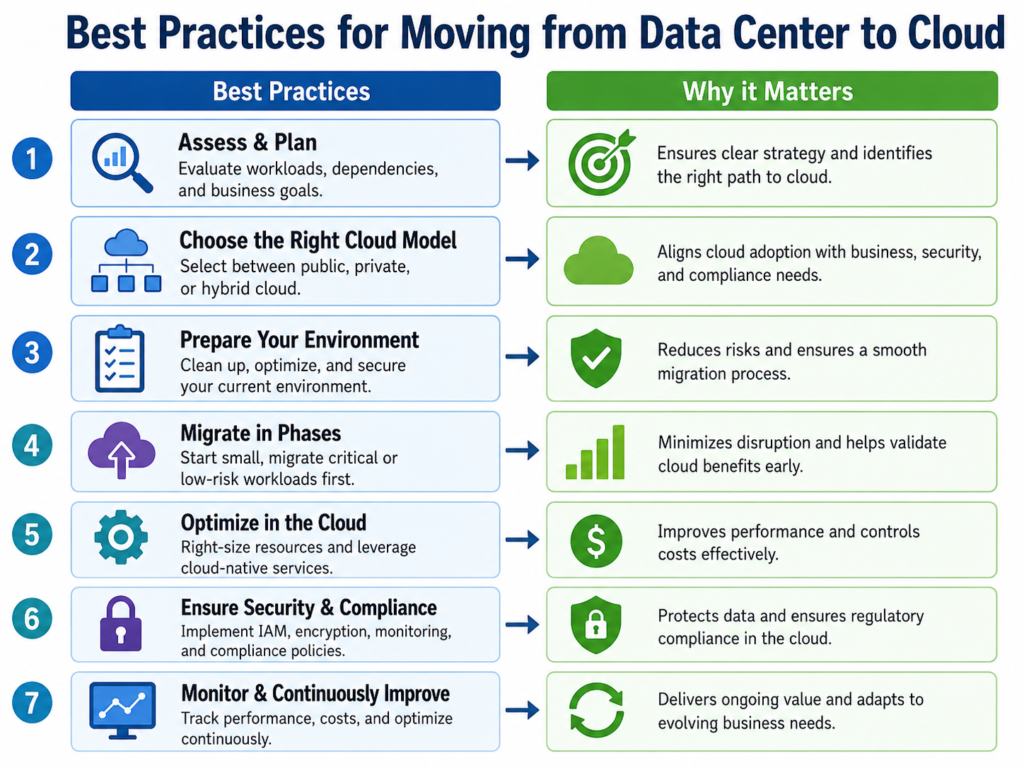
A successful data center-to-cloud move is not just a migration of workloads; it is a shift in operating model, governance, automation, security, and cost accountability. Follow the best practices mentioned in the table below to standardize identity, networking, deployment patterns, observability, and cost controls before large-scale cloud adoption begins.
How Generative AI and Agentic AI Change Cloud Operations
Generative AI and Agentic AI are starting to change how engineers interact with cloud environments, but they do not remove the need for strong architecture foundations.
In traditional IT, engineers often relied on runbooks, tickets, scripts, and manual troubleshooting. In cloud, AI assistants can help generate Terraform templates, explain CLI commands, summarize logs, review architecture diagrams, suggest cost optimizations, and identify configuration risks.
Agentic AI goes one step further. Instead of only answering questions, an agentic workflow may be able to inspect cloud resources, compare configurations, open change requests, generate deployment plans, or recommend remediation steps.
But this creates an important architectural lesson: AI can accelerate cloud operations only when the environment is well governed.
If identity is weak, logs are missing, naming is inconsistent, tags are absent, and resources are deployed manually, AI will not magically fix the platform. It may simply make bad operations faster.
From an architecture perspective, the value of AI is not simply generating code or automating tasks. Its real value lies in accelerating decision-making, reducing operational effort, and improving consistency across cloud environments.
As AI becomes integrated into cloud platforms and engineering workflows, organizations must balance automation with governance. The following examples show how AI can support cloud operations and the controls needed to maintain security, compliance, and operational reliability.
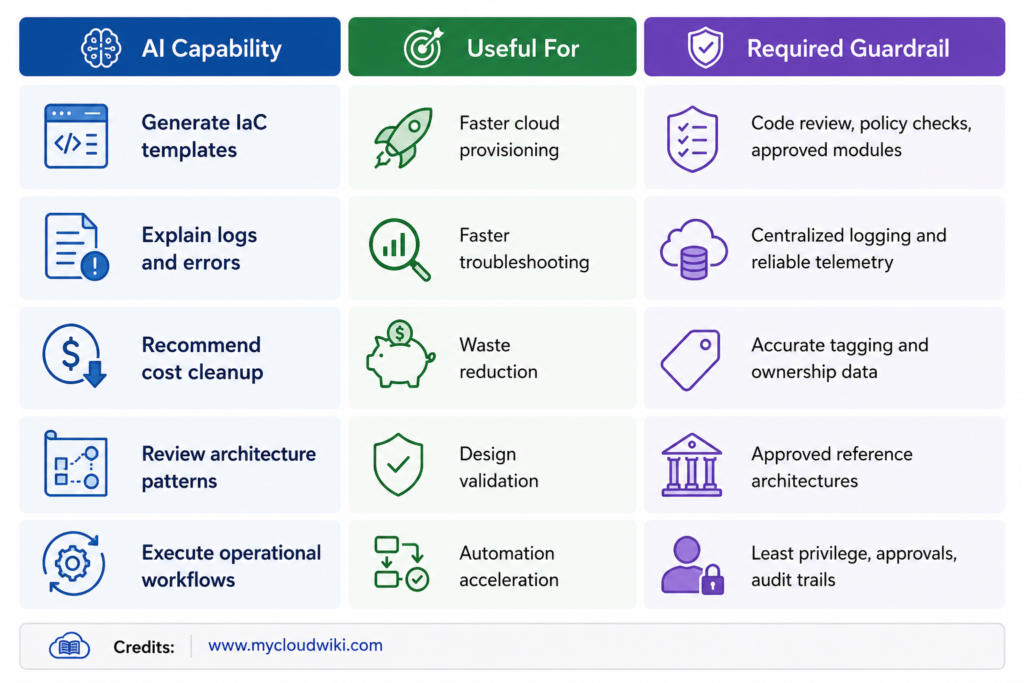
The practical message is simple: Agentic AI increases the value of cloud automation, but it also increases the need for governance. Before AI can safely operate cloud environments, the platform must have clear identity boundaries, policy guardrails, observability, approval workflows, and audit trails.
Common Mistakes and Misconceptions
“Cloud is just a cheaper data center.”
Cloud can reduce waste, but it is not automatically cheaper. Poorly governed cloud environments can become expensive quickly.
“We can migrate first and govern later.”
This creates technical debt. Governance, identity, network design, logging, and cost visibility should be part of the foundation.
“The provider handles all security.”
The provider secures the underlying platform. You still own identity, permissions, data, configuration, and application security.
“Manual console changes are fine for production.”
Manual changes are difficult to review, repeat, audit, and troubleshoot. Production environments should move toward Infrastructure as Code and controlled pipelines.
Key Takeaways
- Cloud is not just a different location for servers; it is a different operating model.
- Traditional IT is built around ownership, while cloud is built around service consumption.
- Cloud infrastructure is programmable through consoles, CLIs, APIs, SDKs, pipelines, and Infrastructure as Code.
- Cloud speed must be balanced with identity, networking, security, cost, and governance.
- Engineers focus more on automation and service operations; architects focus more on platform standards and guardrails.
- Successful cloud adoption requires reliability, security, cost optimization, operational excellence, and governance from the start.
- Multi-cloud adds complexity because each provider has different identity, networking, governance, monitoring, and automation models.
- Generative AI and Agentic AI can accelerate cloud engineering, but only when strong guardrails, observability, and governance are already in place.

