
Modern enterprise architecture is entering a new phase where cloud platforms, AI systems, security operations, and emerging quantum technologies are no longer evolving independently. Over the last few weeks, major technology providers including AWS, Microsoft Azure, Google Cloud, OpenAI, Anthropic, IBM Research, and Microsoft Security have collectively signaled a broader industry transition toward intelligent, automation-driven platforms designed to operate at enterprise scale. Kubernetes environments are becoming AI-ready operational control planes, AI agents are moving into real engineering and business workflows, security systems are adopting AI-assisted defense models, and quantum computing is steadily progressing toward specialized enterprise use cases.
For enterprise architects, platform engineers, and technology leaders, the challenge is no longer simply adopting new technologies. The real challenge is designing platforms that can securely connect automation, identity, governance, observability, resilience, and intelligent workflows into a unified operating model. This update focuses on the most important developments across Cloud Computing, Artificial Intelligence, Security, and Quantum Computing, along with the broader architecture patterns enterprises should prepare for next.
Latest Developments in Enterprise Technologies
- Enterprise technology is moving toward a controlled automation model, where cloud platforms, AI agents, security systems, and emerging quantum services operate as connected parts of the same architecture.
- Cloud platforms are becoming the foundation for AI-ready applications, Kubernetes modernization, workload identity, observability, cost optimization, and resilient operations.
- Artificial Intelligence is shifting from productivity assistance to governed enterprise workflows, coding agents, agentic business processes, and AI-enabled software delivery.
- Security is becoming more tightly connected to AI agents, cloud identities, developer tooling, CI/CD systems, Kubernetes platforms, and software supply chains.
- Quantum computing remains early for most enterprises, but quantum-centric supercomputing, cloud-based access to quantum processors, and post-quantum cryptography readiness are becoming important architecture signals.
- The main architecture priority is not adopting every new tool quickly. The priority is building platforms that are secure, observable, governed, scalable, and automation-ready.
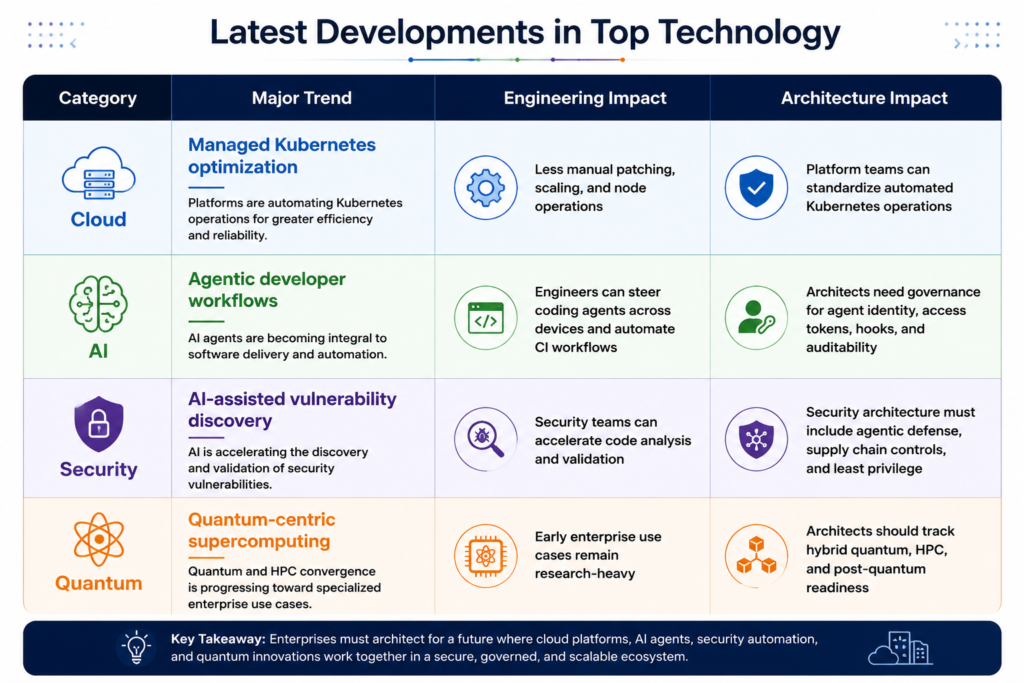
Cloud Computing Trends
- Microsoft Azure and Red Hat: Azure Red Hat OpenShift is being positioned as a modernization and production AI platform supporting containers, virtualized workloads, governance, security, and scale for enterprise environments.
- AWS EKS: Amazon EKS Auto Mode continues to reduce Kubernetes operational overhead through automated provisioning, compute optimization, scaling, patching, and integration with AWS-native security services.
- AWS Containers: Recent EKS guidance focused on cross-region disaster recovery, centralized observability, container network visibility, inter-AZ traffic optimization, and cost-aware Kubernetes operations.
- Microsoft Azure: Secure-by-design infrastructure continues to be a major cloud architecture theme, especially for identity, control plane protection, compute isolation, network segmentation, data protection, and monitoring.
- Architecture signal: Cloud platforms are evolving into the enterprise control plane for AI workloads, automation, governance, and modern application delivery.
Artificial Intelligence Trends
- OpenAI: Codex updates show AI-assisted software engineering moving into mobile, IDE, CLI, CI/CD, and enterprise-controlled workflows through programmatic access tokens and automation integrations.
- OpenAI: Workspace agents highlight how enterprise AI is moving from chat-based interaction to task-oriented workflows connected to business systems, tools, approvals, and administrative controls.
- Anthropic and PwC: Claude enterprise adoption signals that organizations are moving from isolated AI pilots to structured workforce transformation and AI-assisted engineering programs.
- AWS Security: AI security frameworks are becoming essential for production AI systems covering data access, infrastructure security, model interaction, governance, monitoring, and lifecycle management.
- Microsoft Security: Autonomous AI agents continue introducing new risks around tool usage, sensitive data access, workflow execution, and excessive privilege escalation.
- Architecture signal: AI must now be treated as a governed enterprise platform capability with identity, policy, auditability, monitoring, and operational controls.
Security Trends
- Microsoft Security: AI-assisted vulnerability discovery systems such as MDASH demonstrate how agentic AI can accelerate enterprise-scale vulnerability identification and validation.
- Microsoft Security: Security guidance around autonomous AI agents continues to emphasize prompt injection risks, unsafe tool invocation, excessive permissions, and data exposure.
- Microsoft Security: AI agent framework vulnerabilities reinforce that prompt injection can become infrastructure risk when agents interact with tools, code execution environments, and operational systems.
- OpenAI: The TanStack npm supply chain incident highlights the ongoing importance of dependency governance, developer endpoint security, credential rotation, and code-signing validation.
- Microsoft Agent 365: AI agent inventory and governance are becoming operational requirements because enterprises need visibility into agent identities, permissions, integrations, and reachable systems.
- Architecture signal: Security models must now extend across AI agents, CI/CD systems, Kubernetes platforms, developer devices, software supply chains, and cloud identities.
Quantum Computing Trends
- IBM Research: Quantum-centric supercomputing continues to position quantum as a future accelerator for specialized workloads such as chemistry, financial modeling, energy, materials science, and advanced simulation.
- IBM Research: IBM’s roadmap continues emphasizing quantum advantage and fault-tolerant quantum computing milestones over the next several years.
- Google Quantum AI: The Willow Early Access Program demonstrates that advanced quantum processor access is increasingly cloud-mediated and partnership-driven.
- Microsoft Quantum: Enterprise-focused quantum research continues concentrating on scalable architectures, quantum collaboration programs, and long-term practical quantum computing models.
- NIST: Post-quantum cryptography remains an important enterprise planning area as organizations evaluate certificate lifecycles, crypto inventory, and long-term cryptographic migration strategies.
- Architecture signal: Quantum is not yet a mainstream enterprise runtime, but architects should begin preparing for crypto-agility, research partnerships, and hybrid quantum-classical architectures.
Cross-Domain Architecture Insight
The combined direction across cloud, AI, security, and quantum is clear:
Enterprises are moving toward an automation-first architecture where platforms must be controlled, observable, secure, and governed by design.
Cloud provides the runtime.
AI provides workflow and decision automation.
Security provides control and trust.
Quantum provides future specialized compute potential.
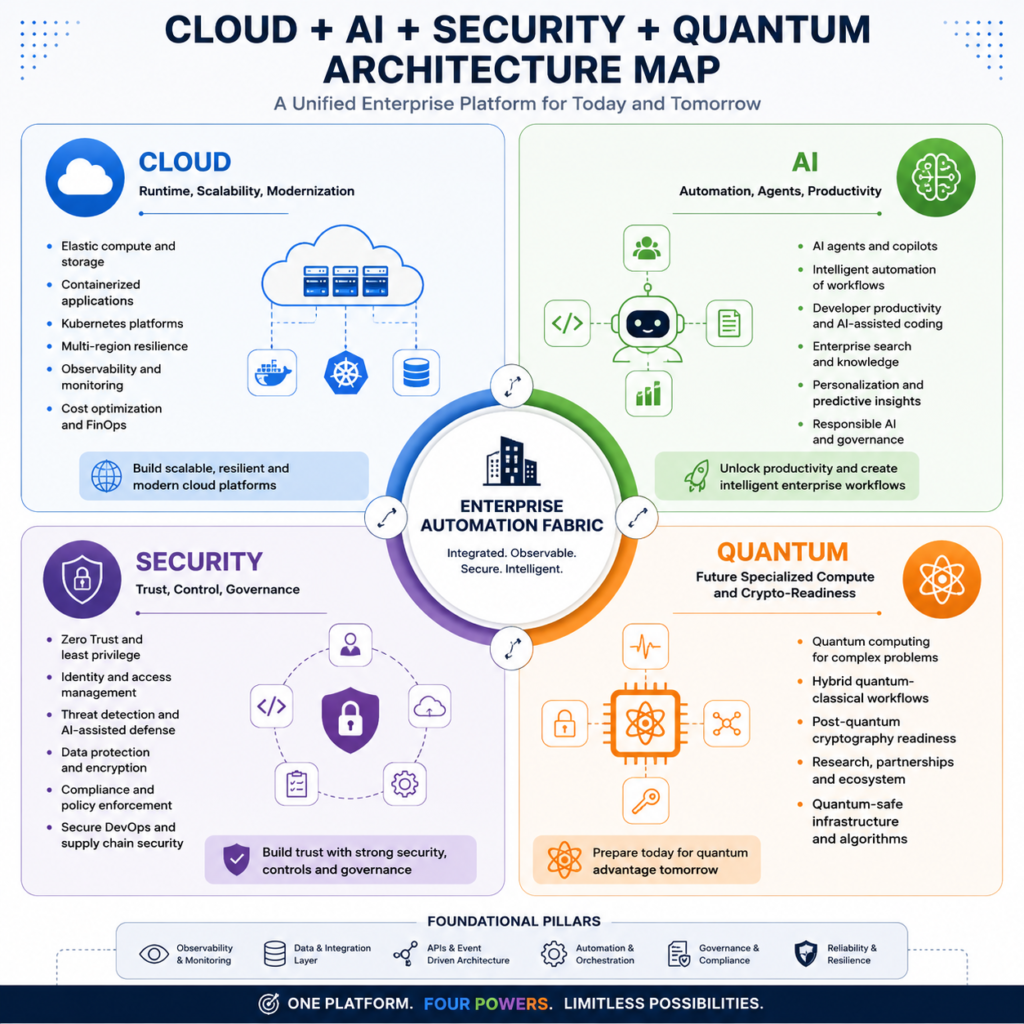
The architecture challenge is connecting these capabilities without introducing unmanaged operational, governance, or security risk.
Enterprise Readiness Checklist
- Build a standardized enterprise cloud platform model for Kubernetes, identity, observability, resilience, and cost governance.
- Define AI agent governance before agents gain access to production systems, business workflows, or enterprise data.
- Use workload identity, short-lived credentials, and scoped access tokens instead of embedded secrets.
- Add dependency scanning, package verification, SBOM tracking, and code-signing validation into CI/CD pipelines.
- Create an inventory of AI agents, tools, identities, connected systems, and data access paths.
- Centralize observability across cloud accounts, clusters, regions, and critical workloads.
- Review disaster recovery patterns for Kubernetes and stateful cloud-native workloads.
- Start post-quantum readiness planning with crypto inventory and certificate lifecycle mapping.
- Align AI, cloud, and security programs under one enterprise platform strategy.
Final Recommendations
- Cloud teams should focus on building standardized, observable, secure, and cost-aware platforms.
- AI teams should move from experimentation to governed enterprise AI delivery.
- Security teams should expand controls to cover AI agents, developer tools, supply chains, CI/CD systems, and machine identities.
- Platform teams should design reusable patterns for Kubernetes, workload identity, observability, disaster recovery, and secure automation.
- Architecture teams should design an enterprise automation fabric connecting cloud, AI, security, and future quantum readiness.
- Technology leaders should treat AI adoption, cloud modernization, and security architecture as one combined enterprise platform strategy.
Key Takeaways
- Cloud platforms are becoming the foundation for enterprise automation.
- AI agents require governance, identity, access control, and auditability.
- Security must now cover cloud, AI, CI/CD, developer devices, and software supply chains.
- Kubernetes remains central to modernization and AI-ready platforms.
- Quantum is still early, but crypto-agility planning should begin now.
- Enterprise architecture should prioritize controlled automation over uncontrolled experimentation.
- The future enterprise platform model is secure, scalable, observable, governed, and automation-ready.

