
Advertisement

Follow Us

Basic & Fundamentals

Advertisement

Recent Posts

Advertisement
Advertisement

Most Read

Virtualization Basics and Fundamentals

Virtualization is the process or a technique which can create a virtual version of IT datacenter components such as Compute, storage and network etc....

AWS Certified Solutions Architect Associate (SAA02) – Free Practice Tests

This AWS practice test helps you to pass the following AWS exams and can also helps you to revise the AWS concepts if you...

Cloud Computing Basics and Fundamentals

In this first post, we learn the fundamental basics of Cloud Computing, cloud characteristics and its advantages, different cloud implementation models, major cloud services...

Network Basics and Fundamentals

A Network is basically connecting two or more devices though a wired or wireless channel to share & exchange the information electronically. These devices...

Cloud Infrastructure Performance Tuning -Basics and Fundamentals

Applications in cloud environment may need to be tuned for the performance over the time and to meet the continuous changes in the user...

Basic concepts of Cloud Configurations and Cloud Deployments

A successful cloud deployment requires proper planning and determining the right cloud configurations and then executing the plan as it is. But to create...

Security Basics and Fundamentals

Security is the important strategy which is to be planned and implemented across all infrastructure layers to secure the IT infrastructure and the information...

3.5 Overview of RAID 10 and its use cases

HomeStorage Area Networking3.5 Overview of RAID 10 and its use cases
RAID 1+0 is also known as RAID 10 (Ten) or RAID 1/0. RAID 1+0 is also called striped mirror. It is a hybrid of RAID 1 (mirror sets) and RAID 0 (stripe sets). The objective of this RAID type is to combine both striping and mirroring techniques to get both the protection and performance of RAID 0 and RAID 1.
The basic concept of RAID 1+0 is a mirrored pair, which means that data is first mirrored and then both copies of the data are striped across multiple disk drive pairs in a RAID set. 
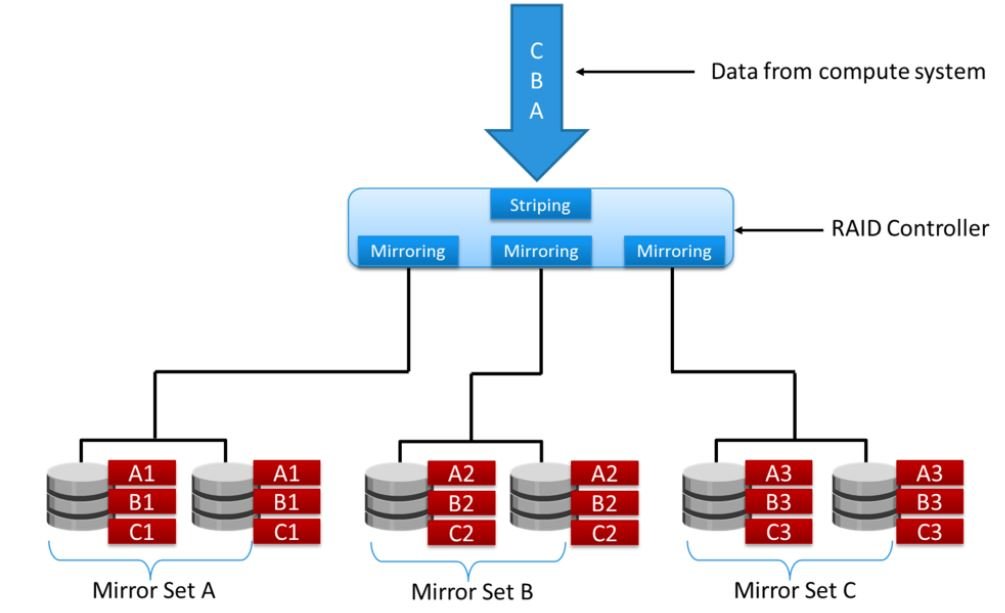
RAID 10
When replacing a failed drive, only the mirror is rebuilt. In other words, the storage system controller uses the surviving drive in the mirrored pair for data recovery and continuous operation. 

Data from the surviving disk is copied to the replacement disk. Most data centers require data redundancy and performance from their RAID arrays. RAID 1+0 combines the performance benefits of RAID 0 with the redundancy benefits of RAID 1. It uses mirroring and striping techniques and combines their benefits. This RAID type requires an even number of disks and the minimum is four.
RAID 10 and RAID 01 are not the same, and people often get confused the two . You
always want RAID 10 rather than RAID 01. The technical difference is that RAID 01 first
creates two stripe sets and then creates a mirror between them. The major concern with
RAID 01 is that it is more prone to data loss than RAID 10.

RAID 10 Use Cases

Choose RAID 10 if the capacity overhead can be affordable which comes with RAID 1, then RAID 10 potentially offers the best mix of performance and protection available from the traditional levels. 

Advertisement

Advantages

If something goes wrong with one of the disks in a RAID 10 configuration, the rebuild time is very fast since all that is needed is copying all the data from the surviving mirror to a new drive. This can take as little as 30 minutes for drives of  1 TB.

Disadvantages

Half of the storage capacity goes to mirroring, so compared to large RAID 5  or RAID 6 arrays, this is an expensive way to have redundancy.


Go To >> Index Page
Sponsored Links

You might also like to read

9.3 How data is stored and retrieved from Object based Storage Systems

Unlike SAN and NAS storage systems where data is accessed through block and file level respectively, Object based storage systems stores and retrieves any...

3.8 What is Hot Sparing ?

A hot sparing refers to a process that temporarily replaces a failed disk drive with a spare  drive in a RAID array by taking...

7.6 Using Deduplication techniques in SAN infrastrucutre

Deduplication is also one of the Storage Capacity Optimization techniques which will identify the duplicate data and making sure that duplicate data is not stored...

7.4 Traditional and Virtual Storage Provisioning Overview

Traditional Storage Provisioning It is also known as Thick Provisioning, In Traditional storage provisioning, physical storage drives are logically grouped together on which a required...

4.4 Introduction to Fibre Channel (FC) SAN Architecture and port virtualization

The FC SAN physical components such as network cables network adapters and hubs or switches can be used to design a Fibre channel Storage...

10.5 Storage Provisioning in Software Defined Storage Environment

In traditional storage environments, a storage space request from a user is provisioned by storage administrator upon checking the availability of the storage space...
Anil K Y Ommi
Anil K Y Ommihttps://mycloudwiki.com
Cloud Solutions Architect with more than 15 years of experience in designing & deploying application in multiple cloud platforms.

LEAVE A REPLY

Please enter your comment!
Please enter your name here

AWS Certified Solutions Architect Professional – Free Practice Tests

This AWS practice test helps you to pass the following AWS exams and can also helps you to revise the AWS concepts if you...