
Platform engineering, cloud-native operations, and security continue to converge into a single enterprise operating model. Over the past four weeks, several developments have reinforced a trend that has been building for years – platform teams are becoming responsible not only for developer productivity, but also for security, governance, observability, and AI readiness.
This month’s technical radar highlights five developments that deserve attention from platform engineers, DevSecOps teams, SREs, and enterprise architects. Kubernetes 1.36 introduces significant security changes, OpenTelemetry reaches CNCF Graduation, software supply chain threats continue to expand into AI development workflows, Backstage evolves into an AI governance platform, and platform teams increasingly become the owners of security-by-default architectures.
The common theme across these developments is clear: modern platforms are becoming the primary governance layer for cloud-native and AI-enabled enterprises.
Executive Summary
- Kubernetes 1.36 introduces major security enhancements including User Namespaces and Mutating Admission Policies reaching GA.
- OpenTelemetry has achieved CNCF Graduation, cementing its position as the industry observability standard.
- Software supply chain attacks increased 73% and are increasingly targeting AI-assisted development environments.
- Backstage surpassed 3,000 enterprise deployments and is evolving into a governance platform for AI agents.
- Platform teams are increasingly embedding security, identity, and compliance directly into developer platforms.
- Organizations that align platform engineering, observability, security, and AI governance will be better positioned for future enterprise workloads.
Key Developments This Month
| Development | Category | Impact Level | Recommended Action |
|---|---|---|---|
| Kubernetes 1.36 Security Enhancements | Kubernetes | High | Audit workloads before upgrades |
| OpenTelemetry CNCF Graduation | Observability | High | Standardize telemetry pipelines |
| Software Supply Chain Threats | Security | High | Strengthen SBOM and SLSA controls |
| Backstage Agentic IDP Evolution | Platform Engineering | Medium | Plan AI governance strategy |
| Platform Teams as Security Owners | Platform Security | Medium | Review platform operating models |
1. Kubernetes 1.36 — Security Hardening Reaches GA
What’s the Buzz?
- User Namespaces graduated to GA.
- Mutating Admission Policies graduated to GA.
- Fine-Grained Kubelet Authorization reached GA.
- Ingress NGINX officially retired.
- Gateway API adoption continues to accelerate.
Why It Matters
Kubernetes 1.36 is one of the most security-focused releases in recent years. User Namespaces improve workload isolation while Mutating Admission Policies simplify policy enforcement without external webhooks. Organizations running large Kubernetes estates should evaluate workload compatibility and migration requirements before upgrading production environments.
What Engineers Should Learn
✓ User Namespace configuration
✓ CEL-based admission policies
✓ Gateway API fundamentals
✓ Kubernetes 1.36 upgrade validation
What Architects Should Prepare For
✓ Workload privilege audits
✓ Gateway API migration plans
✓ Admission policy consolidation
✓ Security posture reviews across cluster fleets
2. OpenTelemetry Achieves CNCF Graduation
What’s the Buzz?
- OpenTelemetry achieved CNCF Graduation.
- More than 12,000 contributors support the project.
- Vendor-neutral observability continues gaining momentum.
- Continuous Profiling entered public Alpha.
- Major observability vendors fully support OTel ingestion.
Why It Matters
OpenTelemetry has moved beyond emerging technology status and is now the industry standard for observability. Organizations still relying on proprietary instrumentation approaches should evaluate migration paths. The introduction of Continuous Profiling adds another important capability for troubleshooting complex distributed systems and AI workloads.
What Engineers Should Learn
✓ OpenTelemetry Collector deployment
✓ Auto-instrumentation techniques
✓ Traces, metrics, and logs correlation
✓ Continuous Profiling fundamentals
What Architects Should Prepare For
✓ OTel-based observability architecture
✓ Vendor-neutral telemetry pipelines
✓ Profiling platform evaluation
✓ AI workload observability strategy
3. Software Supply Chain Attacks Up 73%
What’s the Buzz?
- Malicious packages increased 73% across open-source ecosystems.
- AI-assisted development workflows are becoming attack targets.
- Living SBOM adoption continues accelerating.
- SLSA Level 3 is becoming a common enterprise requirement.
- ML-BOM discussions are emerging for AI model governance.
Why It Matters
Software supply chain security is no longer limited to traditional application development. AI coding assistants, dependency automation, and autonomous development agents introduce new risks that require stronger governance. Security teams must treat AI-enabled development pipelines as critical components of the enterprise attack surface.
What Engineers Should Learn
✓ SLSA framework fundamentals
✓ SBOM generation and validation
✓ Artifact signing with Sigstore
✓ Dependency governance practices
What Architects Should Prepare For
✓ SLSA enforcement in CI/CD
✓ Living SBOM strategies
✓ AI development governance
✓ Non-human identity architectures
4. Backstage Crosses 3,000 Deployments
What’s the Buzz?
- Backstage surpassed 3,000 enterprise deployments.
- AI agents are increasingly treated as platform users.
- MCP token support expands governance capabilities.
- Commercial IDP platforms continue maturing.
- Platform teams are evaluating build-versus-buy decisions.
Why It Matters
Internal Developer Platforms are evolving beyond developer self-service. They are becoming governance layers that manage developers, applications, infrastructure, and increasingly AI agents. Organizations investing in platform engineering should evaluate how AI workloads and agent identities fit into their existing IDP strategies.
What Engineers Should Learn
✓ Backstage Software Templates
✓ Golden path design
✓ Platform adoption metrics
✓ Agent governance concepts
What Architects Should Prepare For
✓ AI agent identity models
✓ IDP governance frameworks
✓ Build-versus-buy evaluations
✓ Platform operating model evolution
5. Platform Teams as Security Owners
What’s the Buzz?
- Security capabilities are increasingly platform-owned.
- Golden paths embed security by default.
- Identity-first architectures continue expanding.
- Policy-as-Code adoption is accelerating.
- Shared security services reduce developer burden.
Why It Matters
Many organizations are discovering that distributed ownership of security controls creates inconsistent outcomes. Platform teams are increasingly responsible for providing secure-by-default templates, identity integrations, compliance guardrails, and policy enforcement mechanisms that application teams consume as services.
What Engineers Should Learn
✓ Policy-as-Code practices
✓ Workload identity models
✓ Secrets management integration
✓ Security automation workflows
What Architects Should Prepare For
✓ Security ownership models
✓ Zero Trust platform integration
✓ Platform governance frameworks
✓ Security posture measurement strategies
6. Other Notable Updates
Kubernetes & Cloud Native
- OCI Artifact Volumes gained attention for AI and application packaging.
- Fine-Grained Kubelet Authorization reached GA.
- AI workload orchestration patterns continue evolving.
GitOps & Infrastructure
- Flux Terraform Controller adoption continues growing.
- GitOps and Infrastructure as Code workflows are converging.
- Argo CD remains dominant in enterprise environments.
Developer Experience
- AI coding assistants are increasingly governed by platform teams.
- Developer portals continue expanding in large enterprises.
- DORA research continues highlighting platform engineering benefits.
Architect’s View: The Bigger Enterprise Signal
The most important signal this month is not Kubernetes, OpenTelemetry, Backstage, or supply chain security individually.
It is convergence.
Historically, observability teams, security teams, platform teams, and developer experience teams often operated independently. That separation is becoming increasingly difficult to maintain.
The same platform that provisions infrastructure now enforces security controls. The same observability pipeline that collects application telemetry is also expected to monitor AI agents. The same identity architecture that governs developers is increasingly governing workloads, automation systems, and AI services.
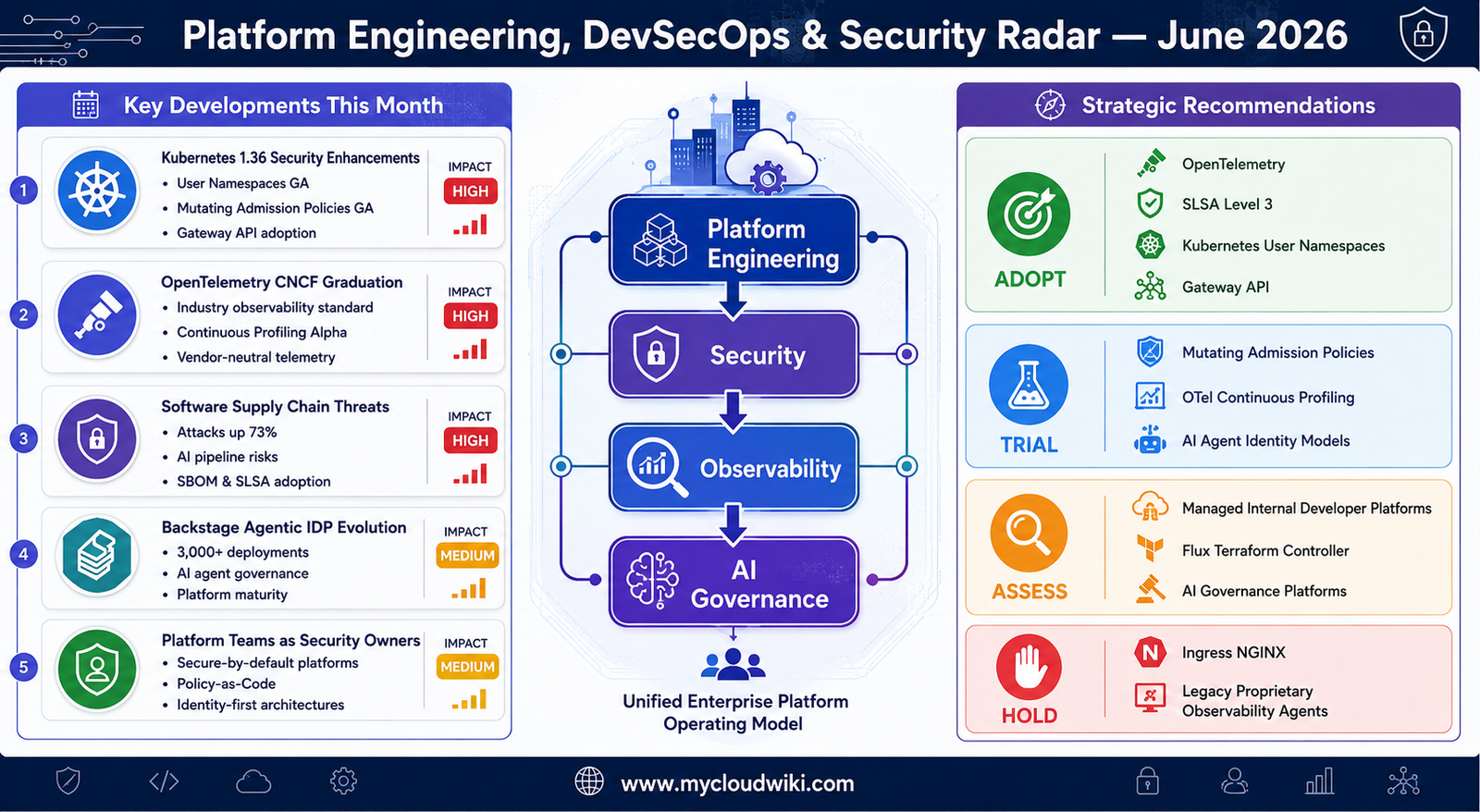
For enterprise architects, this means platform engineering should no longer be viewed as a tooling initiative. It is becoming a strategic operating model.
Organizations that succeed over the next several years will likely standardize around a few key principles:
- Identity-first architecture
- Secure-by-default platforms
- Unified observability
- Policy-driven governance
- AI-ready operating models
The question is no longer whether platform engineering matters. The question is whether the platform has become the enterprise control plane.
Hands-On Readiness Checklist
Platform Engineer Checklist
✓ Audit Kubernetes workloads for 1.36 compatibility
Identify workloads that may be affected by User Namespaces, admission policy changes, or deprecated ingress configurations.
✓ Inventory Ingress NGINX deployments
Create a migration plan toward Gateway API-compatible controllers before support and security risks increase.
✓ Deploy OpenTelemetry Collector in staging
Validate a unified telemetry pipeline for logs, metrics, and traces before expanding to production.
✓ Generate SBOMs for critical workloads
Establish visibility into software dependencies and prepare for future supply chain security requirements.
✓ Review AI development tool usage
Understand where AI coding assistants and agents are being used and identify governance gaps.
Platform Architect Checklist
✓ Review Kubernetes upgrade strategy
Treat Kubernetes 1.36 as a security architecture review rather than a routine platform upgrade.
✓ Define observability consolidation roadmap
Reduce operational complexity by standardizing telemetry collection around OpenTelemetry.
✓ Evaluate SLSA maturity levels
Assess software supply chain controls and identify gaps in build integrity verification.
✓ Design AI agent identity models
Ensure AI agents have proper identity, authorization, and audit controls before production adoption.
✓ Assess security-by-default platform capabilities
Verify that security, identity, compliance, and observability are embedded into platform services.
Strategic Recommendations
Adopt
✓ OpenTelemetry
Industry-standard observability framework with broad ecosystem support and vendor neutrality.
✓ SLSA Level 3
Provides stronger build integrity guarantees and improves software supply chain resilience.
✓ Kubernetes User Namespaces
Improves workload isolation and reduces container privilege-related security risks.
✓ Gateway API
Represents the future direction of Kubernetes traffic management and ingress architecture.
Trial
✓ Mutating Admission Policies
Evaluate CEL-based policy enforcement as a simpler alternative to some webhook-based implementations.
✓ OTel Continuous Profiling
Explore continuous profiling capabilities for troubleshooting performance-sensitive workloads.
✓ AI Agent Identity Models
Prepare for increasing use of autonomous systems and agent-based workflows.
Assess
✓ Managed Internal Developer Platforms
Evaluate whether commercial IDP solutions can reduce platform maintenance overhead.
✓ Flux Terraform Controller
Monitor GitOps and Infrastructure-as-Code convergence for future platform simplification.
✓ Emerging AI Governance Capabilities
Track governance and security features that support enterprise AI adoption.
Hold
✓ Ingress NGINX
Avoid new deployments and prioritize migration planning due to project retirement.
✓ Legacy Proprietary Observability Agents
Limit additional investment and move toward OpenTelemetry-based observability architectures.
This format reads much better in a Technology Radar article because every recommendation immediately answers “why should I care?” while still remaining concise.
Key Takeaways
The most important developments platform teams, security leaders, and architects should remember from this month’s radar.
- Kubernetes 1.36 is a security-first release — User Namespaces and Mutating Admission Policies introduce stronger workload isolation and policy enforcement capabilities.
- OpenTelemetry Graduation closes the observability debate — standardize telemetry pipelines now to avoid growing tooling and instrumentation debt.
- Software supply chain attacks are increasingly targeting AI development workflows — SBOMs, SLSA, and AI governance controls are becoming operational requirements.
- Backstage and Internal Developer Platforms are evolving into AI governance platforms — plan agent identity, authorization, and audit capabilities early.
- Platform teams are becoming security owners by design — secure golden paths, workload identity, and policy-as-code are becoming standard platform capabilities.
What’s Next
Watch these developments over the next 4–8 weeks as they continue shaping platform engineering and security strategies.
- Kubernetes 1.37 roadmap — GPU scheduling, Dynamic Resource Allocation (DRA), and accelerator management continue advancing for AI workloads.
- OpenTelemetry Profiling maturity — monitor beta releases and backend support across Grafana, Elastic, and other observability platforms.
- EU Cyber Resilience Act preparations — organizations should begin evaluating SBOM generation and software supply chain compliance readiness.
- CNCF governance and security initiatives — increased focus on operational resilience, platform security, and enterprise readiness.
- AI agent security tooling — emerging solutions for agent identity, authorization, activity logging, and prompt injection protection deserve attention.
Learning Resources
Recommended resources for deeper exploration of this month’s key developments.
- Kubernetes v1.36 Release Notes — Security enhancements, User Namespaces, admission policies, and upgrade guidance.
- OpenTelemetry Documentation — Collectors, instrumentation, telemetry pipelines, and Continuous Profiling.
- SLSA Framework — Software supply chain security maturity model and implementation guidance.
- Backstage Documentation — Internal Developer Platform capabilities, software templates, and governance features.
- CNCF Supply Chain Security Guidance — Best practices for securing modern software delivery pipelines.
References
Sources used for research, analysis, and validation of this month’s radar.
- Kubernetes Project — Kubernetes v1.36: Haru Release Notes
- CNCF — Cloud Native Computing Foundation Announces OpenTelemetry Graduation
- OpenTelemetry Project — OpenTelemetry Continuous Profiling Alpha Documentation
- ReversingLabs — 2026 Software Supply Chain Security Report
- Cloud Security Alliance — Zero Trust Guidance for Building a Resilient Enterprise
- SiliconANGLE — Platform Engineering is Essential in the Age of AI Agents, KubeCon EU 2026
- InfoQ — Kubernetes v1.36 Released: Security Defaults Tighten as AI Workload Support Matures
- Cloudsmith — The 2026 Guide to Software Supply Chain Security
- platformengineering.org — 10 Platform Engineering Predictions for 2026
- Backstage Project — Platform Engineering and Internal Developer Platform Updates
- KubeCon + CloudNativeCon Europe 2026 — Key Announcements and Platform Engineering Sessions

