
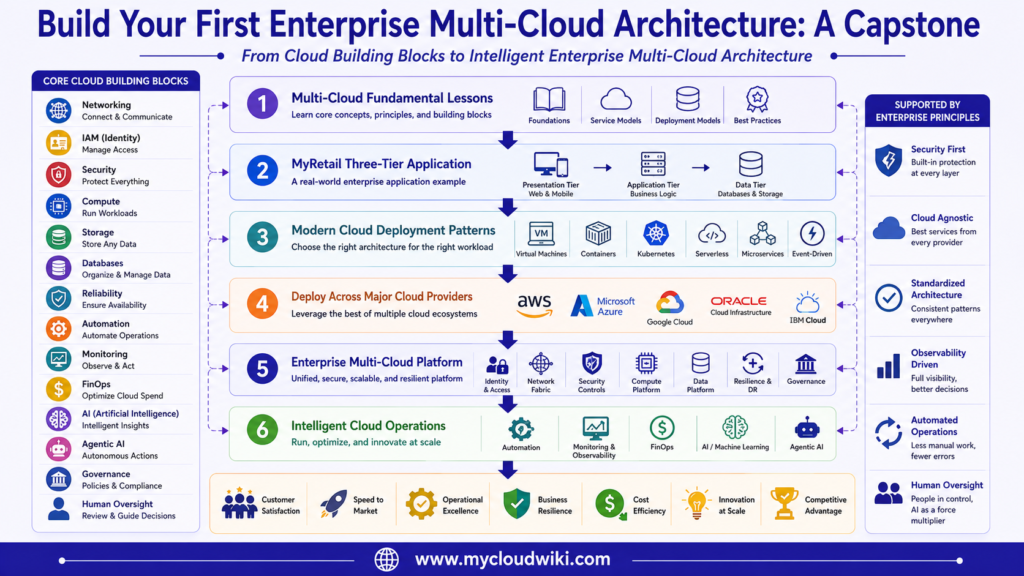
🎓 Multi-Cloud Learning Series Capstone
Congratulations on completing the Multi-Cloud Fundamental Lessons.
Throughout this learning journey, you explored the essential building blocks of cloud computing — networking, identity, security, compute, storage, databases, reliability, automation, monitoring, FinOps, Artificial Intelligence, and Agentic AI.
This capstone brings those lessons together into one enterprise architecture. Instead of studying individual services, you will follow the MyRetail application as it evolves from a simple three-tier system into an intelligent enterprise multi-cloud platform across AWS, Microsoft Azure, Google Cloud, Oracle Cloud Infrastructure, and IBM Cloud.
📖 At a Glance
- 🎯 Connect every Multi-Cloud Fundamental Lesson into one enterprise architecture.
- 🏢 Follow MyRetail from a simple application to a modern intelligent cloud platform.
- 🌍 See how the same architecture maps across AWS, Azure, Google Cloud, OCI, and IBM Cloud.
- 🤖 Understand how automation, monitoring, FinOps, AI, and Agentic AI support operations.
- 🚀 Prepare for the Multi-Cloud Advanced Lessons by thinking like an enterprise architect.
In the previous lesson, AI, Generative AI & Agentic AI in Cloud Computing Across Multi-Cloud Environments, you learned how AI enhances cloud engineering, security, automation, observability, and enterprise operations.
You also learned that Agentic AI can plan tasks, coordinate tools, execute approved workflows, and support operations under governance and human oversight.
Now we will place those capabilities inside a complete enterprise architecture.
This capstone shows how every cloud building block works together inside the MyRetail platform.
💡 Architect’s Tip
The best architects do not begin with cloud services. They begin with business requirements, then choose the architecture patterns and cloud capabilities that best support the business.
Recap — Multi-Cloud Fundamental Concepts
Before we design the MyRetail platform, let’s reconnect the knowledge you’ve gained throughout the Multi-Cloud Fundamental Lessons.
Each lesson introduced one essential building block. Individually, these concepts help you understand cloud computing. Together, they form the foundation of every enterprise multi-cloud architecture.
As we build the MyRetail platform, you’ll see how each lesson fits into a complete business solution:
- Cloud Networking Fundamentals introduced how users, applications, APIs, and cloud resources communicate securely across networks.
- Cloud Identity & Access Management (IAM) Fundamentals explained how users, applications, and AI agents authenticate and receive only the permissions they need.
- Cloud Security Fundamentals showed how layered security protects customers, applications, data, and cloud resources.
- Cloud Compute Fundamentals covered the compute services that run business applications using virtual machines, containers, Kubernetes, and serverless technologies.
- Cloud Storage Fundamentals demonstrated how organizations store product images, documents, backups, logs, and other business data.
- Cloud Databases Fundamentals explained how relational and NoSQL databases manage customer records, orders, inventory, and payments.
- Cloud Reliability & High Availability Fundamentals showed how architectures remain available during failures and unexpected demand.
- Cloud Automation Fundamentals introduced Infrastructure as Code, configuration management, CI/CD, and GitOps for consistent deployments.
- Monitoring & Observability Fundamentals demonstrated how metrics, logs, traces, dashboards, and alerts help teams understand platform health.
- Cloud Pricing & FinOps Fundamentals explained how organizations govern cloud spending while maximizing business value.
- AI, Generative AI & Agentic AI in Cloud Computing showed how intelligent assistants and governed AI agents enhance engineering productivity, automation, and cloud operations.
Individually, each lesson introduced an important architectural capability.
Now it’s time to bring them together into a single enterprise platform.
The remainder of this capstone follows one continuous business story, showing how these building blocks work together to transform MyRetail from a simple three-tier application into an intelligent enterprise multi-cloud platform.
Multi-Cloud Architecture Mental Model
Think of the lessons as architectural layers.
MyRetail is not built from one cloud service. It is built from many capabilities working together.
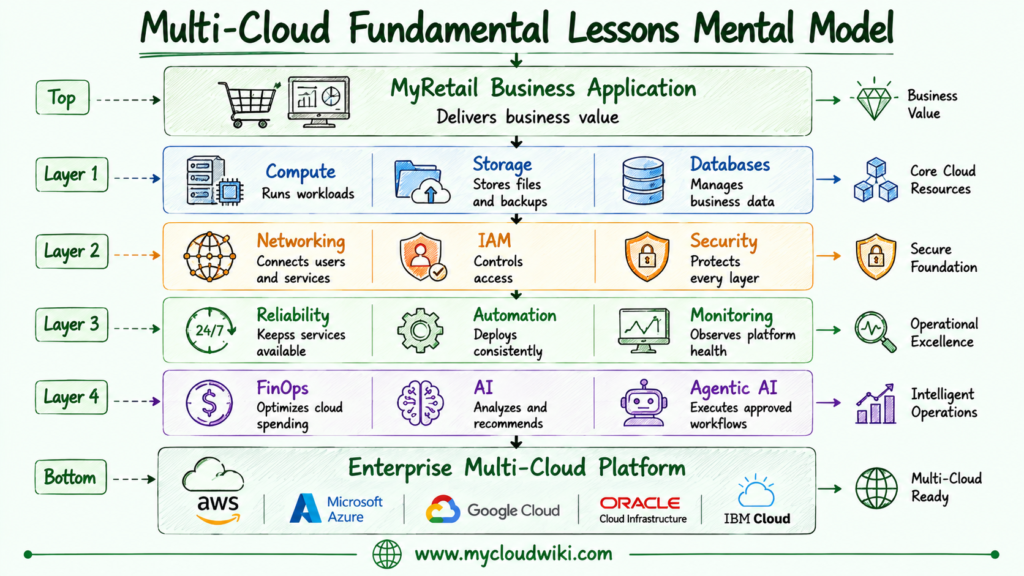
Every successful architecture begins with a business requirement.
Before MyRetail chooses AWS, Azure, Google Cloud, OCI, or IBM Cloud, the architecture team must first understand what the business needs.
Let’s begin where every successful enterprise architecture begins—with understanding the business. In Step 1, we’ll meet MyRetail, explore its business requirements, and design the first version of the application before making any cloud technology decisions.
🧭 Your Enterprise Multi-Cloud Journey
Over the next five steps, you’ll transform MyRetail from a simple business application into an intelligent enterprise multi-cloud platform. Each step builds on the previous one, just as real enterprise architectures evolve over time.
🏢 Step 1 — Understand MyRetail
Understand the business goals and design the first three-tier application.
☁️ Step 2 — Modernize MyRetail
Modernize the application using virtual machines, containers, Kubernetes, serverless, microservices, and event-driven architectures.
🌍 Step 3 — Deploy Across the Major Cloud Providers
Deploy the same architecture across AWS, Microsoft Azure, Google Cloud, Oracle Cloud Infrastructure (OCI), and IBM Cloud using equivalent cloud services.
🏗️ Step 4 — Build the Enterprise Multi-Cloud Platform
Combine every cloud building block into a secure, scalable, resilient, and intelligent enterprise platform.
🤖 Step 5 — Operate with AI & Agentic AI
Operate the platform using monitoring, automation, FinOps, Artificial Intelligence, Agentic AI, governance, and human oversight.
🎯 By the end of this journey, you’ll understand how to design, modernize, deploy, and operate enterprise applications across multiple cloud providers—thinking like an Enterprise Multi-Cloud Architect, not just a cloud engineer.
🚀 Step 1 — Build the First Version of MyRetail
Every successful architecture begins with a business requirement—not a cloud provider. Before selecting AWS, Microsoft Azure, Google Cloud, Oracle Cloud Infrastructure (OCI), or IBM Cloud, architects first understand the business they are designing for. Let’s begin by understanding MyRetail.
Meet MyRetail – A fictional Company
Imagine MyRetail is a rapidly growing online retail company.
Customers visit the website every day to browse products, place orders, make payments, and track deliveries.
Behind the scenes, employees manage inventory, pricing, warehouses, customer support, marketing campaigns, and financial reporting.
Every business activity depends on technology.
As the company grows, so do the demands placed on its applications and infrastructure.
Today’s architect must answer questions such as:
- Can the platform support millions of customers?
- How do we protect customer information?
- What happens if a server or an entire cloud region fails?
- How can we deploy new features faster?
- How do we control cloud costs?
- How can AI improve customer experience and operations?
These questions cannot be answered by a single cloud service.
They require a complete enterprise architecture.
💡 Architect’s Tip
Architects don’t design servers. They design business capabilities that allow organizations to grow, innovate, and operate reliably.
Understanding the MyRetail Business
Before designing technology, architects first understand the business.
For MyRetail, the platform must support multiple stakeholders.
| Stakeholder | Business Need |
|---|---|
| Customers | Browse products, place orders, track deliveries |
| Employees | Manage inventory, pricing, warehouses, and support |
| Business Leaders | Monitor sales, customer growth, and business performance |
| Partners | Exchange inventory, shipping, and payment information |
| AI Assistants | Improve recommendations, customer support, and operations |
Each stakeholder depends on the same enterprise platform.
This means the architecture must be secure, reliable, scalable, and easy to operate.
The following illustration shows how different users interact with the MyRetail platform before we begin designing its architecture.
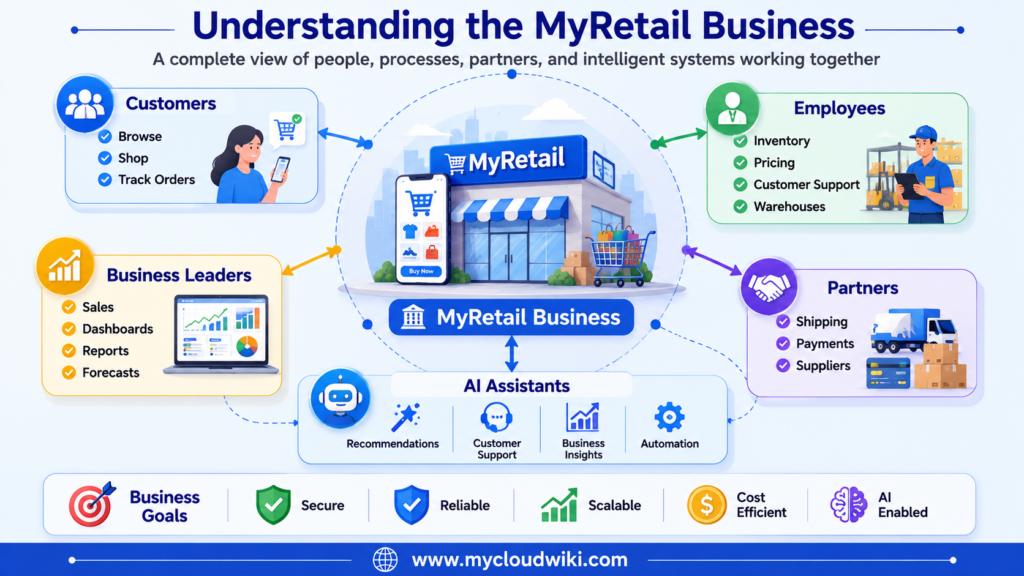
Everything begins with the business.
Technology exists to help MyRetail deliver products, improve customer experience, support employees, and achieve business goals.
🎯 Architect’s Mental Model
Business requirements drive architecture. Architecture drives technology. Technology supports business outcomes. Never design in the opposite direction.
The Traditional Architecture Version of MyRetail
Like many businesses, MyRetail didn’t start as a multi-cloud platform.
It started with a simple application running in a traditional three-tier architecture.
The application contained three logical layers:
- Presentation Layer – The website customers use to browse products and place orders.
- Application Layer – Business logic that processes shopping carts, payments, inventory, and orders.
- Data Layer – Databases that store customer accounts, products, inventory, and transactions.
Although simple, this architecture established a clear separation of responsibilities and became the foundation for future growth.
Before moving to the cloud, let’s build the first version of the MyRetail application using a traditional three-tier architecture.
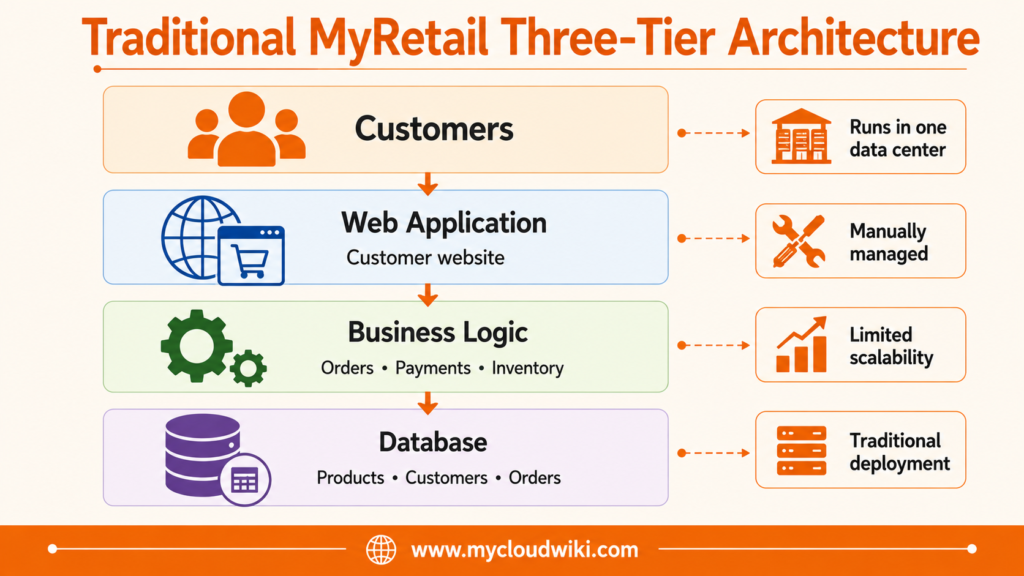
The three-tier architecture separates presentation, business logic, and data into independent layers, making applications easier to build, maintain, and scale.
However, as MyRetail grows, this traditional deployment model begins to show its limitations.
Business Growth Creates New Challenges
As MyRetail becomes more successful, new business challenges begin to emerge.
- Customer traffic continues to increase.
- Seasonal shopping events generate unpredictable demand.
- The business expands into new geographic regions.
- Security and compliance requirements become stricter.
- Faster software releases become a competitive advantage.
- AI-powered customer experiences become a business expectation.
The traditional architecture still works—but the way it is deployed must evolve.
This is where cloud computing begins to transform the business.
👨💼 Engineer → Enterprise Architect
A cloud engineer might focus on keeping the MyRetail application running. An enterprise architect asks a different question: “How should MyRetail evolve over the next five years while remaining secure, scalable, resilient, cost-efficient, and ready for AI?” That shift—from operating today’s platform to designing tomorrow’s platform—is what defines enterprise architecture.
The MyRetail application itself doesn’t need to change.
Customers will continue shopping.
Employees will continue managing inventory.
Orders will continue flowing through the business.
What changes is how the application is deployed and operated.
In the next section, we’ll modernize MyRetail by exploring today’s most common cloud deployment patterns—including virtual machines, containers, Kubernetes, serverless, microservices, and event-driven architectures—using AWS as our reference implementation before extending those same patterns across the major cloud providers.
☁️ Step 2 — Modernize the MyRetail Platform
The MyRetail application continues to serve the same business, but the way it is deployed must evolve to support business growth, global expansion, improved reliability, faster software delivery, and Artificial Intelligence.
Modernizing the MyRetail Platform Architecture
The traditional three-tier architecture has served MyRetail well.
Customers can browse products.
Employees can manage inventory.
Orders are processed successfully.
However, as the business grows, the architecture must support new business requirements.
Rather than rebuilding the application from scratch, architects usually modernize how the application is deployed.
Today, organizations can deploy the same business application using several cloud architecture patterns.
Each pattern offers different advantages depending on scalability, operational complexity, cost, and business requirements.
💡 Architect’s Tip
Modernization doesn’t always mean rewriting applications. In many cases, the business application remains the same while the deployment model evolves to better support scalability, resilience, and operational efficiency.
How MyRetail Architecture Can Evolve
MyRetail can modernize gradually.
Each deployment pattern builds on the previous one while solving different business challenges.
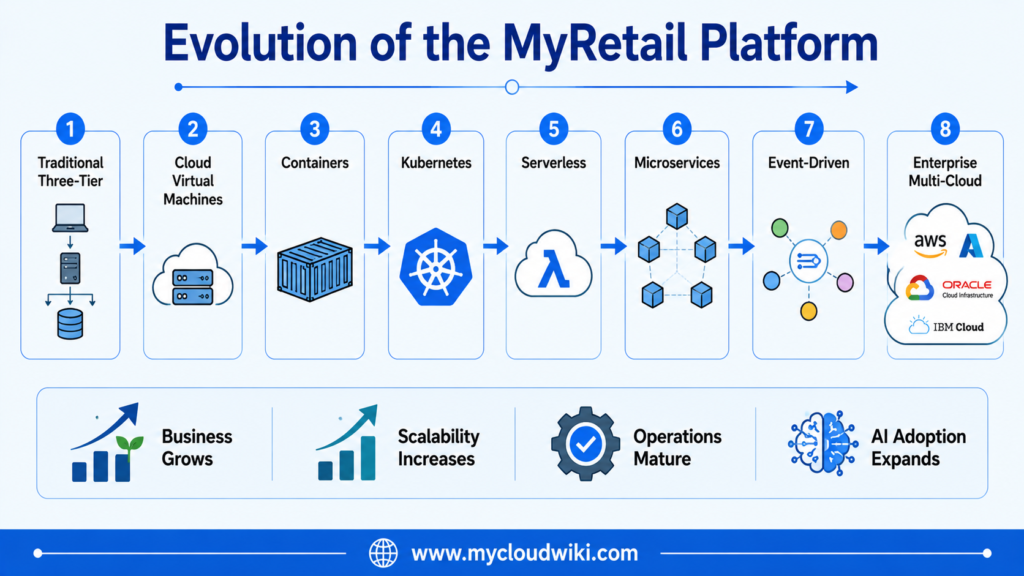
The business application remains the same.
The deployment model evolves to support changing business needs.
Deployment Pattern 1 — Virtual Machines
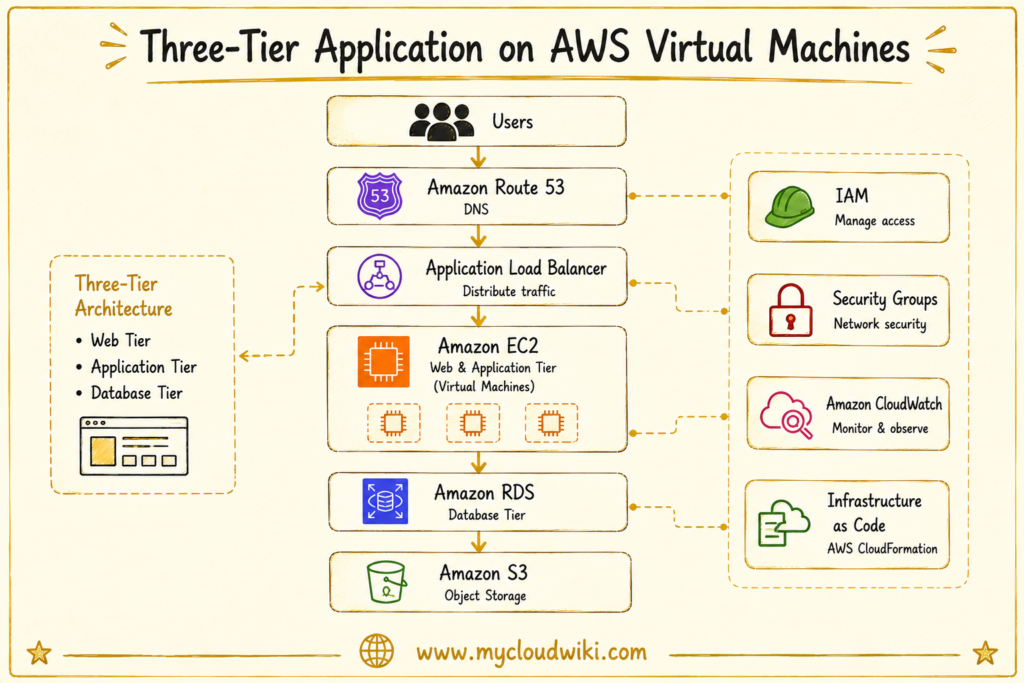
The simplest way for MyRetail to adopt cloud computing is to move the existing application onto cloud virtual machines.
Very little changes inside the application.
Instead, the infrastructure moves from a traditional data center into the cloud.
This approach is commonly called Lift and Shift.
MyRetail Benefits
- Fast cloud migration
- Minimal application changes
- Familiar operational model
- Faster infrastructure provisioning
Considerations
- Operating systems still require maintenance.
- Engineers manage virtual machines.
- Capacity planning remains important.
The first cloud version of MyRetail moves the existing three-tier application onto AWS virtual machines while preserving the familiar architecture.
🎯 Architect’s Mental Model
MyRetail’s business application hasn’t changed. Only the infrastructure changed.
Deployment Pattern 2 — Containers & Kubernetes
As MyRetail continues to grow, engineering teams begin releasing software more frequently.
Managing individual virtual machines becomes increasingly difficult.
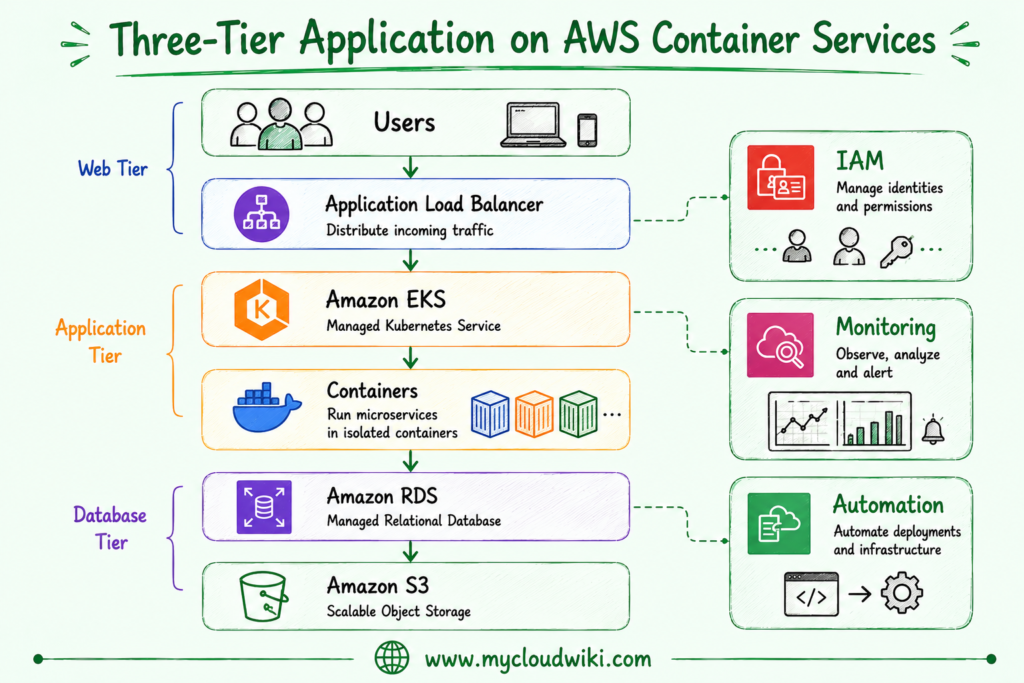
Containers package the application together with its runtime and dependencies, making deployments more consistent.
Kubernetes automates deployment, scaling, networking, and lifecycle management.
MyRetail Benefits
- Faster software releases
- Consistent deployments
- Better scalability
- Platform standardization
- Improved portability
Considerations
- Higher operational complexity
- Kubernetes expertise required
- Platform engineering becomes important
Instead of deploying applications directly onto virtual machines, MyRetail now runs containers managed by Kubernetes.
🎯 Architect’s Mental Model
Containers package applications. Kubernetes operates those containers at enterprise scale.
Deployment Pattern 3 — Serverless
Some MyRetail workloads don’t need dedicated servers at all.
Examples include:
- Order notifications
- Image processing
- Inventory synchronization
- Payment events
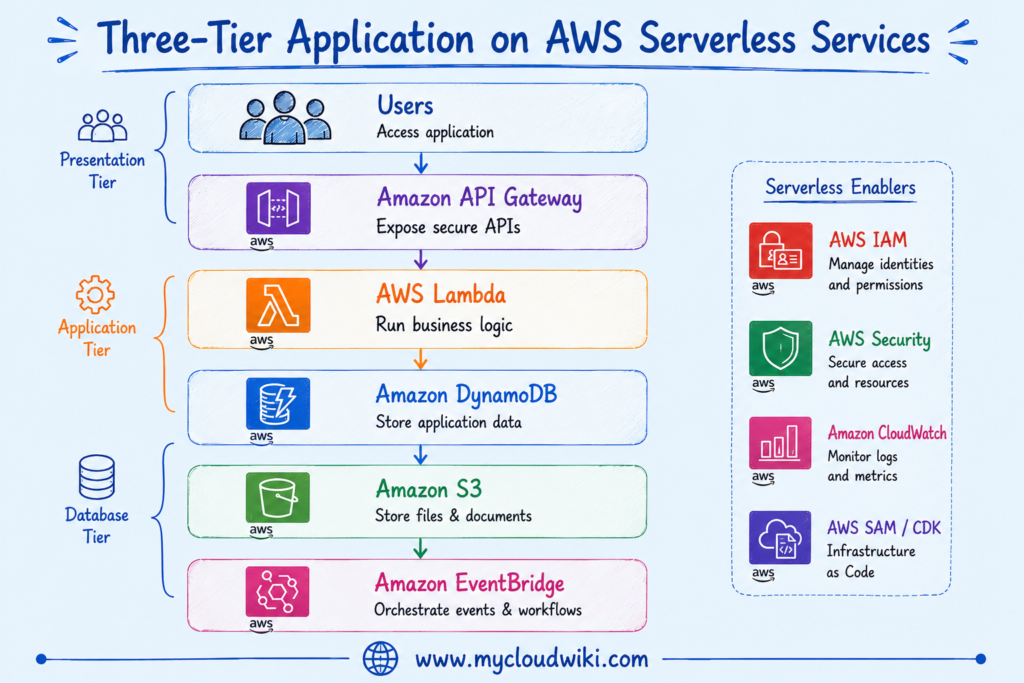
Instead of managing infrastructure, developers focus on business logic while the cloud platform automatically scales the application.
MyRetail Benefits
- No server management
- Automatic scaling
- Pay only for usage
- Faster feature delivery
Considerations
- Best suited for event-driven workloads
- Application architecture may need redesign
- Service integration becomes important
Serverless allows MyRetail to automatically process events as customers interact with the shopping platform.
🎯 Architect’s Mental Model
Serverless allows MyRetail engineers to spend less time managing infrastructure and more time delivering business capabilities.
Deployment Pattern 4 — Microservices & Event-Driven Architecture
As MyRetail expands globally, different engineering teams begin owning different business capabilities.
Instead of one large application, MyRetail evolves into independent services.
Examples include:
- Product Service
- Order Service
- Payment Service
- Inventory Service
- Shipping Service
- Recommendation Service
These services communicate through APIs and events, allowing each team to develop, deploy, and scale independently.
MyRetail Benefits
- Independent deployments
- Faster innovation
- Better scalability
- Easier team ownership
- Supports AI-powered business services
Considerations
- Higher architectural complexity
- Distributed data management
- Strong governance required
- Comprehensive monitoring becomes essential
The MyRetail platform has now evolved into a modern enterprise application composed of multiple independent business services.
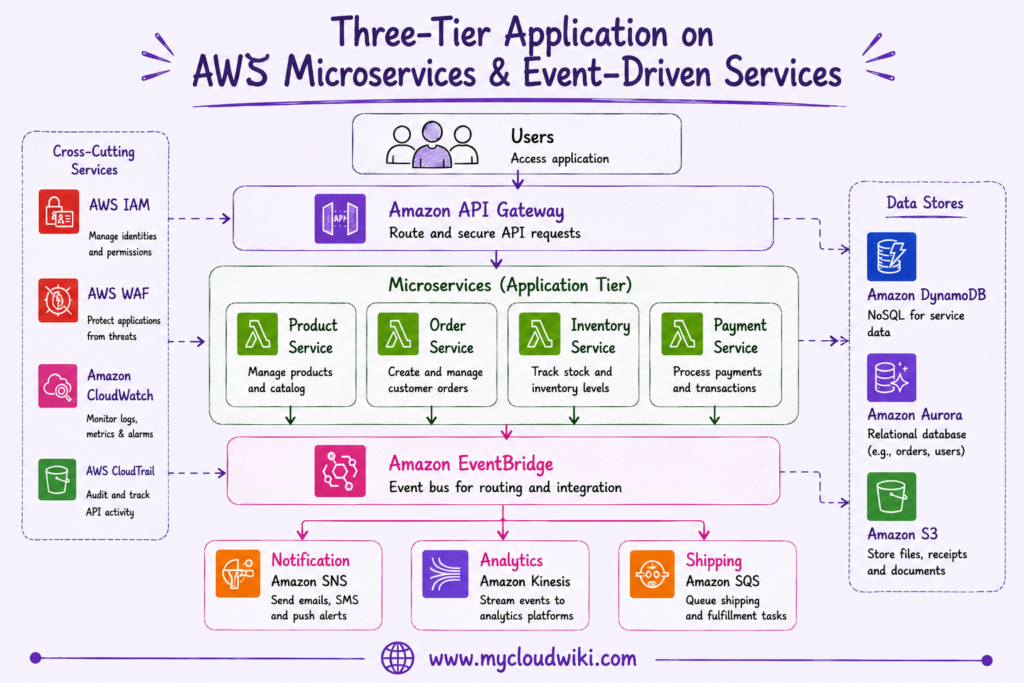
Comparing MyRetail Deployment Patterns
👨💼 Engineer → Enterprise Architect
A cloud engineer might ask, “Which deployment technology should I use?” An enterprise architect asks a different question: “Which deployment pattern best supports MyRetail’s business goals, engineering maturity, operational model, and long-term growth?” Architects choose technology to serve the business—not the other way around.
At this stage, MyRetail has successfully modernized its application using cloud-native deployment patterns.
One important question remains:
Are these architectures unique to AWS?
Fortunately, the answer is no.
Every major cloud provider offers equivalent capabilities for virtual machines, containers, Kubernetes, serverless computing, databases, storage, networking, and event-driven architectures.
In the next section, we’ll map these same MyRetail deployment patterns across AWS, Microsoft Azure, Google Cloud, Oracle Cloud Infrastructure (OCI), and IBM Cloud, demonstrating that enterprise architects design around architectural capabilities, not vendor-specific products.
🌍 Step 3 — Deploy MyRetail Across the Major Cloud Providers
MyRetail has successfully modernized its application using cloud-native deployment patterns. The next question is whether those same architectures can be implemented across different cloud providers. The answer is yes. Enterprise architects design around architectural capabilities, not vendor-specific products.
Deploying MyRetail Across the Major Cloud Providers
In the previous section, we modernized the MyRetail application using virtual machines, containers, Kubernetes, serverless computing, microservices, and event-driven architectures.
Those architectural patterns are not unique to AWS.
Every major cloud provider offers equivalent services that support the same business capabilities.
This means MyRetail can be deployed on AWS, Microsoft Azure, Google Cloud, Oracle Cloud Infrastructure (OCI), or IBM Cloud without changing the overall architecture.
The cloud provider changes.
The architecture does not.
💡 Architect’s Tip
Architects design business capabilities first and map them to cloud services later. The cloud provider is an implementation choice—not the architecture itself.
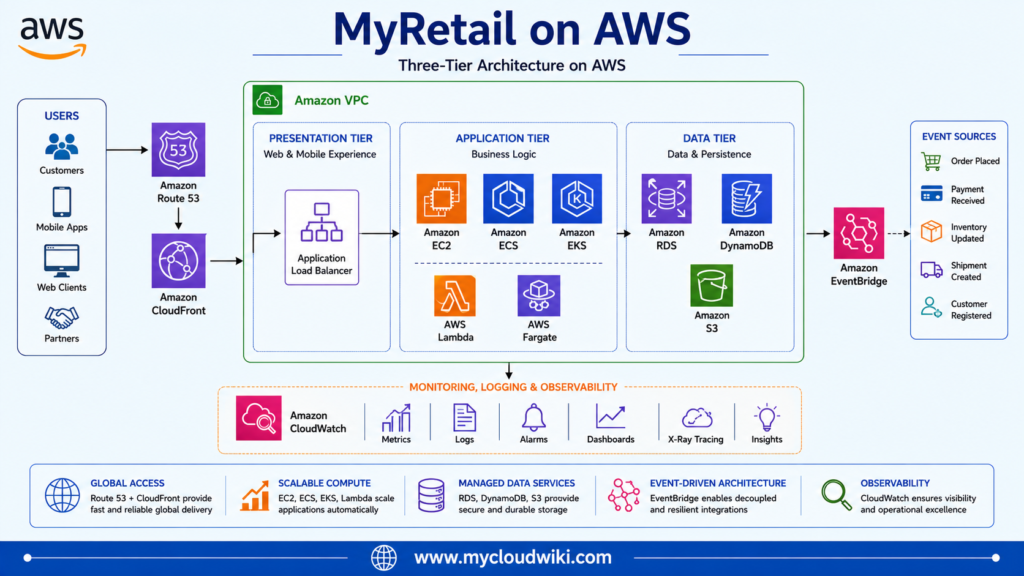
MyRetail on AWS
Let’s begin with AWS because it is one of the most widely adopted cloud platforms.
The MyRetail architecture can be implemented using AWS services while preserving the same business functionality introduced earlier.
AWS Reference Architecture Services
Notice that nothing changed from a business perspective.
Customers still browse products.
Orders are still processed.
Employees still manage inventory.
Only the cloud services implementing those capabilities have changed.
MyRetail Across the Major Cloud Providers
Although every cloud provider uses different service names, they all provide equivalent architectural capabilities.
The following comparison demonstrates how the same MyRetail architecture maps across the major cloud providers.
Although the service names are different, every provider delivers the same architectural capabilities required to operate the MyRetail platform.
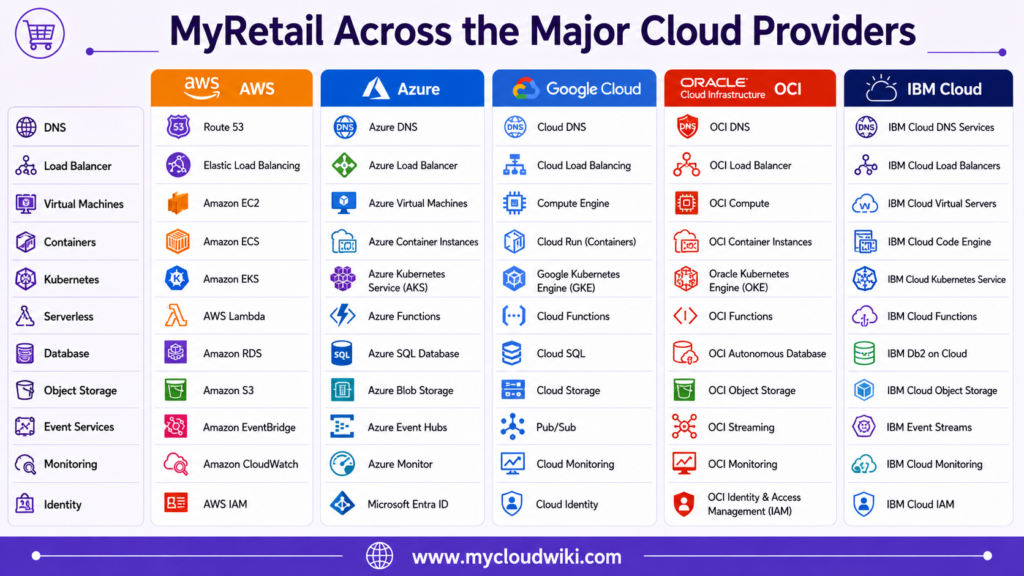
Enterprise architects focus on capabilities such as networking, compute, storage, databases, security, monitoring, and automation.
Cloud providers simply implement those capabilities using different services and product names.
MyRetail Architecture Across the Major Cloud Providers
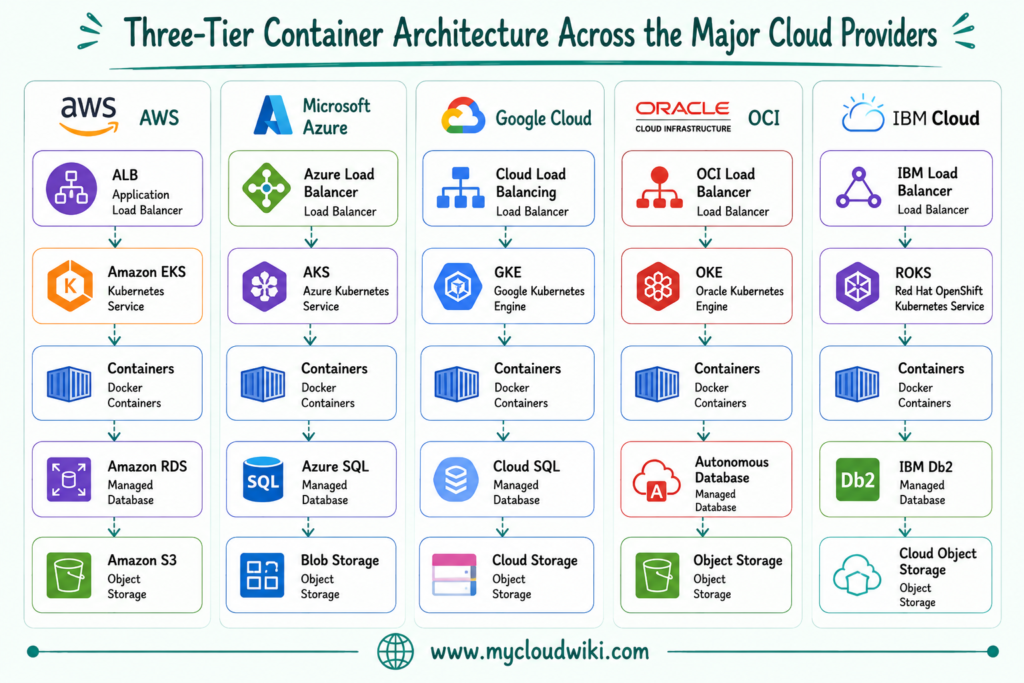
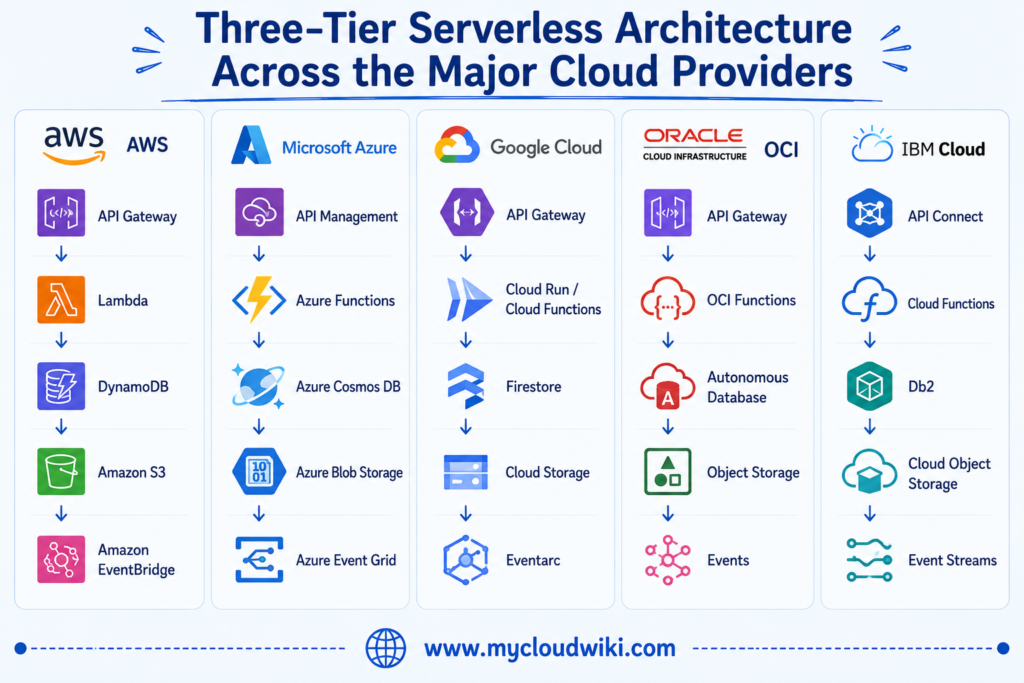
The MyRetail application can be deployed across AWS, Microsoft Azure, Google Cloud, Oracle Cloud Infrastructure (OCI), and IBM Cloud without changing its overall architecture.
Although service names differ, every provider offers equivalent capabilities for networking, compute, containers, Kubernetes, serverless computing, databases, storage, and security.
The following examples show how the same architecture is implemented using different cloud services.
Three-Tier Virtual Machine Architecture
Many organizations begin by migrating traditional applications to cloud virtual machines with minimal application changes.
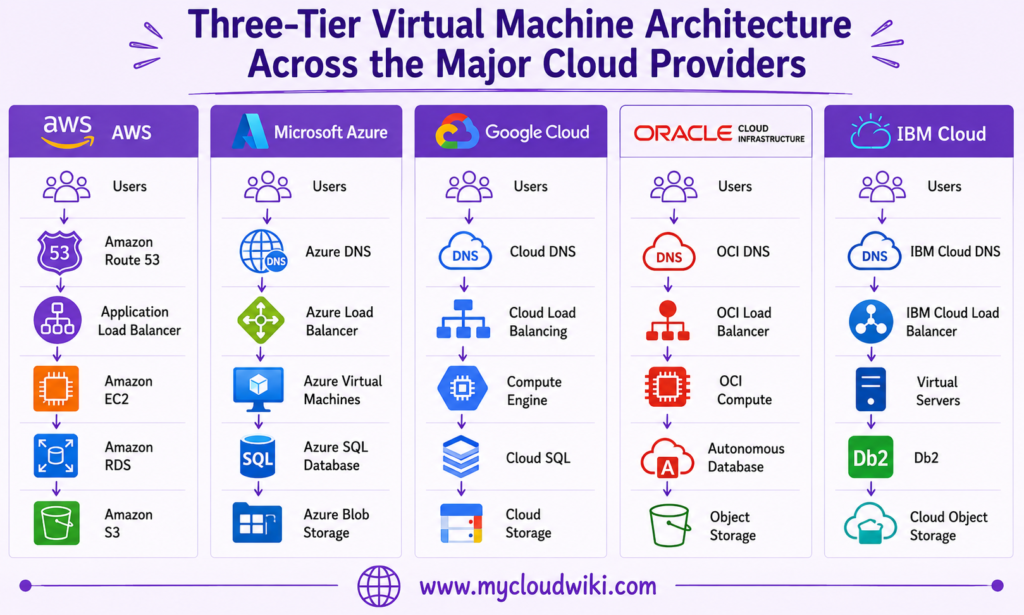
Three-Tier Container & Kubernetes Architecture
As MyRetail grows, containers and Kubernetes provide a more scalable and portable deployment model across all major cloud providers.
Three-Tier Serverless Architecture
For event-driven workloads, serverless services automatically scale based on demand while reducing operational overhead.
Why MyRetail Might Choose Multiple Cloud Providers
As MyRetail expands globally, business requirements become more diverse.
Different regions, regulations, acquisitions, and technology investments may lead to workloads running across multiple cloud providers.
Some common scenarios include:
Common Enterprise Multi-Cloud Scenarios
Organizations adopt multi-cloud to address real business needs rather than simply using multiple cloud providers.
Typical scenarios include:
- Business continuity and disaster recovery
- Best-of-breed cloud services
- Workload optimization
- Gradual application modernization
Business Requirements and Multi-Cloud Strategy
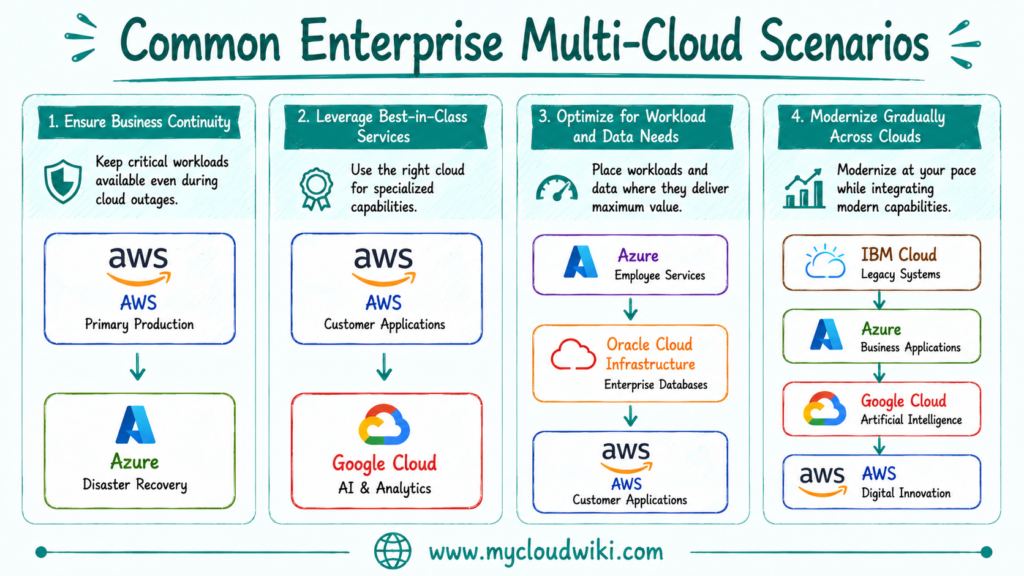
For MyRetail, multi-cloud is a business strategy—not a technology trend.
🎯 Architect’s Mental Model
Think in this order:
Business Requirement
↓
Architectural Capability
↓
Cloud Provider Service
Architects design capabilities first. Cloud services are simply one implementation of those capabilities.
👨💼 Engineer → Enterprise Architect
A cloud engineer might ask: “How do I deploy MyRetail on AWS?” An enterprise architect asks: “How do I design MyRetail so it can run consistently across AWS, Azure, Google Cloud, OCI, and IBM Cloud while meeting business, security, governance, and operational requirements?” This shift in thinking—from products to architectural capabilities—is what distinguishes enterprise architecture from cloud implementation.
At this point, we’ve proven that MyRetail can be implemented on any major cloud provider because every provider offers the core architectural capabilities needed to support the business.
The next step is even bigger.
Instead of looking at individual cloud providers, we’ll combine every cloud building block—networking, identity, security, compute, storage, databases, reliability, automation, monitoring, FinOps, AI, and Agentic AI—into a single Enterprise Multi-Cloud Reference Architecture that represents how modern organizations design and operate business platforms at scale.
🏢 Step 4 — Build the MyRetail Enterprise Multi-Cloud Platform
So far, we’ve modernized MyRetail and shown that the same architecture can run across AWS, Microsoft Azure, Google Cloud, Oracle Cloud Infrastructure (OCI), and IBM Cloud. The final step is to combine every cloud building block into one complete enterprise platform that supports the business today and can continue evolving in the future.
Putting It All Together — The MyRetail Enterprise Multi-Cloud Platform
By now, you’ve seen every major cloud building block individually.
You’ve also learned how the same architectural patterns can be implemented across different cloud providers.
Enterprise architects now take the next step.
Instead of designing individual cloud services, they design complete business platforms.
For MyRetail, that means bringing together networking, identity, security, compute, storage, databases, reliability, automation, monitoring, FinOps, Artificial Intelligence, and Agentic AI into one integrated architecture that supports customers, employees, partners, and business leaders.
This is the point where the Multi-Cloud Fundamental Lessons become a complete enterprise architecture.
💡 Architect’s Tip
Enterprise architecture is about designing a platform that can support today’s business while remaining flexible enough to accommodate tomorrow’s technologies, cloud providers, and AI capabilities.
Every Cloud Building Block Has a Business Purpose
Throughout this capstone, we never introduced technology for its own sake.
Every cloud capability exists because it solves a business problem.
The MyRetail platform depends on every building block working together.
Cloud Building Blocks Supporting MyRetail
Each capability contributes to one shared objective:
Deliver an exceptional customer experience while operating a secure, scalable, resilient, and intelligent enterprise platform.
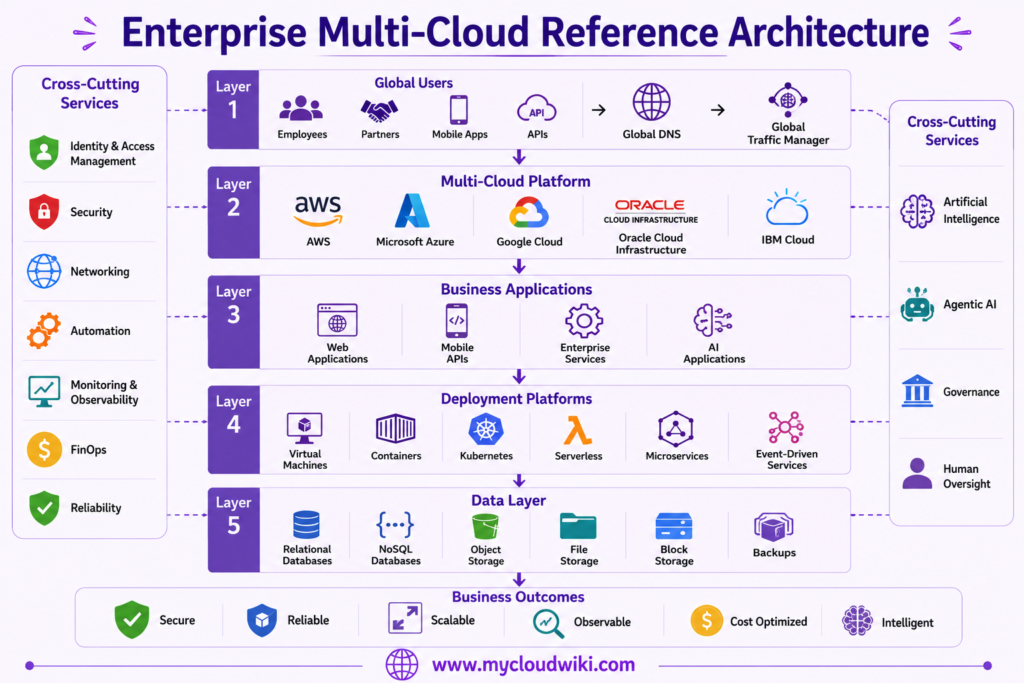
The following architecture combines every lesson you’ve completed into one enterprise platform.
Rather than focusing on individual cloud services, it demonstrates how business capabilities, cloud building blocks, and operational practices work together to support the MyRetail business.
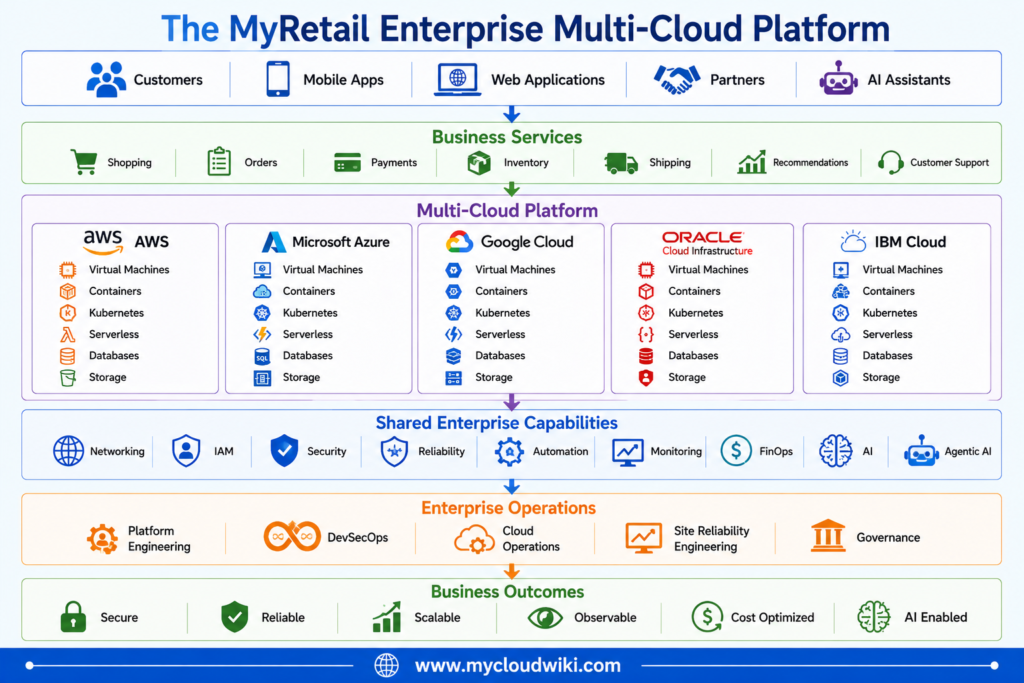
Every cloud building block contributes to the same business platform.
Although workloads may run across multiple cloud providers, consistent architecture, governance, and operational practices allow MyRetail to operate as one integrated enterprise.
The Enterprise Operating Model
Notice something important about the architecture.
MyRetail isn’t organized around cloud providers.
It is organized around business capabilities.
Engineering teams focus on delivering customer value.
Platform teams provide standardized cloud services.
Security teams establish governance.
Operations teams monitor platform health.
FinOps teams optimize cloud spending.
AI assists every team by accelerating analysis, automation, and decision-making.
This operating model allows the business to grow without creating unnecessary technical complexity.
🎯 Architect’s Mental Model
Successful enterprise platforms are not built by combining cloud services. They are built by combining people, processes, governance, automation, and technology into one consistent operating model. Technology enables the platform. People and processes make it successful.
MyRetail Is Ready for the Future
The architecture we’ve built throughout this capstone is designed to evolve.
As MyRetail grows, it can:
- Expand into new countries and regions.
- Adopt additional cloud providers when business requirements demand it.
- Introduce new AI-powered customer experiences.
- Modernize workloads without disrupting existing services.
- Scale globally while maintaining consistent governance and security.
This adaptability is one of the defining characteristics of enterprise architecture.
Rather than solving today’s challenges alone, architects design platforms that remain valuable as business needs continue to change.
👨💼 Engineer → Enterprise Architect
A cloud engineer might focus on deploying one workload successfully. An enterprise architect asks: “Can the MyRetail platform continue supporting new markets, acquisitions, cloud providers, AI capabilities, and future business strategies without requiring a complete redesign?” Enterprise architecture is about building platforms that evolve with the business.
The MyRetail platform is now fully designed.
Customers are shopping.
Orders are being processed.
Engineering teams are continuously delivering new features.
Artificial Intelligence is helping improve customer experiences.
But designing the platform is only half the journey.
Every day, the platform must be monitored, secured, optimized, governed, and continuously improved.
In the final part of this capstone, we’ll follow the MyRetail platform after deployment and explore how Monitoring, Automation, FinOps, Artificial Intelligence, Agentic AI, and the Well-Architected Framework work together to keep the business running successfully.
🤖 Step 5 — Operate the MyRetail Enterprise Platform
Designing an enterprise platform is only the beginning. Every day, the MyRetail platform must process customer orders, protect sensitive information, scale during busy shopping events, recover from failures, optimize cloud costs, and continuously improve business outcomes. This is where operations become just as important as architecture.
Our MyRetail platform is now live. The following lifecycle illustrates how enterprise teams continuously operate and improve the platform after deployment.
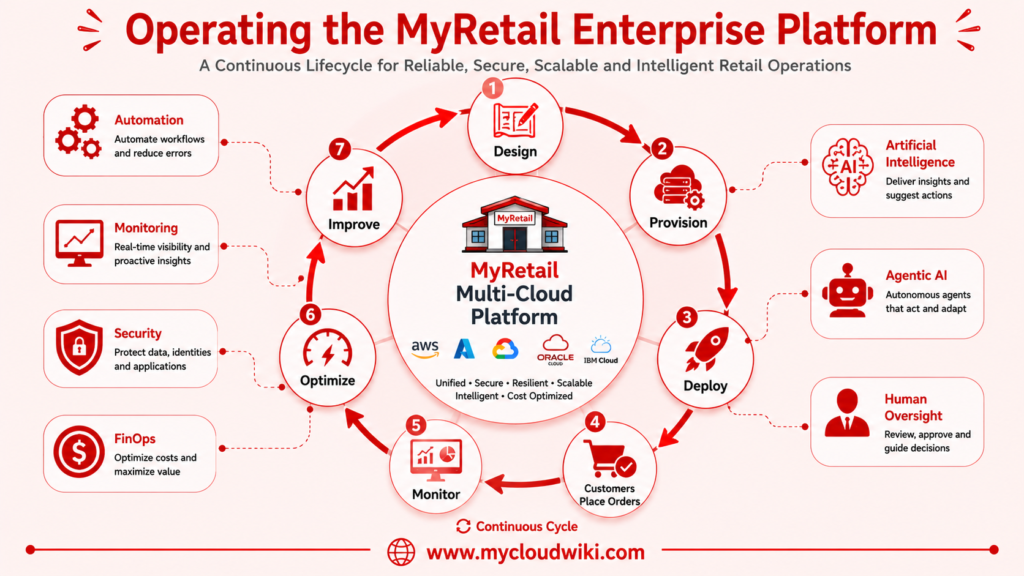
Operating the Multi-Cloud MyRetail Platform with Agentic AI
The MyRetail platform is now running successfully across multiple cloud providers.
Customers browse products.
Employees update inventory.
Orders are processed continuously.
Engineering teams deploy new features every week.
Artificial Intelligence assists customer support and product recommendations.
Everything appears to be operating normally.
Then one day, a real business event occurs.
It is Black Friday.
Millions of customers begin shopping at the same time.
Can the platform handle the demand?
💡 Architect’s Tip
Enterprise architects don’t design platforms for normal days. They design platforms that continue delivering business value during the most demanding business events.
A Real Operational Scenario
During the Black Friday sale, customer traffic increases dramatically.
Within minutes:
- Website traffic grows 10×.
- Checkout requests increase rapidly.
- Payment transactions spike.
- Inventory updates occur continuously.
- Recommendation services receive millions of requests.
The MyRetail platform must respond immediately.
Fortunately, every building block you’ve learned throughout the Multi-Cloud Fundamental Lessons now works together.
How Cloud Building Blocks Support MyRetail During Black Friday
This is exactly why enterprise platforms are built from many architectural capabilities rather than one technology.
The following workflow illustrates how MyRetail responds to a real operational incident using monitoring, automation, Artificial Intelligence, Agentic AI, and human oversight.
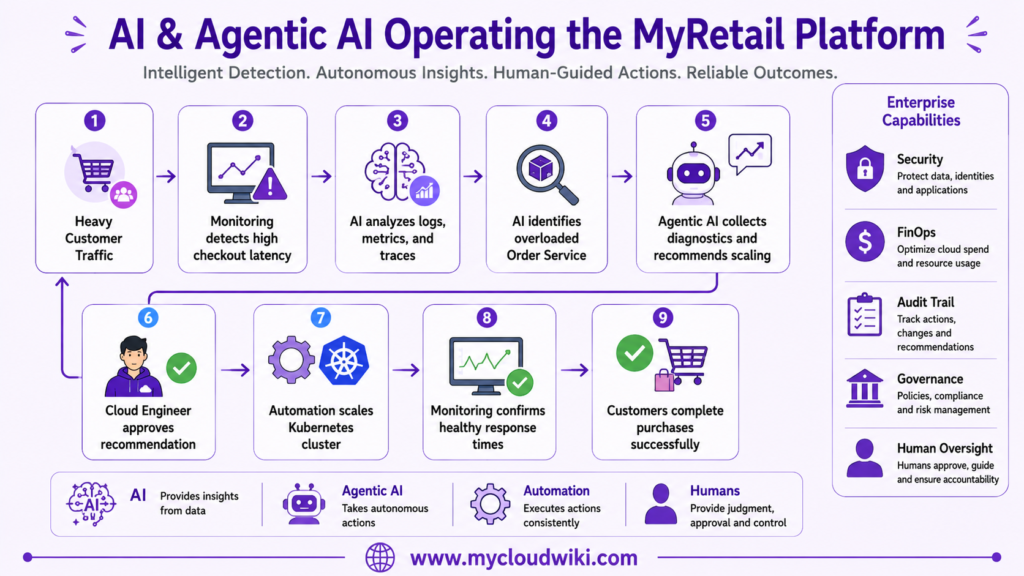
Every building block contributes to successful operations.
Monitoring detects problems.
AI explains them.
Agentic AI coordinates approved actions.
Automation implements changes.
Engineers remain accountable for business decisions.
Applying the Well-Architected Framework
The Well-Architected Framework provides a simple way to evaluate whether the MyRetail platform is designed and operated successfully.
Well-Architected Strategy for MyRetail
Enterprise architects continuously review these principles to ensure the platform remains aligned with business objectives.
The following illustration shows how the Well-Architected pillars support every aspect of the MyRetail platform.
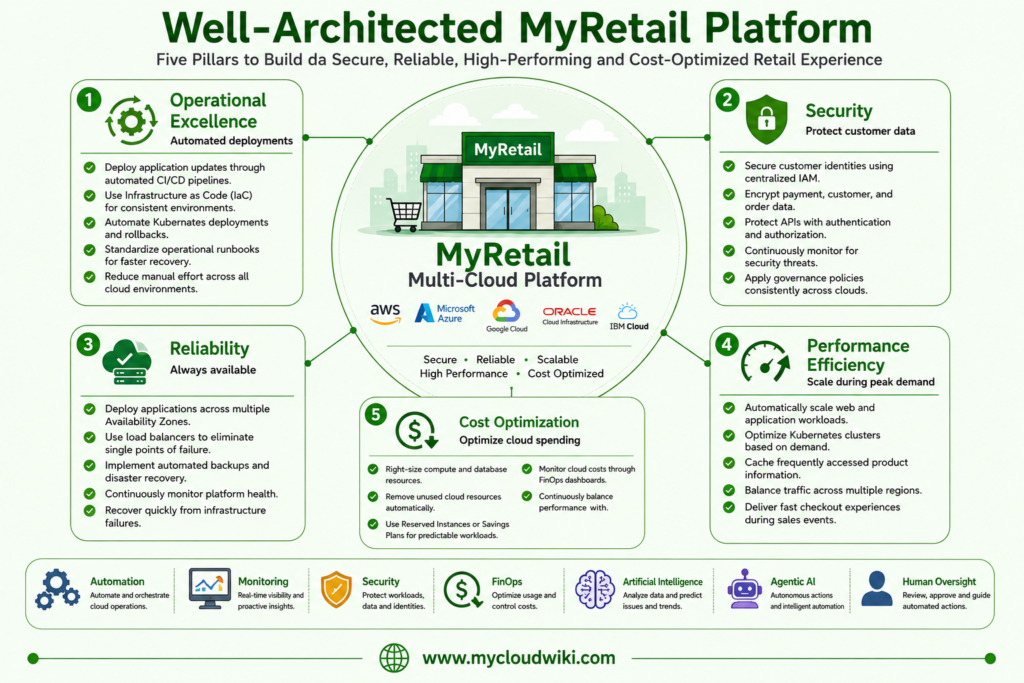
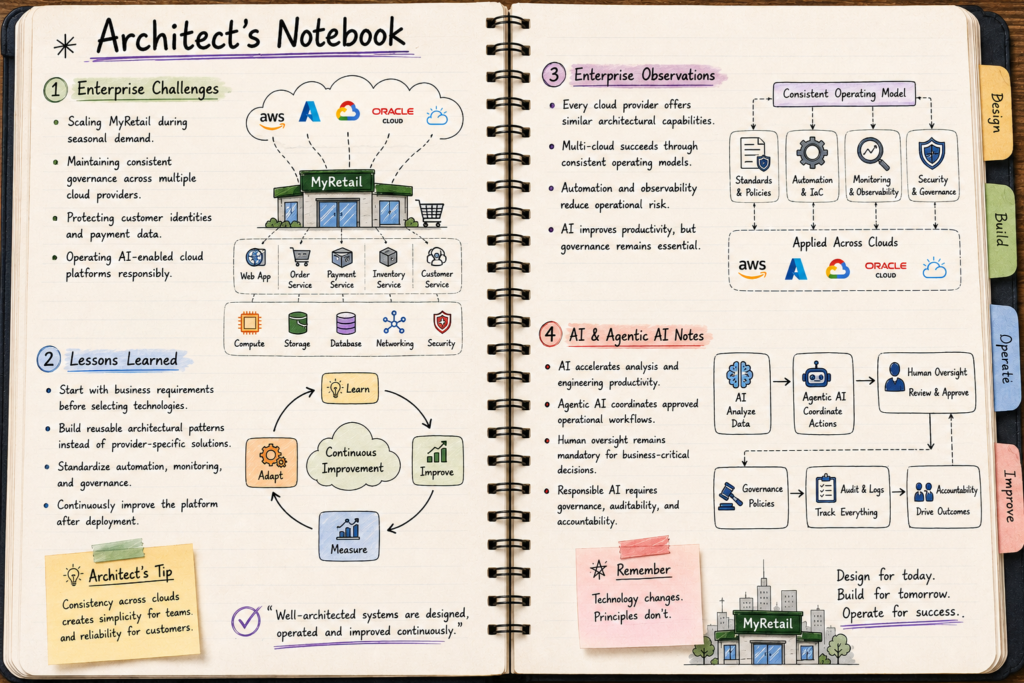
Architect’s Notebook
Enterprise Challenges
- Balancing rapid business growth with operational stability.
- Governing workloads across multiple cloud providers.
- Protecting customer data while enabling innovation.
- Operating AI-enabled platforms responsibly.
Lessons Learned
- Business requirements drive architecture.
- Architectural capabilities remain consistent across cloud providers.
- Standardization reduces operational complexity.
- Automation and observability are essential operational capabilities.
Enterprise Observations
- Successful organizations standardize operating models rather than cloud products.
- Multi-cloud succeeds through governance and consistency.
- AI enhances engineering productivity.
- Human judgment remains essential for enterprise decision-making.
AI & Agentic AI Notes
- AI accelerates operational analysis.
- Agentic AI coordinates governed operational workflows.
- Humans remain accountable for business outcomes.
- Responsible AI requires governance, auditability, and transparency.
🎯 Architect’s Mental Model
Designing the platform is only half the job. Operating, governing, optimizing, and continuously improving the platform throughout its lifecycle is what creates long-term business value.
Knowledge Check
Before moving on to the Multi-Cloud Advanced Lessons, consider the following questions:
- If MyRetail expands into Europe, how might the architecture change?
- Which deployment pattern would you choose for a new AI-powered recommendation service?
- How would you ensure checkout remains available during Black Friday?
- Which cloud building blocks would be involved if the payment service experienced high latency?
- How could Agentic AI accelerate incident response while maintaining human oversight?
Key Takeaways
- Enterprise architecture combines individual cloud building blocks into one integrated business platform.
- Modern deployment patterns enable MyRetail to evolve without changing its business objectives.
- Architectural capabilities remain consistent across AWS, Azure, Google Cloud, OCI, and IBM Cloud.
- Successful enterprise platforms rely on governance, automation, monitoring, FinOps, AI, and Agentic AI working together.
- Enterprise architects design platforms that can adapt to changing business requirements over many years.
🎉 Congratulations — You’ve Completed the Multi-Cloud Fundamental Lessons
Throughout this capstone, you followed MyRetail from a simple three-tier application to an intelligent enterprise multi-cloud platform operating across the major cloud providers.
Along the way, you saw how networking, identity, security, compute, storage, databases, reliability, automation, monitoring, FinOps, Artificial Intelligence, and Agentic AI work together to deliver secure, scalable, resilient, and intelligent business solutions.
🚀 You’ve moved beyond learning individual cloud services and started thinking like an enterprise architect—designing business capabilities, choosing architectural patterns, and building platforms that can evolve with the organization.
🌟 Continue Your Journey
In the Multi-Cloud Advanced Lessons, you’ll build on this foundation by exploring platform engineering, landing zones, governance, reference architectures, Kubernetes at scale, DevSecOps, and advanced multi-cloud design patterns.
Welcome to the next stage of your journey—from cloud engineer to enterprise cloud architect.

, and IBM Cloud while learning cloud architecture, modern deployment patterns, AI, Agentic AI, FinOps, and enterprise operations.)