
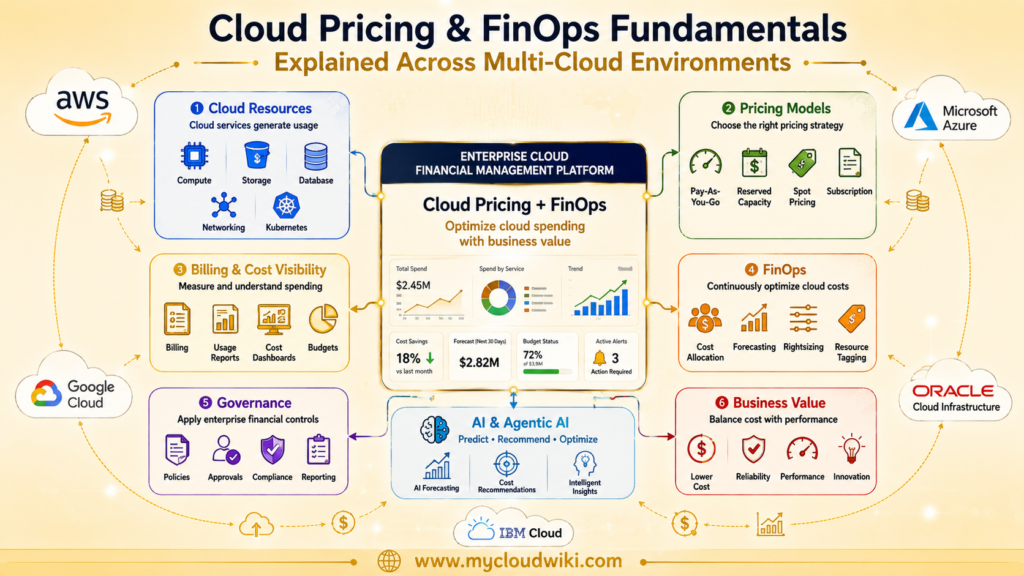
Quick Read
- ✅ Cloud providers charge for services using different pricing models based on resource consumption, commitments, subscriptions, and workload characteristics.
- ✅ FinOps helps organizations understand, allocate, govern, and continuously optimize cloud spending while maximizing business value.
- ✅ Every major cloud provider offers similar pricing principles, but enterprise organizations standardize cost governance across all cloud environments.
- ✅ Cloud engineers deploy and optimize workloads, while architects design pricing strategies and governance models that balance cost, performance, reliability, and scalability.
- ✅ AI and Agentic AI increasingly help organizations forecast spending, identify optimization opportunities, automate cost analysis, and improve financial governance while maintaining human oversight.
In the previous lesson, you learned how Cloud Monitoring & Observability Fundamentals Explained Across Multi-Cloud Environments provides operational visibility through metrics, logs, traces, dashboards, alerts, and OpenTelemetry.
Monitoring tells organizations how their cloud platforms are performing, but another important question remains:
How much does it cost to operate those cloud resources?
Every virtual machine, database, storage volume, Kubernetes cluster, API request, and AI workload generates cloud costs. Understanding how cloud providers calculate those costs—and how organizations continuously optimize them—is essential for building sustainable multi-cloud environments.
This lesson introduces cloud pricing fundamentals and explains how FinOps enables organizations to balance technical excellence with financial responsibility.
Cloud Pricing & FinOps Introduction
One of the biggest differences between traditional data centers and cloud computing is the way organizations pay for technology.
In a traditional data center, organizations purchase servers, storage, networking equipment, and software licenses before workloads are deployed. These investments are typically made months or years in advance and remain fixed regardless of actual utilization.
Cloud computing changes this model completely.
Instead of purchasing infrastructure upfront, organizations consume cloud resources as services and pay according to predefined pricing models. This flexibility enables rapid innovation, but it also introduces new financial challenges because cloud spending changes continuously as workloads grow, scale, and evolve.
Enterprise organizations therefore need more than an understanding of cloud pricing. They also need a disciplined approach to managing cloud spending, forecasting future costs, allocating expenses, and continuously optimizing cloud investments.
That discipline is known as Financial Operations (FinOps).
💡 Architect’s Tip
Cloud pricing determines how providers charge for services. FinOps determines how organizations manage those charges. Successful cloud strategies require both technical architecture and financial governance to work together.
The following illustration shows how cloud pricing and FinOps work together to transform cloud resource consumption into governed business value.
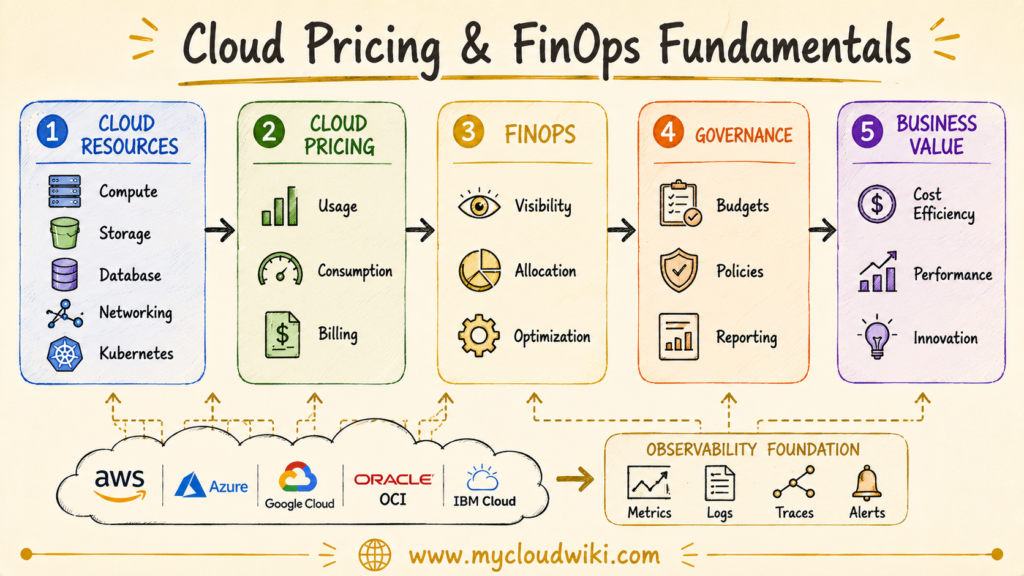
Cloud pricing explains how cloud providers calculate charges, while FinOps helps organizations govern and optimize those costs. Together, they enable enterprises to make informed financial and architectural decisions across multi-cloud environments.
Learning Objectives
After completing this lesson, you will be able to:
- Explain how cloud providers charge for cloud services.
- Understand the relationship between cloud pricing and FinOps.
- Compare common cloud pricing models.
- Explain how enterprise organizations govern and optimize cloud spending.
- Understand how AI and Agentic AI improve cloud cost management across the major cloud providers.
Understanding Cloud Pricing
Cloud pricing is the method cloud providers use to calculate charges for the infrastructure, platform services, software, and managed services consumed by customers.
Unlike traditional IT procurement, cloud pricing is based on measurable resource consumption. Organizations pay for what they use rather than purchasing large amounts of infrastructure in advance.
Cloud providers measure many different types of resource usage, including:
- Compute running time
- Storage capacity
- Network data transfer
- Database consumption
- API requests
- AI and machine learning services
- Backup storage
- Monitoring and observability data
Different services use different pricing models depending on how the resource is consumed.
💡 Architect’s Tip
Cloud pricing is not a single pricing model. Enterprise architects should understand how different services are billed because workload design decisions directly influence long-term cloud costs.
The following illustration demonstrates how cloud providers measure different types of resource consumption before calculating customer charges.
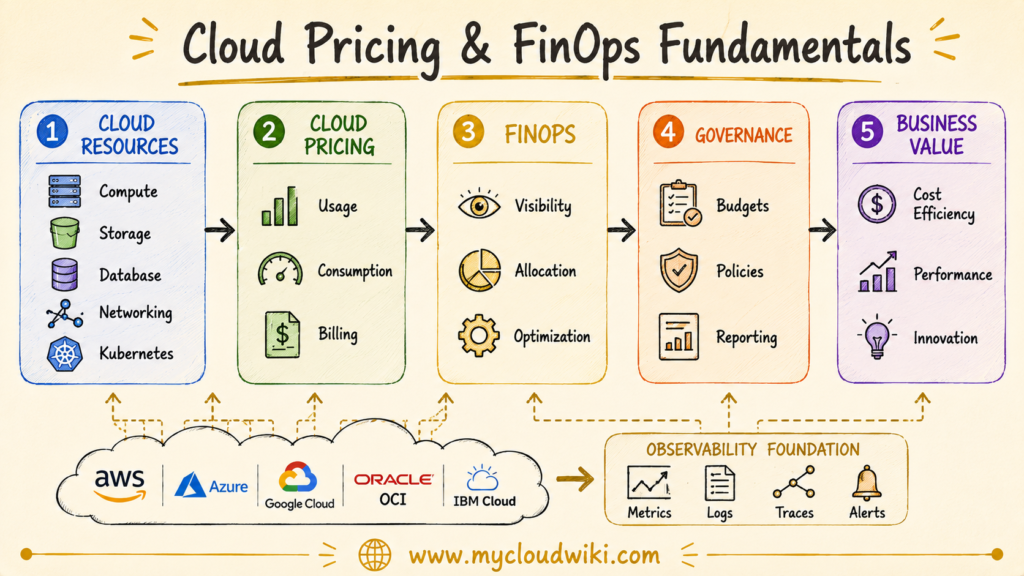
Cloud pricing begins with resource consumption. Every cloud service records usage, applies the appropriate pricing model, and generates billing information that organizations use to manage cloud spending.
Understanding Cloud Billing
Cloud pricing defines how services are charged, while cloud billing is the process of measuring usage, calculating charges, generating invoices, and reporting costs.
A typical cloud billing process includes:
- Measuring resource usage.
- Recording consumption data.
- Applying pricing rules.
- Calculating charges.
- Applying discounts or commitments.
- Generating invoices.
- Producing cost reports for analysis.
Enterprise organizations often consolidate billing across multiple business units, subscriptions, projects, or cloud accounts to improve financial visibility and governance.
💡 Architect’s Tip
Billing data is one of the most valuable operational datasets in cloud computing. Accurate billing information supports budgeting, forecasting, cost allocation, optimization, and executive decision-making across the enterprise.
The following illustration shows how cloud usage becomes billing information that organizations use for financial governance.
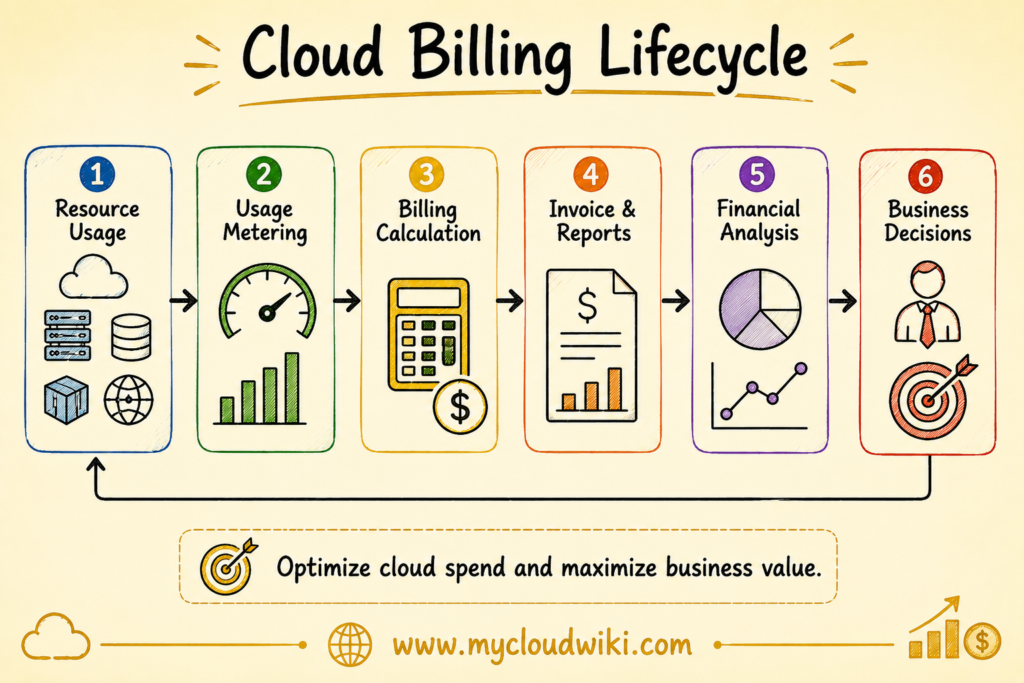
Cloud billing transforms technical resource consumption into financial information, enabling organizations to understand where cloud spending occurs and make informed business decisions.
What Is FinOps?
Cloud Pricing explains how cloud providers charge for services.
FinOps explains how organizations manage, govern, and optimize those charges to maximize business value.
FinOps, short for Financial Operations, is an operational framework that brings together engineering, finance, operations, and business teams to make informed cloud spending decisions.
Unlike traditional IT procurement, cloud resources can be provisioned in minutes and billed continuously based on actual usage. While this flexibility accelerates innovation, it also introduces financial complexity because cloud spending changes as workloads scale, applications evolve, and business demand fluctuates.
FinOps helps organizations answer questions such as:
- Where are we spending money?
- Which workloads generate the highest costs?
- Are resources being fully utilized?
- Can costs be reduced without affecting reliability or performance?
- How should future cloud investments be planned?
Rather than treating cloud cost management as an annual budgeting exercise, FinOps promotes continuous collaboration between technical and business teams.
💡 Architect’s Tip
FinOps is not about spending less—it is about spending wisely. Successful organizations balance cost optimization with performance, reliability, security, scalability, and business outcomes.
The following illustration demonstrates how FinOps connects engineering, finance, and business teams to continuously optimize cloud spending.
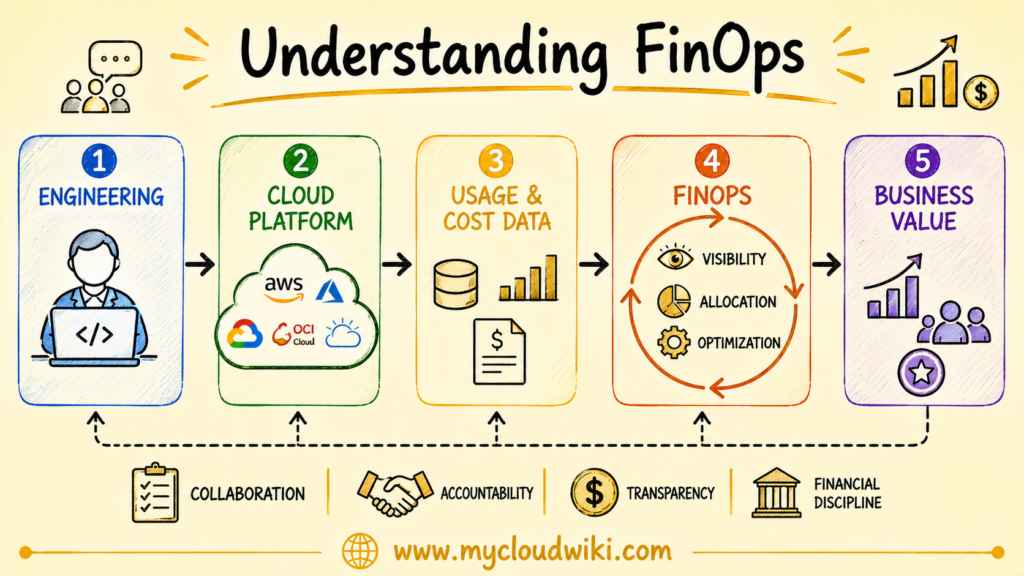
FinOps transforms cloud cost management from a financial reporting exercise into a continuous operational practice that improves both technical and business outcomes.
Why Cloud Pricing and FinOps Work Together
Cloud Pricing and FinOps are complementary disciplines.
Cloud Pricing defines how cloud providers calculate charges for resource consumption.
FinOps helps organizations understand those charges, allocate costs to teams, forecast future spending, and continuously optimize cloud investments.
Think of the relationship this way:
- Cloud Pricing answers: How am I billed?
- FinOps answers: How should I optimize what I’m billed for?
Without understanding pricing models, effective cost optimization is impossible. Likewise, understanding pricing without applying FinOps often results in unnecessary cloud spending.
💡 Architect’s Tip
Every architecture decision has a financial impact. Enterprise architects should evaluate pricing, operational requirements, workload characteristics, and business objectives together rather than treating cost optimization as a separate activity.
The following illustration shows how cloud pricing and FinOps work together to support informed engineering and business decisions.
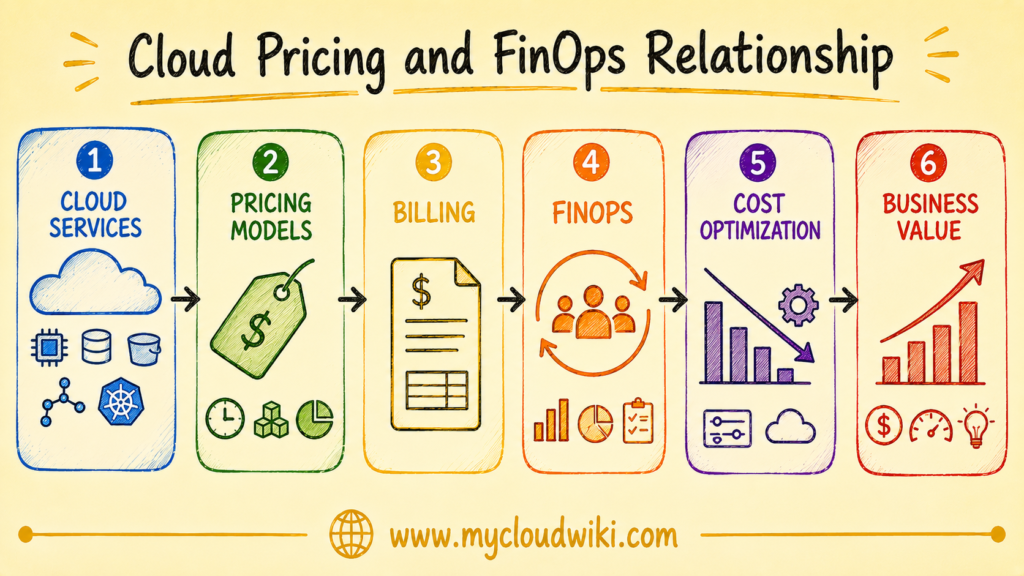
Cloud pricing determines how costs are calculated, while FinOps ensures those costs remain aligned with business priorities and architectural objectives.
Cloud Pricing Models and FinOps Decision Framework
Every workload has different technical, operational, and financial requirements.
Instead of selecting pricing models based solely on cost, enterprise organizations evaluate several factors before making a pricing decision, including workload predictability, availability requirements, scalability needs, operational risk, and long-term business value.
FinOps provides the governance framework that helps organizations make these decisions consistently.
The following illustration demonstrates how cloud architects evaluate workload characteristics before selecting an appropriate pricing model.
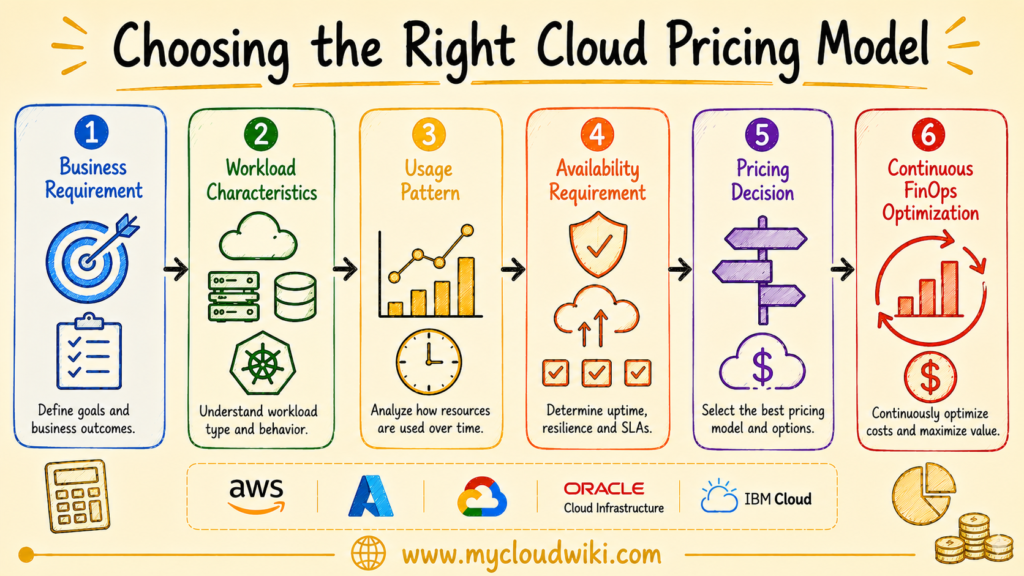
Selecting the right pricing model is an architectural decision rather than simply a purchasing decision. FinOps ensures that pricing choices continue to evolve as workloads and business requirements change.
Pay-As-You-Go Pricing
Pay-As-You-Go is the most common cloud pricing model. Organizations pay only for the resources they consume without making long-term commitments.
This model provides maximum flexibility because resources can be provisioned, scaled, and removed as business demand changes.
Typical use cases include:
- Development and testing environments.
- Short-term projects.
- Seasonal workloads.
- Experimental applications.
- Proof-of-concept deployments.
FinOps Perspective
Although Pay-As-You-Go provides flexibility, continuously running workloads often become more expensive than commitment-based pricing models.
FinOps teams regularly analyze Pay-As-You-Go environments to identify opportunities for optimization.
Typical recommendations include:
- Identify idle virtual machines.
- Remove unattached storage volumes.
- Resize oversized compute instances.
- Shut down non-production resources outside business hours.
- Move predictable workloads to commitment-based pricing where appropriate.
Architectural Trade-Offs
💡 Architect’s Tip
Use Pay-As-You-Go for unpredictable workloads where flexibility is more valuable than long-term discounts. As usage stabilizes, regularly review workloads to determine whether commitment-based pricing models provide better value.
The following illustration demonstrates how organizations evaluate Pay-As-You-Go workloads and continuously optimize them through FinOps practices.
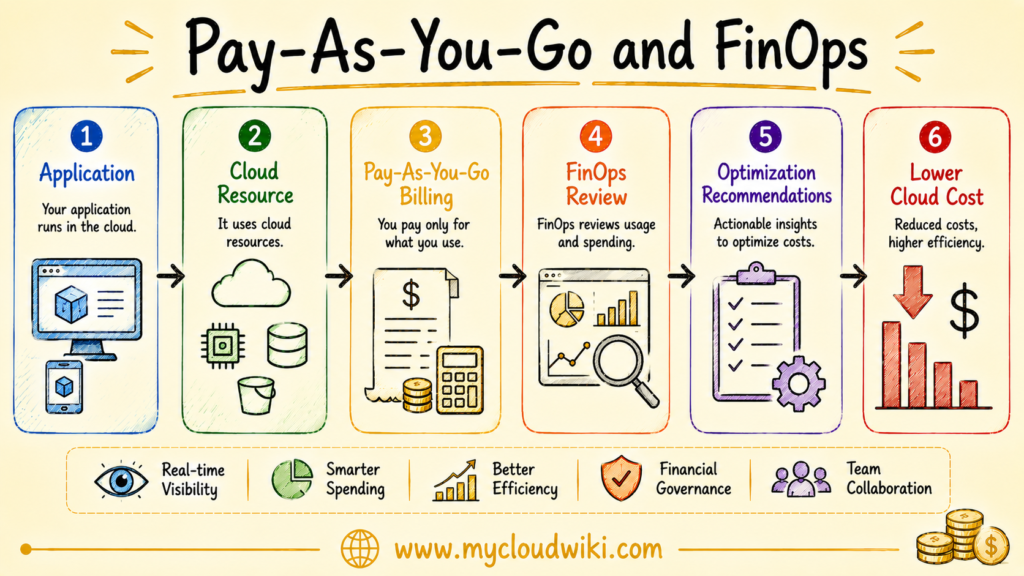
Pay-As-You-Go delivers outstanding flexibility, but mature organizations continuously review usage patterns to ensure workloads remain aligned with the most appropriate pricing model.
Reserved Capacity, Savings Plans & Committed Use Pricing
Many enterprise workloads run continuously and have predictable resource requirements. Paying the standard Pay-As-You-Go rate for these workloads often results in unnecessary long-term costs.
To address this, cloud providers offer commitment-based pricing models. Although the names differ between providers—such as Reserved Instances, Savings Plans, Reserved Capacity, or Committed Use Discounts—they all follow the same principle: organizations commit to using cloud resources for a defined period in exchange for discounted pricing.
These pricing models are commonly used for:
- Production application servers.
- Enterprise databases.
- Identity platforms.
- ERP systems.
- Business-critical APIs.
- Long-running Kubernetes clusters.
By exchanging flexibility for predictability, organizations can significantly reduce operating costs.
FinOps Perspective
One of the primary goals of FinOps is identifying workloads that consistently operate at high utilization. These workloads are strong candidates for commitment-based pricing because their usage patterns are stable and easier to forecast.
Typical FinOps activities include:
- Reviewing historical resource utilization.
- Forecasting future demand.
- Comparing commitment options.
- Tracking commitment utilization.
- Avoiding over-purchasing reserved capacity.
The objective is not to purchase the largest discount but to match commitments with actual business demand.
Architectural Trade-Offs
💡 Architect’s Tip
Commit to workloads—not infrastructure. Select commitment-based pricing only after confirming that workload demand is predictable and expected to remain stable throughout the commitment period.
The following illustration shows how enterprise organizations evaluate predictable workloads before choosing commitment-based pricing.
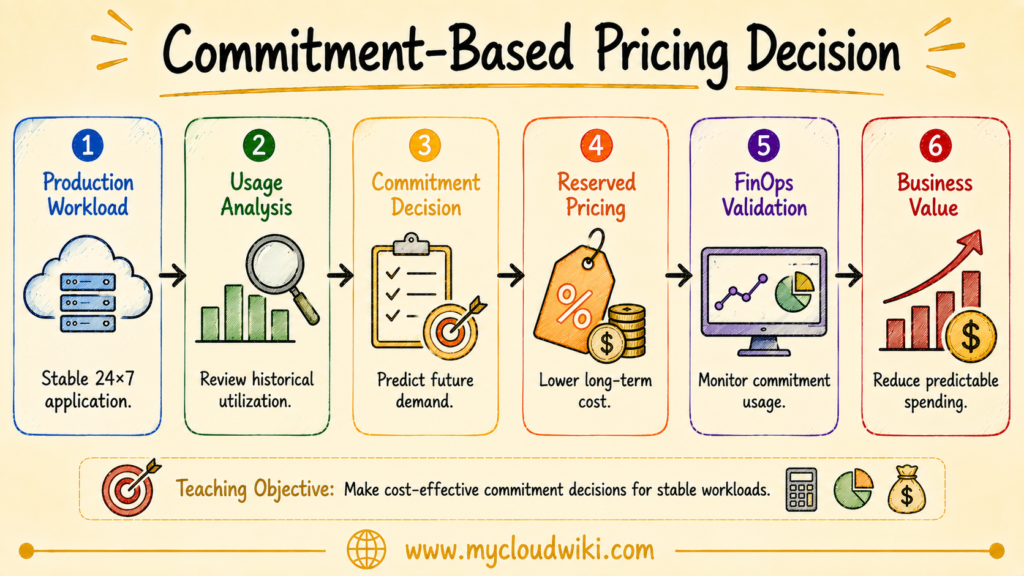
Commitment-based pricing delivers the greatest value when predictable workloads are continuously reviewed to ensure commitments remain aligned with business demand.
Spot & Preemptible Pricing
Some cloud workloads can tolerate interruptions. For these workloads, cloud providers offer deeply discounted pricing by using spare computing capacity.
AWS refers to these resources as Spot Instances, while Google Cloud uses Spot VMs (formerly Preemptible VMs). Similar capabilities are available across the other major cloud providers.
Suitable workloads include:
- Batch processing.
- AI model training.
- Video rendering.
- Scientific computing.
- CI/CD build pipelines.
- Large-scale data analytics.
These workloads can often restart automatically if interrupted, making them good candidates for discounted pricing.
FinOps Perspective
FinOps encourages organizations to classify workloads based on business criticality rather than simply selecting the lowest-cost pricing option.
Typical recommendations include:
Use Spot pricing for:
- Batch jobs.
- Parallel processing.
- Temporary compute.
- Fault-tolerant workloads.
Avoid Spot pricing for:
- Authentication services.
- Production databases.
- Business-critical APIs.
- Transaction processing systems.
Architectural Trade-Offs
💡 Architect’s Tip
Never select Spot pricing solely because it is cheaper. First determine whether the workload can tolerate interruptions without affecting customers or business operations.
The following illustration demonstrates how architects determine whether a workload is suitable for Spot pricing.
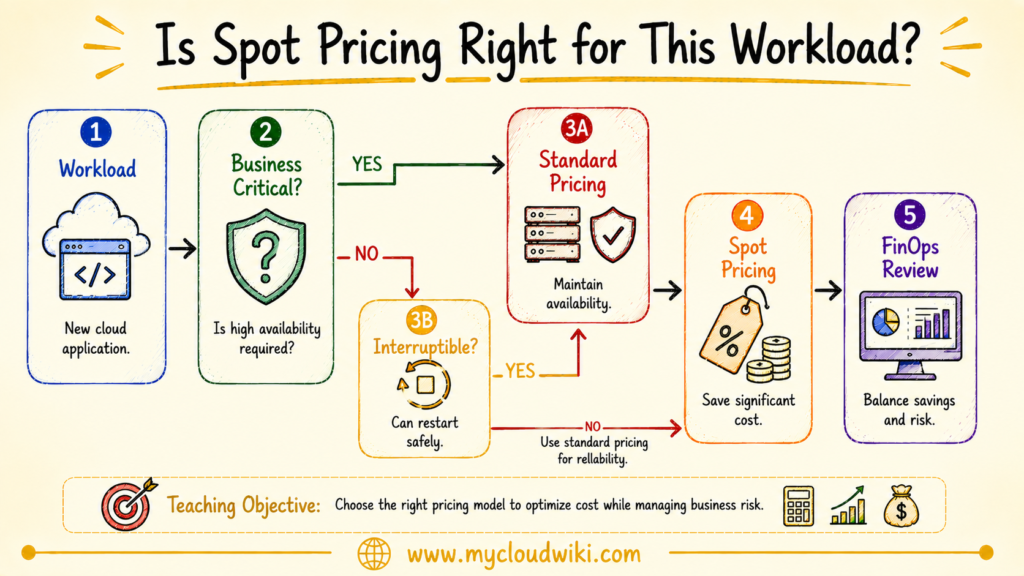
Spot pricing can dramatically reduce cloud costs, but only when workload resilience and business requirements have been carefully evaluated.
Subscription & Licensing
Not every cloud service uses consumption-based pricing. Many enterprise software products continue to use subscription or licensing models alongside cloud infrastructure pricing.
Examples include:
- Microsoft 365.
- Enterprise SaaS platforms.
- Commercial databases.
- Security platforms.
- Third-party marketplace solutions.
Organizations may choose:
- Monthly subscriptions.
- Annual subscriptions.
- Bring Your Own License (BYOL).
- License Included pricing.
- Enterprise Agreements.
FinOps Perspective
Subscription costs should be reviewed regularly to ensure licenses remain aligned with actual business usage.
Common FinOps activities include:
- Removing unused licenses.
- Consolidating subscriptions.
- Reviewing renewal schedules.
- Tracking license utilization.
- Eliminating duplicate software purchases.
Architectural Trade-Offs
💡 Architect’s Tip
Cloud cost optimization should include software licensing as well as infrastructure spending. Regularly reviewing subscriptions helps eliminate unnecessary recurring costs while maintaining compliance.
The following illustration summarizes how enterprise organizations manage subscription-based cloud services throughout their lifecycle.
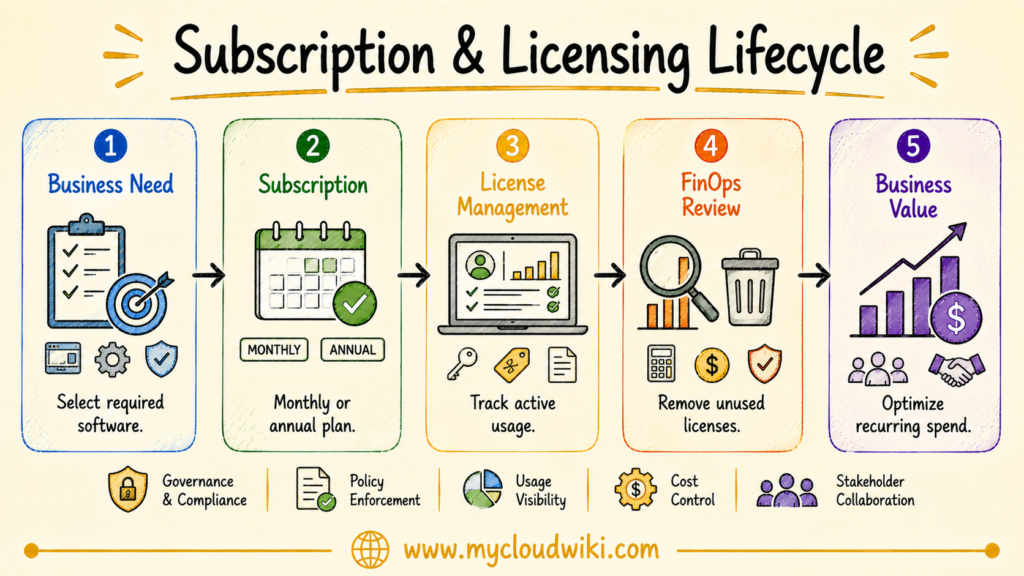
Pricing & FinOps Across the Major Cloud Providers
Although each cloud provider uses different service names and commercial offerings, the underlying pricing principles remain remarkably consistent.
Every major cloud provider supports:
- Consumption-based pricing.
- Commitment-based discounts.
- Discounted spare capacity.
- Enterprise subscriptions.
- Native cost management tools.
- Budgets and forecasting.
- Cost allocation and tagging.
- FinOps best practices.
Enterprise organizations should understand provider-specific capabilities while standardizing financial governance across all cloud environments.
Rather than building different cost management processes for each provider, successful organizations establish a single FinOps operating model that works consistently across AWS, Azure, Google Cloud, OCI, and IBM Cloud.
The following comparison shows how the major cloud providers implement similar pricing and FinOps capabilities using different services and commercial offerings.
Cloud Pricing & FinOps Across the Major Cloud Providers
Although commercial terminology differs, enterprise architects focus on common financial principles rather than provider-specific branding.
The following comparison highlights equivalent pricing and FinOps capabilities across the major cloud providers.
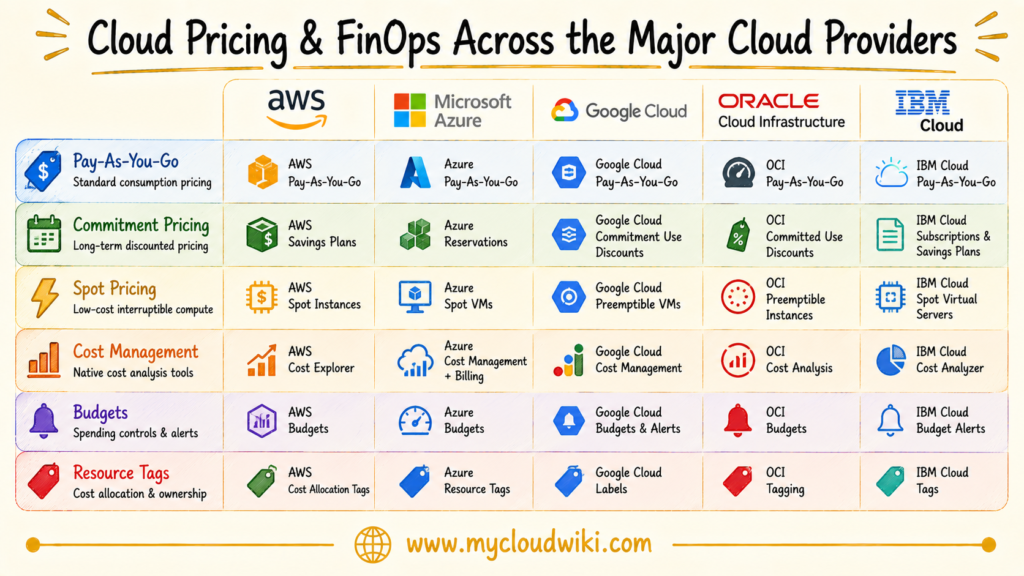
While the names of pricing services vary across providers, the architectural principles remain the same. Standardizing governance, reporting, and optimization practices enables organizations to manage cloud spending consistently across multi-cloud environments.
Cloud Pricing & FinOps Through the Engineer and Architect Lens
Cloud engineers and enterprise architects both influence cloud spending, but they do so from different perspectives.
Engineers make day-to-day deployment decisions that directly affect cloud costs, while architects establish the governance, standards, and financial strategies that guide those decisions across the enterprise.
Engineer Perspective
Cloud engineers focus on implementing and operating cloud resources efficiently.
Typical responsibilities include:
- Selecting appropriate resource sizes.
- Removing unused infrastructure.
- Applying resource tags.
- Monitoring workload utilization.
- Scheduling non-production environments.
- Optimizing storage consumption.
- Reviewing daily cost reports.
- Following organizational FinOps guidelines.
Every engineering decision—whether deploying a virtual machine, selecting storage, or scaling Kubernetes workloads—has a direct financial impact.
Architect Perspective
Enterprise architects design cloud platforms that balance cost, performance, reliability, security, and scalability.
Typical responsibilities include:
- Defining enterprise pricing strategies.
- Establishing FinOps governance.
- Standardizing tagging policies.
- Selecting commitment-based pricing models.
- Creating budgeting standards.
- Designing chargeback and showback models.
- Defining cost optimization processes.
- Aligning cloud spending with business objectives.
Architects focus on ensuring that financial governance becomes part of enterprise architecture rather than an afterthought.
💡 Architect’s Tip
Cloud cost optimization is everyone’s responsibility. Engineers influence daily cloud spending through implementation choices, while architects establish the governance and standards that enable sustainable financial management across the enterprise.
The following illustration compares the operational responsibilities of cloud engineers with the strategic responsibilities of enterprise architects in cloud pricing and FinOps.
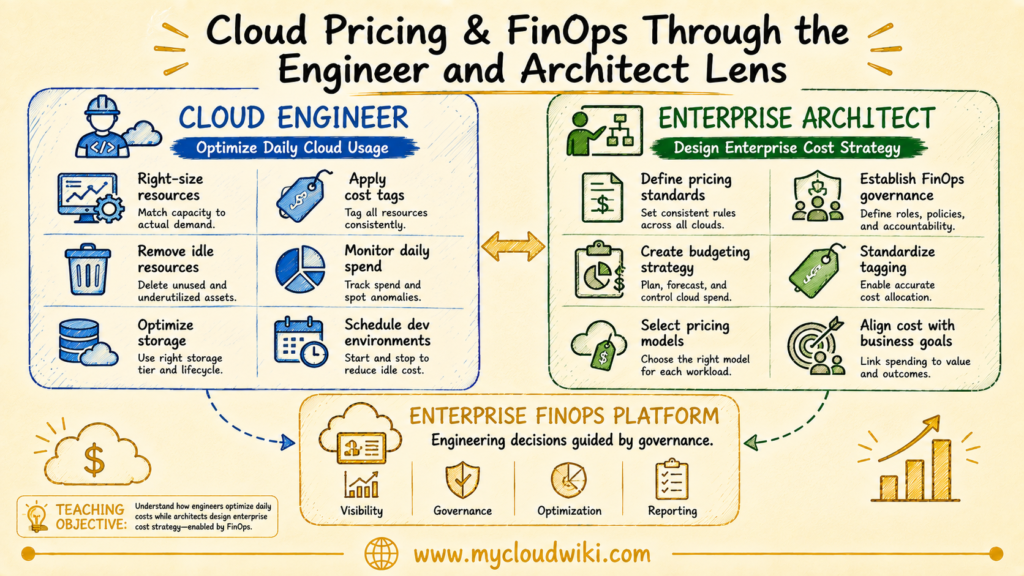
Cloud engineers optimize the cost of individual workloads, while enterprise architects establish the financial governance and architectural standards that ensure cloud investments deliver long-term business value.
Cloud Pricing & FinOps in Multi-Cloud Environments
Managing costs becomes significantly more challenging as organizations adopt multiple cloud providers.
Each provider uses different pricing terminology, billing formats, discount programs, and reporting tools. Without a consistent governance model, engineering teams often struggle to compare costs, forecast spending, and identify optimization opportunities across cloud environments.
A mature multi-cloud FinOps strategy addresses these challenges by standardizing financial governance while allowing teams to use the services that best meet technical and business requirements.
Key elements of a successful multi-cloud pricing and FinOps strategy include:
- Standardized resource tagging.
- Consistent cost allocation models.
- Centralized cost reporting.
- Unified budgeting processes.
- Cross-cloud spending analysis.
- Enterprise-wide optimization reviews.
- Common governance policies.
- Executive financial dashboards.
Continue Learning: The next lesson, AI, Generative AI & Agentic AI in Cloud Computing, builds on this foundation by showing how intelligent assistants and autonomous agents can help forecast costs, identify optimization opportunities, and automate governance across multi-cloud environments.
The following illustration demonstrates how enterprise organizations centralize pricing, billing, and FinOps governance across multiple cloud providers.
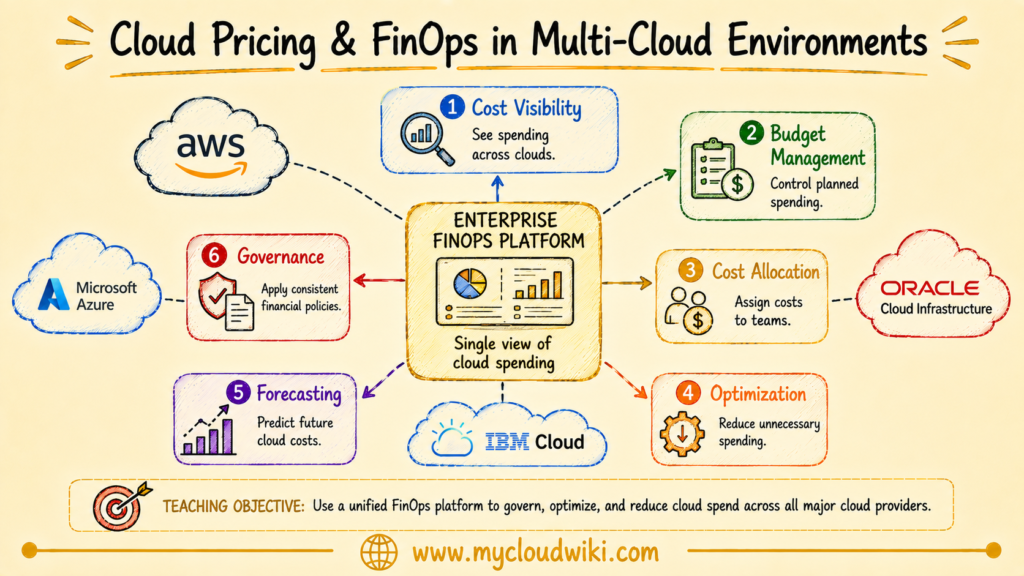
A unified FinOps platform enables organizations to manage cloud spending consistently across the major cloud providers, improving visibility, governance, forecasting, and long-term financial sustainability.
AI & Agentic AI for Cloud Pricing & FinOps
Cloud pricing and FinOps generate enormous amounts of operational and financial data. As cloud environments continue to grow, manually analyzing usage patterns, invoices, budgets, and optimization opportunities becomes increasingly difficult.
Artificial Intelligence (AI) and Agentic AI are transforming cloud financial management by helping organizations understand spending patterns, identify optimization opportunities, forecast future costs, and automate governed financial operations.
Rather than replacing FinOps teams, AI enhances their ability to make faster, data-driven decisions while maintaining enterprise governance.
How AI Helps Cloud Pricing & FinOps
Artificial Intelligence analyzes large volumes of cloud usage and billing data to identify trends that would be difficult for humans to discover manually.
Common AI-assisted capabilities include:
- Forecasting future cloud spending.
- Detecting unusual cost increases.
- Identifying idle resources.
- Recommending rightsizing opportunities.
- Explaining billing anomalies.
- Optimizing commitment purchases.
- Predicting budget overruns.
- Summarizing cloud spending trends.
By continuously analyzing operational and financial telemetry, AI enables organizations to make proactive cost optimization decisions.
How Agentic AI Helps Cloud Pricing & FinOps
Agentic AI extends beyond analysis by coordinating approved financial optimization activities.
Examples include:
- Collecting cost data across cloud providers.
- Reviewing resource utilization.
- Identifying optimization opportunities.
- Generating executive cost reports.
- Opening optimization tasks.
- Recommending commitment purchases.
- Enforcing tagging policies.
- Supporting governance workflows.
Agentic AI helps accelerate FinOps processes while ensuring that optimization activities remain aligned with enterprise policies.
Governance
Financial data is business-critical information and must be managed securely.
Enterprise governance should include:
- Role-based access to cost reports.
- Approval workflows for optimization actions.
- Budget ownership.
- Cost allocation standards.
- Tagging compliance.
- Audit trails.
- Policy enforcement.
- Financial reporting standards.
-
Human Oversight
AI recommendations should always be reviewed before significant financial or architectural decisions are implemented.
Human oversight remains essential for:
- Commitment purchases.
- Budget approvals.
- Architectural changes.
- Business-critical workload decisions.
- Financial forecasting.
- Enterprise governance.
AI improves decision-making, but business accountability continues to rest with engineers, architects, FinOps teams, and organizational leadership.
💡 Architect’s Tip
AI can identify optimization opportunities quickly, but successful FinOps requires balancing cost savings with application performance, reliability, security, and business priorities. Human judgment remains essential for enterprise cloud governance.
The following illustration demonstrates how AI and Agentic AI help organizations analyze cloud spending, recommend optimizations, and support governed financial operations.
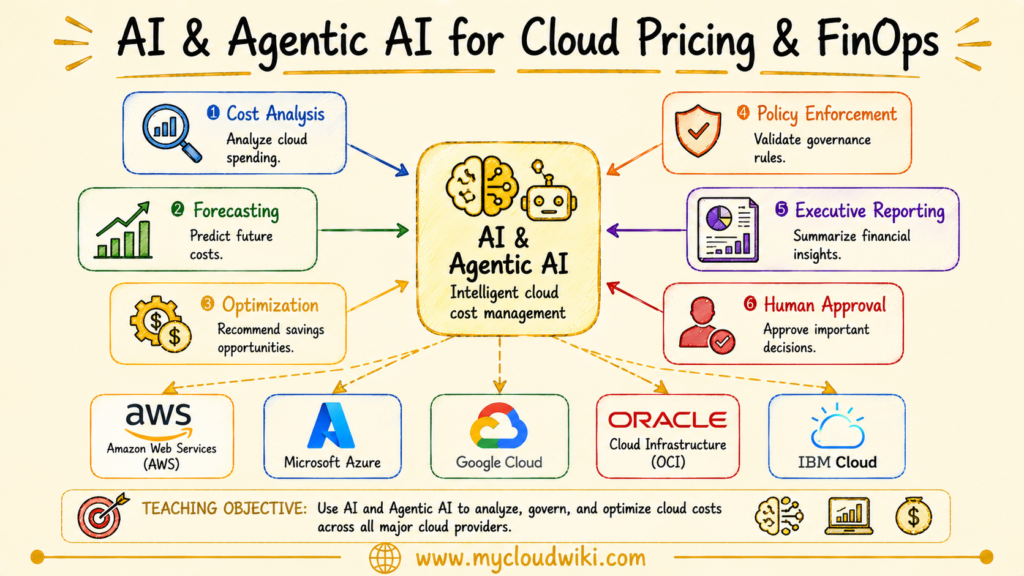
AI improves cloud financial intelligence, while Agentic AI accelerates governed optimization activities. Together they enable organizations to manage cloud spending more effectively without compromising governance or accountability.
Well-Architected Multi-Cloud Pricing & FinOps Strategy
A mature FinOps strategy extends beyond reducing cloud costs. It enables organizations to balance financial efficiency with operational excellence, security, reliability, and long-term business value across the major cloud providers.
Operational Excellence
- Standardize cost reporting across cloud providers.
- Automate recurring FinOps reviews.
- Continuously monitor spending trends.
- Integrate cost optimization into engineering workflows.
- Establish measurable financial KPIs.
Security
- Protect financial and billing information.
- Apply least-privilege access to cost data.
- Audit financial changes regularly.
- Secure billing accounts.
- Monitor privileged financial operations.
Reliability
- Avoid cost optimizations that reduce service availability.
- Validate commitment strategies regularly.
- Balance savings with resilience.
- Monitor workload changes continuously.
- Review business-critical spending.
Performance Efficiency
- Right-size cloud resources.
- Optimize commitment utilization.
- Remove underutilized services.
- Continuously improve workload efficiency.
- Monitor optimization outcomes.
Cost Optimization
- Eliminate waste.
- Optimize pricing models.
- Improve resource utilization.
- Review subscription usage.
- Forecast future cloud investments.
💡 Architect’s Tip
Successful organizations optimize cloud spending continuously rather than treating cost reduction as a one-time project. FinOps should become part of everyday engineering and architectural decision-making.
The following illustration summarizes how the Well-Architected Framework supports enterprise cloud pricing and FinOps strategies.
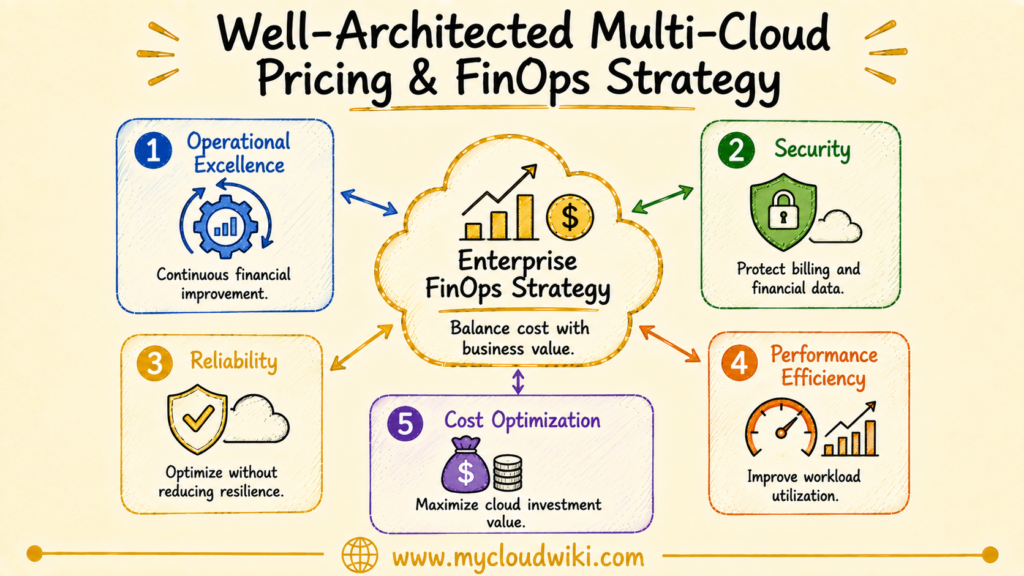
A well-architected FinOps strategy enables organizations to make cloud spending predictable, transparent, and aligned with technical and business objectives.
Common Cloud Pricing & FinOps Mistakes
Architect’s Notebook — Cloud Pricing & FinOps
Enterprise Challenges
- Balancing cost optimization with performance and reliability.
- Standardizing FinOps across multiple cloud providers.
- Maintaining accurate resource ownership.
- Forecasting cloud spending in dynamic environments.
Lessons Learned
- Every architecture decision has a financial impact.
- Cost visibility is the foundation of effective FinOps.
- Small optimization opportunities compound into significant savings over time.
- Governance enables sustainable cloud adoption.
Enterprise Observations
- Organizations increasingly integrate FinOps into platform engineering.
- AI is improving forecasting and optimization accuracy.
- Commitment-based pricing requires continuous review.
- Multi-cloud governance is becoming a strategic capability.
AI & Agentic AI Notes
- AI accelerates cloud cost analysis.
- Agentic AI supports governed optimization workflows.
- Human accountability remains essential.
- Financial governance evolves alongside AI adoption.
The following notebook captures practical architectural lessons for building sustainable cloud pricing and FinOps practices across enterprise multi-cloud environments.
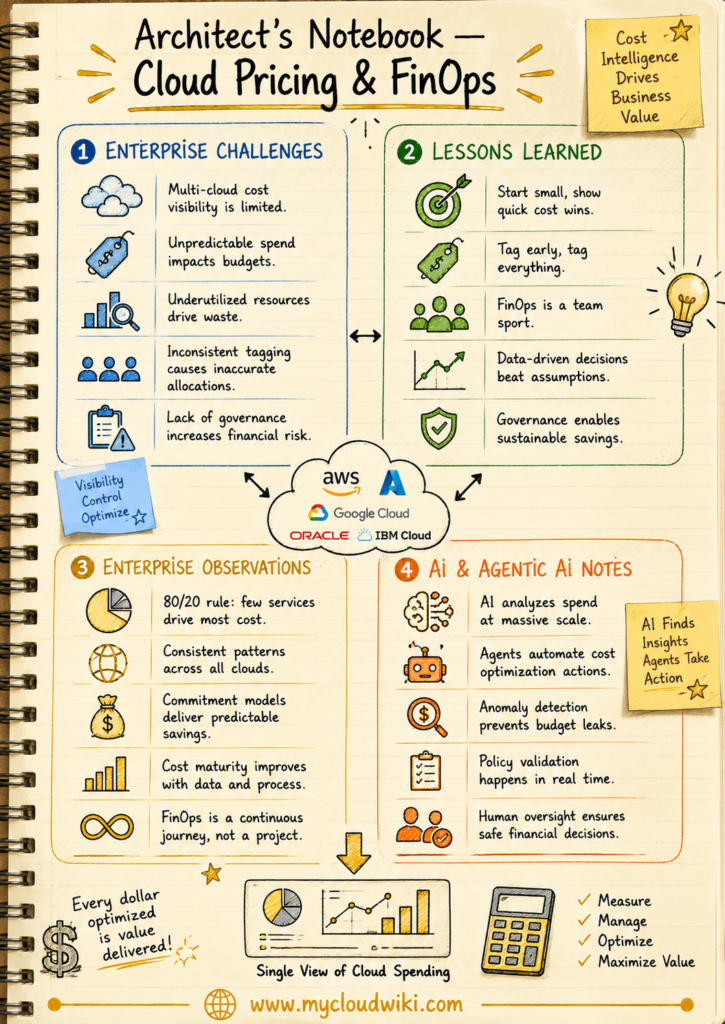
The lessons captured in an architect’s notebook help organizations build pricing and FinOps strategies that remain effective as cloud adoption grows across the major cloud providers.
Key Takeaways
- Cloud pricing defines how providers calculate charges, while FinOps helps organizations understand, govern, and optimize those costs.
- Different pricing models support different workload characteristics, business priorities, and architectural trade-offs.
- Enterprise organizations standardize FinOps practices across the major cloud providers to improve visibility, governance, and financial accountability.
- AI and Agentic AI enhance cloud financial management through intelligent analysis, forecasting, optimization, and governed automation.
- Successful cloud architecture balances cost, performance, reliability, security, scalability, and long-term business value.
What’s Next
Cloud pricing and FinOps help organizations make financially responsible cloud decisions. The next lesson expands this foundation by exploring how AI, Generative AI, and Agentic AI are transforming cloud engineering, operations, platform engineering, and enterprise architecture across the major cloud providers.

