
Artificial Intelligence continues to dominate technology investment and innovation, but the broader emerging technology landscape is evolving rapidly. Frontier AI models are becoming more capable, AGI governance discussions are moving from research communities into government and enterprise boardrooms, Physical AI is advancing beyond digital assistants into real-world environments, and Post-Quantum Cryptography programs are becoming practical enterprise initiatives.
At the same time, semiconductor competition continues shaping AI infrastructure strategy, scientific AI is accelerating research and drug discovery, and stablecoins are emerging as one of the few blockchain technologies showing meaningful enterprise adoption.
This month’s Emerging Technology Radar focuses on the developments that technology leaders, architects, and innovation teams should monitor closely over the next several years.
Executive Summary
- OpenAI, Anthropic, Google DeepMind, and Microsoft continue expanding frontier AI capabilities and enterprise adoption.
- AGI governance and AI safety discussions are accelerating across governments, regulators, and leading AI labs.
- NVIDIA, Tesla, Figure AI, and other robotics leaders continue advancing Physical AI initiatives.
- NIST-driven Post-Quantum Cryptography migration planning is gaining momentum.
- NVIDIA, AMD, Intel, TSMC, and hyperscalers continue competing to support AI infrastructure demand.
- AI-powered scientific research and drug discovery continue showing promising results.
- Stablecoins remain the most practical enterprise blockchain use case currently available.
Key Developments This Month
| Development | Category | Impact Level | Recommended Action |
|---|---|---|---|
| Frontier AI Capabilities Continue Expanding | Artificial Intelligence | High | Evaluate future workforce and operating model impacts |
| AGI Governance Discussions Accelerate | Advanced AI | High | Monitor governance, safety, and regulatory developments |
| Physical AI and Robotics Investment Surges | Robotics & Physical AI | High | Assess automation opportunities and operational impacts |
| Post-Quantum Cryptography Programs Expand | Quantum Security | High | Begin cryptographic inventory planning |
| AI Infrastructure and Semiconductor Competition Intensifies | Semiconductors | High | Monitor infrastructure dependency risks |
| AI-Powered Scientific Research Accelerates | Biotechnology & AI | Medium | Track industry-specific innovation opportunities |
| Stablecoin Adoption Continues Growing | Digital Assets | Medium | Monitor payment and treasury modernization use cases |
1. Frontier AI Capabilities Continue Expanding
What’s the Buzz?
- OpenAI expanded enterprise adoption of advanced GPT-based reasoning and agent workflows through Azure and AWS ecosystems.
- Anthropic released Claude Opus 4.8, improving coding, reasoning, and long-context performance.
- Google DeepMind continued expanding Gemini-powered agent experiences and enterprise AI capabilities.
- Microsoft Copilot continued integrating AI agents across productivity and enterprise workflows.
- Meta accelerated open-weight AI model development through the Llama ecosystem.
Why It Matters
The conversation has shifted from content generation to autonomous task execution. Organizations are increasingly evaluating how AI systems can assist with software development, operations, research, customer support, and knowledge-intensive work. Enterprise leaders should begin preparing for AI operating models that include both human and AI workers.
What Engineers Should Learn
✓ Agentic AI fundamentals
✓ Multi-modal AI architectures
✓ AI orchestration platforms
✓ Model evaluation techniques
What Architects Should Prepare For
✓ Enterprise AI operating models
✓ AI governance frameworks
✓ Workforce transformation planning
✓ AI platform strategy
2. AGI Governance Discussions Accelerate
What’s the Buzz?
- OpenAI, Anthropic, and Google DeepMind continue expanding AI safety and alignment investments.
- Governments in the United States, European Union, and United Kingdom continue evaluating advanced AI governance frameworks.
- AI Safety Institutes continue expanding research into frontier AI evaluation.
- Industry discussions increasingly focus on governance for highly autonomous systems.
- Enterprise organizations are beginning to evaluate long-term AI governance operating models.
Why It Matters
Whether AGI arrives within years or decades, governance decisions made today will influence future enterprise adoption. Organizations should monitor evolving regulatory frameworks, safety standards, and risk management approaches as AI systems become increasingly capable.
What Engineers Should Learn
✓ AI safety fundamentals
✓ Responsible AI principles
✓ Model governance concepts
✓ AI risk management
What Architects Should Prepare For
✓ Enterprise governance frameworks
✓ Regulatory readiness
✓ AI policy development
✓ Future operating model changes
3. Physical AI and Robotics Investment Surges
What’s the Buzz?
- NVIDIA continues positioning Physical AI as the next major AI growth category through Isaac and Omniverse platforms.
- Tesla Optimus remains one of the most closely watched humanoid robotics initiatives.
- Figure AI continues expanding industrial and enterprise robotics partnerships.
- Boston Dynamics advances commercial robotics deployments.
- Agility Robotics expands logistics and warehouse automation programs.
Why It Matters
Physical AI extends intelligence beyond software systems into machines capable of interacting with the real world. Manufacturing, logistics, healthcare, retail, and infrastructure organizations should begin evaluating how robotics and autonomous systems may affect future operations and workforce strategies.
What Engineers Should Learn
✓ Robotics software platforms
✓ Edge AI architectures
✓ Sensor integration concepts
✓ Autonomous system fundamentals
What Architects Should Prepare For
✓ Operational technology integration
✓ Edge computing strategies
✓ Security implications
✓ Future automation roadmaps
4. Post-Quantum Cryptography Programs Expand
What’s the Buzz?
- NIST continues driving adoption of standardized Post-Quantum Cryptography algorithms.
- IBM Quantum advances enterprise quantum roadmap discussions.
- Google Cloud, Microsoft, and major security vendors continue expanding PQC support.
- Government agencies increase migration guidance and readiness programs.
- Enterprise security teams accelerate cryptographic inventory initiatives.
Why It Matters
Quantum computers capable of breaking traditional encryption may still be years away, but cryptographic migrations often require significant planning and execution time. Organizations that start preparation early will be better positioned when broader migration efforts become necessary.
What Engineers Should Learn
✓ PQC fundamentals
✓ Cryptographic discovery tools
✓ Hybrid cryptography approaches
✓ Certificate lifecycle impacts
What Architects Should Prepare For
✓ Multi-year migration roadmaps
✓ Vendor readiness assessments
✓ Security modernization strategies
✓ Compliance implications
5. AI Infrastructure and Semiconductor Competition Intensifies
What’s the Buzz?
- NVIDIA continues leading AI accelerator demand across hyperscale and enterprise environments.
- AMD expands enterprise AI infrastructure positioning through Instinct accelerators.
- Intel continues investing in AI infrastructure and foundry capabilities.
- TSMC remains central to global AI chip manufacturing.
- Hyperscalers continue investing heavily in proprietary AI silicon and infrastructure.
Why It Matters
AI innovation increasingly depends on infrastructure availability. Enterprise architects should monitor compute availability, supplier concentration risks, geographic dependencies, and infrastructure economics as AI adoption expands.
What Engineers Should Learn
✓ GPU platform architectures
✓ AI infrastructure fundamentals
✓ Capacity planning concepts
✓ Hardware acceleration trends
What Architects Should Prepare For
✓ AI infrastructure strategy
✓ Supplier concentration risks
✓ Capacity forecasting
✓ Cost management planning
6. AI-Powered Scientific Research Accelerates
What’s the Buzz?
- Google DeepMind’s AlphaFold ecosystem continues influencing life sciences research.
- Isomorphic Labs advances AI-driven drug discovery initiatives.
- NVIDIA BioNeMo continues supporting scientific AI workloads.
- Pharmaceutical companies expand AI-assisted research partnerships.
- Scientific foundation models continue improving research productivity.
Why It Matters
AI has the potential to accelerate scientific discovery across healthcare, biotechnology, pharmaceuticals, and materials science. Organizations operating in research-intensive industries should closely monitor developments that could significantly reduce research timelines and costs.
What Engineers Should Learn
✓ Scientific AI concepts
✓ Domain-specific AI applications
✓ Data requirements
✓ Regulatory considerations
What Architects Should Prepare For
✓ Research platform evolution
✓ Industry disruption scenarios
✓ Governance requirements
✓ Data strategy impacts
7. Stablecoin Adoption Continues Growing
What’s the Buzz?
- Circle (USDC) continues expanding institutional adoption and payment integrations.
- Tether (USDT) remains the dominant stablecoin by transaction volume.
- Major financial institutions continue exploring tokenized payment systems.
- Stablecoin regulatory discussions advance across multiple jurisdictions.
- Enterprise treasury and settlement use cases continue gaining attention.
Why It Matters
Stablecoins continue demonstrating practical value for payments, settlement, and treasury operations. While broader blockchain adoption remains mixed, stablecoins represent one of the clearest enterprise blockchain use cases currently available.
What Engineers Should Learn
✓ Digital asset infrastructure
✓ Blockchain settlement concepts
✓ Payment architecture basics
✓ Security and custody fundamentals
What Architects Should Prepare For
✓ Payment modernization strategies
✓ Treasury transformation opportunities
✓ Regulatory considerations
✓ Cross-border transaction impacts
8. Other Notable Updates
Artificial Intelligence
- Anthropic, OpenAI, and Google DeepMind continue expanding agentic AI capabilities.
- Enterprise AI governance platforms continue maturing.
Robotics
- Figure AI, Agility Robotics, and Boston Dynamics continue enterprise deployments.
- Warehouse and industrial automation investments remain strong.
Quantum Computing
- IBM Quantum, IonQ, and Quantinuum continue advancing quantum roadmaps.
- Government funding programs continue expanding globally.
Semiconductors
- NVIDIA, AMD, and hyperscalers continue introducing AI infrastructure innovations.
- Advanced packaging technologies remain a strategic focus area.
Architect’s View: The Bigger Enterprise Signal
The most important trend this month is the expansion of intelligence beyond traditional software systems.
Generative AI transformed how organizations create content, write software, and process information. The next phase appears broader. Agentic AI is increasing autonomy. Physical AI is extending intelligence into real-world environments. Scientific AI is accelerating research and discovery. Quantum technologies are forcing organizations to reconsider long-term security assumptions.
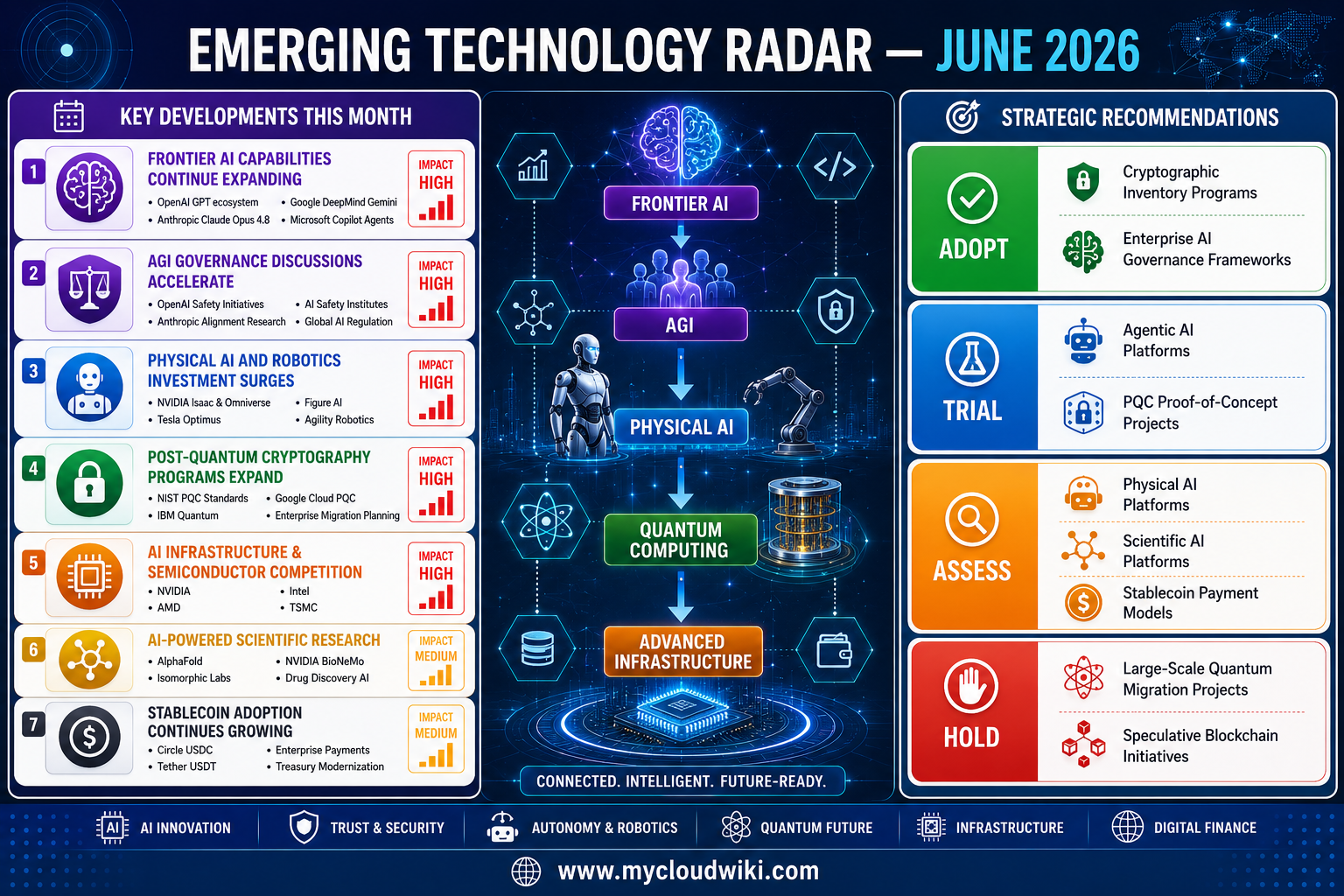
While these technologies are progressing at different speeds, they share common architectural requirements:
- Strong governance
- Identity and trust models
- Scalable data platforms
- Security by design
- Observability and auditability
- Responsible AI controls
Enterprise architects should focus less on predicting which technology will dominate and more on building foundational capabilities that enable organizations to adapt as these technologies mature.
Hands-On Readiness Checklist
Engineer Checklist
✓ Explore agentic AI platforms
Understand how autonomous AI systems differ from traditional AI assistants.
✓ Perform a cryptographic inventory assessment
Identify where encryption algorithms and certificates are currently used.
✓ Evaluate edge AI technologies
Gain familiarity with architectures supporting Physical AI deployments.
✓ Review AI infrastructure dependencies
Understand current reliance on specific hardware platforms and providers.
✓ Track emerging standards
Monitor developments across AI governance, PQC, and robotics ecosystems.
Architect Checklist
✓ Define a future AI operating model
Prepare governance and platform strategies for broader AI adoption.
✓ Build a PQC migration roadmap
Create a phased approach for future cryptographic modernization.
✓ Assess automation opportunities
Identify business processes that may benefit from robotics and Physical AI.
✓ Review infrastructure concentration risks
Evaluate dependency on specific AI infrastructure providers.
✓ Maintain an emerging technology watchlist
Continuously monitor developments with enterprise relevance.
Strategic Recommendations
Adopt
✓ Cryptographic inventory programs
Understanding current cryptographic usage is a prerequisite for future PQC migration.
✓ Enterprise AI governance frameworks
Governance capabilities should mature alongside AI adoption.
Trial
✓ Agentic AI platforms
Pilot emerging AI operating models and autonomous workflows.
✓ PQC proof-of-concept projects
Build familiarity with migration challenges before large-scale adoption.
Assess
✓ Physical AI platforms
Monitor real-world enterprise use cases and deployment maturity.
✓ Stablecoin payment models
Evaluate practical applications for treasury and payment modernization.
✓ Scientific AI platforms
Track developments with potential industry-specific impact.
Hold
✓ Large-scale quantum migration projects
Most organizations should focus on planning rather than immediate full migration.
✓ Speculative blockchain initiatives
Prioritize practical business outcomes over experimental deployments.
Key Takeaways
The following developments deserve the closest attention from technology leaders this month.
- OpenAI, Anthropic, Google DeepMind, and Microsoft continue expanding frontier AI capabilities.
- AGI governance and AI safety discussions are becoming increasingly important.
- NVIDIA, Tesla, Figure AI, and robotics leaders are accelerating Physical AI development.
- NIST-led PQC preparation is becoming a practical enterprise requirement.
- AI infrastructure competition remains strategically significant.
- Scientific AI continues accelerating research and innovation.
- Stablecoins remain the strongest enterprise blockchain use case.
What’s Next
Watch these developments over the next 4–8 weeks.
- Frontier AI capability announcements from OpenAI, Anthropic, Google, and Meta.
- AGI governance and regulatory developments.
- Commercial Physical AI deployments.
- PQC migration initiatives and vendor support announcements.
- Next-generation AI accelerator releases.
- Scientific AI breakthroughs.
- Stablecoin regulatory developments.
Learning Resources
Recommended resources for further exploration.
- OpenAI Research Publications
- Anthropic AI Safety Research
- Google DeepMind Research
- NIST Post-Quantum Cryptography Program
- IBM Quantum Learning Resources
- NVIDIA Physical AI Resources
- Semiconductor Industry Association Reports
References
- OpenAI — Frontier AI Research Updates
- Anthropic — Claude Opus 4.8 and AI Safety Research
- Google DeepMind — Gemini and Frontier AI Research
- NVIDIA — Isaac, Omniverse and Physical AI Announcements
- NIST — Post-Quantum Cryptography Standardization Project
- IBM Quantum — Quantum Roadmap Updates
- Isomorphic Labs — AI Drug Discovery Initiatives
- McKinsey — The State of AI Infrastructure
- Gartner — Emerging Technology Trends 2026
- CoinDesk — Stablecoin Adoption Trends

