
The last four weeks reinforced a major industry shift: AI is becoming a cloud platform capability rather than a standalone technology initiative.
OpenAI expanded model availability through AWS. Microsoft introduced Azure Cobalt 200 virtual machines optimized for agentic AI workloads. Google announced Gemini Spark, a persistent AI agent experience. AWS expanded access to Claude Opus 4.8 through Amazon Bedrock. Meanwhile, Anthropic’s $35 billion infrastructure expansion highlights the growing importance of AI compute capacity.
For architects and engineers, the focus is shifting from selecting models to designing secure, scalable, and governed AI platforms. Infrastructure, identity, observability, cost management, and workload portability are becoming as important as model performance.
Organizations that prepare now will be better positioned to adopt the next generation of AI-enabled applications, autonomous agents, and cloud-native AI platforms.
Key Developments This Month
Architectural Priority indicates how urgently technology teams should evaluate the update.
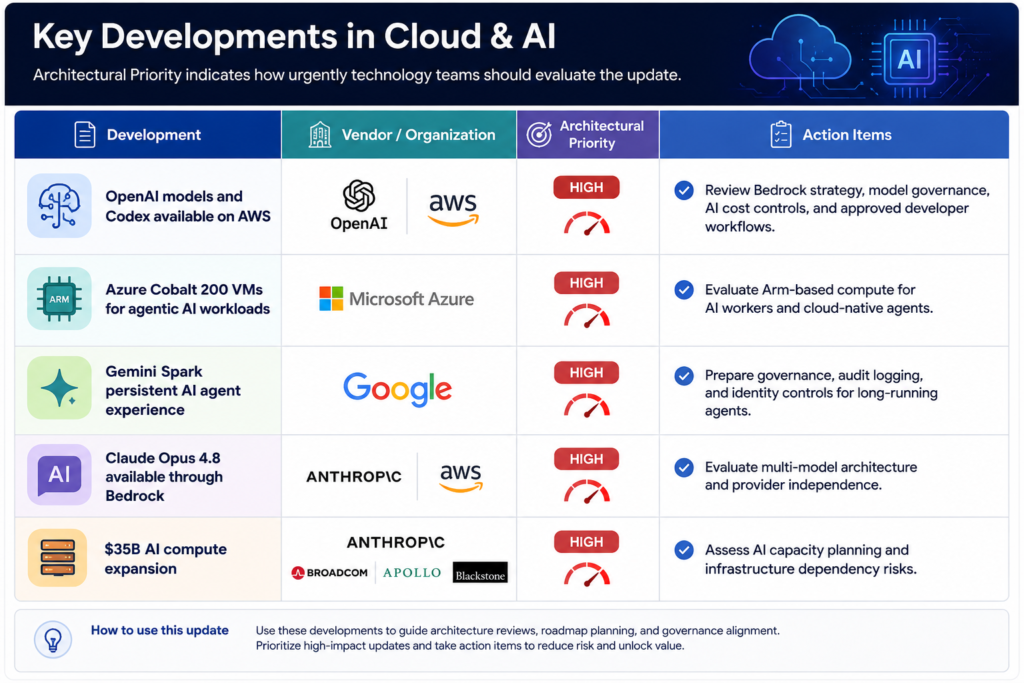
1. OpenAI Models and Codex Become Available on AWS
What is the Update?
OpenAI announced that its frontier models and Codex are now available through AWS and Amazon Bedrock.
This allows AWS customers to access OpenAI capabilities using existing AWS identity, networking, logging, procurement, and governance controls rather than creating separate AI operating models.
Why It Matters
This development reinforces a major trend: foundation models are moving into cloud control planes.
Enterprises increasingly want a single governance layer that manages model access, security, monitoring, compliance, and cost controls. Cloud providers are evolving from infrastructure platforms into enterprise AI platforms.
For many organizations, the discussion is no longer about choosing a model. It is about deciding where model access should be governed and how AI capabilities integrate into existing cloud architectures.
What Engineers Should Learn
✓ Amazon Bedrock fundamentals
✓ Secure AI application deployment
✓ Model invocation patterns using SDKs and APIs
✓ Codex-assisted development workflows
What Architects Should Prepare For
✓ Multi-model AI governance
✓ AI workload placement strategies
✓ Centralized AI platform architectures
✓ FinOps controls for model consumption
2. Microsoft Introduces Azure Cobalt 200 for Agentic AI
What is the Update?
Microsoft introduced Azure Cobalt 200 Arm-based virtual machines designed for Linux-based, cloud-native, and agentic AI workloads.
According to Microsoft, Cobalt 200 delivers significant improvements in CPU performance, storage throughput, storage IOPS, and network bandwidth compared with the previous generation.
Why It Matters
AI agents introduce new infrastructure requirements.
Unlike traditional applications that respond to short-lived requests, agents often execute long-running workflows, call tools, access APIs, analyze data, and maintain context over time.
This is pushing cloud providers to optimize infrastructure specifically for AI-driven execution models.
Architects should expect future cloud infrastructure innovations to focus increasingly on agent orchestration, AI runtimes, and autonomous workload execution rather than traditional application hosting.
What Engineers Should Learn
✓ Arm-based cloud computing
✓ Linux workload optimization
✓ AI runtime performance benchmarking
✓ Container compatibility across architectures
What Architects Should Prepare For
✓ Compute selection frameworks
✓ Agent worker pool architectures
✓ Cost-performance comparisons between x86, Arm, GPU, and accelerator platforms
✓ Hybrid AI compute strategies
3. Google Pushes Gemini into the Agentic Era
What is the Update?
Google introduced Gemini Spark, a persistent AI agent experience powered by Gemini 3.5 and hosted on its Antigravity platform.
Unlike traditional chat interactions, Gemini Spark is designed to operate continuously, perform multi-step tasks, and interact with users over extended periods.
Google also expanded agentic capabilities across Gemini, Search, Android, Chrome, and developer tools.
Why It Matters
Persistent AI agents introduce a fundamentally different architecture model.
Instead of responding to a single request, agents can maintain context, invoke tools, access enterprise systems, and execute workflows autonomously.
This creates new challenges around identity, authorization, auditability, approval workflows, and governance.
Many organizations are still building governance models for generative AI. Agentic AI introduces an additional layer of operational complexity that architects must address before large-scale adoption.
What Engineers Should Learn
✓ Model Context Protocol (MCP)
✓ Secure tool integration patterns
✓ Agent state management
✓ Long-running workflow orchestration
What Architects Should Prepare For
✓ Agent identity models
✓ Human approval workflows
✓ Agent governance frameworks
✓ Audit and observability requirements for autonomous systems
4. Claude Opus 4.8 Expands Through Amazon Bedrock
What is the Update?
AWS announced Claude Opus 4.8 availability through Amazon Bedrock, making Anthropic’s latest enterprise-focused model available through AWS-managed AI services.
AWS positioned Claude Opus 4.8 for coding, knowledge work, complex reasoning, and autonomous task execution.
Why It Matters
Enterprises increasingly want access to multiple AI models without rebuilding governance, security, compliance, and operational controls for each provider.
Amazon Bedrock continues strengthening its position as a multi-model AI platform where organizations can evaluate OpenAI, Anthropic, Amazon, and other models under a common governance framework.
What Engineers Should Learn
✓ Retrieval-Augmented Generation (RAG)
✓ Model observability and performance monitoring
✓ AI-assisted development workflows
✓ Knowledge-base integration patterns
What Architects Should Prepare For
✓ Provider-independent AI architectures
✓ Model routing and selection strategies
✓ Enterprise AI governance standards
✓ Multi-model platform architectures
5. Anthropic Infrastructure Expansion Highlights the AI Capacity Race
What is the Update?
Apollo and Blackstone announced support for a $35 billion AI computing capacity expansion for Anthropic using Broadcom custom AI chips and high-performance networking technologies.
The initiative is expected to significantly expand Anthropic’s AI infrastructure capacity over the coming years.
Why It Matters
AI infrastructure is becoming a strategic technology asset.
Compute availability, power consumption, networking capacity, accelerator access, and infrastructure financing are increasingly influencing AI platform decisions.
This signals that AI is no longer just a software discussion. It is now an infrastructure, capacity planning, and supply-chain discussion.
What Engineers Should Learn
✓ GPU and AI accelerator fundamentals
✓ AI networking concepts
✓ Capacity planning principles
✓ AI infrastructure cost drivers
What Architects Should Prepare For
✓ AI sourcing strategies
✓ Infrastructure dependency risk assessments
✓ Multi-cloud AI capacity planning
✓ Workload portability strategies
Other Notable Updates
Foundation Models & AI Platforms
✓ DeepSeek continued expanding enterprise interest in open-weight AI models and cost-efficient inference strategies.
✓ Mistral AI expanded enterprise deployment options and integration capabilities for European customers.
✓ Meta continued advancing enterprise adoption of its open model ecosystem.
✓ xAI expanded Grok platform capabilities and enterprise integration discussions.
Cloud & Data Platforms
✓ Databricks introduced additional AI governance and data intelligence enhancements.
✓ Snowflake continued expanding Cortex AI capabilities and enterprise AI integrations.
Enterprise AI Platforms
✓ IBM watsonx continued adding AI governance, model management, and lifecycle management enhancements.
✓ OCI AI Services continued expanding AI infrastructure and enterprise AI platform capabilities.
AI Infrastructure
✓ AMD continued expanding enterprise AI accelerator adoption across cloud and enterprise environments.
✓ Groq announced additional enterprise deployments of its inference-focused AI infrastructure platform.
Cross-Domain Architecture Insight
The most important trend this month is convergence.
AI models are moving into cloud control planes. Cloud infrastructure is increasingly optimized for agentic workloads. Coding assistants are evolving into enterprise workflow platforms. AI capacity is becoming a strategic infrastructure concern.
The organizations that succeed will not treat AI as a separate innovation initiative. Instead, they will integrate AI into cloud strategy, platform engineering, security, governance, FinOps, observability, and operating models.
Future architecture decisions will increasingly focus on platform integration, governance, portability, and operational excellence rather than simply choosing the most capable model.
Enterprise Readiness Checklist
Cloud Engineer Checklist
✓ Can you deploy AI workloads using AWS Bedrock, Azure AI, or Google Vertex AI?
✓ Can you secure model access using IAM, networking controls, and logging?
✓ Can you monitor AI-enabled applications and agent workflows?
✓ Do you understand GPU, Arm, TPU, and custom silicon tradeoffs?
✓ Are you learning RAG, MCP, AI agents, and AI observability?
Cloud Architect Checklist
✓ Do you have a documented multi-model AI platform architecture?
✓ Have you defined governance standards for model access and data protection?
✓ Are AI budgets protected with quotas, dashboards, and cost controls?
✓ Have you designed agent identity and auditability patterns?
✓ Are you preparing for workload portability across providers?
References
OpenAI — OpenAI frontier models and Codex are now available on AWS
AWS — Get started with OpenAI GPT-5.5, GPT-5.4 models, and Codex on Amazon Bedrock
Microsoft Azure — New Azure Cobalt 200 VMs deliver 50% performance improvement, fully optimized for modern agentic AI workloads
Google — I/O 2026: Welcome to the agentic Gemini era
AWS — AWS Weekly Roundup: Claude Opus 4.8 on AWS
Reuters — Apollo, Blackstone back Anthropic’s $35 billion capacity expansion in new Broadcom tie-up
OpenAI — Codex for every role, tool, and workflow

