
Major Cloud Providers Introduction
In the previous lesson, you learned that every cloud architecture begins with two fundamental decisions:
- What am I consuming? (Cloud Service Model)
- Where will it run? (Cloud Deployment Model)
These decisions help architects design the right operating model before evaluating any technology.
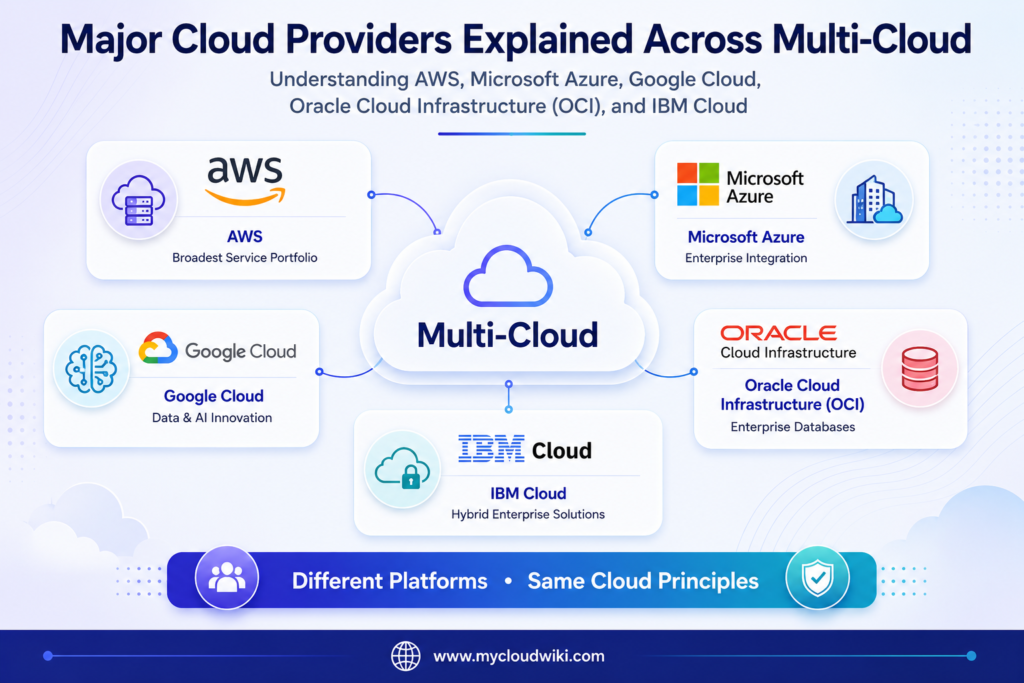
The next logical step is choosing the cloud platform that best supports those decisions. This lesson introduces the five major cloud providers used by enterprises worldwide and explains how they fit into a modern multi-cloud strategy.
You’ll discover that while each provider offers different products, pricing models, and innovation areas, they all implement the same core cloud concepts you’ve already learned.
Why Are There Multiple Cloud Providers?
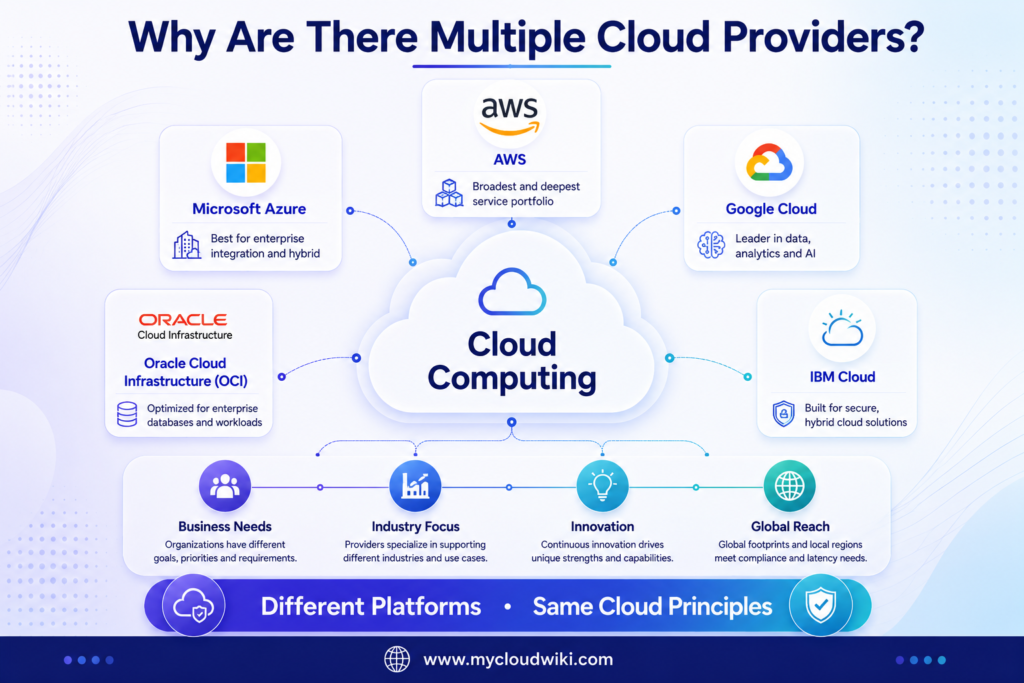
Cloud computing is based on a common set of principles. Every major provider offers services for compute, storage, networking, databases, security, and AI.
So why are there multiple cloud providers?
The answer is simple: they serve different business needs. Each provider has invested in different technologies, industries, ecosystems, and innovation areas over many years.
Instead of asking “Which cloud provider is the best?”, enterprise architects ask:
- Which provider best supports our business goals?
- Which provider fits our existing technology ecosystem?
- Do we need one cloud or multiple clouds?
Understanding these questions is far more valuable than memorizing provider-specific services.
Now that you understand why multiple cloud providers exist, let’s look at each provider at a high level and understand the role it plays in today’s enterprise cloud ecosystem.
Meet the Major Cloud Providers
As you learned in What Is Cloud Computing, cloud computing is based on common principles, regardless of the provider.
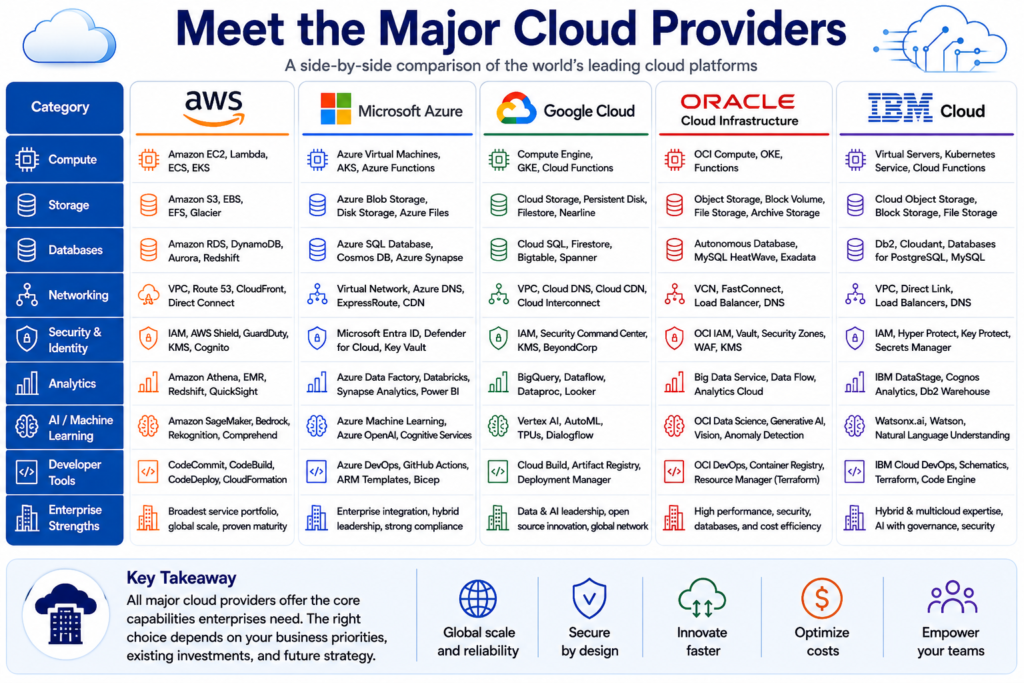
Whether you choose AWS, Microsoft Azure, Google Cloud, Oracle Cloud Infrastructure (OCI), or IBM Cloud, you’ll find the same core capabilities such as compute, storage, networking, databases, security, identity, and AI.
The goal of this lesson isn’t to memorize hundreds of cloud services. Instead, it’s to understand the enterprise strengths of each provider so you can make informed architecture decisions later.
AWS
Amazon Web Services (AWS) is one of the world’s largest cloud platforms and offers one of the broadest portfolios of cloud services.
Organizations often evaluate AWS when they need:
- Broad infrastructure capabilities
- Global availability
- Large service portfolio
- Mature cloud ecosystem
- Flexible application modernization
Enterprise Strength
Broad Service Portfolio
Microsoft Azure
Microsoft Azure is tightly integrated with Microsoft’s enterprise ecosystem, making it a natural choice for organizations already using Microsoft technologies.
Azure is commonly evaluated for:
- Hybrid cloud
- Enterprise identity
- Microsoft 365 integration
- Windows and .NET workloads
- Enterprise management
Enterprise Strength
Enterprise Integration
Google Cloud
Google Cloud is recognized for its innovation in data analytics, Kubernetes, artificial intelligence, and cloud-native technologies.
Organizations frequently consider Google Cloud when focusing on:
- Data analytics
- AI and machine learning
- Cloud-native applications
- Kubernetes
- Open-source technologies
Enterprise Strength
Data & AI Innovation
Oracle Cloud Infrastructure (OCI)
Oracle Cloud Infrastructure focuses on enterprise databases, business applications, and high-performance enterprise workloads.
OCI is commonly evaluated for:
- Oracle Database
- Oracle enterprise applications
- ERP workloads
- Business-critical systems
- High-performance infrastructure
Enterprise Strength
Enterprise Databases & Applications
IBM Cloud
IBM Cloud focuses on hybrid cloud, enterprise modernization, and regulated industries.
Organizations often evaluate IBM Cloud for:
- Hybrid cloud
- Red Hat OpenShift
- Regulated industries
- Mainframe integration
- Enterprise modernization
Enterprise Strength
Hybrid Enterprise Solutions
High-Level Provider Comparison
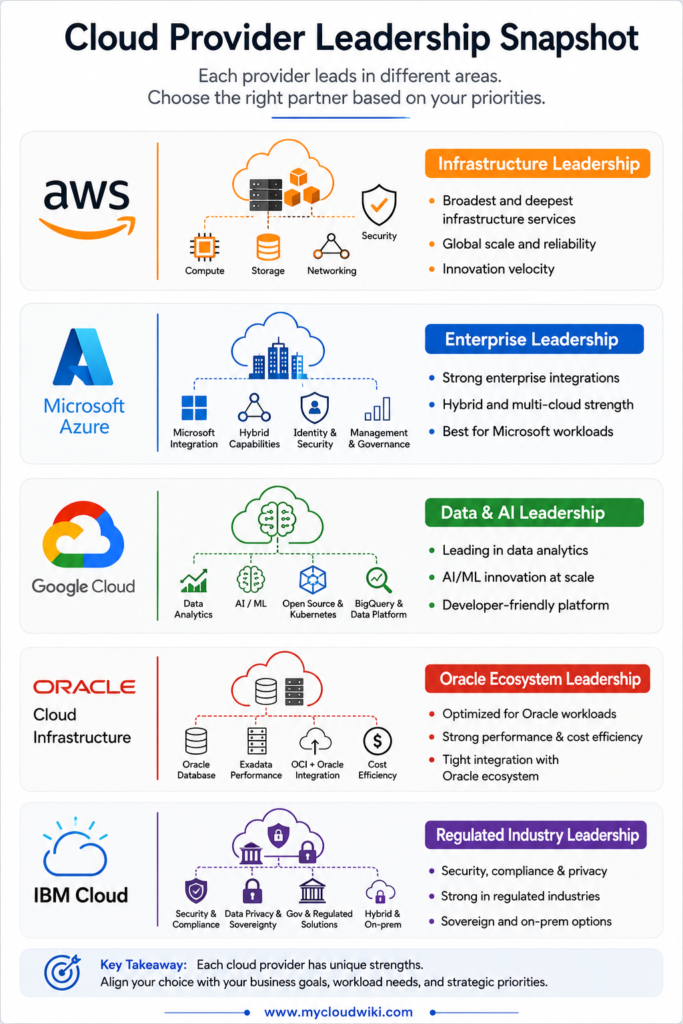
At a high level, every major provider delivers similar cloud capabilities. The biggest differences are their ecosystems, enterprise focus, and areas of innovation.
| Cloud Provider | Enterprise Strength | Common Focus |
|---|---|---|
| AWS | Broad service portfolio | Infrastructure, scalability, cloud services |
| Microsoft Azure | Enterprise integration | Microsoft ecosystem, hybrid cloud |
| Google Cloud | Data & AI innovation | Analytics, Kubernetes, AI |
| Oracle Cloud Infrastructure (OCI) | Enterprise databases | Oracle workloads, ERP, databases |
| IBM Cloud | Hybrid enterprise | Regulated industries, OpenShift |
Remember, these are general positioning statements, not rigid boundaries. Every provider continues to expand its services and invest in new technologies.
Similar Capabilities, Different Platforms
One of the most important lessons for every cloud engineer and architect is this:
Learn the cloud concept before learning the provider’s product names.
Every major provider offers services for:
- Compute
- Storage
- Networking
- Identity & Access Management (IAM)
- Databases
- Containers
- Security
- Observability
- Automation
- Artificial Intelligence
Although the names and management tools differ, the underlying concepts remain the same.
This is why understanding Cloud Service Models and Deployment Models is so important. Once you understand the concepts, moving between cloud providers becomes much easier.
In the next lesson, Cloud Building Blocks Explained, you’ll see how these foundational services work together to build modern cloud applications across multiple providers.
You now have a high-level understanding of what each major cloud provider brings to the enterprise. However, selecting a provider isn’t about choosing a popular brand—it’s about making the right architectural decision for your business.
In the next section, you’ll learn the MyCloudWiki Enterprise Cloud Provider Selection Framework, a reusable decision framework that helps architects evaluate providers using business goals, technical requirements, compliance, skills, AI strategy, and cost rather than marketing or product popularity.
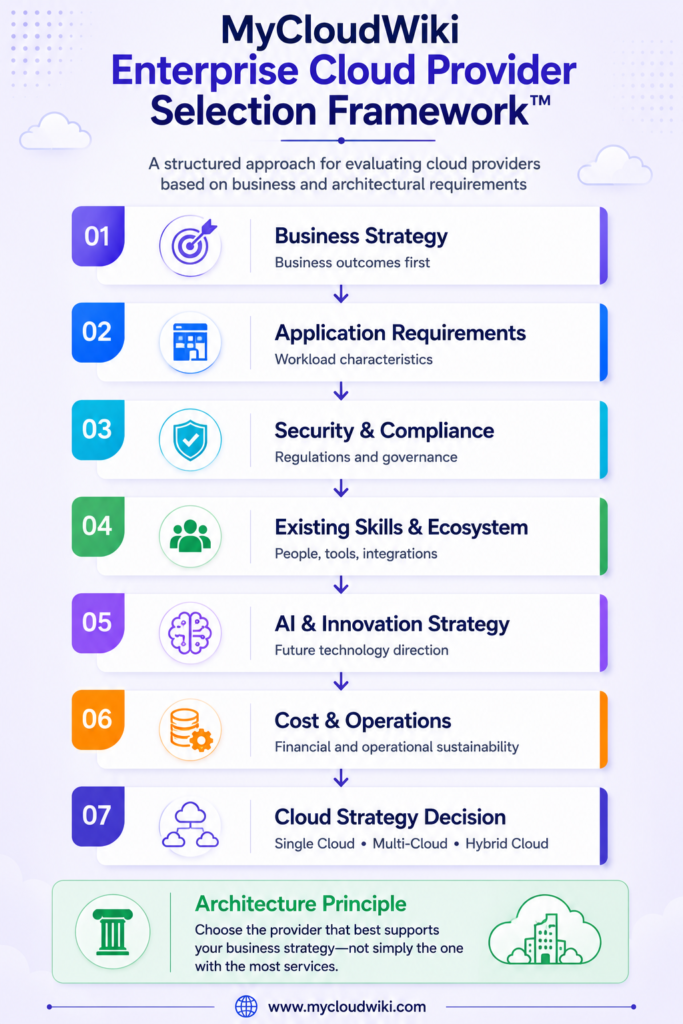
Enterprise Cloud Provider Selection Framework
Choosing a cloud provider isn’t about selecting the most popular platform or the one with the longest list of services. Successful cloud adoption starts with understanding your business goals, technical requirements, operational capabilities, and long-term strategy.
Enterprise architects rarely ask, “Which cloud provider is the best?”
Instead, they ask:
- Which provider best supports our business objectives?
- Which platform aligns with our existing technology investments?
- Which provider satisfies our security and compliance requirements?
- Which cloud supports our future AI and innovation roadmap?
- Where will our teams be most successful?
These questions shift the conversation from comparing products to making informed business decisions.
Why a Structured Decision Process Matters
Large organizations rarely choose a cloud provider based on a single requirement.
Instead, they evaluate multiple factors together because every decision affects future architecture, operations, governance, cost, and innovation.
Without a structured evaluation framework, organizations often experience:
- Inconsistent technology decisions
- Vendor-driven rather than business-driven architectures
- Skills gaps
- Increased operational complexity
- Unexpected long-term costs
A structured framework helps architects make repeatable, well-governed decisions that support both current and future business needs.
Applying the Framework to MyRetail
MyRetail has decided to modernize its IT environment, but it hasn’t selected a cloud provider yet.
Rather than starting with vendor comparisons, the architecture team begins by understanding the business.
Business Goals
The organization wants to:
- Expand into new markets
- Improve application scalability
- Increase operational agility
- Strengthen security
- Prepare for future AI capabilities
These objectives become the foundation for every technology decision.
Next, the architects evaluate the company’s existing applications, infrastructure, data, compliance requirements, operational skills, and budget before recommending a cloud strategy.
By following a structured evaluation process, MyRetail avoids making decisions based solely on marketing, pricing, or product popularity.
Enterprise Architecture Insight
A common misconception is that organizations select a cloud provider first and design the architecture later.
In practice, successful enterprises do the opposite.
They begin by understanding business priorities, then design the target architecture, and finally determine which cloud platform—or combination of platforms—best supports that architecture.
This approach reduces technical debt, improves governance, and creates a cloud strategy that can evolve as business needs change.
Business Insight
The best cloud provider is the one that best supports your organization’s business goals, technical requirements, operational capabilities, and long-term strategy.
When Might an Organization Choose Each Cloud Provider?
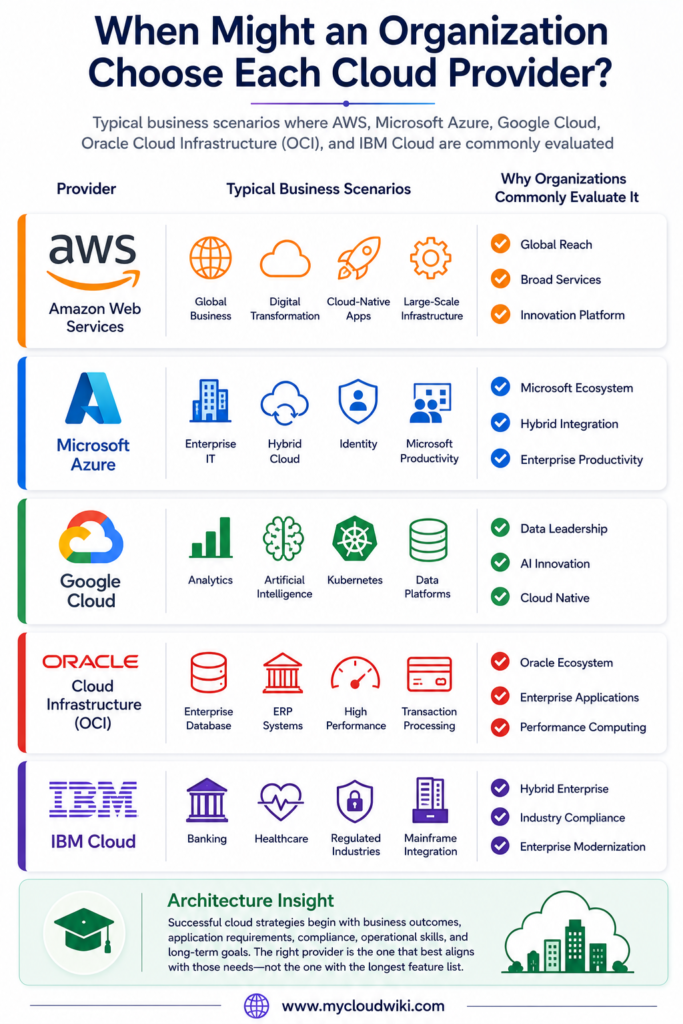
By now, you’ve seen that every major cloud provider offers compute, storage, networking, security, databases, AI, and many other cloud services.
The question is no longer “Which provider has the most services?”
Instead, enterprise architects ask:
“Which provider is the best fit for this business scenario?”
The answer depends on the organization’s existing technology landscape, business priorities, compliance requirements, skills, and long-term strategy.
In many cases, there isn’t a single correct answer. Different providers excel in different situations, and many enterprises deliberately use multiple cloud providers to take advantage of their unique strengths.
AWS
Organizations commonly evaluate AWS when they need:
- A broad portfolio of cloud services
- Global infrastructure across many regions
- Mature cloud-native capabilities
- Large partner ecosystem
- Flexibility for diverse workloads
Typical enterprise scenarios
- Digital transformation initiatives
- Modern application development
- Global customer-facing platforms
- Large-scale cloud migrations
- Startup and enterprise innovation
Microsoft Azure
Organizations frequently consider Microsoft Azure when they already have significant investments in Microsoft technologies.
Common scenarios include:
- Windows Server modernization
- Microsoft 365 integration
- Microsoft Entra ID identity services
- Hybrid cloud environments
- Enterprise collaboration platforms
Typical enterprise scenarios
- Large enterprise IT modernization
- Hybrid cloud strategies
- Microsoft-centric organizations
- Internal business applications
- Enterprise productivity platforms
Google Cloud
Google Cloud is often evaluated when organizations prioritize data, analytics, artificial intelligence, and cloud-native technologies.
Typical scenarios include:
- Data platforms
- AI initiatives
- Machine learning
- Kubernetes platforms
- Digital products
Typical enterprise scenarios
- AI-first organizations
- Analytics platforms
- Modern cloud-native applications
- Data engineering
- Customer insights
Oracle Cloud Infrastructure (OCI)
OCI is commonly considered by organizations operating large Oracle environments or business-critical enterprise applications.
Typical scenarios include:
- Oracle Database modernization
- ERP modernization
- Financial systems
- Enterprise transaction processing
- High-performance infrastructure
IBM Cloud
IBM Cloud is frequently evaluated by organizations operating regulated workloads or large hybrid enterprise environments.
Typical scenarios include:
- Banking
- Healthcare
- Government
- Mainframe modernization
- Hybrid cloud integration
Important Architecture Principle
Although these are common scenarios, they should never be treated as strict rules.
Today’s cloud providers continue to expand their capabilities.
For example:
- AWS offers AI platforms.
- Microsoft Azure offers analytics platforms.
- Google Cloud provides enterprise infrastructure.
- OCI supports general-purpose workloads.
- IBM Cloud provides AI capabilities.
The goal is to understand each provider’s traditional enterprise strengths, not to assume that only one provider can support a particular workload.
Architect’s Tip
Evaluate every cloud provider with the same decision criteria. A consistent scorecard makes trade-offs visible and prevents vendor preference from replacing architecture judgment.
How Do Organizations Evaluate a Cloud Provider?
Choosing a cloud provider is rarely a one-time technical decision. Enterprise architects evaluate cloud platforms from both a business and technology perspective to ensure the selected provider supports the organization’s long-term strategy.
Rather than asking “Which cloud provider is the best?”, successful organizations ask a more meaningful question:
“Which cloud provider is the best fit for our business objectives?”
Every organization has unique priorities. Existing technology investments, engineering expertise, security requirements, regulatory obligations, global presence, and future innovation goals all influence the final decision. As a result, two organizations with similar workloads may legitimately choose different cloud providers.
The evaluation process is therefore less about comparing service catalogs and more about understanding how each provider aligns with the organization’s business and architectural goals.
Architecture Decision Guide
Cloud Provider Evaluation Criteria
| Evaluation Area | Questions Enterprise Architects Consider |
|---|---|
| Business Strategy | Does the provider support the organization’s long-term business goals, expansion plans, and digital transformation initiatives? |
| Existing Technology | Will the provider integrate effectively with existing enterprise applications, databases, and business platforms? |
| Engineering Skills | Do internal teams already possess the knowledge and operational experience required to manage the platform? |
| Security & Compliance | Can the provider satisfy security standards, governance policies, and industry or regional compliance requirements? |
| Performance & Availability | Can workloads achieve the required levels of scalability, resilience, and global availability? |
| Cost Management | Can cloud resources be governed and optimized throughout the workload lifecycle without unnecessary cost? |
| Future Innovation | Does the provider support future modernization initiatives such as AI, cloud-native development, automation, and platform engineering? |
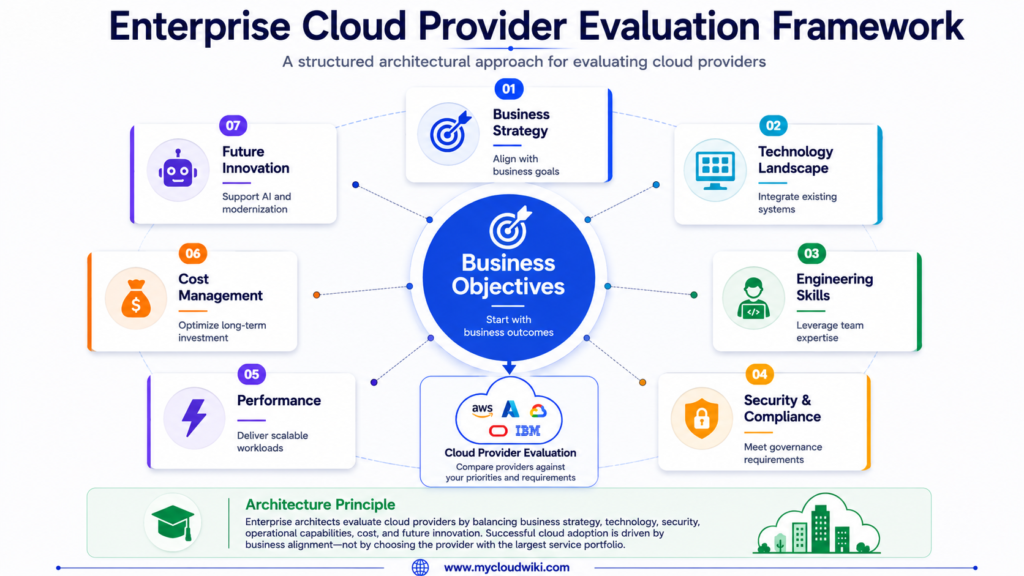
No single evaluation criterion determines the right cloud provider. Enterprise architects balance all these considerations to identify the platform that best supports both current business needs and future growth.
For example, one organization may prioritize seamless integration with existing enterprise systems, while another may focus on advanced analytics or global expansion. Both decisions can be equally valid because they are driven by different business objectives rather than by the popularity of a particular cloud provider.
Business Insight
The best cloud provider is not always the provider with the most services. It is the provider that best supports the required business outcome, risk profile, operating model, and long-term growth plan.
Multi-Cloud Perspective
After evaluating the major cloud providers, one important realization becomes clear: no single provider is the perfect choice for every business requirement. Although AWS, Microsoft Azure, Google Cloud, Oracle Cloud Infrastructure (OCI), and IBM Cloud all deliver similar core cloud capabilities, each platform has developed unique strengths that make it better suited for particular workloads, industries, and business objectives.
For this reason, modern enterprises rarely ask “Which cloud provider is the best?” Instead, they ask “Which provider—or combination of providers—best supports each business capability?” This shift in thinking moves cloud adoption from a technology decision to an enterprise architecture decision.
Successful multi-cloud organizations apply the same evaluation principles regardless of the provider. Business objectives, governance, security, compliance, operational maturity, cost optimization, and future innovation remain the foundation of every cloud decision.
Multi-Cloud Perspective
Thinking Beyond a Single Cloud Provider
Enterprise architects evaluate every cloud provider using the same business and technical criteria. The goal is not to identify a universal winner, but to determine which platform—or combination of platforms—best supports each business capability.
🏢 Business Perspective
- Support business strategy.
- Meet regulatory requirements.
- Enable global expansion.
- Accelerate innovation.
🏗️ Architecture Perspective
- Apply consistent governance.
- Standardize security controls.
- Design workload placement.
- Reduce operational complexity.
As organizations grow, they often discover that different business units, acquisitions, geographic regions, or specialized workloads require capabilities that extend beyond a single cloud provider. A well-governed multi-cloud strategy allows enterprises to leverage the strengths of multiple platforms while maintaining consistent security, governance, operational standards, and business alignment.
In the following sections, you’ll explore how engineers, architects, enterprise frameworks, and AI-assisted decision-making all contribute to selecting and governing cloud platforms in a modern multi-cloud environment.
Engineer & Architect Perspective
Choosing a cloud provider is a shared responsibility. Engineers focus on building and operating cloud solutions, while architects ensure the selected platform supports long-term business goals, governance, security, and enterprise scalability.
Although their responsibilities differ, both roles work toward the same objective—delivering a secure, reliable, and business-aligned cloud platform.
Engineer & Architect Perspective
Different Responsibilities, One Common Goal
| 👨💻 Engineer Focus | 🏗️ Architect Focus |
|---|---|
| Deploy cloud resources efficiently using the selected provider’s services and tools. | Evaluate which provider best aligns with business strategy and enterprise architecture. |
| Automate provisioning, monitoring, and operational tasks. | Define governance, security standards, and operational policies across cloud environments. |
| Optimize application performance, availability, and day-to-day operations. | Design scalable, resilient, and cost-effective cloud platforms that support future growth. |
| Develop expertise in provider-specific services, APIs, and automation tools. | Balance business priorities, regulatory requirements, technology investments, and operational complexity. |
| Implement the architecture successfully. | Ensure the architecture remains sustainable throughout the organization’s cloud journey. |
Architecture Insight
Successful cloud adoption requires both perspectives. Engineers transform architecture into working solutions, while architects ensure those solutions remain aligned with enterprise strategy, standards, and future growth.
The next step is understanding how cloud provider selection supports the principles of a Well-Architected Framework, helping organizations build secure, resilient, and cost-effective cloud environments.
Well-Architected Perspective
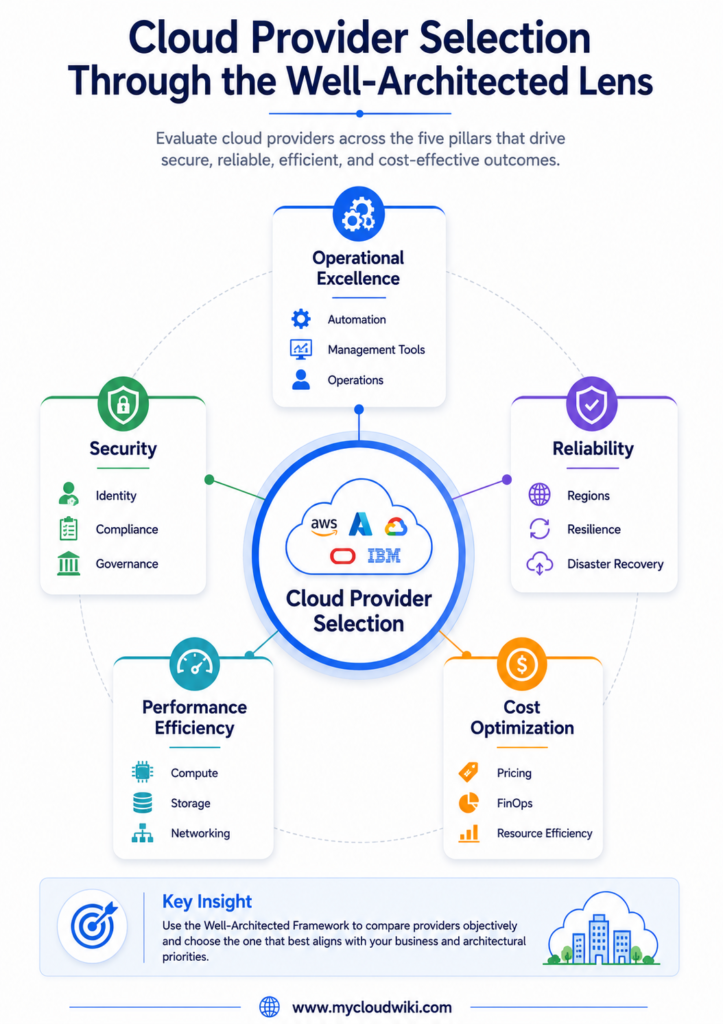
Choosing a cloud provider influences every stage of an organization’s cloud journey. Enterprise architects evaluate providers not only by their services, but also by how well they support secure, reliable, high-performing, and cost-effective cloud environments.
A well-informed provider decision establishes a stronger foundation for governance, operations, and future growth. Choosing a cloud provider influences security, reliability, operations, performance, and cost. Architects should evaluate how well each platform supports these principles across the full workload lifecycle.
Well-Architected Perspective
Evaluating Providers Through an Architecture Lens
| Architecture Pillar | Provider Evaluation Focus |
|---|---|
| Operational Excellence | Automation, management tools, observability, support models, and operational consistency. |
| Security | Identity, encryption, policy controls, compliance coverage, and security monitoring. |
| Reliability | Regional availability, resilience options, backup, disaster recovery, and service maturity. |
| Performance Efficiency | Compute, storage, networking, database, analytics, and scaling capabilities. |
| Cost Optimization | Pricing transparency, budgeting, resource optimization, commitments, and FinOps support. |
AI & Agentic AI Perspective
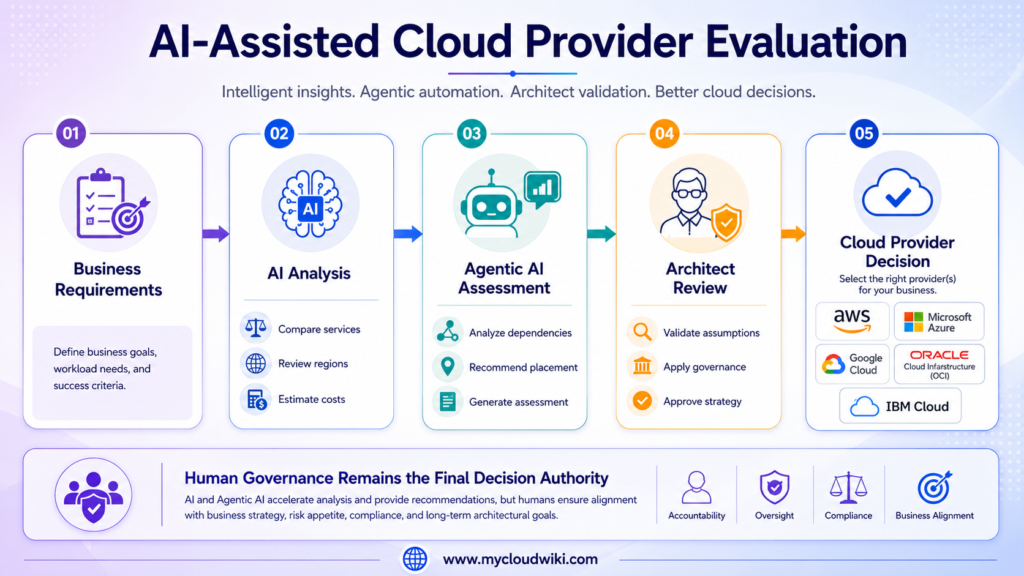
Artificial Intelligence is changing how organizations evaluate cloud platforms. AI can compare provider capabilities, summarize documentation, estimate migration effort, and recommend architectures, allowing teams to make decisions more efficiently.
Agentic AI extends these capabilities by performing multi-step analysis, such as assessing workloads, identifying dependencies, and generating migration recommendations. Enterprise architects remain responsible for validating every recommendation before implementation.
AI & Agentic AI Perspective
AI-Assisted Cloud Provider Evaluation
1. Analyze
- Business requirements
- Application inventory
- Workload dependencies
2. Compare
- Provider capabilities
- Regional availability
- Estimated costs
3. Recommend
- Workload placement
- Migration options
- Architecture patterns
4. Approve
- Architect validation
- Security review
- Governance approval
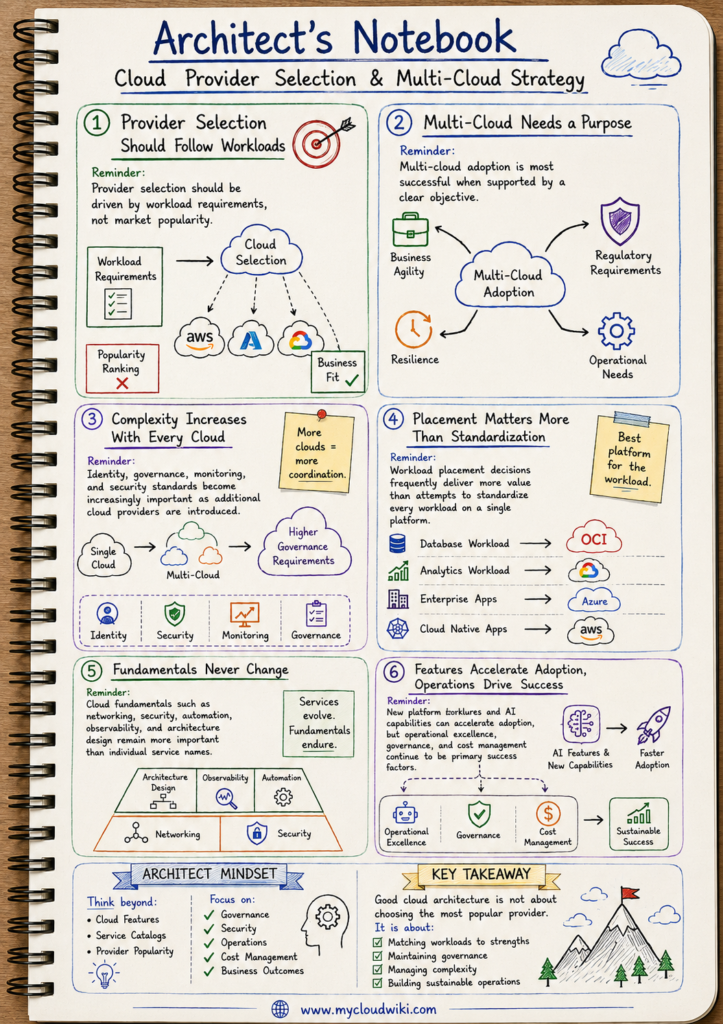
Architect’s Notebook
Cloud provider selection should be documented as an architecture decision, not treated as a one-time technology choice. The notes below capture the most important lessons, risks, and multi-cloud observations.
MyRetail Planned Cloud Solution
MyRetail will not select a provider based only on market popularity or service count. The architecture team will evaluate each platform against business priorities, workload needs, governance requirements, regional availability, skills, and cost.
The goal is to create a controlled cloud strategy that supports future growth without committing every workload to the same provider.
MyRetail Planned Cloud Solution
Building an Evidence-Based Provider Strategy
Business Need
- Support retail growth
- Improve resilience
- Enable regional expansion
- Control cloud spending
Evaluation Approach
- Compare providers consistently
- Assess workload fit
- Review security controls
- Validate operating readiness
Planned Direction
- Select by business capability
- Use shared governance standards
- Avoid unnecessary lock-in
- Expand in controlled phases
Expected Outcome
- Better provider fit
- Stronger governance
- Lower migration risk
- Flexible future architecture
MyRetail now has a clear decision framework instead of a provider-first strategy. The next step is to confirm the reader’s understanding through a short knowledge check.
Knowledge Check
Test your understanding before moving to the next lesson. These questions reinforce the key concepts covered in this article.
Knowledge Check
Check Your Understanding
- Why shouldn’t organizations select a cloud provider based only on market popularity?
- Name three factors architects should evaluate before choosing a cloud provider.
- What are the benefits of a multi-cloud strategy?
- How does the Well-Architected Framework help when evaluating cloud providers?
- How can AI and Agentic AI assist cloud provider selection while maintaining governance?
Key Takeaways
Every cloud provider offers unique strengths. Successful organizations select providers based on business requirements, architecture principles, governance, and long-term operational goals—not popularity alone.
Key Takeaways

, and IBM Cloud. Learn provider strengths, enterprise adoption patterns, AI capabilities, workload placement strategies, and multi-cloud architecture considerations.)