
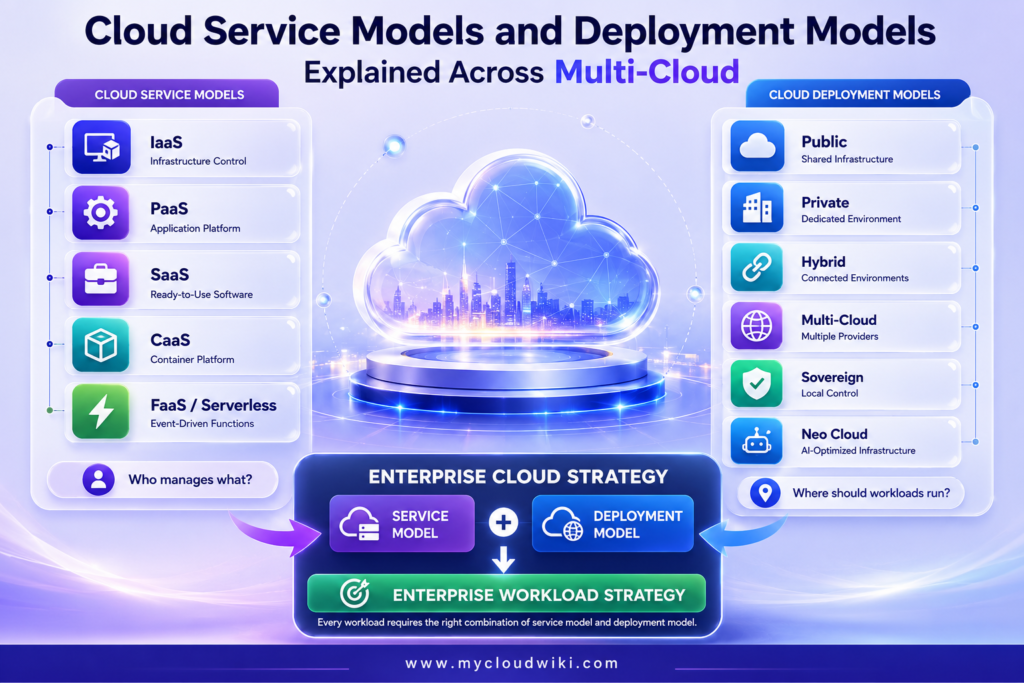
From Cloud Computing to Cloud Consumption
In the previous lesson, Traditional Data Centers vs Cloud Computing: What Really Changed?, we learned why organizations are moving away from managing physical infrastructure toward consuming technology as cloud services.
That comparison answered an important question:
Why are organizations adopting cloud computing?
The next question is equally important:
How should organizations consume cloud services, and where should their workloads run?
If you’re new to the series, it’s worth reviewing What Is Cloud Computing? to understand the fundamental characteristics of cloud computing before exploring service and deployment models. Likewise, Traditional Data Centers vs Cloud Computing explains the business and architectural motivations behind enterprise cloud adoption, providing the foundation for the decisions discussed in this lesson.
These decisions influence everything from application architecture and security to operational efficiency, governance, cost optimization, and regulatory compliance.
For cloud engineers, this determines the technologies they will provision, configure, and operate.
For architects, it defines how responsibilities are shared between the organization and cloud providers, and how workloads are deployed across public, private, hybrid, and multi-cloud environments.
Throughout this lesson, we’ll continue following MyRetail as the company begins planning its cloud adoption strategy. Rather than choosing technologies immediately, MyRetail first needs to understand the available service and deployment models so it can make informed architectural decisions in the lessons ahead.
Previous Lesson: Traditional Data Centers vs Cloud Computing: What Really Changed?
Next Milestone: Understand how cloud services are consumed and where enterprise workloads should run before selecting cloud platforms or designing architectures.
Understanding Cloud Service Models
Cloud computing is much more than virtual machines running in someone else’s data center.
As cloud platforms evolved, providers began offering increasingly managed services so organizations could spend less time managing infrastructure and more time delivering business value.
This evolution introduced different cloud service models, each defining how operational responsibilities are shared between customers and cloud providers.
Rather than representing different cloud technologies, service models represent different levels of management and abstraction.
As organizations move from Infrastructure as a Service (IaaS) toward Software as a Service (SaaS) and Function as a Service (FaaS), more operational responsibility shifts to the cloud provider, allowing engineering teams to focus increasingly on applications, innovation, and business outcomes.
Understanding these models helps organizations select the right balance between flexibility, operational effort, and managed services for each workload.
In a later lesson, we’ll examine how these service models are implemented across the major cloud providers, including AWS, Microsoft Azure, Google Cloud, Oracle Cloud Infrastructure (OCI), and IBM Cloud, and how organizations combine them when designing enterprise multi-cloud platforms.
Why Service Models and Deployment Models Matter
Cloud computing is much more than moving applications to someone else’s infrastructure.
Every cloud adoption initiative requires organizations to answer two fundamental architectural questions:
- Which cloud service model best fits the workload?
- Which deployment model best meets the business and technical requirements?
These two decisions shape how applications are built, operated, secured, and governed throughout their lifecycle.
A service model determines how responsibilities are shared between the customer and the cloud provider.
A deployment model determines where workloads are hosted and how different cloud environments work together to support business objectives.
Understanding these concepts early enables engineers and architects to make consistent technology decisions as enterprise environments evolve from single-cloud solutions toward governed multi-cloud architectures.
The Five Common Cloud Service Models
Although each cloud service model serves a different purpose, they all aim to simplify how organizations consume technology.
Instead of viewing them as competing services, think of them as different ways of consuming cloud capabilities, depending on the amount of control, flexibility, and operational responsibility your organization requires.
Infrastructure as a Service (IaaS)
Provides virtual infrastructure such as compute, storage, and networking while allowing customers to manage operating systems, middleware, applications, and data.
Platform as a Service (PaaS)
Provides a managed application platform where developers can build and deploy applications without managing the underlying operating systems or runtime infrastructure.
Software as a Service (SaaS)
Delivers complete software applications over the internet, enabling organizations to consume business capabilities without managing the supporting platform or infrastructure.
Containers as a Service (CaaS)
Provides managed container platforms that simplify deploying, scaling, and operating containerized applications while abstracting much of the underlying infrastructure.
Function as a Service (FaaS) / Serverless
Executes individual functions in response to events while automatically managing infrastructure, scaling, and runtime environments, allowing developers to focus only on application logic.
Although these service models provide different levels of abstraction, they all share the same objective:
Allow organizations to consume only the level of technology they need while delegating the remaining operational responsibilities to the cloud provider.
Cloud Service Models at a Glance
Each service model offers a different balance between customer control and provider-managed services. Organizations often use multiple service models together depending on workload requirements.
| Service Model | Customer Manages | Provider Manages | Best Fit |
|---|---|---|---|
| IaaS | Operating systems, middleware, applications, data | Infrastructure, virtualization, networking, storage | Maximum flexibility and infrastructure control |
| PaaS | Applications and data | Platform, runtime, operating system, infrastructure | Application development |
| SaaS | Configuration and business data | Complete application and platform | Business productivity |
| CaaS | Containers and applications | Container platform and infrastructure | Cloud-native applications |
| FaaS / Serverless | Function code | Runtime, scaling, infrastructure | Event-driven workloads |
The table illustrates a simple but important trend: as managed services increase, operational responsibility gradually shifts from the customer to the cloud provider.
Most enterprise organizations do not choose a single service model. Instead, they combine multiple service models to meet different business, operational, and technical requirements across their application portfolio.
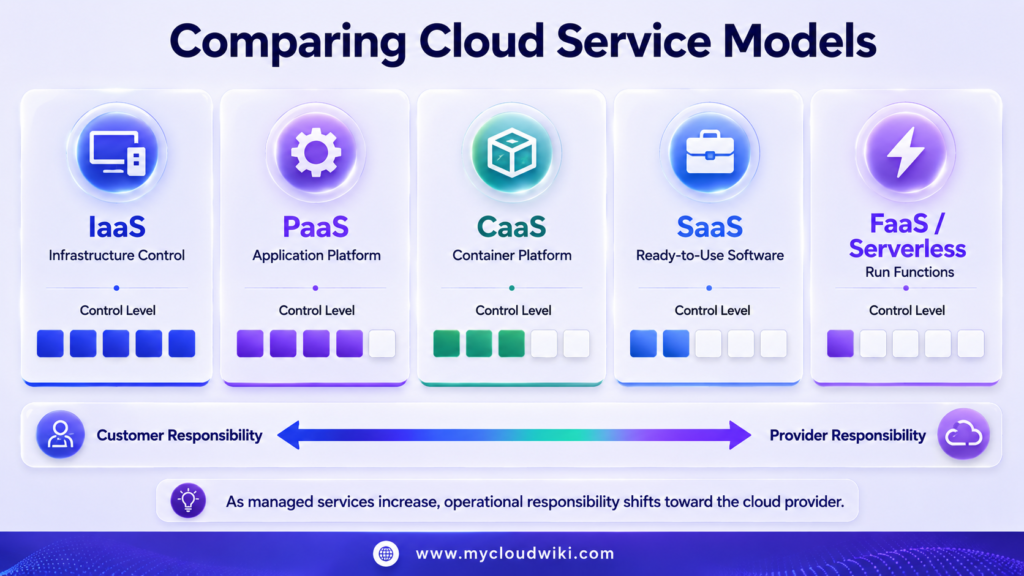
The service model answers “Who manages what?”
In the next section, we’ll explore deployment models, which answer a different but equally important architectural question:
“Where should enterprise workloads run?”
This second decision completes the foundation for designing modern cloud and multi-cloud architectures.
Understanding Cloud Deployment Models
While service models determine who manages the technology, deployment models determine where enterprise workloads run.
Selecting the right deployment model is one of the most important architectural decisions an organization makes because it influences security, compliance, governance, connectivity, resilience, operational complexity, and cost.
Unlike service models, which focus on operational responsibilities, deployment models focus on the location and operating environment of applications and data.
Modern enterprises rarely rely on a single deployment approach. Instead, they combine multiple deployment models to meet different business, regulatory, and technical requirements across their application portfolio.
The Core Cloud Deployment Models
Most enterprise cloud strategies are built using four foundational deployment models.
Each model offers a different balance between control, flexibility, operational responsibility, and business agility.
Public Cloud
Applications and services run on infrastructure owned and operated by a cloud provider, allowing organizations to quickly provision resources without managing physical infrastructure.
Private Cloud
Infrastructure is dedicated to a single organization, providing greater control over security, compliance, and governance while requiring more operational management.
Hybrid Cloud
Combines private and public cloud environments, allowing workloads and data to move between them based on business, security, or operational requirements.
Multi-Cloud
Uses services from multiple cloud providers to improve flexibility, reduce vendor dependency, optimize workload placement, and meet business or regulatory objectives.
Although these four deployment models form the foundation of enterprise cloud strategy, evolving business and regulatory requirements have introduced additional deployment considerations.
Modern Enterprise Deployment Considerations
As cloud adoption has matured, organizations increasingly evaluate specialized deployment approaches to address new business challenges.
Sovereign Cloud
Sovereign cloud environments help organizations meet strict data residency, digital sovereignty, and regulatory compliance requirements by ensuring sensitive workloads remain under defined national or regional control.
They are commonly adopted by government agencies, healthcare providers, financial institutions, and organizations operating under strict regulatory frameworks.
Neo Clouds
Neo Clouds are a new generation of AI-focused cloud providers designed specifically for high-performance GPU infrastructure.
Rather than offering broad enterprise cloud platforms, they specialize in supporting AI training, inference, and large-scale machine learning workloads with optimized GPU resources.
As artificial intelligence adoption continues to accelerate, Neo Clouds are becoming an important consideration for organizations building AI-native applications.
Modern enterprise architects often combine traditional deployment models with these specialized approaches to satisfy evolving compliance, sovereignty, and AI infrastructure requirements.
Cloud Deployment Models at a Glance
Each deployment model provides a different balance between operational control, flexibility, compliance, and workload placement. Modern enterprises often combine multiple deployment models to meet diverse business requirements.
| Deployment Model | Primary Purpose | Best Fit | Key Consideration |
|---|---|---|---|
| Public Cloud | Shared cloud infrastructure | Scalable business applications | Less direct infrastructure control |
| Private Cloud | Dedicated infrastructure | Sensitive workloads | Higher operational responsibility |
| Hybrid Cloud | Connect multiple environments | Gradual modernization | Integration complexity |
| Multi-Cloud | Use multiple providers | Enterprise flexibility | Governance across clouds |
| Sovereign Cloud | Regional control and compliance | Government and regulated industries | Data residency requirements |
| Neo Cloud | AI-optimized infrastructure | AI and GPU-intensive workloads | Specialized cloud capabilities |
Rather than selecting a single deployment model, enterprise organizations typically adopt multiple deployment strategies, choosing the environment that best aligns with each workload’s security, compliance, performance, and business objectives.
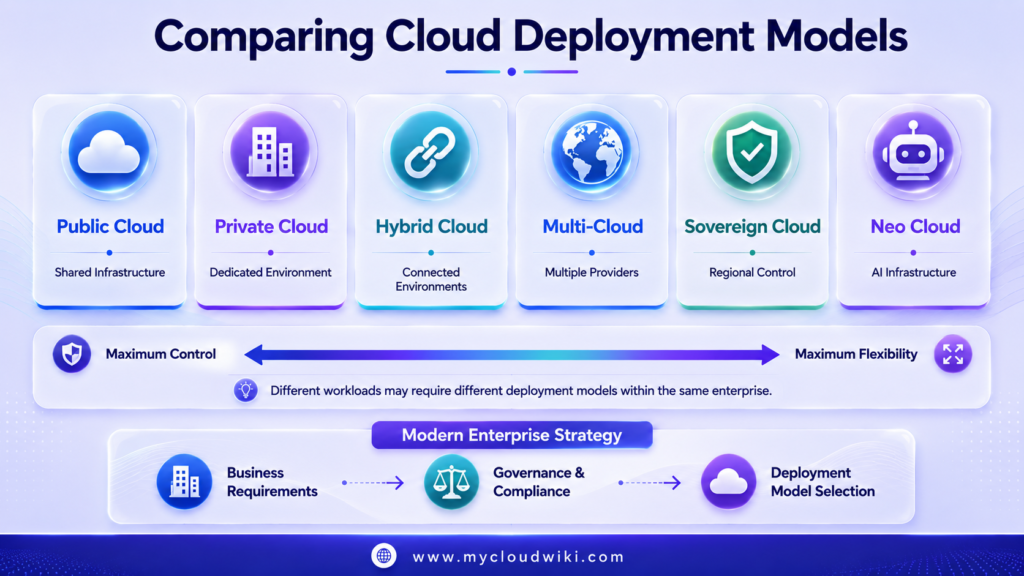
Choosing a deployment model answers where workloads should run, but enterprise architects must also understand how these concepts are implemented across different cloud providers.
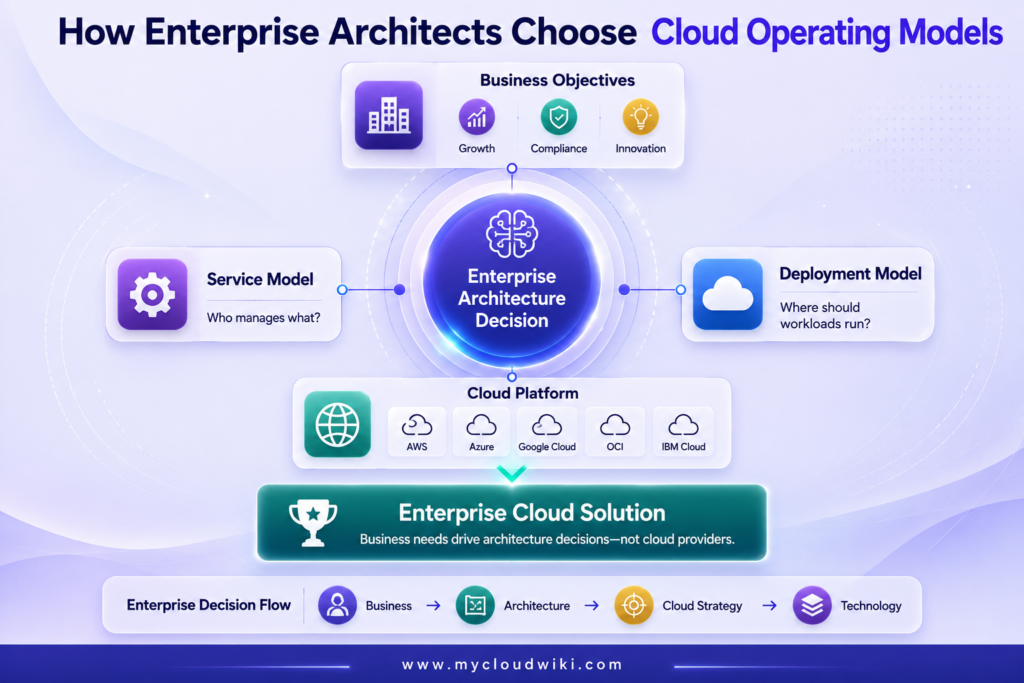
Every Cloud Architecture Starts with Two Decisions – Framework
Before selecting a cloud provider or designing an architecture, every cloud engineer and architect answers two fundamental questions. The first determines how the application will be consumed, while the second determines where it will run. Together, these decisions establish the foundation for every cloud solution, regardless of the provider.
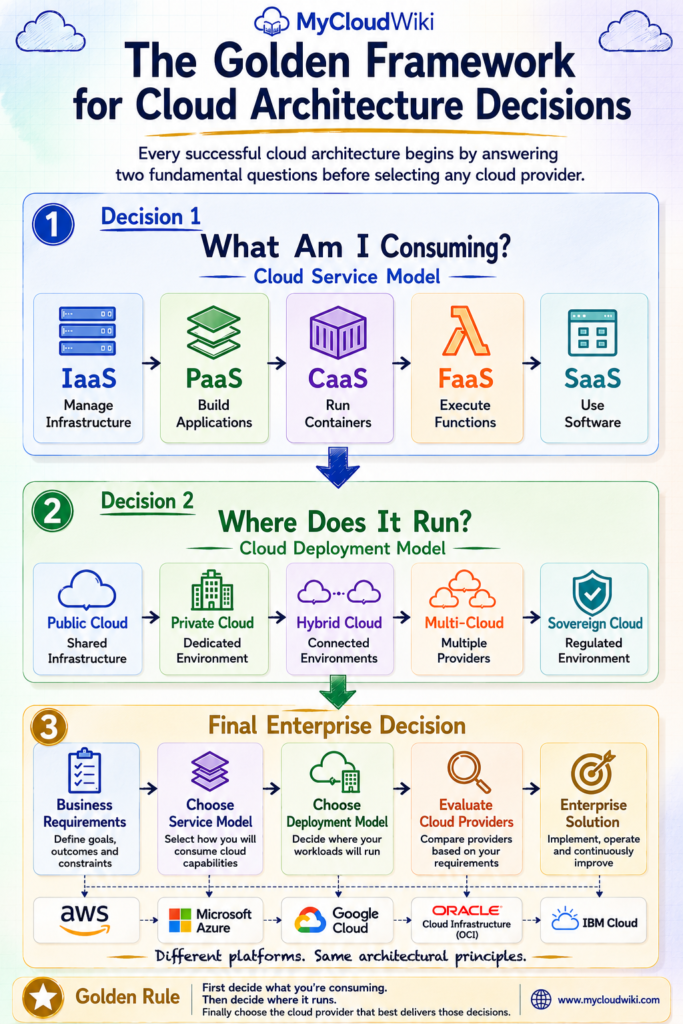
The diagram summarizes the two key architectural decisions introduced in this lesson.
Service Models answer the question “What am I consuming?” They define the level of responsibility shared between the cloud provider and the customer. Depending on the workload, an organization may choose Infrastructure as a Service (IaaS), Platform as a Service (PaaS), Container as a Service (CaaS), Function as a Service (FaaS), or Software as a Service (SaaS).
Deployment Models answer the question “Where does the workload run?” They determine the environment in which applications are deployed based on business requirements, security, compliance, performance, and operational needs. Common deployment models include Public Cloud, Private Cloud, Hybrid Cloud, Multi-Cloud, and Sovereign Cloud.
Together, these two decisions form the foundation of every cloud architecture. Once an organization understands what services it needs and where those services should run, it can confidently evaluate cloud providers and design a solution that aligns with its business and technical objectives.
Multi-Cloud Mapping: Service and Deployment Models Across Major Cloud Providers
One of the biggest misconceptions in cloud computing is that every cloud provider offers completely different capabilities.
In reality, AWS, Microsoft Azure, Google Cloud, Oracle Cloud Infrastructure (OCI), and IBM Cloud all provide comparable cloud service models and support similar deployment approaches. While the service names, implementation details, and managed offerings vary, the underlying architectural principles remain remarkably consistent.
Understanding these common patterns allows engineers and architects to focus on cloud concepts first, making it easier to work across multiple providers without learning an entirely new operating model each time.
As organizations adopt multi-cloud strategies, this concept-first approach becomes essential for designing portable, resilient, and well-governed enterprise platforms.
In the next lesson, Major Cloud Providers Explained, we’ll explore each provider in greater detail, including their strengths, service portfolios, and enterprise use cases. This lesson focuses on understanding the common concepts they all share.
Multi-Cloud Mapping Overview
Although cloud providers use different product names, they implement similar cloud service and deployment concepts. Learning the concepts first makes it easier to design and operate multi-cloud environments.
| Concept | AWS | Microsoft Azure | Google Cloud | OCI | IBM Cloud |
|---|---|---|---|---|---|
| IaaS | Compute, Storage, Networking | Virtual Machines | Compute Engine | Compute | Virtual Servers |
| PaaS | Managed Platforms | App Services | App Engine | Application Platform | Cloud Foundry |
| Containers | EKS | AKS | GKE | OKE | IKS |
| Serverless | Lambda | Functions | Cloud Functions | Functions | Code Engine |
| Deployment Models | Public, Hybrid, Multi-Cloud | Public, Hybrid, Multi-Cloud | Public, Hybrid, Multi-Cloud | Public, Hybrid, Multi-Cloud | Public, Hybrid, Multi-Cloud |
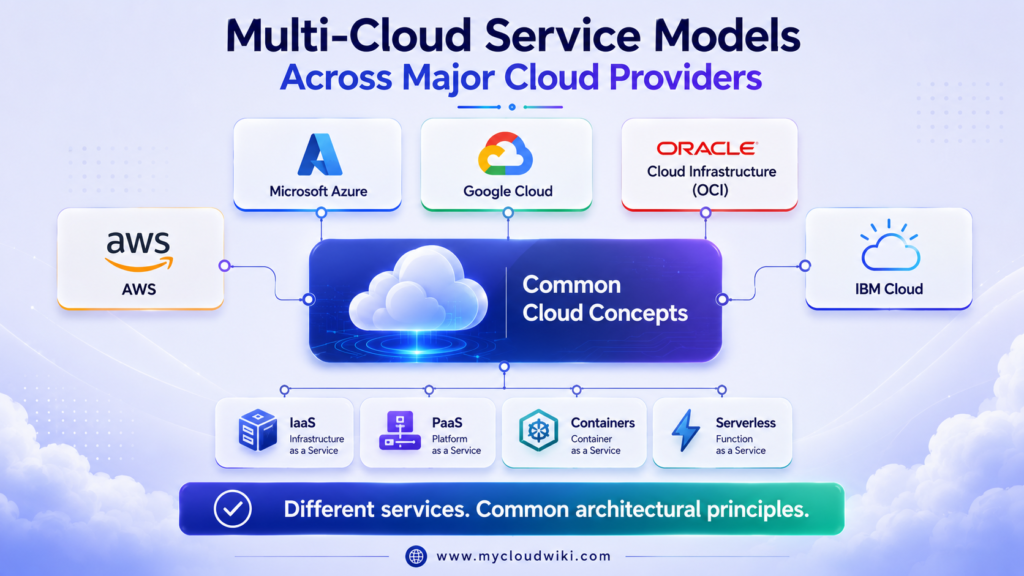
Although every cloud provider has its own terminology and managed services, the underlying concepts remain consistent. By understanding service models and deployment models first, MyRetail can evaluate cloud platforms based on business and technical requirements rather than product names alone.
This concept-first approach is one of the most important skills for engineers and architects building modern multi-cloud solutions, and it prepares us for the next lesson, where we’ll explore the major cloud providers in greater detail.
Well-Architected Perspective
Selecting the right cloud service model and deployment model is not simply a technology decision—it directly influences the quality, security, resilience, and long-term sustainability of an enterprise cloud environment.
The Well-Architected Framework provides a structured way for engineers and architects to evaluate these decisions before workloads are deployed. Rather than asking “Which cloud service should we use?”, it encourages organizations to ask “Which operating model best supports our business and technical objectives?”
For example, a customer-facing application that must scale globally may benefit from managed platform services running in a multi-cloud environment, while a highly regulated financial system may require a private or sovereign cloud deployment with greater operational control.
As you continue through the learning series, you’ll see the Well-Architected Framework applied to topics such as Cloud Identity and Access Management (IAM), Networking, Storage, Compute, Observability, and Platform Engineering, helping you make consistent architectural decisions across every layer of a multi-cloud platform.
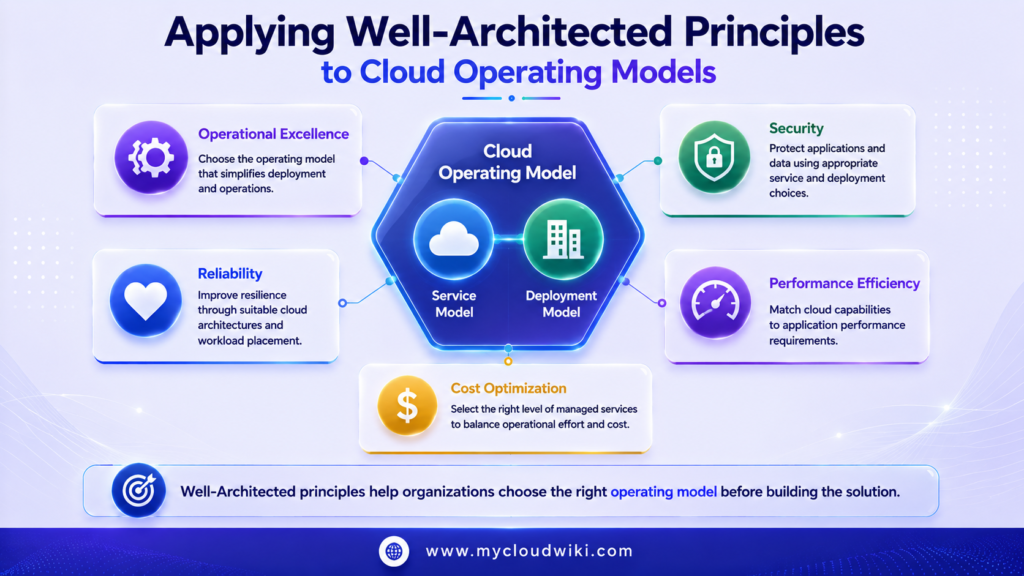
The Well-Architected Framework does not prescribe a single service model or deployment model for every workload. Instead, it helps organizations evaluate trade-offs and select the combination that best supports business objectives.
For MyRetail, this means evaluating each future application based on its business value, operational requirements, security needs, compliance obligations, and expected growth. Rather than adopting one operating model for every workload, MyRetail will gradually build a governed multi-cloud strategy, selecting the most appropriate service and deployment model for each business capability.
In the next section, we’ll explore how AI and Agentic AI are beginning to assist organizations in evaluating cloud operating models, accelerating architectural analysis while keeping engineers and architects in control of the final decisions.
AI & Agentic AI Perspective
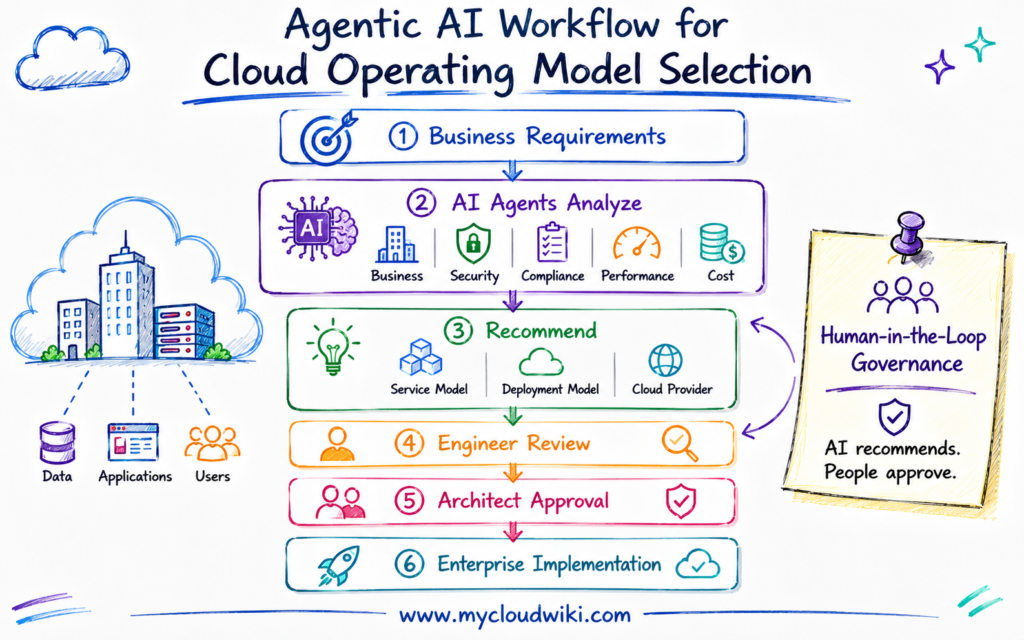
Choosing the right cloud service model and deployment model has traditionally relied on the experience of engineers and architects. Today, Artificial Intelligence (AI) and Agentic AI are transforming this decision-making process by helping organizations analyze requirements, evaluate architectural options, and recommend suitable cloud operating models.
Rather than replacing human expertise, AI accelerates architectural analysis by processing large amounts of business, technical, security, compliance, and operational information. Engineers and architects remain responsible for validating recommendations, applying organizational policies, and making the final design decisions.
How AI & Agentic AI Improve Cloud Decision-Making
| Focus Area | How AI & Agentic AI Help |
|---|---|
| Business | Analyze business goals and recommend suitable cloud operating models that balance agility, governance, compliance, and cost. |
| Technical | Evaluate workload characteristics and recommend appropriate service models, deployment models, and cloud platforms based on technical requirements. |
| Agentic AI | Coordinate multiple AI agents to analyze architecture, compare cloud providers, validate governance policies, and generate implementation recommendations for human review. |
| Human Oversight | Engineers and architects review AI recommendations, apply organizational policies, and approve the final cloud operating model. |
The greatest value of AI is not making architectural decisions automatically—it’s helping engineers and architects evaluate more options in less time while maintaining governance and human accountability.
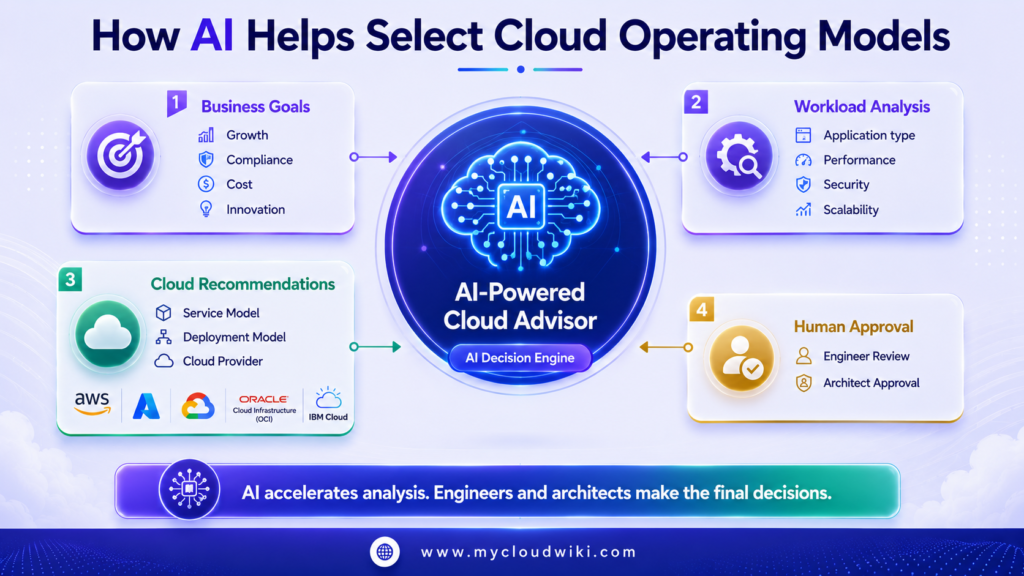
Applying This to MyRetail
As MyRetail begins planning its multi-cloud journey, AI can help evaluate application requirements, compare cloud service models, assess deployment options, and identify suitable cloud providers based on business and technical objectives. Agentic AI can further coordinate specialized analysis across security, compliance, cost optimization, and architecture domains to produce a consolidated recommendation.
However, the final decision remains with MyRetail’s engineers and architects. They must validate every recommendation against organizational policies, governance standards, regulatory obligations, and long-term business strategy before selecting the appropriate cloud operating model.
In later lessons, including Infrastructure as Code and Automation, Cloud Identity and Access Management (IAM), Cloud Observability, and Platform Engineering, we’ll see how AI and Agentic AI continue to assist throughout the cloud lifecycle—from provisioning and operations to governance and continuous optimization—while keeping humans firmly in control of critical architectural decisions.
Architect’s Notebook
Every cloud modernization initiative involves more than selecting technologies—it requires making informed architectural decisions that balance business objectives, operational complexity, governance, and long-term flexibility.
The following notebook captures the key observations a senior enterprise architect might record after completing a cloud strategy workshop with MyRetail. Rather than documenting implementation details, it highlights the decision-making principles that will guide the company’s future multi-cloud journey.
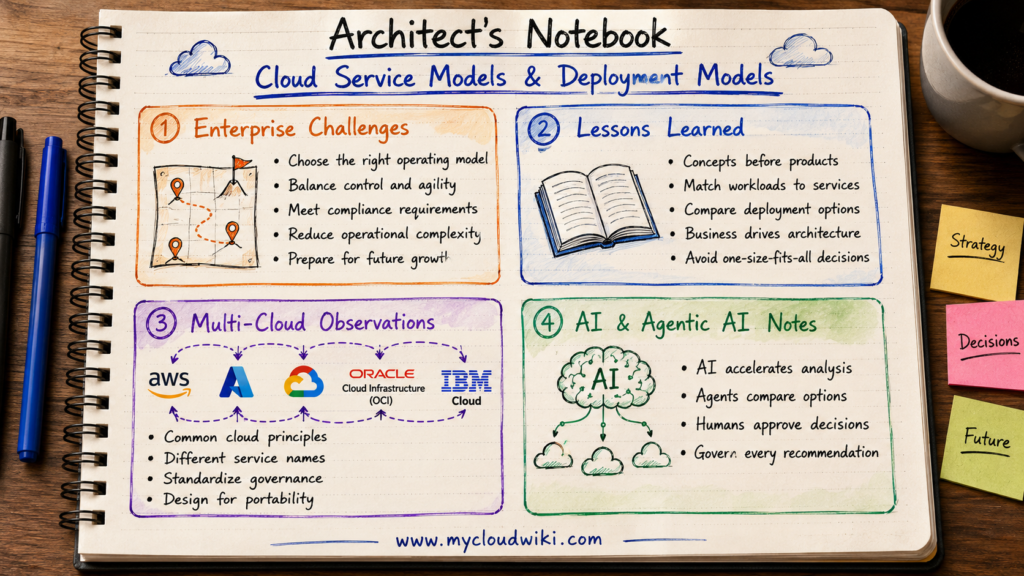
The notebook reinforces one of the most important lessons from this article: there is no single cloud operating model that fits every workload. Successful enterprise architects evaluate business goals first, then select the combination of service models and deployment models that best supports those objectives.
For MyRetail, these notes provide a practical decision framework that will guide future lessons as the company begins evaluating cloud providers, designing architectures, and planning workload migrations across a governed multi-cloud environment.
How MyRetail Will Apply These Concepts
Throughout this lesson, MyRetail has explored two of the most important decisions in its cloud modernization journey:
- Which cloud service model best fits each workload?
- Which deployment model best supports business and regulatory requirements?
Rather than adopting a single operating model for every application, MyRetail will evaluate each workload independently. Customer-facing applications, internal business systems, analytics platforms, and future AI solutions may each require different combinations of cloud service models and deployment models.
This workload-first approach will help the company balance agility, governance, operational efficiency, and long-term flexibility while preparing for a governed multi-cloud environment.
As the learning series progresses, these decisions will become more detailed. Future lessons on Major Cloud Providers Explained, Cloud Identity and Access Management (IAM), Networking, Storage, Compute, and Infrastructure as Code & Automation will demonstrate how these operating models are implemented across real enterprise architectures.
The decisions made in this lesson establish the operating model for MyRetail’s cloud journey. In the next lesson, we’ll move from cloud concepts to cloud platforms by exploring the major cloud providers and understanding how each contributes to a successful enterprise multi-cloud strategy.
Key Takeaways
As you complete this lesson, remember these five essential concepts:
- Cloud service models define who is responsible for managing different layers of the technology stack.
- Cloud deployment models determine where applications and workloads run based on business, technical, and regulatory requirements.
- Most enterprises use a combination of service models and deployment models rather than relying on a single approach.
- AWS, Microsoft Azure, Google Cloud, Oracle Cloud Infrastructure (OCI), and IBM Cloud provide similar cloud capabilities using different services and terminology.
- Successful multi-cloud architecture begins with understanding cloud concepts and business requirements before selecting providers or technologies.
These foundational principles will help you evaluate cloud platforms more effectively and make informed architecture decisions as the learning series progresses.
The most important lesson from this article is that cloud adoption is not about choosing a provider first—it is about selecting the right operating model for every workload. Once these architectural decisions are understood, evaluating cloud platforms becomes significantly easier and more consistent.
Architecture Principles
Remember These Principles
Understand cloud concepts before learning provider-specific services.
Business requirements should drive architecture decisions—not technology preferences.
Different workloads often require different service and deployment models.
Design portable architectures that can evolve as business and technology change.

