
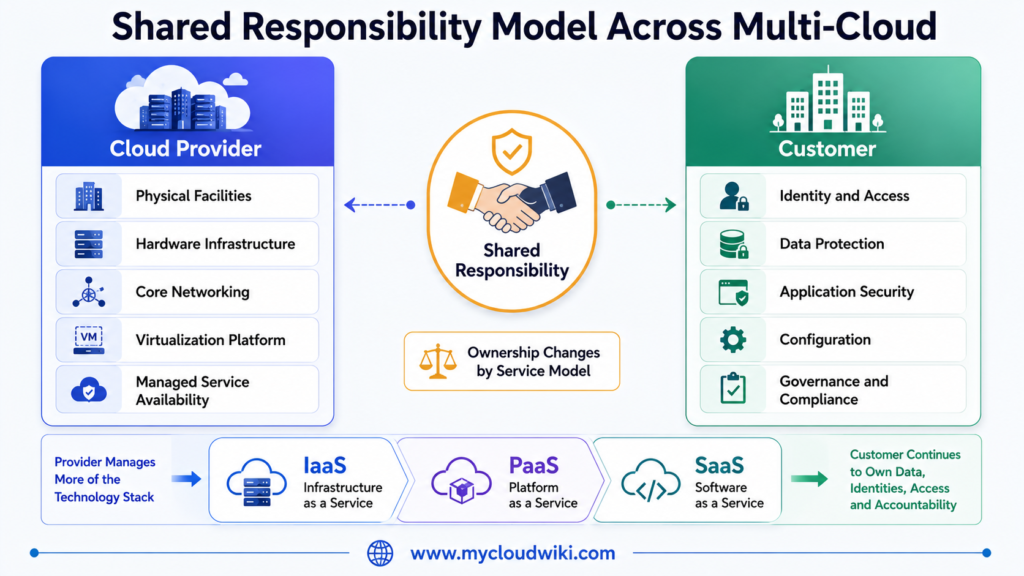
From Cloud Service Models to Shared Responsibility
In Cloud Service Models and Deployment Models, you learned that organizations can choose different cloud service models based on the level of control and management they need. Whether you select IaaS, PaaS, SaaS, or FaaS affects much more than how applications are deployed.
It also determines who is responsible for securing, operating, and managing each part of the environment. Understanding these responsibilities is essential before migrating workloads to the cloud.
Why This Lesson Matters
One of the most common cloud misconceptions is that moving to the cloud transfers all security and operational responsibilities to the cloud provider. In reality, every cloud deployment follows a Shared Responsibility Model, where both the provider and the customer have clearly defined responsibilities.
Understanding this model helps organizations build secure, compliant, and well-governed cloud environments. It also enables cloud engineers and architects to make informed decisions when designing and operating workloads across AWS, Microsoft Azure, Google Cloud, Oracle Cloud Infrastructure (OCI), and IBM Cloud.
By the end of this lesson, you’ll understand how responsibilities are divided, why they change across cloud service models, and how to apply this knowledge when designing secure multi-cloud architectures.
MyRetail has not yet selected or implemented every cloud service. At this stage, its objective is to understand how responsibility changes so that security and operational requirements can become part of the architecture decision rather than an afterthought.
This assessment will also help the organization compare similar services across providers without assuming that managed services remove customer accountability.
What Is the Shared Responsibility Model?
The Shared Responsibility Model is a foundational cloud computing principle that defines how security, operations, and management responsibilities are divided between the cloud provider and the customer.
Rather than one party managing everything, both work together to build and operate a secure, reliable, and compliant cloud environment. The exact responsibilities vary depending on the cloud service being used, but the principle of shared ownership remains consistent across AWS, Microsoft Azure, Google Cloud, Oracle Cloud Infrastructure (OCI), and IBM Cloud.
The simplest way to remember this model is:
The cloud provider secures the cloud, while the customer secures what they build and operate in the cloud.
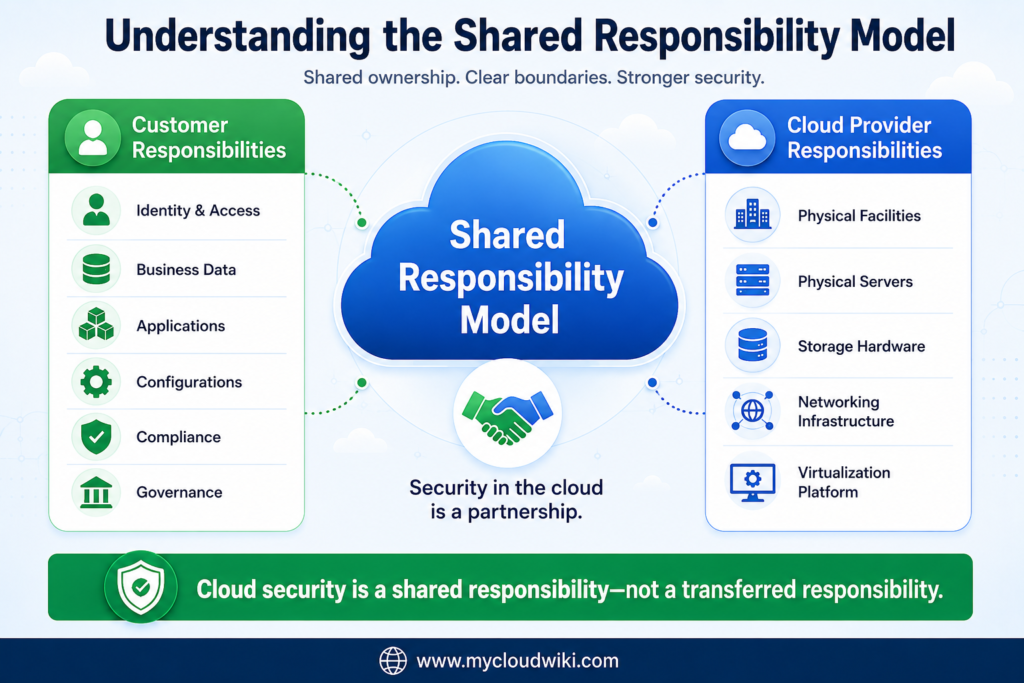
The Shared Responsibility Model is not about transferring responsibility—it is about clearly defining ownership. While cloud providers manage the underlying infrastructure that delivers cloud services, customers remain responsible for securing their identities, applications, data, and configurations.
As organizations adopt additional managed services, these responsibilities evolve. Understanding how and why they change is the next step in designing secure and well-governed cloud environments.
Why Do Responsibilities Change Across Cloud Services?
As organizations move from infrastructure-focused services to fully managed cloud services, the cloud provider takes responsibility for managing more of the underlying technology. This allows customers to spend less time maintaining infrastructure and more time building business applications.
However, increased provider management does not eliminate customer responsibilities. Organizations continue to own critical areas such as identities, business data, application security, governance, and regulatory compliance, regardless of the cloud service they use.
In other words, the more the provider manages the platform, the less infrastructure the customer manages—but responsibility is never completely transferred.
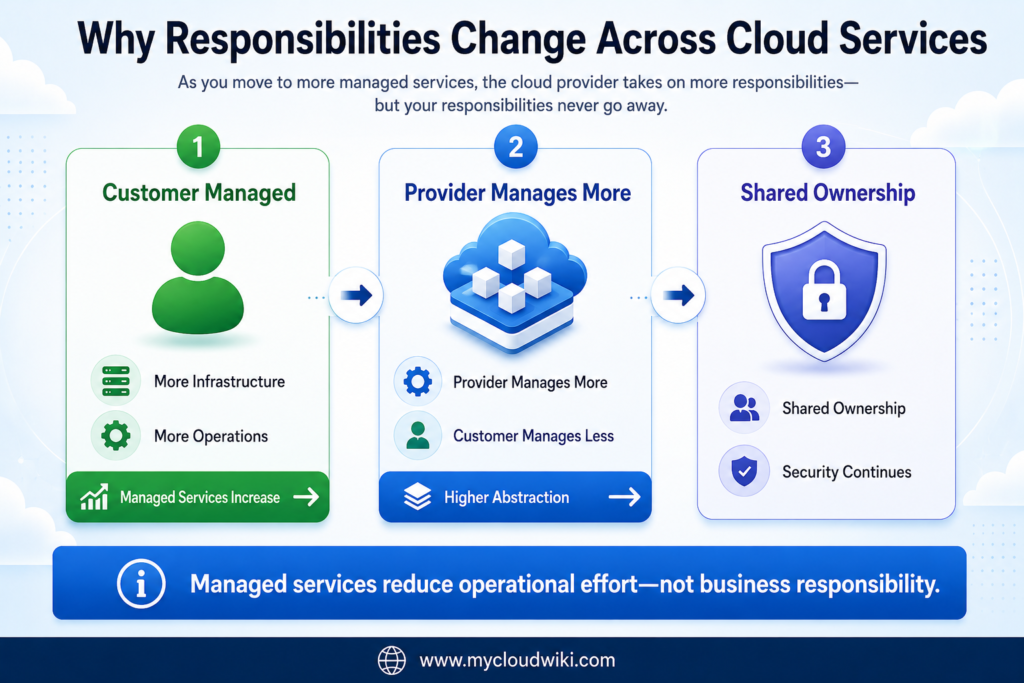
This progression explains why the Shared Responsibility Model is dynamic rather than fixed. As cloud providers deliver higher-level managed services, they assume responsibility for more infrastructure components. Customers, however, continue to own the security and governance of their workloads, making shared responsibility a constant principle rather than a one-time decision.
Managed services simplify operations, but they do not change the fundamental principle of shared ownership. The next section builds on this concept by comparing how responsibilities are divided across IaaS, PaaS, SaaS, and FaaS, making it easier to understand how responsibility shifts in real-world cloud service models.
Responsibility Comparison Across Cloud Service Models
Now that you understand why responsibilities change, let’s see how ownership shifts across the major cloud service models. As cloud services become more managed, the cloud provider assumes responsibility for additional infrastructure components, while customers continue to own their applications, identities, data, and governance.
Although the exact implementation varies slightly between providers, the overall responsibility model remains consistent across AWS, Microsoft Azure, Google Cloud, Oracle Cloud Infrastructure (OCI), and IBM Cloud.
Technology Ownership Matrix
Responsibility by Cloud Service Model
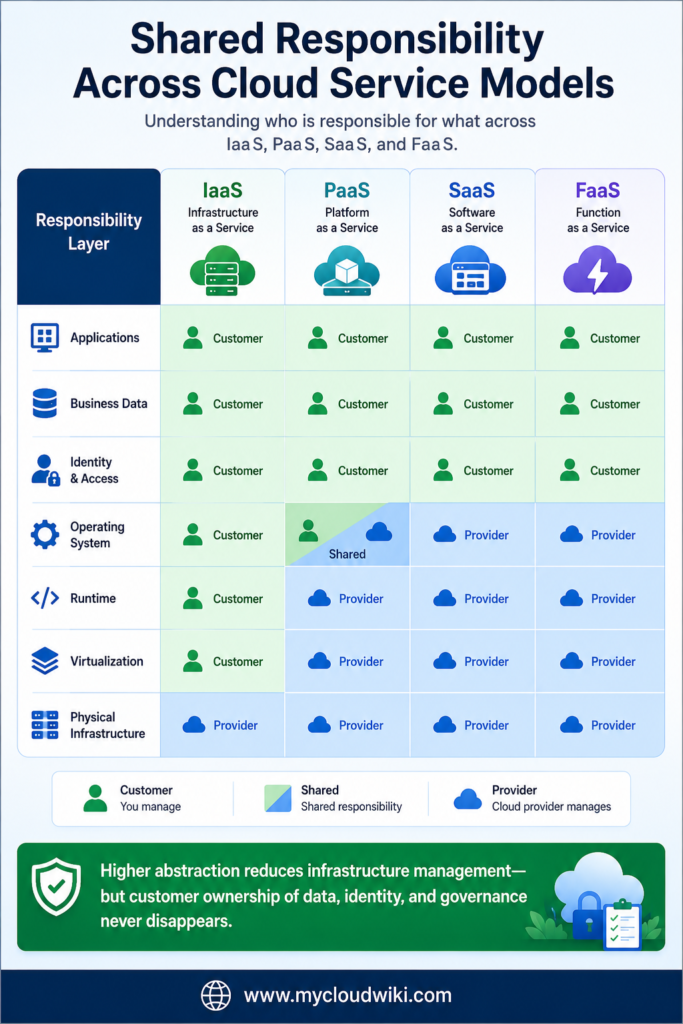
This matrix shows how responsibility for each technology layer changes across IaaS, PaaS, SaaS, and Function as a Service.
| Technology Layer | IaaS | PaaS | SaaS | FaaS |
|---|---|---|---|---|
| Applications | Customer | Customer | Provider | Customer Code |
| Business Data | Customer | Customer | Customer | Customer |
| Identity & Access | Customer | Customer | Customer | Customer |
| Operating System | Customer | Provider | Provider | Provider |
| Runtime | Customer | Provider | Provider | Provider |
| Virtualization | Provider | Provider | Provider | Provider |
| Physical Infrastructure | Provider | Provider | Provider | Provider |
The comparison highlights an important pattern. As organizations move from Infrastructure as a Service (IaaS) to Platform as a Service (PaaS), Software as a Service (SaaS), and Function as a Service (FaaS), the cloud provider manages more of the underlying technology stack. However, responsibilities related to business data, identity and access management, governance, and regulatory compliance remain with the customer regardless of the service model.
Understanding this shift helps cloud engineers choose the right service for operational efficiency while ensuring architects assign ownership correctly across teams.
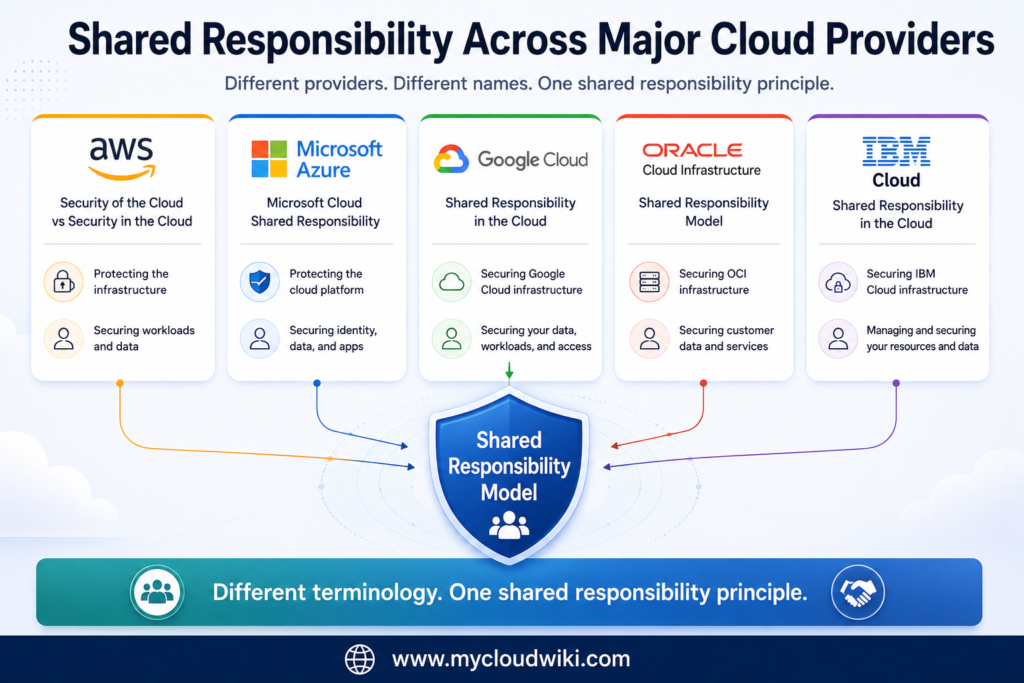
Shared Responsibility Across Major Cloud Providers
Every major cloud provider follows the Shared Responsibility Model, but each explains and documents it slightly differently. Regardless of the platform, the underlying principle remains the same: the cloud provider secures the infrastructure that delivers cloud services, while customers remain responsible for securing and managing the resources they deploy.
For cloud engineers and architects working in multi-cloud environments, understanding this common principle is more valuable than memorizing provider-specific terminology. It enables teams to apply consistent security, governance, and operational practices across AWS, Microsoft Azure, Google Cloud, Oracle Cloud Infrastructure (OCI), and IBM Cloud.
Although the terminology varies, the expectation does not. Every major cloud provider expects customers to secure their identities, business data, application configurations, and access controls, while the provider is responsible for the security of the underlying cloud infrastructure. This consistency allows organizations to establish a single governance model that can be applied across multiple cloud platforms.
Common Mistakes When Applying the Shared Responsibility Model
Understanding the Shared Responsibility Model is only the first step. Many cloud security incidents occur not because the model is unclear, but because organizations misunderstand or incorrectly apply their responsibilities.
Recognizing these common mistakes helps cloud engineers and architects avoid security gaps, improve compliance, and establish clear operational ownership before workloads are deployed.
Architecture Warning
Common Mistakes
Avoid these common misconceptions when adopting cloud services and applying the shared responsibility model.
| Common Mistake | Reality |
|---|---|
| Assuming the cloud provider secures everything | Customers remain responsible for identities, business data, applications, access controls, and resource configurations. |
| Believing managed services eliminate security responsibilities | Managed services reduce operational effort, but security, governance, compliance, and correct configuration remain shared responsibilities. |
| Ignoring identity and access management | Identity remains one of the customer’s most important responsibilities across every cloud service model. |
| Treating security as a one-time migration task | Security ownership continues throughout the complete lifecycle of cloud resources, applications, identities, and data. |
| Using different security practices for each cloud provider | Apply consistent governance and security principles across all cloud platforms while adapting implementation details to provider-specific services. |
These mistakes often arise when organizations focus only on cloud technology instead of ownership. The Shared Responsibility Model is most effective when responsibilities are documented, communicated, and integrated into engineering processes from the beginning of every cloud project.
For MyRetail, establishing clear ownership before migration helps engineering, security, and operations teams work from the same expectations, reducing risk and avoiding gaps that could affect business operations.
Applying the Shared Responsibility Model: Engineer & Architect Perspective
The Shared Responsibility Model influences day-to-day engineering activities as well as long-term architectural decisions. While cloud engineers focus on implementing and operating secure workloads, cloud architects define governance, ownership, and design standards that ensure those workloads remain secure and compliant throughout their lifecycle.
Although both roles work toward the same business objectives, they apply the Shared Responsibility Model from different perspectives.
The Shared Responsibility Model is most effective when engineers and architects work together. Engineers implement the technical controls that protect cloud workloads, while architects define the governance framework that ensures those controls are applied consistently across the organization. Both roles are essential to maintaining a secure and well-managed multi-cloud environment.
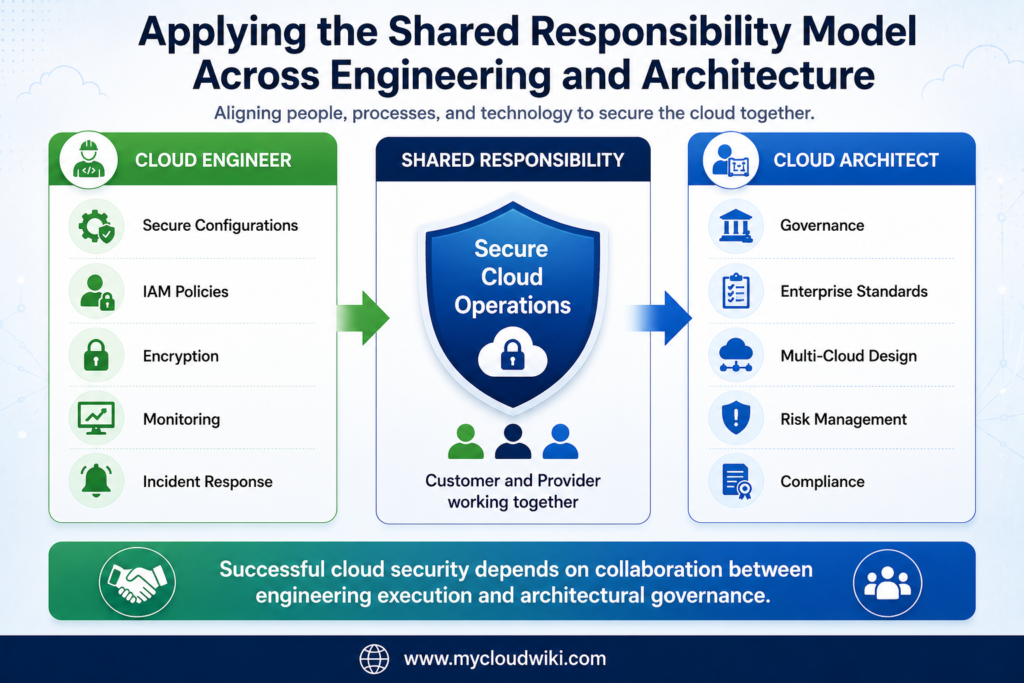
This visual reinforces that the Shared Responsibility Model is not owned by a single team. Engineers implement security controls, architects establish governance, and together they ensure that customer responsibilities are consistently fulfilled across cloud environments.
Applying the Well-Architected Principles
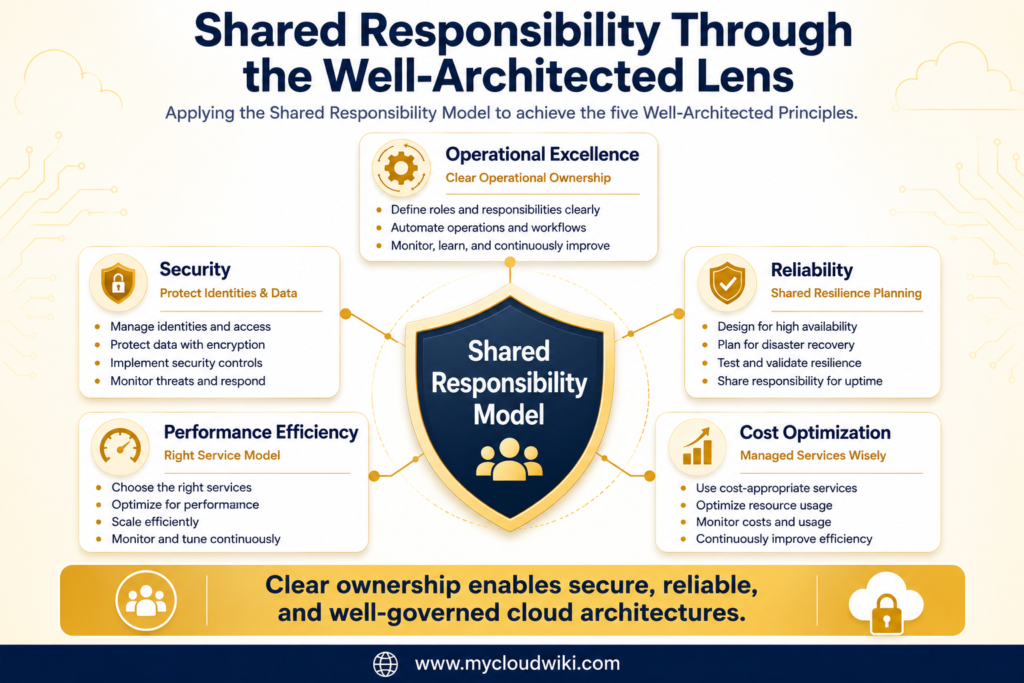
The Shared Responsibility Model directly influences how organizations design, secure, and operate cloud workloads. Clearly defining ownership helps engineering teams implement consistent operational practices while enabling architects to build secure, resilient, and cost-effective multi-cloud environments.
Regardless of the cloud provider, understanding who is responsible for each layer of the technology stack is fundamental to applying the Well-Architected Principles successfully.
The Shared Responsibility Model supports every Well-Architected Principle by defining who owns each operational, security, and governance activity. When responsibilities are clearly understood, organizations can implement consistent engineering practices, improve compliance, and design resilient multi-cloud solutions that align with business objectives.
AI & Agentic AI Perspective
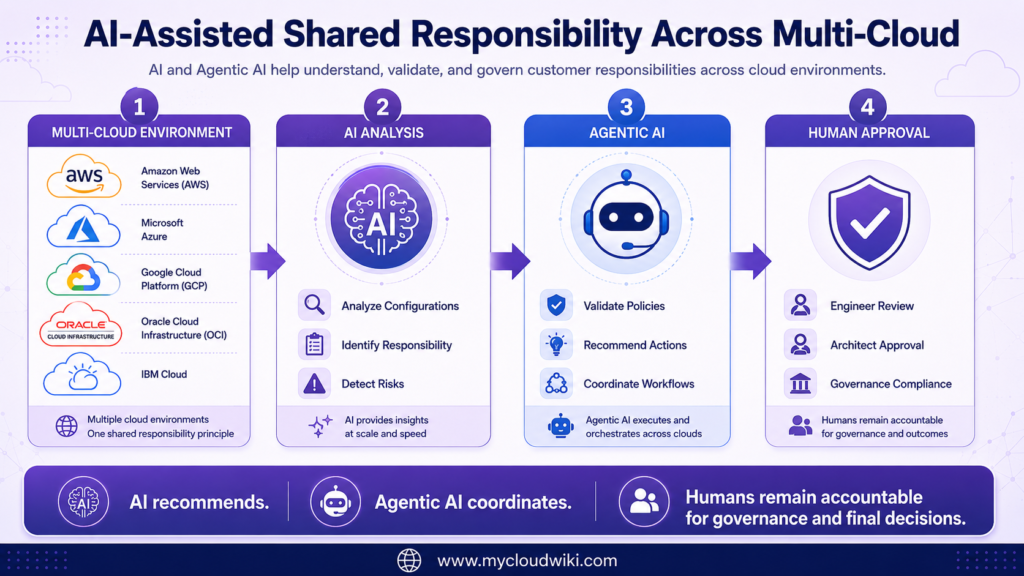
Artificial Intelligence is increasingly helping organizations understand, validate, and improve how they apply the Shared Responsibility Model. Rather than replacing human decision-making, AI analyzes cloud environments, identifies potential responsibility gaps, and recommends actions that improve security and governance.
As organizations expand across multiple cloud providers, AI can continuously evaluate cloud resources against organizational policies, while Agentic AI can automate approved operational workflows under human oversight.
How AI Helps MyRetail
As MyRetail prepares its multi-cloud migration, AI can analyze planned cloud architectures to identify ownership gaps, highlight customer responsibilities, and recommend security improvements. Agentic AI can then coordinate approved governance workflows—such as compliance checks, configuration reviews, and policy validation—before workloads are deployed. Final architectural decisions and production approvals remain with MyRetail’s engineering and architecture teams.
Governance Principle: AI can analyze and recommend, and Agentic AI can automate approved workflows, but accountability for security, compliance, and governance always remains with the organization.
Architect’s Notebook
The Shared Responsibility Model is not just a security concept—it is an operational agreement that defines who owns what throughout the lifecycle of a cloud workload. Successful multi-cloud organizations treat these responsibilities as part of their governance model, not as assumptions.
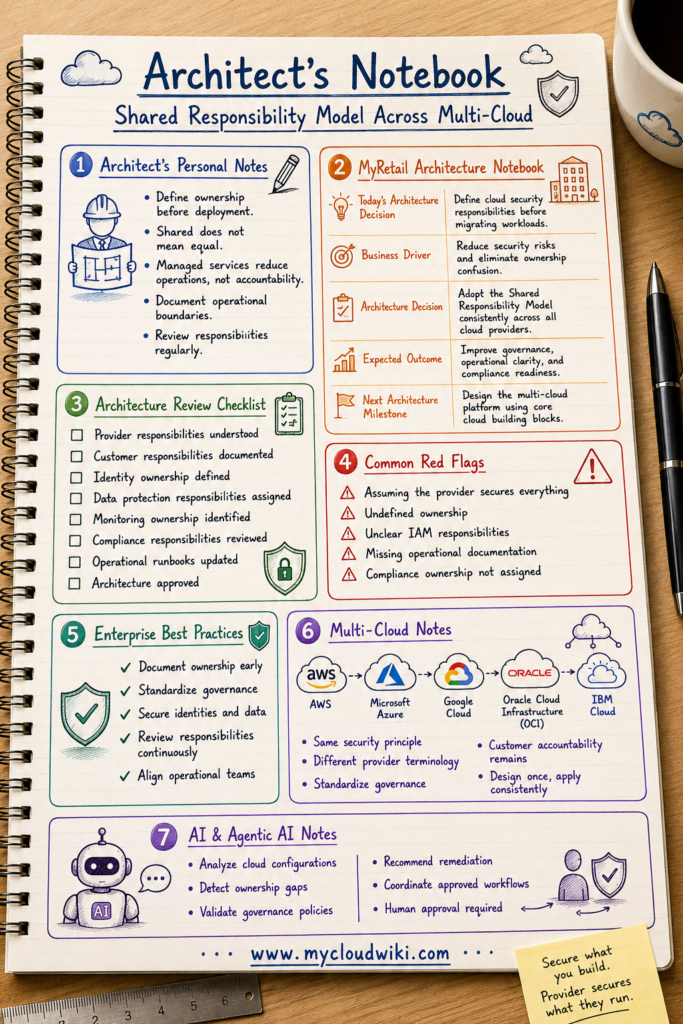
MyRetail Solution Snapshot
Throughout this lesson, MyRetail learned that migrating applications to the cloud involves more than selecting the right cloud provider or service model. Success depends on clearly defining who is responsible for securing, operating, and governing every part of the environment.
By adopting the Shared Responsibility Model, MyRetail establishes a common understanding between engineering, security, operations, and architecture teams before migrating workloads across multiple cloud providers.
MyRetail Progress
By completing this step, MyRetail has established a shared understanding of cloud ownership across the organization. This provides a strong foundation for the next stage of the transformation, where identities, users, applications, and cloud resources must be protected through effective Identity and Access Management (IAM).
Knowledge Check
Test your understanding of the Shared Responsibility Model before moving to the next lesson.
“`html “`Key Takeaways
- The Shared Responsibility Model defines which security and operational responsibilities belong to the cloud provider and which belong to the customer.
- Cloud providers secure the underlying cloud infrastructure, while customers secure their identities, applications, data, and configurations.
- Customer responsibilities change across IaaS, PaaS, SaaS, and FaaS, but ownership of business data, governance, and compliance always remains with the customer.
- All major cloud providers—including AWS, Microsoft Azure, Google Cloud, Oracle Cloud Infrastructure (OCI), and IBM Cloud—follow the same shared responsibility principle.
- Clearly understanding responsibilities helps reduce security risks, improve compliance, and strengthen operational governance.
- AI can help identify responsibility gaps and recommend improvements, but organizations remain accountable for security and governance.
Remember These Principles
The Shared Responsibility Model is one of the foundational concepts that every cloud engineer and architect should understand. Keep these principles in mind as you continue building your multi-cloud knowledge.
“`html “`
