
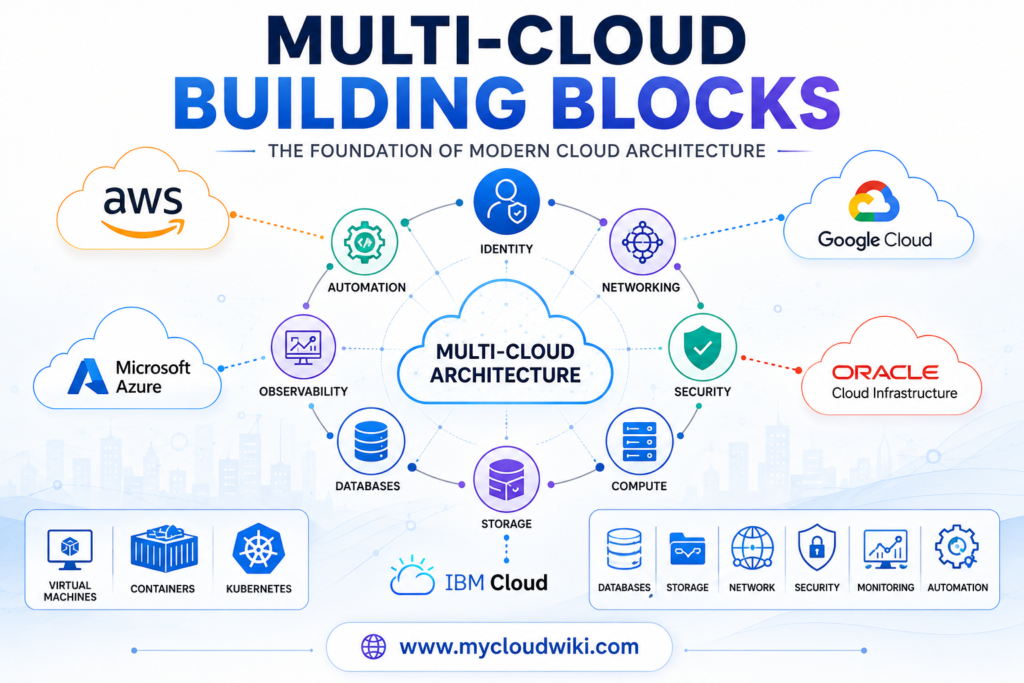
From Shared Responsibility to Cloud Building Blocks
In the previous lesson, Shared Responsibility Model Across Multi-Cloud, you learned that adopting cloud services does not eliminate operational responsibilities. Instead, cloud providers and customers share responsibility based on the cloud service model being used. Understanding who is responsible is an essential first step toward designing secure and reliable cloud environments.
The next logical question is: what exactly are we responsible for building and managing? The answer lies in understanding the core building blocks that make up every cloud platform. Regardless of whether you use AWS, Microsoft Azure, Google Cloud, Oracle Cloud Infrastructure (OCI), or IBM Cloud, every cloud environment is constructed from a common set of foundational capabilities that work together to deliver applications and business services.
Introduction
Modern cloud platforms may appear very different on the surface. Each provider offers hundreds of services, unique product names, and specialized capabilities. This can make cloud computing seem complex, especially for engineers who are beginning their multi-cloud journey.
Fortunately, the underlying architecture is much simpler than it first appears. Every cloud platform is built using a relatively small number of core building blocks. These building blocks provide the essential capabilities required to run applications, store data, connect systems, protect resources, automate operations, and monitor the health of enterprise workloads.
Rather than memorizing hundreds of cloud services, successful cloud engineers and architects first learn these fundamental building blocks. Once these concepts become familiar, learning provider-specific services becomes significantly easier because every cloud platform is solving the same engineering problems in different ways.
Throughout this lesson, you’ll develop an architectural view of cloud platforms by understanding how these building blocks fit together. In the following lessons, we’ll explore each building block individually, beginning with networking and continuing through compute, storage, databases, identity, security, observability, and automation.
Why Cloud Platforms Are Built Using Building Blocks
Enterprise applications perform many different functions simultaneously. They authenticate users, process business logic, store information, communicate across networks, enforce security policies, collect operational data, and recover from failures. Attempting to build all of these capabilities into a single monolithic platform would make cloud environments difficult to manage, scale, and evolve.
Instead, cloud providers design their platforms using modular building blocks. Each building block focuses on a specific responsibility while working together with other services to deliver complete business solutions. This modular approach allows organizations to scale individual components independently, improve reliability, automate operations, and adopt new technologies without redesigning entire applications.
The same architectural principle has been used in enterprise software engineering for decades. Modern cloud platforms simply extend this philosophy by delivering these capabilities as managed cloud services that organizations can combine as needed.
Modern enterprise applications are therefore assembled much like building blocks. Identity secures access, networking connects components, compute processes workloads, storage preserves information, databases organize business data, observability provides operational visibility, automation simplifies management, and security protects every layer. Together, these capabilities create the foundation of every cloud platform.
What Are Cloud Building Blocks?
Cloud building blocks are the fundamental technology capabilities that every cloud platform provides to support modern applications and digital services. Although each provider uses different product names and implementation details, the underlying capabilities remain remarkably consistent across the industry.
Instead of viewing cloud services as hundreds of unrelated products, think of them as a collection of reusable architectural capabilities. Each capability performs a specific function, and together they create the complete cloud platform that organizations use to build, deploy, and operate enterprise applications.
The most important building blocks include:
- Compute – Runs applications and business workloads.
- Storage – Stores files, objects, backups, and application data.
- Networking – Connects users, applications, and cloud resources.
- Databases – Organizes and manages structured business information.
- Identity & Access Management (IAM) – Authenticates users and controls permissions.
- Security – Protects workloads, data, and infrastructure.
- Observability – Collects logs, metrics, traces, and operational insights.
- Automation – Standardizes provisioning, deployment, and operational tasks.
- AI Services – Add intelligence, prediction, and automation to cloud applications.
Each of these capabilities will be explored in detail throughout the Multi-Cloud Learning Series. For now, your goal is to understand what role each building block plays within the overall cloud architecture, rather than learning provider-specific services.
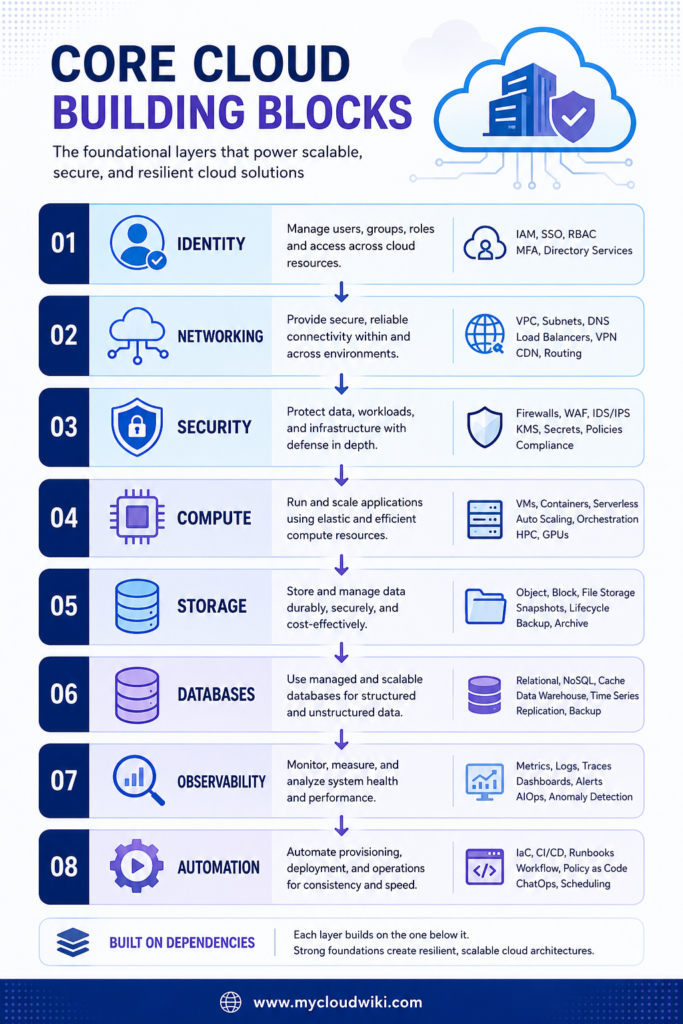
The diagram illustrates an important architectural principle: cloud platforms are ecosystems rather than collections of isolated services. Every building block contributes a specific capability, but real business applications succeed only when these capabilities work together as a cohesive platform.
This architectural mindset is one of the biggest differences between simply learning cloud services and becoming a cloud architect. Architects focus on how capabilities interact to solve business problems rather than on individual services in isolation.
At this point, we’ve identified the core capabilities that exist within every cloud platform. The next step is understanding how these individual building blocks collaborate to deliver complete business applications and why no single building block can operate effectively on its own.
How Cloud Applications Are Built Using Cloud Building Blocks
Knowing the individual cloud building blocks is only the beginning. Real-world cloud applications are never built using a single service. Instead, they combine multiple building blocks that work together to deliver a secure, scalable, and reliable business solution.
Think about an online shopping application. When a customer opens the website, dozens of cloud capabilities begin working together behind the scenes. The customer only sees a webpage, but the cloud platform is coordinating identity verification, network communication, application processing, data storage, security enforcement, monitoring, and automation simultaneously.
This layered approach is one of the defining characteristics of cloud architecture. Rather than embedding every capability into a single application, cloud platforms separate responsibilities into specialized building blocks that can evolve, scale, and operate independently while remaining tightly integrated.
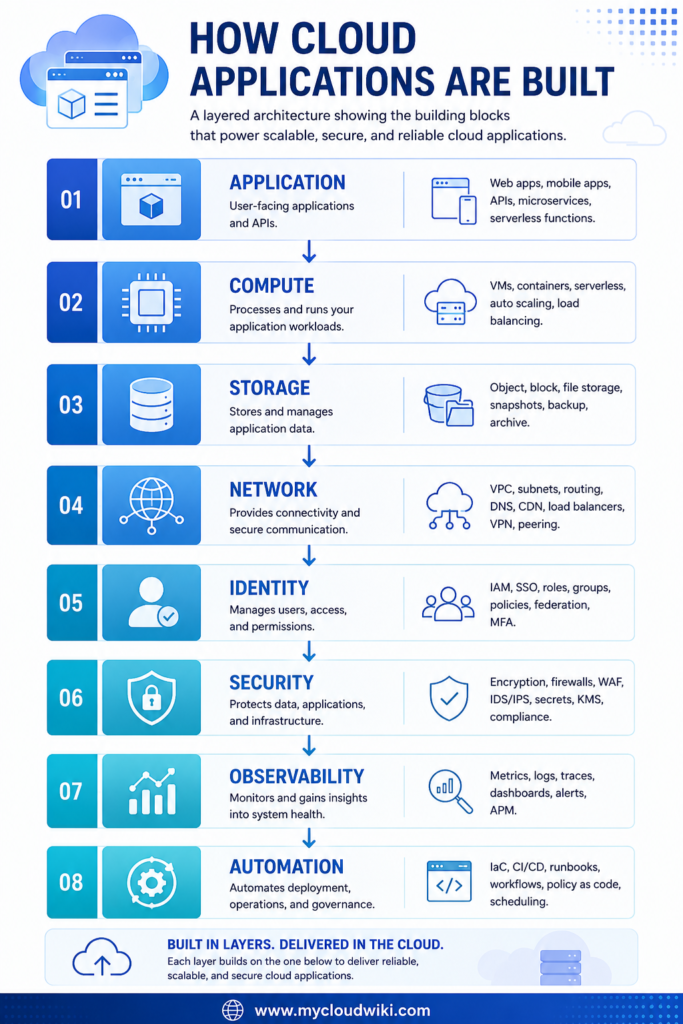
The illustration shows how every request passes through multiple cloud capabilities before reaching the business application. Users connect through secure networks, applications execute on compute resources, data is stored in managed storage and databases, while identity, security, observability, and automation operate continuously across every layer.
Although different cloud providers implement these capabilities using different products and managed services, the overall architectural pattern remains remarkably consistent. Once you understand this pattern, moving between cloud platforms becomes much easier because the underlying concepts stay the same.
How Cloud Building Blocks Work Together
Cloud building blocks are not independent technologies. Every business transaction requires several building blocks to collaborate in real time.
Consider a customer placing an online order. The customer’s identity must first be authenticated before access is granted. The request travels through the network to the application, where compute services process the business logic. Product information is retrieved from databases, files such as images are delivered from storage, security services inspect the request, observability platforms record operational data, and automation ensures the environment continues operating consistently.
If any one of these building blocks fails, the entire business transaction may be affected. This is why architects design cloud platforms as integrated systems rather than focusing on individual services.
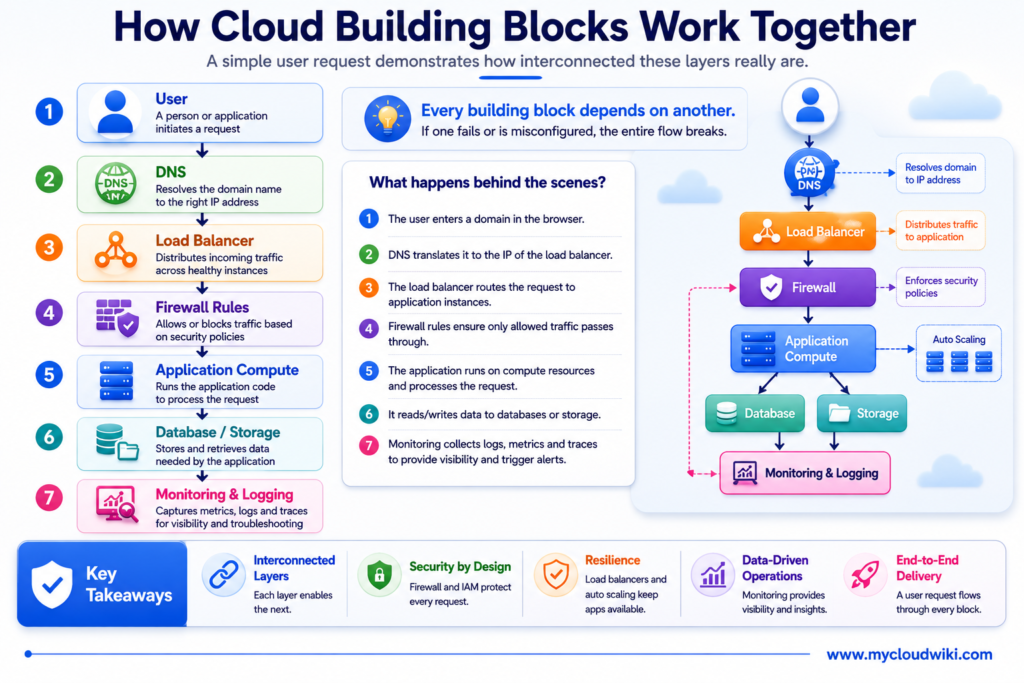
The diagram highlights an important architectural principle: every cloud building block depends on others to deliver business value. Networking connects services, identity protects access, compute processes requests, storage and databases preserve information, while security, observability, and automation provide continuous operational support across the entire platform.
Instead of asking “Which cloud service should I use?”, experienced architects ask “Which capabilities must work together to solve this business problem?” This capability-first mindset leads to simpler, more resilient, and more portable cloud architectures.
Building Blocks Across Major Cloud Providers
One of the biggest misconceptions about multi-cloud computing is that every cloud provider offers fundamentally different capabilities. In reality, all major cloud platforms provide the same core architectural building blocks. The primary differences lie in service names, implementation details, operational features, and integration capabilities.
For example, every provider offers virtual machines, managed databases, networking services, object storage, identity platforms, monitoring tools, and automation capabilities. While the products may differ, the architectural purpose remains consistent.
This common foundation enables engineers and architects to transfer their knowledge across cloud providers without relearning cloud computing from scratch.
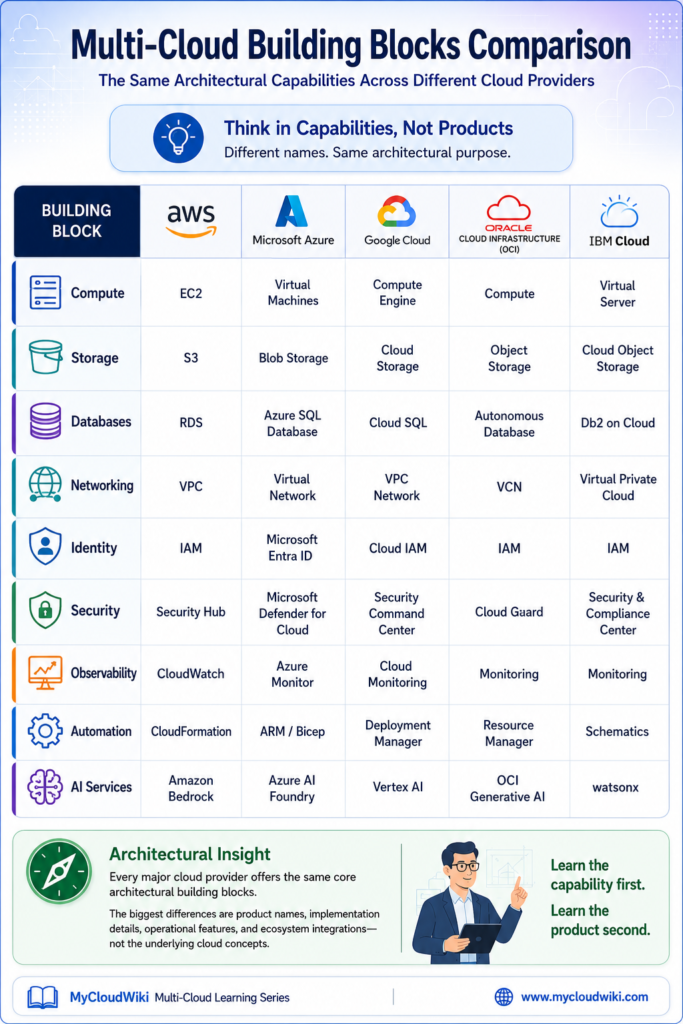
The comparison illustrates how common architectural capabilities map across AWS, Microsoft Azure, Google Cloud, Oracle Cloud Infrastructure (OCI), and IBM Cloud. Rather than memorizing dozens of product names, focus on understanding the capability each service provides. Once the capability is clear, selecting the appropriate provider service becomes a straightforward implementation decision.
Choosing the Right Building Blocks
As organizations modernize their applications, architects must determine which building blocks are required to satisfy specific business and technical requirements. Rather than selecting services first, they begin by identifying the capabilities needed to solve the business problem.
The following decision guide illustrates how enterprise architects typically map business requirements to cloud building blocks.
This capability-first approach helps organizations avoid unnecessary complexity while ensuring that every architectural decision supports a clear business objective. It also creates a provider-neutral design that can be implemented consistently across multiple cloud environments.
At this stage, MyRetail now understands the essential building blocks required to build its future multi-cloud platform. However, understanding the components alone is not enough. The engineering and architecture teams must also understand how different roles collaborate to design, implement, govern, and operate these building blocks effectively.
The next section explores this difference through the Engineer vs Architect Perspective, one of the signature learning sections in the MyCloudWiki Multi-Cloud Learning Series.
Engineer vs Architect Perspective
Building a successful cloud platform requires collaboration between engineers and architects. Although both roles work with the same cloud building blocks, they approach problems from different perspectives and make different types of decisions.
Cloud engineers focus on implementing, operating, automating, and troubleshooting cloud services. Their goal is to ensure that cloud resources are deployed correctly, perform reliably, and remain secure throughout their lifecycle.
Cloud architects, on the other hand, focus on designing the overall platform. They determine how cloud building blocks should be combined to meet business objectives while balancing scalability, security, reliability, governance, and cost optimization across the enterprise.
Neither role is more important than the other. Enterprise success depends on architects creating a sound design and engineers implementing that design consistently.
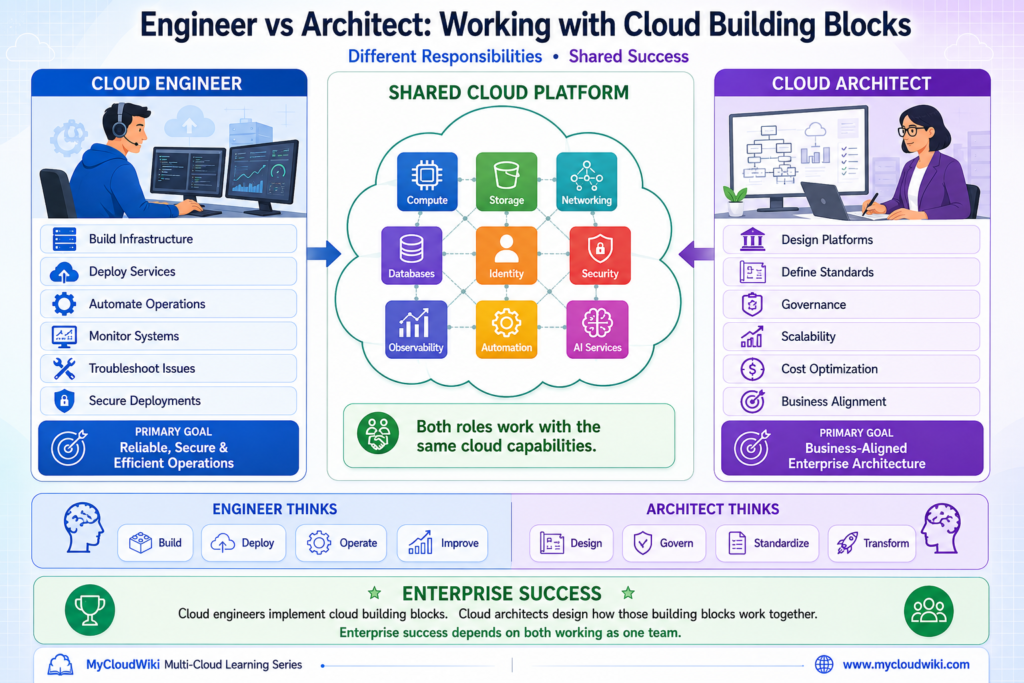
The illustration highlights how both roles work with the same cloud capabilities but at different levels of responsibility. Engineers concentrate on implementation and day-to-day operations, while architects focus on platform design, standards, governance, and long-term business outcomes.
Understanding both perspectives helps organizations reduce implementation gaps and improve collaboration across engineering and architecture teams.
Cloud maturity develops as professionals learn to shift their thinking from individual technologies to complete business platforms. Engineers naturally expand into architecture by understanding how cloud building blocks interact, while architects remain effective by understanding the operational realities faced by engineering teams.
Well-Architected Perspective
Every cloud building block contributes to one or more principles of the Well-Architected Framework. Rather than viewing compute, storage, networking, identity, and security as isolated technologies, enterprise architects evaluate how these capabilities work together to create operational excellence, secure systems, resilient applications, high performance, and cost-efficient platforms.
This holistic approach helps organizations build cloud environments that are not only technically functional but also aligned with long-term business goals.
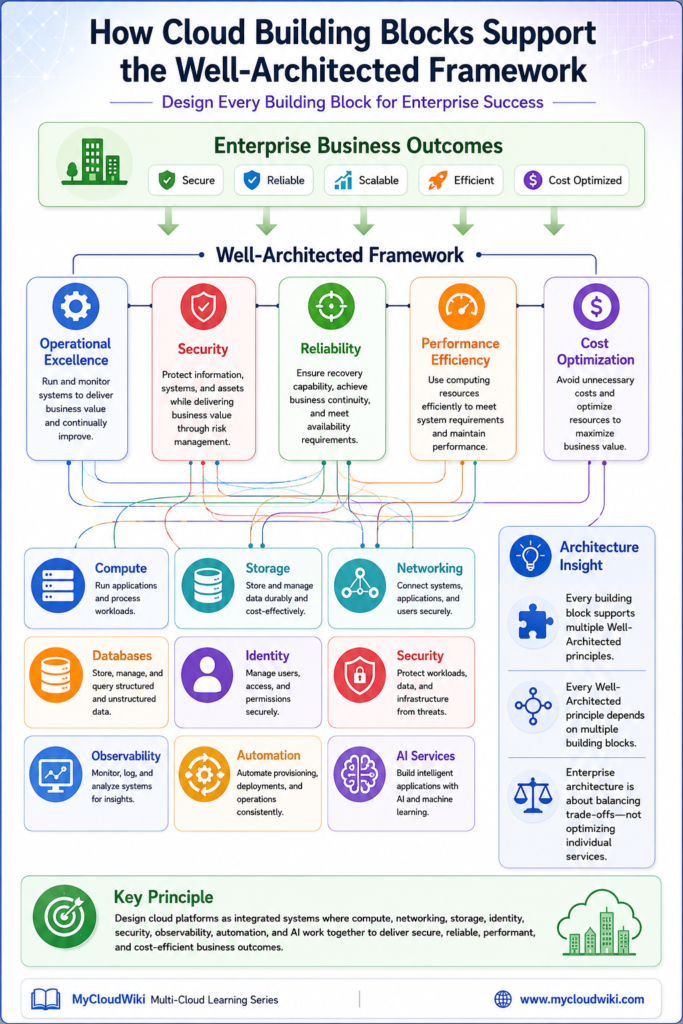
The framework demonstrates that every building block contributes to multiple architectural principles. For example, networking affects performance and reliability, identity strengthens security and governance, automation improves operational excellence, while observability enhances reliability through proactive monitoring and continuous improvement.
Rather than optimizing individual services, architects evaluate how the entire platform contributes to enterprise outcomes.
AI & Agentic AI Perspective
Artificial Intelligence is transforming how cloud engineers and architects interact with cloud building blocks. Instead of manually configuring every service or searching through documentation, AI-powered assistants can recommend architectures, generate infrastructure code, explain service relationships, identify security risks, and automate repetitive operational tasks.
Agentic AI takes this evolution a step further. Rather than simply answering questions, AI agents can coordinate multiple cloud building blocks to complete business workflows, provision infrastructure, perform compliance checks, monitor environments, and assist engineers throughout the application lifecycle.
Although AI accelerates cloud operations, architectural responsibility remains with human engineers and architects. AI should be viewed as an intelligent collaborator that improves productivity while humans continue to validate design decisions and governance requirements.
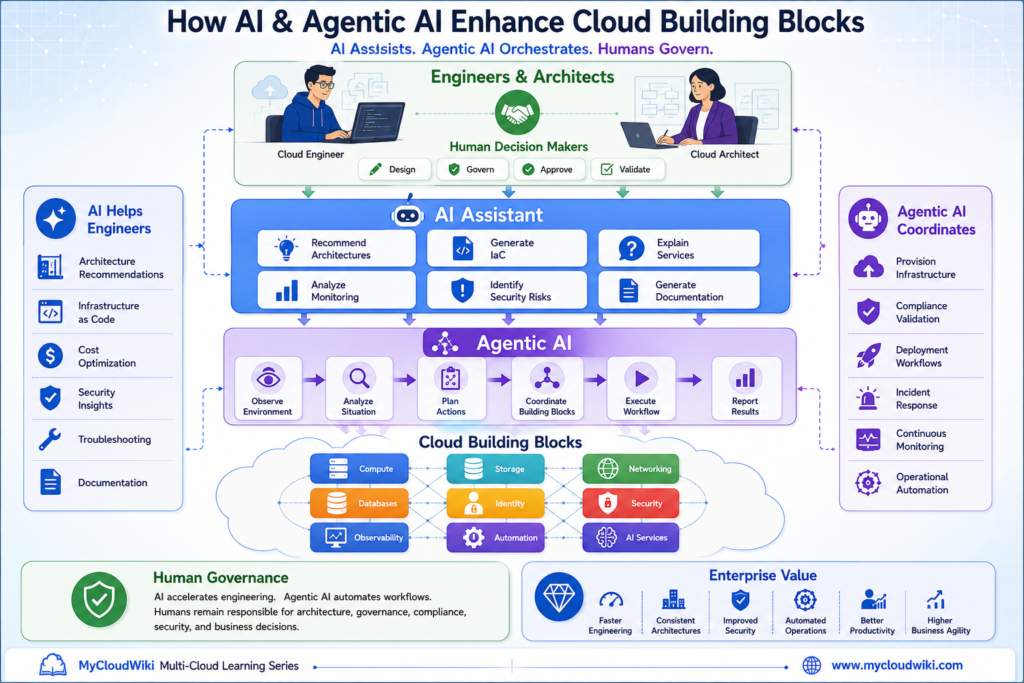
The illustration demonstrates how AI interacts with every cloud building block. AI assists with provisioning, monitoring, security analysis, optimization, documentation, and operational recommendations, while Agentic AI coordinates workflows across multiple cloud services to automate complex enterprise tasks.
This collaboration allows engineering teams to spend less time on repetitive activities and more time delivering business value.
As MyRetail continues its multi-cloud transformation, the engineering and architecture teams now share a common understanding of the cloud building blocks that power modern applications. The final section of this lesson captures the most important architecture lessons, enterprise observations, and practical takeaways in the Architect’s Notebook, providing a concise reference that engineers and architects can revisit throughout the Multi-Cloud Learning Series.
Architect’s Notebook
After understanding the core cloud building blocks, experienced architects no longer think about individual cloud services. Instead, they view cloud platforms as interconnected systems where every capability contributes to delivering secure, reliable, scalable, and efficient business outcomes.
The following notebook summarizes the practical lessons that cloud engineers and architects should remember when designing multi-cloud environments.
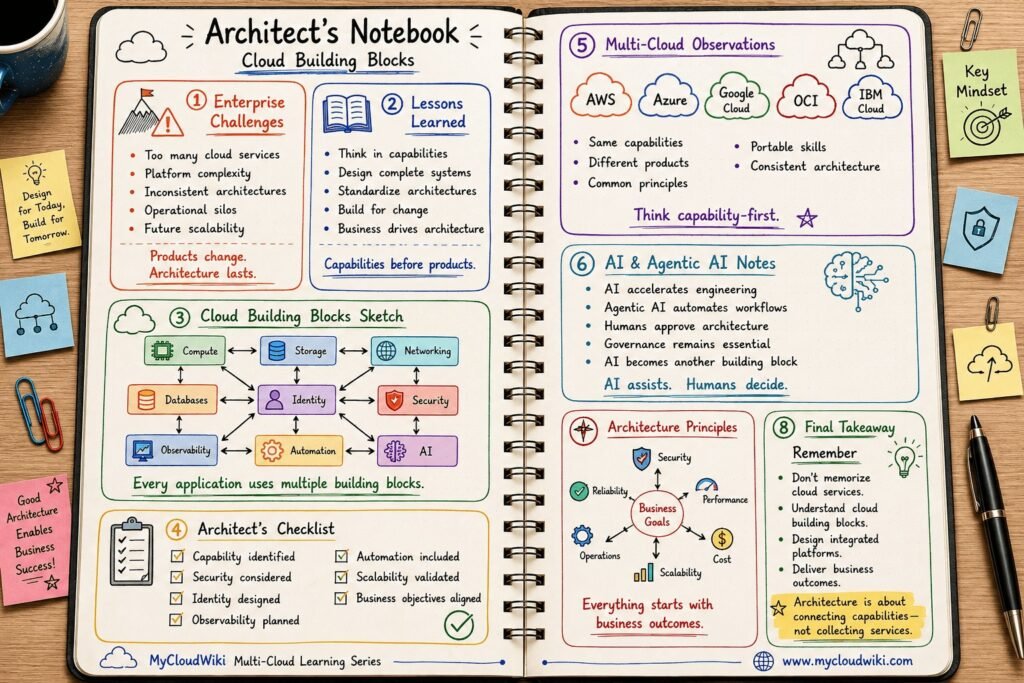
The notebook captures the essential architecture principles, implementation guidance, and enterprise observations discussed throughout this lesson. Rather than memorizing cloud products, focus on understanding how architectural capabilities work together to build resilient enterprise platforms.
Knowledge Check
Question 1
B. Product names change frequently, but architectural capabilities remain consistent.
C. Building blocks replace cloud services.
D. Only architects need to understand cloud building blocks.
Question 2
B. They are built by combining multiple cloud building blocks.
C. They eliminate the need for networking and security.
D. They only require compute and storage.
Question 3
B. Troubleshoot deployment failures.
C. Design enterprise platforms that align with business goals.
D. Configure storage services.
Question 4
B. It coordinates workflows across multiple cloud building blocks.
C. It only generates documentation.
D. It manages a single cloud service.
Question 5
B. Design each service independently.
C. Think in architectural capabilities that work together as a complete platform.
D. Standardize on a single cloud provider.
Key Takeaways
- Every cloud platform is built using the same core architectural building blocks.
- Cloud applications combine multiple building blocks to deliver business services.
- Engineers implement cloud building blocks, while architects design how they work together.
- Well-Architected principles apply across all cloud building blocks rather than individual services.
- AI assists cloud engineering, Agentic AI automates workflows, and humans remain responsible for governance and architecture.
- Thinking in architectural capabilities prepares you to work confidently across AWS, Microsoft Azure, Google Cloud, Oracle Cloud Infrastructure (OCI), and IBM Cloud.

