
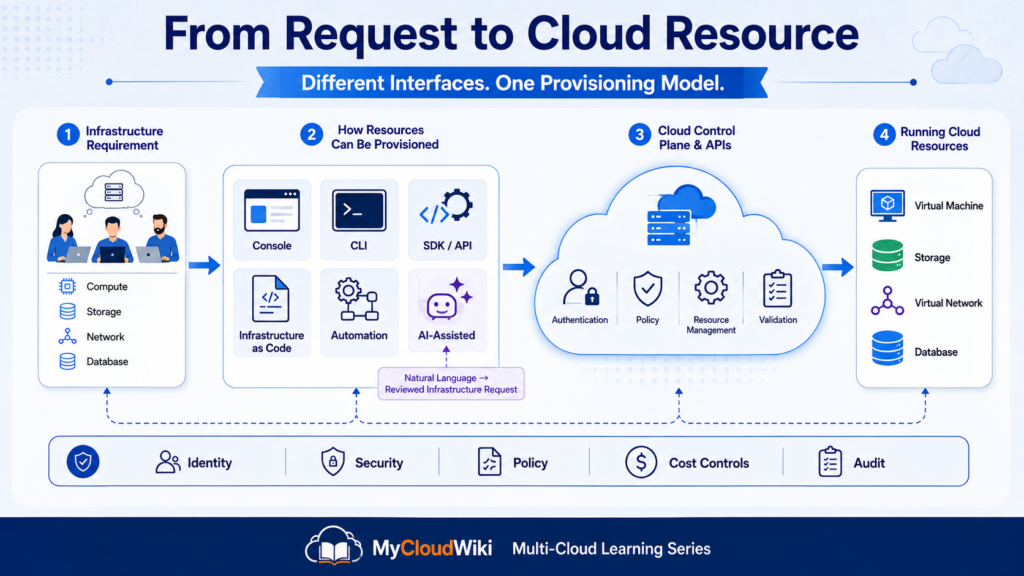
In Cloud Building Blocks, you learned the foundational capabilities every cloud platform provides—compute, storage, networking, identity, security, databases, observability, and automation.
The next question is practical: how do those capabilities become real cloud resources?
Introduction
Understanding a cloud capability is different from creating one.
Knowing that an application needs compute, storage, networking, and databases defines the architecture. Resource provisioning turns that architecture into actual cloud resources.
A provisioning request might create:
- A virtual machine.
- A storage bucket.
- A virtual network.
- A database.
- A load balancer.
- A Kubernetes cluster.
- An entire application environment.
Provisioning Has Changed
Early cloud users often provisioned resources manually through a web console.
Modern enterprises have many more options:
- Console / Portal — create resources visually.
- CLI — provision resources using commands.
- SDK — embed cloud operations into software.
- API — interact directly with the cloud platform.
- Infrastructure as Code — define infrastructure in version-controlled files.
- Automation platforms — execute repeatable provisioning workflows.
- AI-assisted provisioning — translate human intent into commands, configurations, or infrastructure definitions.
- Agentic provisioning — allow governed agents to plan and execute approved provisioning actions.
These methods may look very different to the user.
Underneath, they eventually interact with the provider’s resource-management interfaces and control plane.
The Mental Model That Matters
A beginner may think:
“I clicked Create, so the portal created my virtual machine.”
The better mental model is:
Request → Authentication → Authorization → Validation → Cloud Control Plane → Resource Creation
The console is only one interface into that process.
The same principle applies when the request originates from:
- A CLI command.
- Application code.
- An Infrastructure as Code deployment.
- A CI/CD pipeline.
- An internal developer platform.
- An AI assistant.
- An authorized AI agent.
This distinction becomes increasingly important as cloud environments become more automated.
Provisioning Is More Than Creating Infrastructure
Enterprise provisioning is not simply:
Create a VM.
A production-ready request may also need to define:
- Region and availability requirements.
- Network placement.
- Identity and permissions.
- Security policies.
- Encryption.
- Resource naming.
- Tags and metadata.
- Monitoring.
- Backup.
- Cost controls.
- Lifecycle rules.
Provisioning therefore connects architecture with governance.
The objective is not merely to create infrastructure quickly. It is to create the right infrastructure, in the right way, under the right controls.
Where AI Fits
AI introduces a new interface between human intent and cloud automation.
Instead of manually constructing every command or infrastructure definition, an engineer might ask:
“Create the infrastructure definition for a development API with two application instances, private networking, managed database storage, monitoring, and our standard tags.”
An AI assistant could help:
- Interpret the requirement.
- Draft the Infrastructure as Code.
- Explain configuration choices.
- Identify missing settings.
- Suggest corrections.
- Analyze deployment failures.
- Prepare the provisioning plan for review.
But AI does not eliminate the underlying cloud architecture.
The request must still pass through:
- Identity
- Authorization
- Policy
- Security controls
- Provider APIs
- Resource-management services
- Audit mechanisms
This leads to one of the most important principles in the lesson:
AI can help create the provisioning request. Enterprise controls determine whether that request is allowed to become infrastructure.
What Is Resource Provisioning?
Resource provisioning is the process of creating and configuring the cloud resources required by a workload.
It converts an architecture requirement into something that actually exists inside a cloud environment.
A provisioning action might create:
- A virtual machine.
- A storage bucket.
- A virtual network.
- A database.
- A load balancer.
- A Kubernetes cluster.
- An application environment.
Provisioning can also modify or remove existing resources.
The important idea is simple:
Architecture defines what you need. Provisioning makes it exist.
Provisioning Creates More Than the Resource
Creating a resource usually requires several configuration decisions.
For example, provisioning a virtual machine may also require:
- Cloud account, subscription, or project.
- Region and availability location.
- Virtual network and subnet.
- Machine size.
- Operating system image.
- Storage configuration.
- Identity permissions.
- Security settings.
- Tags and metadata.
- Monitoring configuration.
This is why enterprise provisioning must be controlled.
A resource can be successfully created and still be incorrectly configured.
Provisioning Has a Lifecycle
Provisioning is not limited to the initial Create operation.
Cloud resources move through a lifecycle:
Request → Create → Configure → Update → Scale → Monitor → Replace → Decommission
The provisioning approach should therefore support the entire resource lifecycle.
This becomes especially important when organizations operate thousands of resources across multiple environments and cloud providers.
What Happens When You Provision a Cloud Resource?
When you click Create in a cloud console, the browser itself does not create the infrastructure.
It sends a request into the cloud provider’s management system.
The same principle applies to:
- CLI commands.
- SDK calls.
- Infrastructure as Code.
- Automation pipelines.
- Internal developer platforms.
- AI-assisted provisioning.
- Authorized AI agents.
The interface changes.
The underlying provisioning process remains broadly similar.
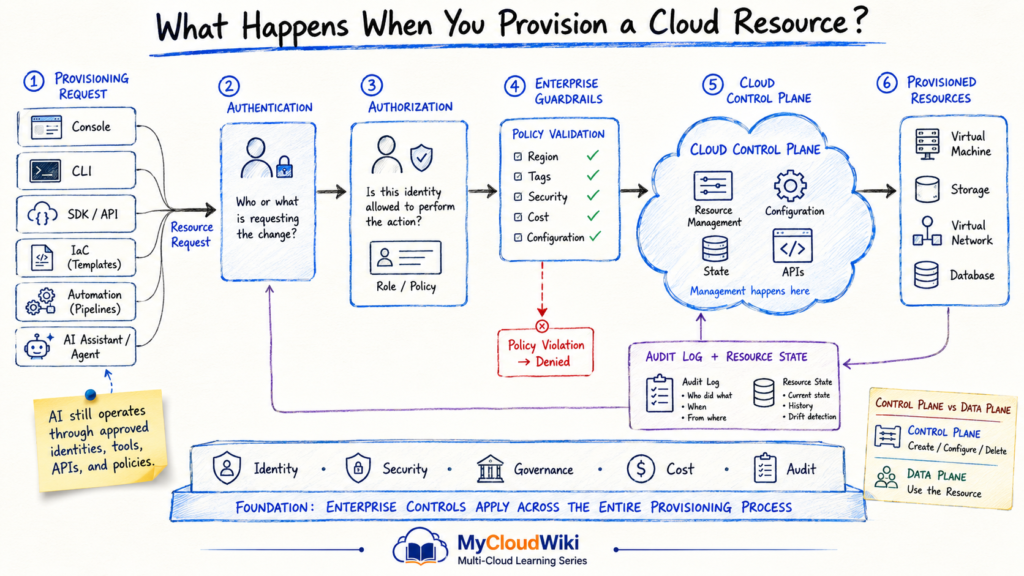
A Simple Provisioning Flow
A resource request typically moves through several stages.
1. Request
Someone or something requests a resource.
The request might originate from:
- A cloud engineer.
- An application.
- A deployment pipeline.
- An Infrastructure as Code tool.
- A platform engineering portal.
- An AI assistant.
- An AI agent.
2. Authentication
The cloud platform determines who or what is making the request.
The identity could represent:
- A human user.
- A service account.
- A workload identity.
- An automation pipeline.
- An application.
- An AI agent.
Authentication establishes identity.
It does not automatically mean the identity is allowed to perform the requested action.
3. Authorization
The platform determines whether the authenticated identity has permission to perform the action.
For example:
- Can this user create virtual machines?
- Can this pipeline modify the production network?
- Can this service account create storage?
- Can this AI agent provision resources in this environment?
The next lesson, Identity and Access Management (IAM), will explore authentication, authorization, roles, policies, and least privilege in depth.
4. Policy and Configuration Validation
Enterprise environments may apply additional controls before allowing deployment.
These can validate:
- Approved regions.
- Resource types.
- Naming standards.
- Required tags.
- Network configuration.
- Encryption.
- Security settings.
- Cost restrictions.
- Organizational policies.
A technically valid resource request may still be rejected because it violates enterprise policy.
5. Control Plane Processing
Once the request is accepted, the provider’s control plane coordinates the resource-management operation.
The control plane handles management activities such as:
- Creating resources.
- Changing configuration.
- Updating resources.
- Applying policies.
- Tracking resource state.
- Deleting resources.
This is different from the data plane, where the workload actually performs its business function.
For example:
- Creating a storage bucket is a control-plane operation.
- Reading an object from that bucket is a data-plane operation.
This distinction becomes increasingly important in cloud architecture.
6. Resource Creation
The cloud platform creates or configures the requested resource.
Examples include:
- Starting a virtual machine.
- Creating a storage bucket.
- Configuring a virtual network.
- Deploying a database.
- Creating a load balancer.
The resulting resource becomes part of the cloud environment.
7. State and Audit
Enterprise cloud platforms also record information about the provisioning action.
This can include:
- Who requested the change.
- What resource changed.
- When the action occurred.
- Whether the deployment succeeded.
- Which configuration was applied.
- Which policy allowed or rejected it.
This information supports:
- Troubleshooting.
- Security investigations.
- Compliance.
- Governance.
- Change management.
Ways Cloud Resources Are Provisioned
Cloud platforms provide several ways to submit provisioning requests.
These methods are not competing definitions of provisioning.
They are different interfaces and operating models for reaching the cloud control plane.
Console / Portal
The console is the graphical interface provided by the cloud provider.
It is usually the easiest provisioning method for someone learning a cloud platform.
Best For
- Learning.
- Exploration.
- One-time administrative tasks.
- Troubleshooting.
- Visual inspection.
Advantages
- Easy to understand.
- Immediate visual feedback.
- Little scripting knowledge required.
- Useful for discovering available configuration options.
Limitations
- Manual.
- Difficult to reproduce consistently.
- Prone to configuration differences.
- Poor fit for large-scale repetitive deployment.
Architect’s note: The console is an excellent interface for exploration, but repeated production deployments should move toward controlled automation.
⌨️ Command-Line Interface
A CLI allows engineers to manage resources using terminal commands.
Instead of selecting options in a browser, the engineer expresses the request as a command.
Best For
- Administration.
- Scripting.
- Troubleshooting.
- Repeatable engineering tasks.
- CI/CD integration.
Advantages
- Faster for experienced engineers.
- Scriptable.
- Repeatable.
- Easy to combine with other command-line tools.
Limitations
- Commands can become complex.
- Scripts may become difficult to maintain.
- Imperative scripts can hide configuration state.
- Credentials and permissions must be carefully controlled.
Architect’s note: CLI automation is useful, but a collection of scripts is not automatically an enterprise provisioning strategy.
💻 SDK
Software Development Kits allow applications to interact with cloud services using programming languages.
Common languages include:
- Python.
- Java.
- JavaScript / TypeScript.
- .NET.
- Go.
Best For
- Applications that create cloud resources.
- Internal developer platforms.
- Automation tools.
- Cloud management software.
- Custom provisioning workflows.
Advantages
- Integrates provisioning directly into software.
- Supports complex application logic.
- Enables custom workflows.
- Provides language-native cloud interfaces.
Limitations
- Requires software development.
- Introduces application maintenance.
- Requires secure credential handling.
- Custom provisioning logic can become difficult to govern.
Architect’s note: Use SDKs when provisioning is part of a software capability—not simply because application code can create infrastructure.
API
APIs are the foundational programmatic interfaces exposed by cloud platforms.
Many other provisioning methods eventually rely on APIs underneath.
For example:
Console → API
CLI → API
SDK → API
Automation → API
AI Tool → API or approved provisioning tool
This is one of the most important concepts in the lesson.
Why APIs Matter
APIs make cloud infrastructure:
- Programmable.
- Automatable.
- Integratable.
- Repeatable.
- Machine accessible.
Without APIs, modern cloud automation would not exist.
Architect’s note: Think of the API as the contract with the cloud control plane. The interface above it can change without changing the fundamental provisioning model.
Infrastructure as Code
Infrastructure as Code, commonly called IaC, defines infrastructure using machine-readable configuration rather than relying on manual creation.
Instead of documenting:
Create a network, then create three subnets, then deploy two virtual machines.
The desired infrastructure is expressed as code or configuration.
That definition can then be:
- Stored in version control.
- Reviewed.
- Tested.
- Reused.
- Audited.
- Deployed repeatedly.
Why IaC Changed Cloud Provisioning
Manual provisioning creates infrastructure.
Infrastructure as Code creates repeatable infrastructure.
That difference becomes critical at enterprise scale.
IaC helps organizations achieve:
- Consistency.
- Repeatability.
- Version control.
- Peer review.
- Standardization.
- Automated deployment.
- Disaster recovery.
- Auditability.
The infrastructure definition also becomes part of the engineering lifecycle.
IaC Does Not Remove the Control Plane
Infrastructure as Code does not create infrastructure outside the cloud provider’s management model.
A simplified flow remains:
IaC Definition → IaC Engine → Provider API → Control Plane → Cloud Resources
The IaC tool changes how the desired configuration is expressed and managed.
The provider still controls the actual creation of the resource.
Architect’s Note
Infrastructure as Code should be treated as an architectural and governance capability—not simply as a deployment convenience.
A poorly designed IaC template can reproduce the same bad configuration hundreds of times.
Automation increases consistency.
It does not automatically guarantee correctness.
Imperative vs Declarative Provisioning
There are two important ways to describe infrastructure changes.
Understanding the difference prepares readers for Infrastructure as Code, automation, GitOps, and platform engineering.
Imperative Provisioning
Imperative provisioning describes the actions to perform.
The mental model is:
Do these steps.
For example:
- Create a virtual network.
- Create a subnet.
- Create a virtual machine.
- Create a disk.
- Attach the disk.
- Configure monitoring.
The instructions describe how to reach the result.
Declarative Provisioning
Declarative provisioning describes the desired state.
The mental model is:
This is what the environment should look like.
For example, the desired state might specify:
- One virtual network.
- Three subnets.
- Two application instances.
- One managed database.
- Monitoring enabled.
- Required tags applied.
The provisioning system determines which actions are necessary to reach that state.
Neither model disappears in modern cloud operations.
Engineers still use imperative commands for troubleshooting and administration.
Declarative approaches become particularly valuable when infrastructure must be reproduced consistently across environments.
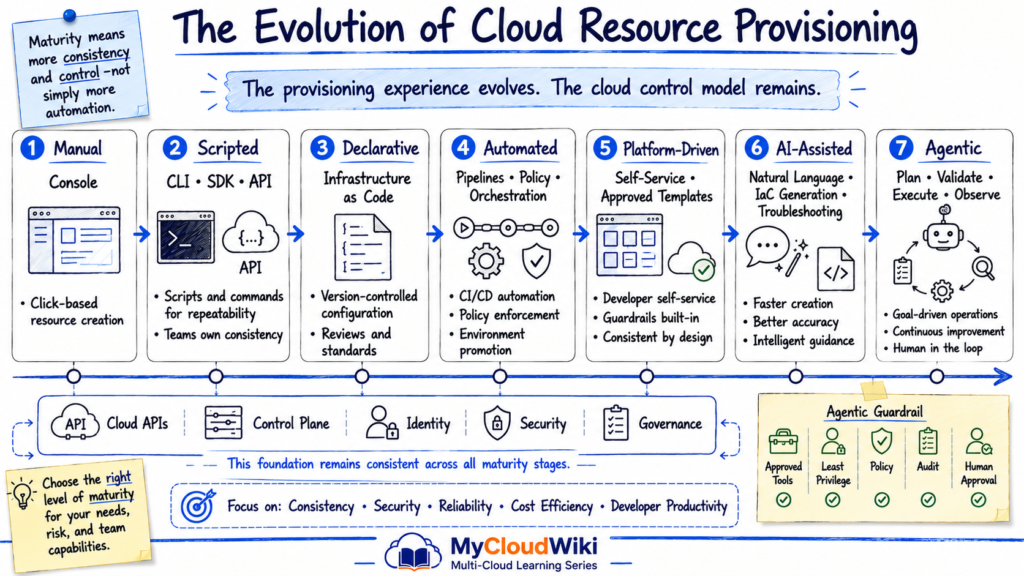
From Manual Provisioning to Enterprise Automation
Provisioning typically evolves as cloud adoption grows.
A small team may begin with manual deployment.
An enterprise eventually needs a controlled provisioning system.
A useful maturity progression is:
Manual → Scripted → Declarative → Automated → Platform-Driven → AI-Assisted → Agentic
Manual
A person creates the resource.
Typical interface: Console.
Scripted
Commands automate repetitive tasks.
Typical interface: CLI, SDK, API.
Declarative
Infrastructure is expressed as desired state.
Typical approach: Infrastructure as Code.
Automated
Provisioning becomes part of repeatable workflows.
Typical approach: CI/CD, orchestration, policy automation.
Platform-Driven
Developers request approved capabilities rather than assembling every infrastructure component themselves.
Typical approach: Internal developer platforms and self-service catalogs.
AI-Assisted
Natural language helps engineers generate, explain, validate, and troubleshoot provisioning definitions.
Typical approach: AI assistants working with CLI, APIs, IaC, and platform tools.
Agentic
Governed agents can potentially plan and perform approved provisioning activities within defined boundaries.
Typical approach: Agent + approved tools + identity + policy + human approval where required.
This is an evolution of the operating model.
The foundational cloud provisioning process still relies on identities, APIs, control planes, policies, and resource-management systems.
Governed Resource Provisioning
Creating a cloud resource is easy.
Creating it consistently, securely, and within enterprise standards is the harder problem.
As cloud adoption grows, organizations need provisioning controls that ensure every resource follows approved architecture and governance requirements.
What Governed Provisioning Adds
A provisioning request may need to satisfy standards for:
- Resource naming.
- Required tags and metadata.
- Approved cloud regions.
- Network placement.
- Identity and access.
- Encryption.
- Security configuration.
- Monitoring and logging.
- Backup and recovery.
- Cost limits.
- Regulatory requirements.
The goal is not to prevent engineers from using cloud.
The goal is to make the approved path the easiest path.
Provisioning Without Governance
Uncontrolled provisioning can create:
- Inconsistent environments.
- Excessive permissions.
- Publicly exposed resources.
- Missing encryption.
- Resources without ownership tags.
- Unsupported regions.
- Unmonitored workloads.
- Unexpected cloud costs.
These problems become harder to correct as the environment grows.
Provisioning With Governance
A governed workflow can validate requirements before resources reach production.
A simplified model is:
Request → Identity → Policy → Approved Configuration → Provision → Observe
The earlier controls are applied, the less remediation is required later.
Architect’s Note
Governance should not depend on engineers remembering every organizational rule.
Encode repeatable requirements into provisioning templates, policies, platforms, and automated validation wherever practical.
Standardized and Self-Service Provisioning
Enterprise teams should not have to design common infrastructure from scratch every time.
Instead, organizations can provide approved provisioning patterns for frequently requested capabilities.
Examples include:
- Standard development environments.
- Approved virtual-machine configurations.
- Standard application networks.
- Approved database patterns.
- Kubernetes environments.
- Application hosting patterns.
- AI development environments.
The engineer requests the capability.
The platform applies the approved configuration.
What a Standard Pattern Can Include
A reusable provisioning pattern might automatically configure:
- Resource naming.
- Network placement.
- Security controls.
- Identity.
- Encryption.
- Monitoring.
- Backup.
- Tags.
- Cost metadata.
- Policy requirements.
This reduces variation between teams.
It also moves governance earlier into the provisioning process.
Self-Service Does Not Mean Uncontrolled
Enterprise self-service should operate within predefined boundaries.
A developer might be allowed to choose:
- Development or test environment.
- Approved compute size.
- Approved database tier.
- Required capacity.
The platform can automatically determine:
- Network.
- Security baseline.
- Logging.
- Required tags.
- Identity integration.
- Policy enforcement.
This principle later becomes important in Platform Engineering.
Architect’s Note
Good self-service removes unnecessary infrastructure complexity without removing governance.
The developer experiences simplicity.
The enterprise retains control.
AI-Assisted Resource Provisioning
AI introduces a new way for engineers to interact with provisioning systems.
Instead of manually constructing every command or infrastructure definition, engineers can describe the required outcome using natural language.
For example:
Create an Infrastructure as Code definition for a development web application using private networking, two application instances, a managed database, monitoring, encryption, and standard tags.
An AI assistant can translate that intent into a provisioning artifact for review.
What AI Can Assist With
AI-assisted provisioning can help engineers:
- Generate CLI commands.
- Draft Infrastructure as Code.
- Explain unfamiliar configuration.
- Recommend resource settings.
- Identify missing parameters.
- Review infrastructure definitions.
- Troubleshoot deployment failures.
- Explain provider errors.
- Generate documentation.
- Suggest remediation.
The engineer remains responsible for validating the result.
AI Changes the Interface
Traditional provisioning might look like:
Engineer → IaC → API → Cloud
AI-assisted provisioning adds another layer:
Engineer → Natural Language → AI → IaC / Command / Plan → Review → Cloud
The underlying cloud control model does not disappear.
The AI is helping translate human intent into something the provisioning system understands.
AI Does Not Replace Infrastructure as Code
AI can generate infrastructure definitions.
That does not make Infrastructure as Code unnecessary.
IaC still provides important enterprise capabilities:
- Version control.
- Peer review.
- Change history.
- Repeatability.
- Testing.
- Auditability.
- Rollback.
- Deployment consistency.
A stronger enterprise pattern is therefore:
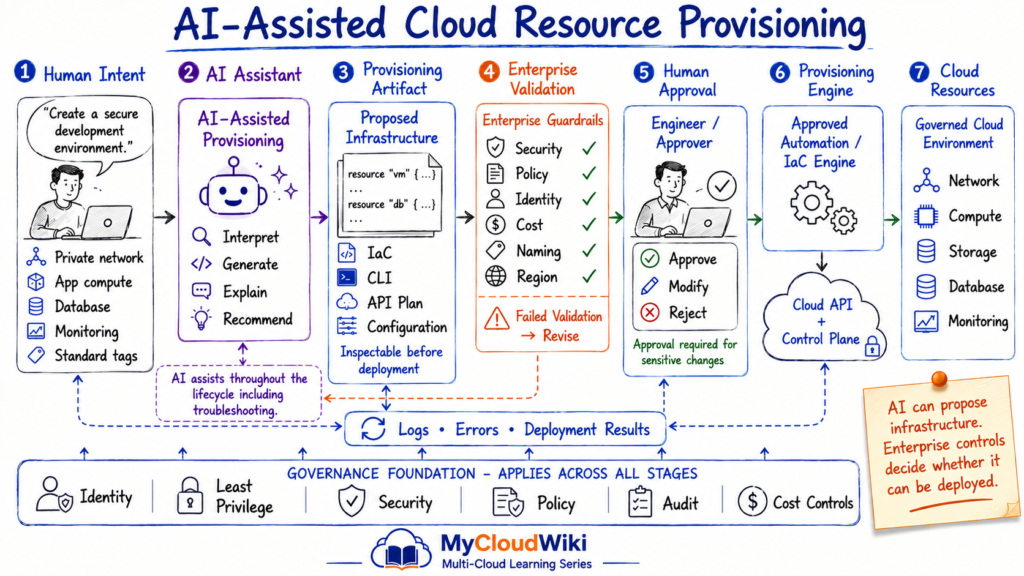
Human Intent → AI Assistance → IaC → Validation → Approval → Deployment
rather than:
Human Intent → AI → Production
Architect’s Note
Treat AI-generated infrastructure exactly like human-generated infrastructure.
It should pass through the same review, testing, security, policy, and deployment controls.
AI-Assisted Provisioning Workflow
A governed AI-assisted provisioning workflow can follow seven steps.
1. Describe the Requirement
The engineer describes the desired outcome.
For example:
- Development environment.
- Private application.
- Managed database.
- Encryption required.
- Monitoring enabled.
- Standard enterprise tags.
The engineer describes intent rather than every implementation command.
2. AI Interprets the Intent
The AI assistant translates the request into technical requirements.
It may identify:
- Required resources.
- Dependencies.
- Missing information.
- Configuration choices.
- Potential risks.
The AI may also ask for information that was not provided.
3. Generate the Provisioning Artifact
The AI produces something that an approved provisioning system can use.
Examples include:
- CLI commands.
- API requests.
- IaC definitions.
- Configuration files.
- Deployment plans.
The generated artifact should be inspectable.
4. Validate
Automated controls inspect the proposed configuration.
Validation can check:
- Syntax.
- Security.
- Policy.
- Naming.
- Tags.
- Region.
- Cost.
- Architecture standards.
Invalid configurations should be rejected before deployment.
5. Human Review
An engineer reviews the proposed change when required.
The reviewer can ask:
- Is this what we intended?
- Are these resources necessary?
- Are security controls correct?
- Is the estimated cost acceptable?
- Does the design follow architecture standards?
AI assistance should improve review—not eliminate accountability.
6. Provision
Approved automation submits the request to the cloud platform.
The provider’s control plane then creates or changes the resources.
7. Observe
The provisioning system records the outcome.
Teams can inspect:
- Deployment status.
- Resource state.
- Logs.
- Policy results.
- Cost.
- Errors.
The feedback can also help engineers troubleshoot future changes.
From AI-Assisted to Agentic Provisioning
AI-assisted provisioning and Agentic AI provisioning are related, but they are not the same.
The key difference is agency.
AI-Assisted Provisioning
The human drives the workflow.
A typical pattern is:
Human Request → AI Suggestion → Human Review → Approved Automation
The AI primarily helps:
- Generate.
- Explain.
- Review.
- Troubleshoot.
The engineer remains directly involved in deciding the next action.
Agentic Provisioning
An AI agent can potentially perform a sequence of approved actions toward a defined objective.
A simplified pattern becomes:
Objective → Plan → Select Approved Tool → Validate → Execute → Observe → Adjust
For example, an agent might receive the objective:
Prepare an approved development environment for the product team.
Within its permitted boundaries, the agent could potentially:
- Identify the approved environment template.
- Collect required parameters.
- Generate a provisioning plan.
- Validate the configuration.
- Request approval.
- Invoke the approved provisioning tool.
- Observe deployment status.
- Report the outcome.
The agent is coordinating a workflow.
It is not replacing the cloud control plane.
Agentic Provisioning Requires Stronger Guardrails
Greater autonomy increases the importance of governance.
An agent capable of changing infrastructure must not receive unrestricted cloud access.
Enterprise controls should include:
- Dedicated agent identity.
- Least-privilege permissions.
- Approved tools.
- Approved resource types.
- Environment boundaries.
- Cost limits.
- Policy enforcement.
- Audit logging.
- Approval checkpoints.
- Execution limits.
- Rollback mechanisms.
High-risk actions may require explicit human approval.
Examples include:
- Production deployment.
- Network changes.
- IAM changes.
- Security-policy changes.
- Resource deletion.
- High-cost provisioning.
- Cross-region changes.
Architect’s Note
Agentic provisioning should increase operational consistency without creating uncontrolled autonomy.
The design objective is bounded agency: enough permission to complete approved tasks, but not enough permission to bypass enterprise governance.
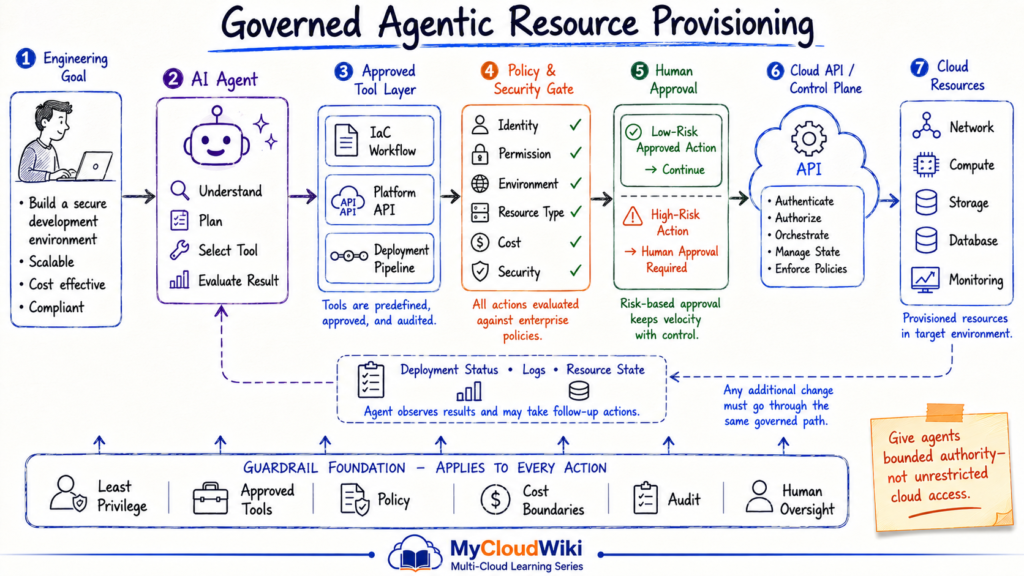
A Governed Agentic Provisioning Model
A useful enterprise mental model is:
Goal → Agent → Approved Tools → Policy → Approval → Control Plane → Resource → Observe
Each layer has a specific responsibility.
Goal
Defines the desired business or engineering outcome.
Agent
Plans the steps required to achieve the goal.
Approved Tools
Limit how the agent can interact with infrastructure.
Examples might include:
- Approved IaC workflows.
- Internal platform APIs.
- Deployment pipelines.
- Read-only discovery tools.
Policy
Determines whether the proposed action follows organizational standards.
Approval
Introduces human oversight when the action exceeds an approved autonomy boundary.
Control Plane
Performs the actual cloud management operation.
Resource
Represents the resulting cloud infrastructure.
Observe
Provides deployment results and operational feedback.
The agent can use that feedback to determine the next permitted action.
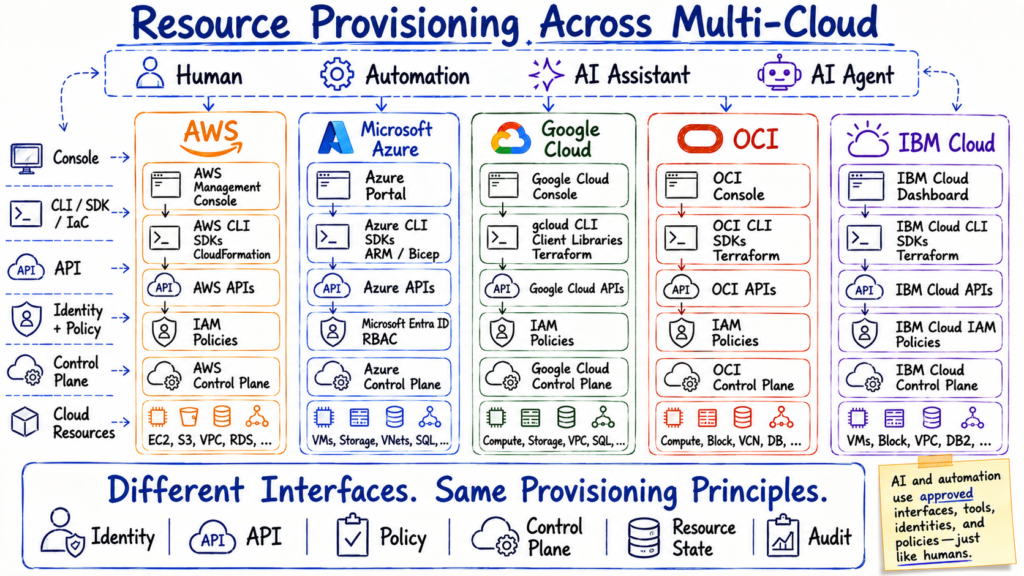
Resource Provisioning Across Multi-Cloud
The provisioning interfaces differ across cloud providers.
The architectural model remains similar:
Identity → Request → API / Control Plane → Policy → Resource
This is why learning the provisioning model is more valuable than memorizing individual commands.
Service names and supported features evolve, so this table should be validated against current provider documentation during final publication.
What This Comparison Teaches
Every major cloud platform provides multiple ways to provision resources.
Across providers, you will consistently encounter:
- A graphical interface.
- A command-line interface.
- APIs.
- Programming libraries.
- Infrastructure as Code.
- Automation capabilities.
The syntax changes.
The service names change.
The provisioning mental model does not.
Capability First, Tool Second
Instead of beginning with:
Which provisioning tool should we use?
Enterprise teams should first ask:
- What are we provisioning?
- Who should be allowed to provision it?
- Which environments are permitted?
- Which controls must always apply?
- How repeatable must the deployment be?
- How will changes be reviewed?
- How will the resource be governed throughout its lifecycle?
The provisioning method follows those requirements.
Architect’s Note
Multi-cloud does not require one provisioning tool for every workload.
It requires a consistent governance model across the provisioning approaches the organization chooses to support.
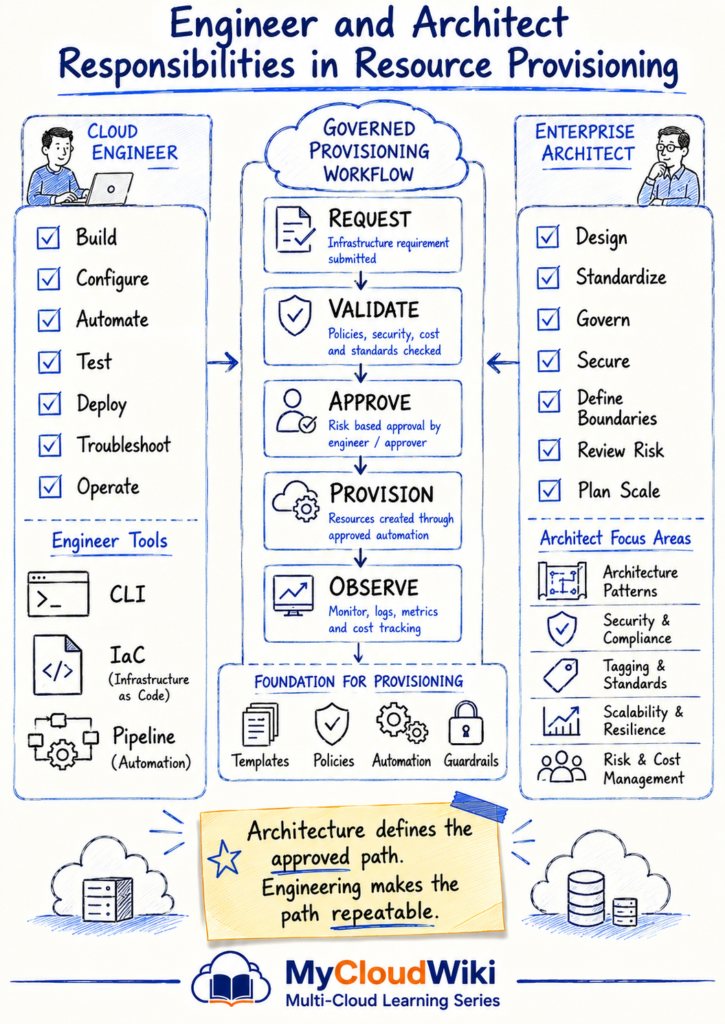
Engineer & Architect Perspective
Resource provisioning is both an engineering activity and an architecture discipline.
Engineers focus on making provisioning reliable and repeatable. Architects focus on ensuring the provisioning model remains secure, governed, scalable, and aligned with enterprise standards.
Cloud Engineer Perspective
Cloud engineers work directly with provisioning interfaces, automation, and deployment workflows.
Their responsibilities commonly include:
- Create and modify cloud resources.
- Develop Infrastructure as Code.
- Build provisioning pipelines.
- Test infrastructure changes.
- Troubleshoot failed deployments.
- Maintain reusable modules and templates.
- Integrate monitoring and logging.
- Validate resource configuration.
- Reduce manual provisioning.
- Maintain deployment consistency.
Engineers typically ask:
- How do I provision this resource?
- Which configuration should I use?
- Can this deployment be automated?
- Why did the deployment fail?
- Can the same definition be reused?
- How do I safely update the resource?
The engineering objective is repeatable execution.
Enterprise Architect Perspective
Architects look beyond individual provisioning commands.
They define how resources should be allowed to enter and evolve within the enterprise cloud environment.
Their responsibilities commonly include:
- Define provisioning principles.
- Establish approved architecture patterns.
- Define automation boundaries.
- Establish governance requirements.
- Standardize environment patterns.
- Define security guardrails.
- Establish multi-cloud provisioning principles.
- Define approval boundaries.
- Review AI and agent autonomy.
- Plan the long-term provisioning operating model.
Architects typically ask:
- Who should be allowed to provision resources?
- Which provisioning paths should the enterprise support?
- Which controls must always be enforced?
- Which patterns should become reusable standards?
- Where should human approval remain mandatory?
- How much autonomy should AI agents receive?
The architecture objective is governed scalability.
Working Together
Provisioning works best when architecture standards can be implemented directly through engineering workflows.
Examples include:
- Architect: defines approved network patterns.
Engineer: implements reusable network modules. - Architect: defines mandatory tagging.
Engineer: adds tag validation to provisioning workflows. - Architect: defines production approval boundaries.
Engineer: implements approval gates. - Architect: defines AI-agent permissions.
Engineer: configures identities, tools, policies, and audit controls.
The strongest model is not architecture documentation on one side and automation on the other.
It is architecture encoded into the provisioning path.
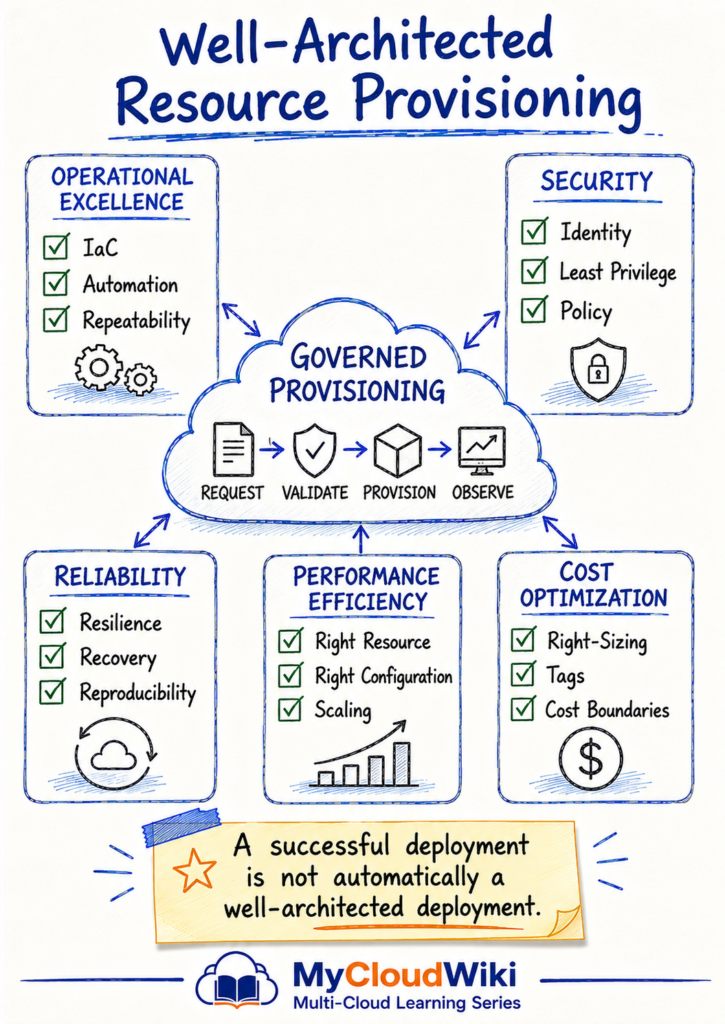
Well-Architected Perspective
Resource provisioning affects every Well-Architected concern.
A resource may deploy successfully and still be poorly architected if it is insecure, oversized, unmonitored, difficult to recover, or manually configured.
Operational Excellence
Provisioning should be repeatable and observable.
Prioritize:
- Infrastructure as Code.
- Version-controlled changes.
- Automated validation.
- Standard deployment workflows.
- Deployment logs.
- Defined rollback procedures.
The goal is to make infrastructure changes predictable.
Security
Every provisioning request should operate through an authenticated identity with appropriate permissions.
Controls include:
- Least privilege.
- Approved identities.
- Encryption requirements.
- Network restrictions.
- Policy validation.
- Secrets protection.
- Audit logging.
AI agents require the same principles—usually with even tighter boundaries.
Reliability
Provisioning should create infrastructure that can tolerate expected failures.
Consider:
- Availability design.
- Backup configuration.
- Recovery requirements.
- Multi-zone deployment.
- Resource dependencies.
- Reproducible environments.
Infrastructure definitions can also help rebuild environments consistently after failure.
Performance Efficiency
Provisioning should select resources appropriate to workload requirements.
Consider:
- Compute sizing.
- Storage performance.
- Database tier.
- Network requirements.
- Scaling configuration.
Standard templates should allow enough flexibility to accommodate legitimate workload differences.
Cost Optimization
Every provisioning action can create financial impact.
Controls can include:
- Approved resource sizes.
- Required cost tags.
- Budgets.
- Environment-specific limits.
- Automated shutdown.
- Lifecycle policies.
- Cost estimation before deployment.
AI-assisted provisioning should never treat cost as an afterthought.
Key Principle
Well-Architected provisioning is not:
Create → Review Later
A stronger model is:
Define Standards → Validate → Provision → Observe → Improve
AI & Agentic AI Perspective
AI changes the interaction model for resource provisioning.
Engineers can increasingly express infrastructure requirements as intent rather than manually constructing every command, configuration, or template.
AI-Assisted Provisioning
AI assistants can support engineers by:
- Generating IaC.
- Drafting CLI commands.
- Explaining configurations.
- Reviewing proposed infrastructure.
- Detecting missing parameters.
- Interpreting deployment errors.
- Suggesting remediation.
- Documenting infrastructure.
The human remains the primary decision-maker.
A strong enterprise workflow remains:
Human Intent → AI Assistance → Reviewable Artifact → Validation → Approval → Provision
Agentic Provisioning
Agentic AI goes further.
An authorized agent can potentially coordinate multiple provisioning actions toward an approved objective.
For example:
Prepare an approved development environment for the MyRetail product team.
A governed agent could:
- Identify the approved environment pattern.
- Gather required parameters.
- Generate a provisioning plan.
- Validate the plan.
- Request approval when required.
- Invoke an approved deployment workflow.
- Observe deployment status.
- Report the result.
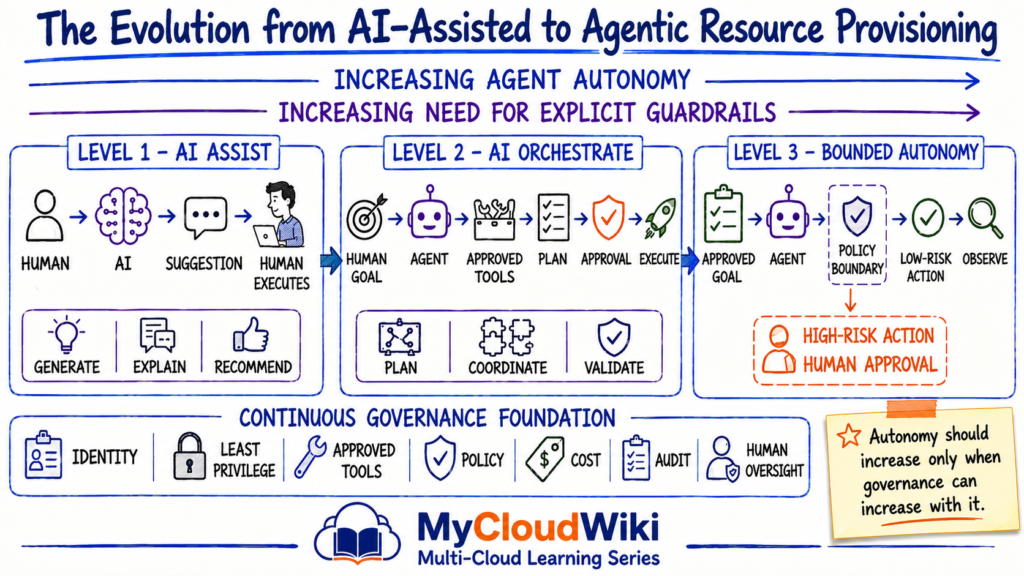
The important architectural concept is bounded autonomy.
AI Must Not Become a Governance Bypass
Adding AI does not remove:
- Identity.
- Authorization.
- Infrastructure as Code.
- Security controls.
- Policy enforcement.
- Cost controls.
- Change management.
- Audit logging.
- Human accountability.
The AI layer should operate inside the enterprise control model.
Not around it.
Three Levels of AI Provisioning
A useful mental model is:
Level 1 — Assist
AI:
- Explains.
- Generates.
- Recommends.
Human executes.
Level 2 — Orchestrate
AI:
- Plans.
- Selects approved tools.
- Prepares actions.
Human approves significant changes.
Level 3 — Bounded Autonomy
AI:
- Executes pre-approved low-risk actions.
- Observes results.
- Responds within defined limits.
Humans retain oversight and escalation authority.
The goal is not maximum autonomy.
The goal is appropriate autonomy for the risk involved.
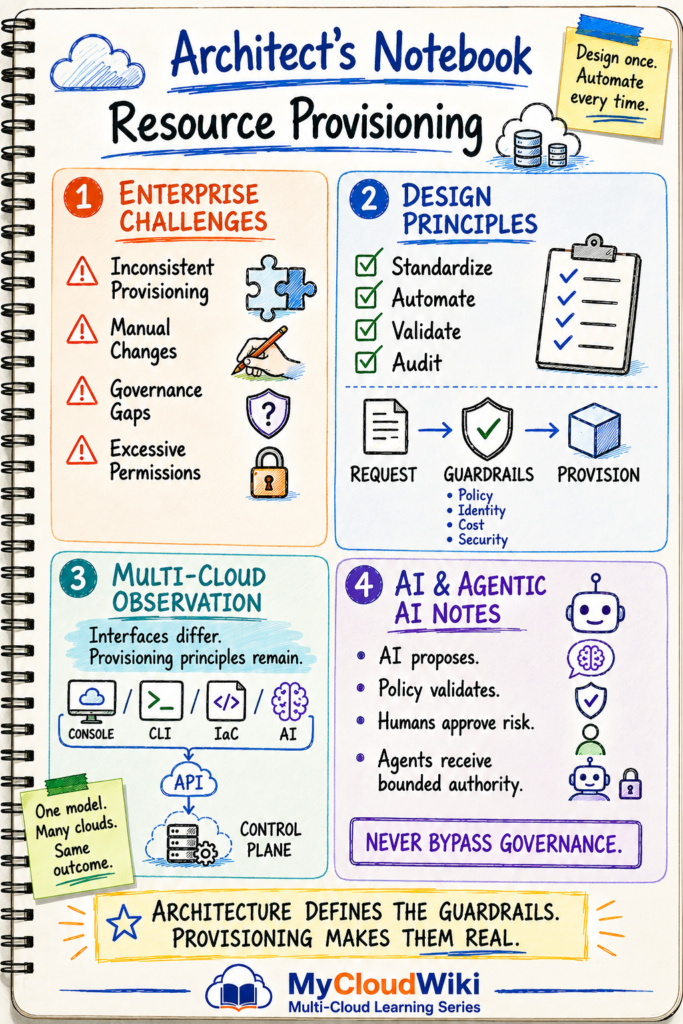
Architect’s Notebook
Resource provisioning is where architecture becomes operational reality.
If architecture standards exist only in documents, engineers must remember and interpret them during every deployment.
The stronger model is to make those standards part of the provisioning system.
Final Reminder
Provisioning maturity is not measured by how quickly infrastructure can be created. It is measured by how safely, consistently, and repeatably the enterprise can create and change it.
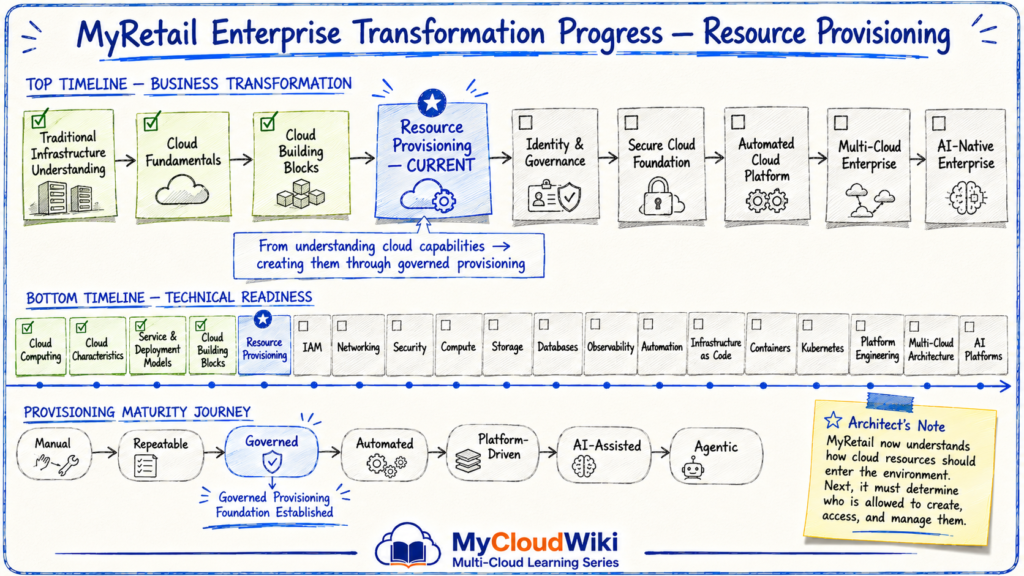
MyRetail Business Solution & Progress
MyRetail now understands how cloud architecture becomes real infrastructure.
The organization is moving away from teams creating resources independently toward a common provisioning model built around repeatability, governance, automation, and controlled AI assistance.
The Business Solution
MyRetail will establish a governed provisioning approach rather than immediately forcing every team onto one tool.
The initial model focuses on:
- Standard provisioning methods.
- Reusable infrastructure patterns.
- Infrastructure as Code for repeatable environments.
- Policy validation before deployment.
- Consistent tagging and naming.
- Security and identity guardrails.
- Cost visibility.
- Deployment audit trails.
- AI assistance within existing controls.
What Changes for MyRetail
Before
- Teams provision resources differently.
- Manual console deployment is common.
- Configuration can vary between environments.
- Architecture standards depend on human interpretation.
- Resource ownership and cost attribution can be inconsistent.
After This Lesson
- Teams understand the approved provisioning lifecycle.
- Repeatable provisioning becomes the preferred direction.
- Architecture standards begin moving into templates and policies.
- AI-generated infrastructure follows the same review process as human-generated infrastructure.
- Future self-service and agentic provisioning have a governance foundation.
MyRetail has not yet completed its provisioning transformation.
Later lessons on IAM, networking, security, automation, Infrastructure as Code, DevOps, and platform engineering will progressively mature this model.
Business Outcome
MyRetail now has a foundation for moving from:
Ad Hoc Resource Creation → Governed Resource Provisioning
This creates the operational bridge between understanding cloud capabilities and safely deploying them at enterprise scale.
Knowledge Check
Test your understanding of resource provisioning before continuing.
1. What is cloud resource provisioning?
💡 Show Answer
Resource provisioning is the process of creating and configuring the cloud resources required by a workload.
Architecture identifies the capabilities a workload requires. Provisioning turns those requirements into actual resources inside the cloud environment.
2. Does the cloud console directly create infrastructure?
💡 Show Answer
No. The console acts as an interface that submits management requests to the cloud provider’s APIs and control plane.
Console, CLI, SDK, IaC, automation, and AI-assisted workflows are different ways of initiating provisioning actions. The provider control plane remains responsible for resource management.
3. What is the main difference between imperative and declarative provisioning?
💡 Show Answer
Imperative provisioning describes the actions to perform. Declarative provisioning describes the desired infrastructure state.
With declarative provisioning, the provisioning engine determines the actions required to reach the specified state.
4. Why does Infrastructure as Code matter in enterprise environments?
💡 Show Answer
IaC makes infrastructure definitions repeatable, version-controlled, reviewable, reusable, and auditable.
IaC reduces dependence on manual configuration, but the infrastructure definition must still follow architecture, security, and governance standards.
5. How should AI-assisted provisioning be governed?
💡 Show Answer
AI-generated infrastructure should pass through the same validation, security, policy, review, approval, and deployment controls as human-generated infrastructure.
AI changes how infrastructure requests can be created or interpreted. It should not become a path around enterprise governance.
6. What does bounded autonomy mean for an AI provisioning agent?
💡 Show Answer
The agent receives only the identities, permissions, tools, environments, resource types, and execution authority required for approved tasks.
Agentic provisioning should provide enough authority to complete permitted workflows without granting unrestricted access to cloud infrastructure.
Key Takeaways
- Resource provisioning turns architecture into running cloud resources.
- Console, CLI, SDK, API, IaC, automation, platforms, and AI are different provisioning interfaces and operating models.
- Cloud management requests ultimately interact with provider APIs and the control plane.
- Authentication identifies the requester; authorization determines what that identity may do.
- Enterprise provisioning adds policy, security, naming, tagging, cost, monitoring, and audit controls.
- Infrastructure as Code makes infrastructure more repeatable, reviewable, and auditable.
- Declarative provisioning describes the desired state rather than every action required to create it.
- Self-service should simplify infrastructure consumption without removing governance.
- AI-assisted provisioning can translate human intent into commands, configurations, IaC, and deployment plans.
- AI-generated infrastructure should follow the same controls as human-generated infrastructure.
- Agentic provisioning introduces greater agency and therefore requires stronger boundaries.
- Provisioning maturity means greater consistency and control—not simply more automation.

