
From Cloud Fundamentals to the Infrastructure Decision
In What Is Cloud Computing? A Practical Multi-Cloud Guide for Engineers and Architects, MyRetail identified cloud computing as a possible foundation for its future technology strategy.
The company has not created cloud infrastructure or migrated any applications.
Before taking that step, MyRetail must understand what would actually change.
Would cloud computing simply place the same servers in another company’s data center?
Or would it change how infrastructure is purchased, provisioned, scaled, governed, and operated?
This lesson explores those questions.
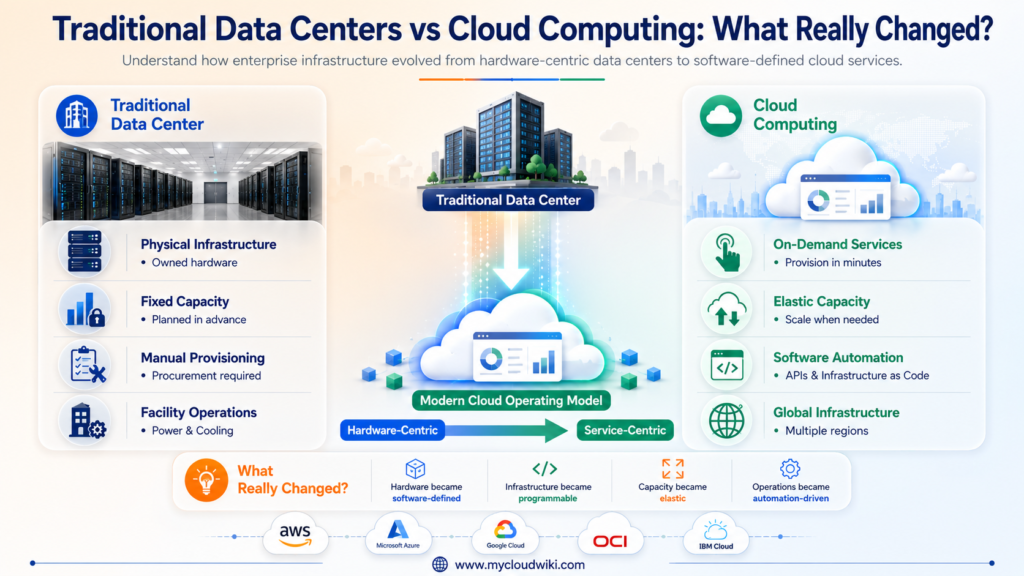
This Is an Operating-Model Comparison
Traditional data centers and cloud platforms both rely on physical infrastructure.
Servers, storage systems, networks, facilities, and operational teams still exist in both models.
The difference is how those capabilities are delivered and managed.
Traditional data centers typically require organizations to:
- Forecast future demand
- Purchase infrastructure
- Install and configure hardware
- Maintain facilities
- Plan replacement cycles
- Build additional capacity before it is needed
Cloud computing introduces a service-based model.
Organizations can request approved resources through software interfaces, automate deployments, adjust capacity, and use managed services without operating every physical layer themselves.
The Decision Is Not Data Center or Cloud
MyRetail does not need to choose one platform for every workload.
Some systems may remain in its existing data centers because of:
- Local store dependencies
- Specialized hardware
- Strict latency requirements
- Legacy integration
- Regulatory requirements
- Long-term application constraints
Other workloads may eventually benefit from cloud capabilities such as elasticity, automation, managed services, analytics, or global infrastructure.
This makes the real decision more practical:
Which environment is the best fit for each workload?
That question will eventually lead MyRetail company toward the deployment choices explored in Cloud Deployment Models Explained: Public, Private, Hybrid, Multi-Cloud and Sovereign Cloud.
Why a Multi-Cloud Perspective Matters
MyRetail company is not evaluating only one cloud provider.
Its future strategy may involve a combination of its existing data centers and services from AWS, Microsoft Azure, Google Cloud, Oracle Cloud Infrastructure (OCI), and IBM Cloud.
Each provider offers different strengths, services, geographic coverage, commercial models, and enterprise integrations.
However, the foundational change is common across all of them:
- Infrastructure becomes software-accessible.
- Capacity becomes more flexible.
- Provisioning becomes faster.
- Services can be consumed when needed.
- Governance becomes increasingly important.
MyRetail must understand these common principles before comparing individual providers in The Five Major Cloud Providers: AWS, Azure, Google Cloud, OCI and IBM Cloud Compared.
What You Will Learn
In this article, you will learn:
- How traditional data centers deliver infrastructure
- Why physical infrastructure can become difficult to scale
- What changed with cloud computing
- How cloud and data center operating models differ
- Why hybrid and multi-cloud models are common
- How engineers and architects evaluate the transition
- How MyRetail will plan its next modernization milestone
This lesson does not assume that cloud is always better.
It provides the foundation needed to make informed workload-placement decisions based on business needs, technical requirements, risk, and long-term value.
MyRetail Business Challenge
In the previous lesson, MyRetail decided that cloud computing could become the foundation of its future technology strategy.
Before making any investment decisions, the leadership team wants to answer an important question:
What exactly would change if we moved from traditional infrastructure to a cloud operating model?
The goal isn’t to replace everything overnight.
Instead, MyRetail wants to understand which parts of its existing infrastructure still provide value and where cloud computing could improve agility, scalability, and operational efficiency.
MyRetail Journey
Business Challenge
MyRetail operates retail stores, warehouses, corporate applications, and a rapidly growing e-commerce platform.
Leadership needs to know whether expanding existing data centers is the best long-term strategy.
Engineers must understand how infrastructure provisioning and operations would change in a cloud environment.
Architects need an objective comparison before recommending a future hybrid and multi-cloud strategy.
Understand the strengths, limitations, and operating differences between traditional data centers and cloud computing before evaluating cloud service models.
What Is a Traditional Data Center?
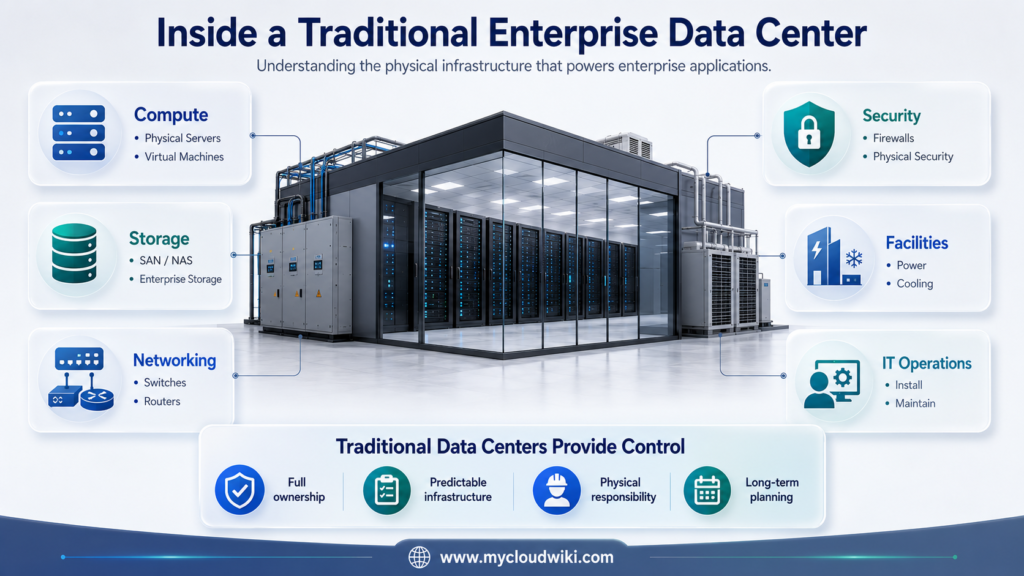
A traditional data center is a physical facility where an organization owns, manages, and operates the infrastructure required to run its business applications.
Instead of consuming computing resources as services, organizations purchase and maintain the hardware themselves.
A typical enterprise data center contains multiple technology components working together to deliver reliable IT services.
Core Components
Most traditional data centers include:
- Compute servers
- Storage systems
- Networking equipment
- Security appliances
- Backup infrastructure
- Power and cooling systems
- Physical security controls
- Monitoring and management platforms
Every component must be planned, installed, maintained, upgraded, and eventually replaced throughout its lifecycle.
Infrastructure Is Built Before It Is Needed
One of the defining characteristics of a traditional data center is capacity planning.
Organizations estimate future demand and purchase enough infrastructure to support expected business growth.
For example, if MyRetail expects its online sales to double over the next three years, it may need to purchase additional servers, storage, and networking equipment well before those resources are actually required.
This approach provides control, but it also introduces forecasting risk.
If demand grows faster than expected, the infrastructure may become constrained.
If growth is slower than expected, expensive hardware may remain underutilized.
Owning Infrastructure Means Owning Responsibility
Operating a traditional data center gives organizations complete control over their infrastructure.
However, that control comes with operational responsibilities.
IT teams are responsible for:
- Procuring hardware
- Installing equipment
- Managing operating systems
- Applying firmware updates
- Replacing failed components
- Monitoring infrastructure health
- Maintaining physical facilities
- Planning future capacity
As business demands increase, these responsibilities also grow.
Traditional Data Centers Still Matter
Cloud computing has changed how infrastructure is consumed, but it has not eliminated the need for traditional data centers.
Many enterprises continue to operate on-premises environments because of:
- Regulatory requirements
- Data sovereignty
- Specialized hardware
- Manufacturing systems
- Low-latency applications
- Existing technology investments
- Legacy business applications
For many organizations—including MyRetail—the future is likely to involve both traditional infrastructure and cloud platforms working together.
Understanding how each model operates is the first step toward making informed architecture decisions.
Why Traditional Data Centers Became Difficult to Scale
For many years, traditional data centers successfully supported enterprise applications.
They provided organizations with full control over infrastructure, security, networking, and operations.
However, as businesses became increasingly digital, customer expectations changed dramatically.
Applications needed to be deployed faster.
Services needed to scale globally.
Innovation cycles became shorter.
Infrastructure was no longer expected to support only business operations—it had to accelerate business growth.
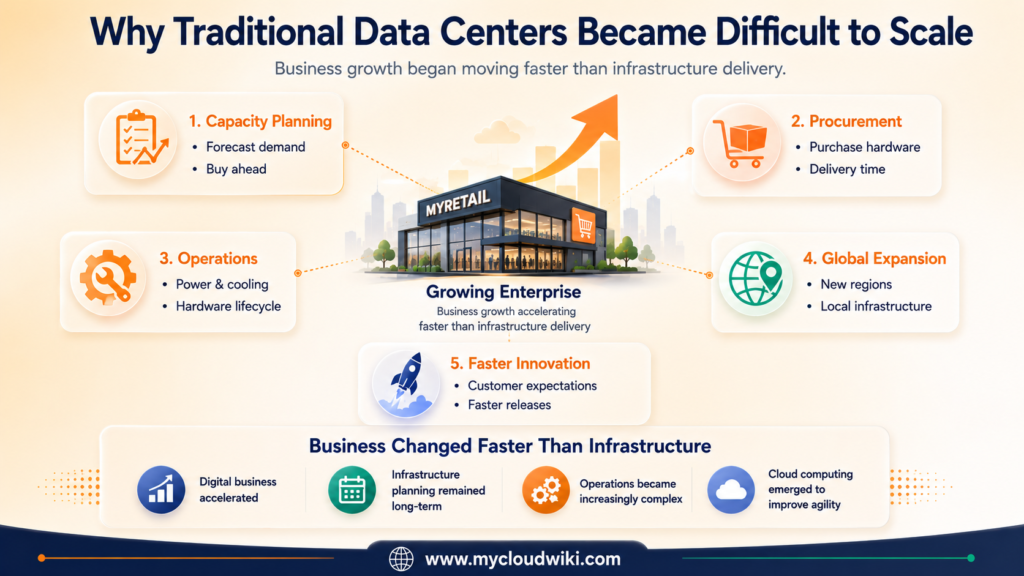
For organizations like MyRetail, these changing expectations exposed several operational challenges.
Infrastructure Growth Required Long-Term Planning
Traditional infrastructure cannot usually be expanded instantly.
Before additional capacity becomes available, organizations often need to complete several activities.
These include:
- Forecasting future demand
- Preparing budgets
- Selecting vendors
- Purchasing hardware
- Waiting for delivery
- Installing equipment
- Configuring infrastructure
- Testing before production
Each activity adds time to the overall delivery process.
For planned business growth this approach works well.
For rapidly changing digital services, it can become a limitation.
Seasonal Business Demand Created Capacity Challenges
Retail businesses rarely experience constant demand.
For MyRetail, online shopping activity increases significantly during events such as:
- Black Friday
- Cyber Monday
- Holiday shopping seasons
- Promotional campaigns
- New product launches
Traditional data centers often require organizations to purchase enough infrastructure for peak demand.
The challenge is that much of this infrastructure may remain underutilized during normal business periods.
As a result:
- Peak demand drives infrastructure investment.
- Normal demand uses only a portion of that investment.
This creates a balance between performance, utilization, and cost.
Infrastructure Ownership Increased Operational Responsibility
Operating a data center involves much more than managing servers.
Enterprise IT teams are also responsible for maintaining:
- Power systems
- Cooling systems
- Physical security
- Network infrastructure
- Hardware lifecycle
- Firmware updates
- Capacity planning
- Disaster recovery facilities
Each additional application increases operational complexity.
As organizations grow, infrastructure teams spend more time maintaining platforms and less time enabling business innovation.
Global Expansion Became More Complex
Expanding into a new country traditionally required much more than deploying an application.
Organizations often needed to consider:
- New data center facilities
- Network connectivity
- Local regulations
- Disaster recovery
- Regional support teams
- Data residency requirements
These activities required significant planning and investment before customers could access new digital services.
For businesses expanding internationally, infrastructure deployment often became one of the longest phases of a project.
Innovation Began Moving Faster Than Infrastructure
Perhaps the biggest challenge wasn’t technology.
It was speed.
Business teams wanted to:
- Launch new digital services
- Test new ideas
- Enter new markets
- Respond to customer demand
- Deliver software more frequently
Traditional infrastructure was designed for stability and predictable growth.
Modern digital businesses required stability and speed.
This growing gap became one of the primary reasons organizations began exploring cloud computing.
💡 Architect’s Tip
The challenge was never that traditional data centers stopped working. The challenge was that **business expectations evolved faster than traditional infrastructure operating models**. Good architects evaluate workload requirements objectively and select the platform that best supports business outcomes.
What Changed with Cloud Computing?
Cloud computing did not eliminate data centers.
In fact, cloud providers operate some of the world’s largest and most advanced data centers.
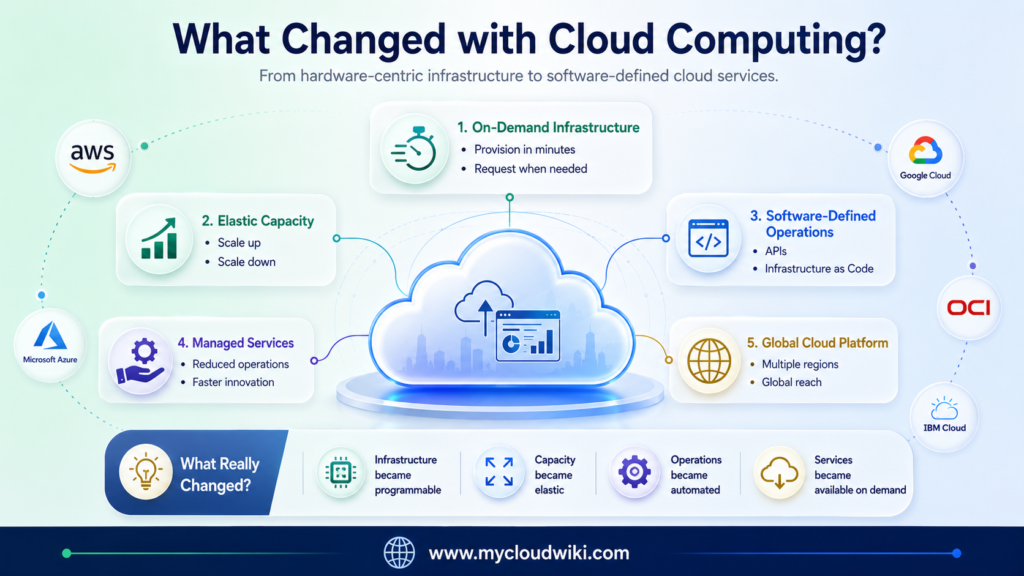
What changed was how organizations consume infrastructure.
Instead of purchasing, installing, and managing every physical component themselves, organizations can request computing resources as services when they are needed.
This represents a shift from a hardware-centric operating model to a service-centric operating model.
Infrastructure Became On-Demand
In a traditional environment, deploying new infrastructure often required weeks or months of planning.
Cloud computing introduced a different approach.
After the necessary governance, security, and approvals are in place, infrastructure can be provisioned through software.
Engineers no longer need to wait for physical hardware before beginning many projects.
Instead, approved resources can be requested using:
- Management consoles
- Command-line interfaces (CLI)
- APIs
- SDKs
- Infrastructure as Code (IaC)
You’ll explore these provisioning methods in detail in How Cloud Resources Are Created Across Multi-Cloud: Console, CLI, SDK, API, IaC and Agentic AI.
Capacity Became Elastic
Business demand rarely remains constant.
Some applications experience steady usage.
Others experience sudden spikes.
Instead of permanently purchasing enough hardware for peak demand, cloud platforms introduced elastic capacity.
Resources can increase or decrease based on workload requirements.
For MyRetail, this could eventually help support major shopping events without maintaining peak infrastructure throughout the year.
Elasticity improves flexibility.
It does not remove the need for good architecture, monitoring, or cost management.
Infrastructure Became Software-Defined
One of the biggest changes introduced by cloud computing was the ability to manage infrastructure through software.
Servers, storage, networking, and security services can now be described as code.
This allows engineering teams to:
- Automate deployments
- Standardize environments
- Version infrastructure
- Review changes
- Reduce manual configuration
Infrastructure becomes repeatable rather than handcrafted.
Global Infrastructure Became Easier to Access
Expanding into a new geographic region traditionally required significant planning and investment.
Cloud platforms provide infrastructure across many regions worldwide.
Instead of building every new facility, organizations can evaluate existing cloud regions that meet their business, regulatory, and technical requirements.
Whether MyRetail eventually chooses AWS, Microsoft Azure, Google Cloud, Oracle Cloud Infrastructure (OCI), IBM Cloud, or a combination of providers, the underlying principle remains the same:
Infrastructure becomes available closer to where the business needs to operate.
Managed Services Reduced Operational Overhead
Cloud computing also introduced managed services.
Instead of operating every database, messaging platform, analytics service, or application platform themselves, organizations can choose services where part of the operational responsibility is managed by the provider.
This allows engineering teams to spend more time delivering business capabilities and less time maintaining supporting infrastructure.
Exactly which responsibilities remain with the customer depends on the cloud service model.
That is why the next lesson on Cloud Service Models (IaaS, PaaS, SaaS, CaaS, FaaS and Serverless) is one of the most important topics in this learning series.
💡 Architect’s Tip
Cloud computing is not simply virtual infrastructure hosted somewhere else. The real transformation is the shift to software-defined operations, automation, elasticity, and service-based consumption. Those operating principles apply across every major cloud provider.
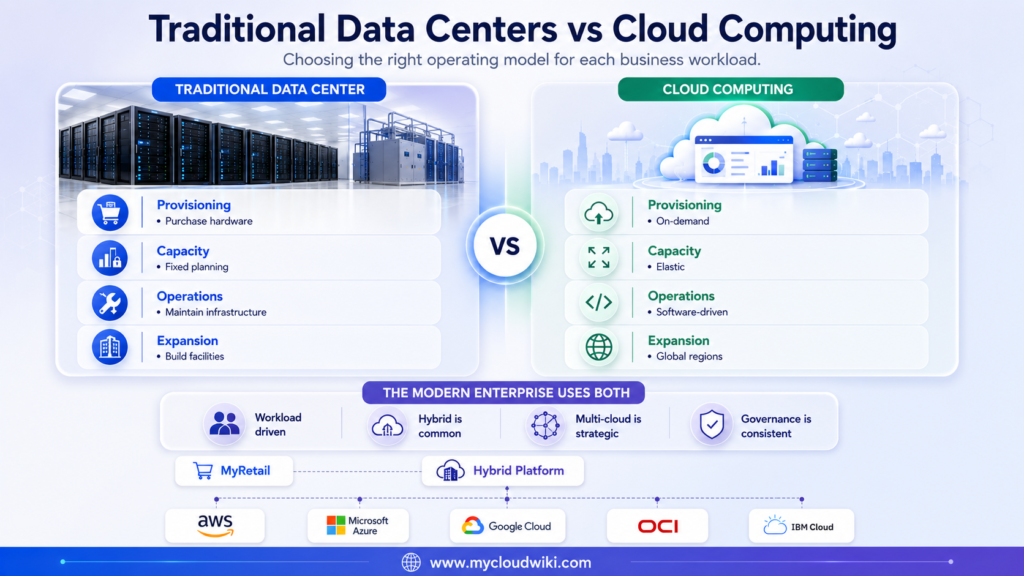
Traditional Data Centers vs Cloud Computing
By now, MyRetail understands how traditional data centers operate and what changed with cloud computing.
The next step is to compare both operating models side by side.
Rather than asking “Which one is better?”, architects ask a different question:
“Which operating model is the best fit for this workload?”
That question forms the foundation of modern enterprise architecture.
Traditional Data Centers and Cloud Computing Serve Different Needs
Traditional data centers provide organizations with complete ownership and direct control over their infrastructure.
Cloud computing focuses on delivering infrastructure as an on-demand service.
Both approaches have strengths.
Many enterprises continue using both because different workloads have different requirements.
For example:
- Manufacturing systems may remain on-premises.
- Customer-facing applications may benefit from cloud elasticity.
- Sensitive workloads may require local infrastructure.
- Analytics platforms may leverage cloud scalability.
The objective is to choose the right platform for each business capability.
Comparison Overview
Compare how traditional data centers and cloud computing differ across provisioning, capacity, operations, automation, expansion, and investment.
| Area | Traditional Data Center | Cloud Computing |
|---|---|---|
| Provisioning | Purchase and install infrastructure | Provision approved services on demand |
| Capacity | Planned and purchased in advance | Elastic and scalable with demand |
| Operations | Manage facilities and infrastructure | Manage cloud resources and services |
| Automation | Often process- and tool-specific | API and Infrastructure as Code driven |
| Expansion | Build or acquire additional infrastructure | Use existing cloud-provider regions |
| Investment | Infrastructure ownership and lifecycle costs | Service consumption and cost governance |
Modern Enterprises Rarely Choose Only One
Cloud computing did not replace traditional data centers overnight.
Instead, it expanded the architectural choices available to organizations.
Today, many enterprises operate:
- Traditional data centers
- Private cloud platforms
- Public cloud services
- SaaS applications
- Edge infrastructure
These environments often work together to support different business requirements.
From Data Centers to Hybrid and Multi-Cloud
For MyRetail, the future is unlikely to involve moving every application to a single cloud provider.
A more realistic approach is to gradually modernize the technology landscape while continuing to use existing investments where they make business sense.
This naturally introduces two important architectural concepts:
Hybrid Cloud
Hybrid cloud combines traditional infrastructure with cloud services.
Some workloads remain on-premises, while others use cloud platforms.
This allows organizations to modernize gradually instead of replacing everything at once.
You’ll explore this approach in Cloud Deployment Models Explained: Public, Private, Hybrid, Multi-Cloud and Sovereign Cloud.
Multi-Cloud
Multi-cloud means intentionally using more than one cloud provider to support business requirements.
MyRetail may eventually evaluate services from:
- AWS
- Microsoft Azure
- Google Cloud
- Oracle Cloud Infrastructure (OCI)
- IBM Cloud
Each provider offers different strengths.
Successful architects focus on choosing the right platform for each workload rather than trying to standardize on a single provider.
Multi-Cloud Perspective
Although service names differ, the underlying concepts remain remarkably consistent.
Whether MyRetail eventually uses AWS, Microsoft Azure, Google Cloud, Oracle Cloud Infrastructure (OCI), or IBM Cloud, architects still need to consider:
- Governance
- Identity
- Security
- Networking
- Automation
- Monitoring
- Cost optimization
- Operational excellence
Understanding these common principles is far more valuable than memorizing provider-specific services.
That is why this learning series always teaches the concept first and the provider implementation second.
📊 Business Insight
Enterprise architecture is no longer about choosing between traditional infrastructure and cloud computing. It is about selecting the right operating model for each workload while maintaining consistent governance across the entire technology landscape.
Engineer and Architect Perspective
Moving from traditional infrastructure to cloud computing changes more than the technology platform.
It also changes how engineers and architects plan, build, operate, and govern enterprise systems.
For MyRetail, both roles will be essential as the company evaluates which workloads should remain in its data centers and which may eventually move to cloud platforms.
Engineer Focus
Engineers will concentrate on how the future environment is implemented and operated.
Their responsibilities may include:
- Discovering current servers, applications, and dependencies
- Building repeatable infrastructure automation
- Configuring networking, identity, and monitoring
- Testing workload performance
- Troubleshooting migration and operational issues
- Improving deployment consistency
The goal is to turn approved architecture into secure, reliable, and supportable environments.
Architect Focus
Architects will concentrate on the long-term operating model.
Their responsibilities may include:
- Defining workload-placement principles
- Evaluating hybrid and multi-cloud options
- Establishing security and governance standards
- Designing for resilience and recovery
- Comparing lifecycle cost and business value
- Reducing unnecessary complexity
Architects must also ensure that provider decisions remain aligned with business requirements rather than vendor preference.
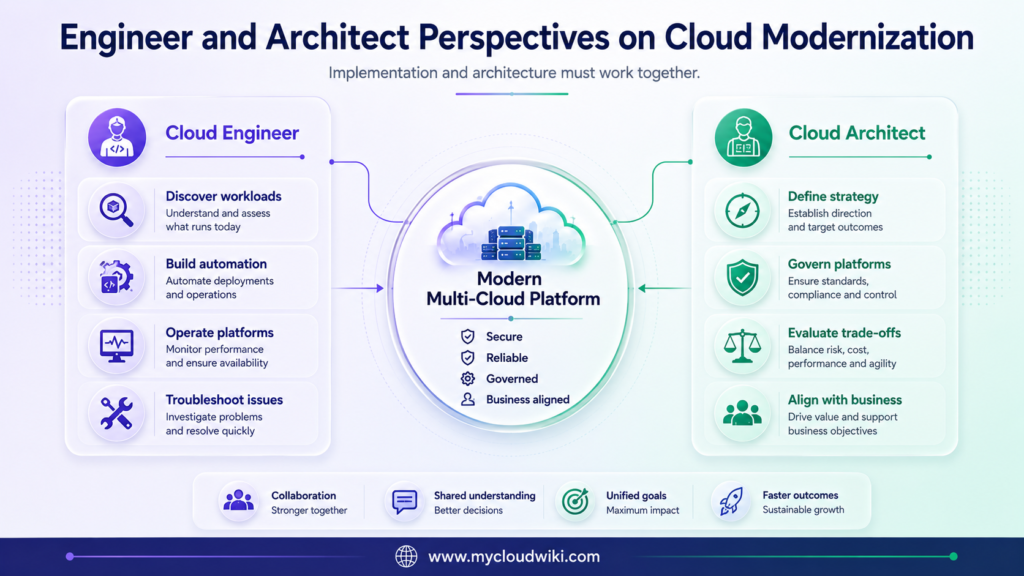
Engineer and Architect Perspective
Engineers focus on implementation and operations, while architects focus on design, governance, and long-term business alignment.
| Cloud Engineer Focus | Cloud Architect Focus |
|---|---|
| Discover workloads and dependencies | Define workload-placement principles |
| Build repeatable automation | Define architecture standards |
| Configure identity, network, and monitoring | Establish security and governance |
| Test performance and reliability | Evaluate resilience and recovery |
| Operate and troubleshoot platforms | Compare cost, risk, and business value |
| Improve operational consistency | Guide the future multi-cloud roadmap |
MyRetail will need both perspectives.
Engineering without architecture may create fast but inconsistent environments.
Architecture without engineering feedback may produce designs that are difficult to implement or operate.
Applying Well-Architected Principles
The decision between traditional infrastructure and cloud computing should not be based on trend or vendor preference.
It should be evaluated through provider-neutral enterprise architecture principles.
These principles remain relevant whether MyRetail uses existing data centers, private platforms, or services from AWS, Microsoft Azure, Google Cloud, Oracle Cloud Infrastructure (OCI), and IBM Cloud.
Operational Excellence
MyRetail should compare how each operating model supports repeatable delivery, monitoring, automation, and continuous improvement.
Traditional environments may already have mature operational processes.
Cloud environments can increase automation, but only when teams establish clear standards and ownership.
Security
Security responsibilities change across operating models.
In a traditional data center, MyRetail manages almost every layer.
In cloud environments, some infrastructure responsibilities shift to the provider, while MyRetail remains responsible for identity, data, configuration, access, and application security.
The exact boundary will depend on the service model explored in the next lesson.
Reliability
Reliability depends on architecture, not location alone.
A workload running in a cloud region is not automatically resilient.
MyRetail must evaluate failure domains, backup, recovery, redundancy, dependencies, and operational readiness across every platform.
Performance Efficiency
Each workload should run where its performance requirements are best supported.
Some applications may need low-latency access to store or warehouse systems.
Others may benefit from elastic cloud capacity or globally distributed services.
Performance decisions should be based on evidence rather than assumptions.
Cost Optimization
Traditional infrastructure and cloud computing use different financial models.
MyRetail will need to compare:
- Hardware ownership
- Facility operations
- Support contracts
- Cloud consumption
- Commitment discounts
- Data-transfer charges
- Migration effort
- Operational skills
Cost optimization is not about selecting the cheapest platform.
It is about achieving the best business value across the full lifecycle.
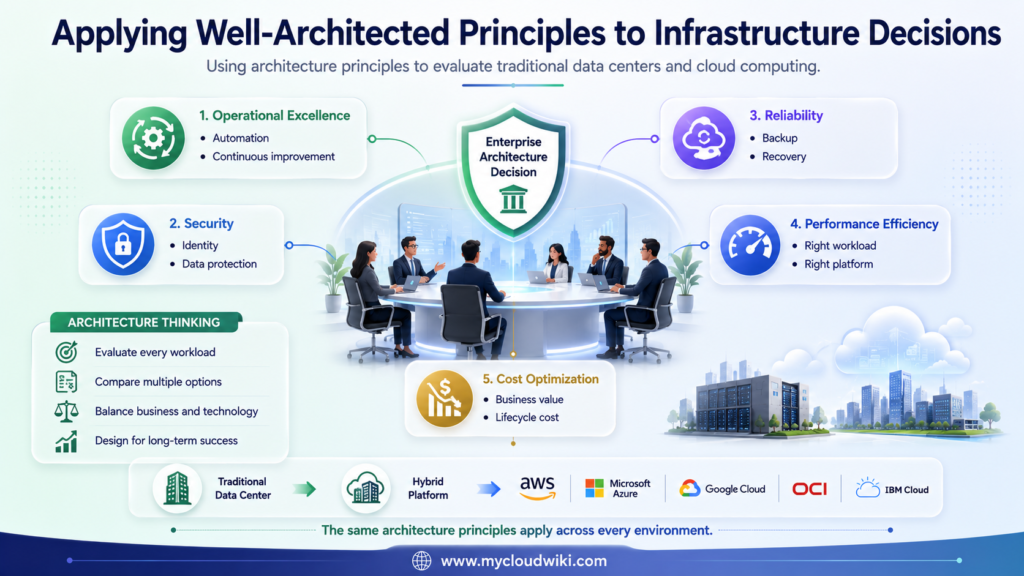
Well-Architected View
Use common enterprise principles to evaluate traditional, hybrid, and cloud operating models.
| Principle | How MyRetail Should Apply It |
|---|---|
| Operational Excellence | Compare automation, monitoring, ownership, and continuous improvement across platforms. |
| Security | Define clear responsibility for identity, data, configuration, applications, and infrastructure. |
| Reliability | Design for failure, recovery, redundancy, and operational readiness in every environment. |
| Performance Efficiency | Place workloads where latency, scale, and service capabilities best meet business needs. |
| Cost Optimization | Compare lifecycle cost, consumption, migration effort, commitments, and business value. |
The same principles will continue across later lessons covering identity, networking, compute, storage, databases, automation, and resilience.
AI and Agentic AI Perspective
MyRetail is at the assessment stage of its modernization journey.
Before purchasing new hardware or investing in cloud platforms, the company first needs to understand its current technology landscape and evaluate the available options.
This is where AI and Agentic AI can significantly improve both business planning and technical analysis.
Rather than replacing human expertise, these technologies help organizations make better, faster, and more informed infrastructure decisions.
Business Transformation
One of the biggest challenges facing enterprise leaders is deciding where to invest next.
AI helps transform infrastructure planning from a manual, spreadsheet-driven activity into a data-driven decision process.
For organizations evaluating traditional data centers and cloud computing, AI can help:
- Forecast future infrastructure demand
- Compare modernization investment options
- Identify operational risks earlier
- Prioritize business initiatives
- Improve planning accuracy
- Accelerate executive decision-making
Instead of relying on assumptions, leadership teams gain insights based on real infrastructure data and business trends.
MyRetail
AI Business Value
| MyRetail Challenge | How AI & Agentic AI Help |
|---|---|
| Growing infrastructure complexity | Automatically discover infrastructure assets and application relationships. |
| Uncertain future capacity | Forecast infrastructure demand using historical utilization trends. |
| Modernization planning | Compare traditional, hybrid, and cloud operating models before investing. |
| Leadership decisions | Generate executive-ready assessment reports with supporting recommendations. |
AI helps organizations understand where they are today and where they should invest next, making it easier to evaluate whether traditional infrastructure, cloud computing, or a combination of both best supports future business goals.
Technical Transformation
Before organizations can modernize infrastructure, they need an accurate understanding of their existing environment.
AI can analyze infrastructure significantly faster than traditional manual assessments.
For this lesson, AI can assist with:
- Discovering servers and infrastructure assets
- Mapping application dependencies
- Identifying underutilized resources
- Assessing cloud readiness
- Comparing operating models
- Generating assessment documentation
These capabilities provide engineers and architects with better visibility into the current environment before any modernization decisions are made.
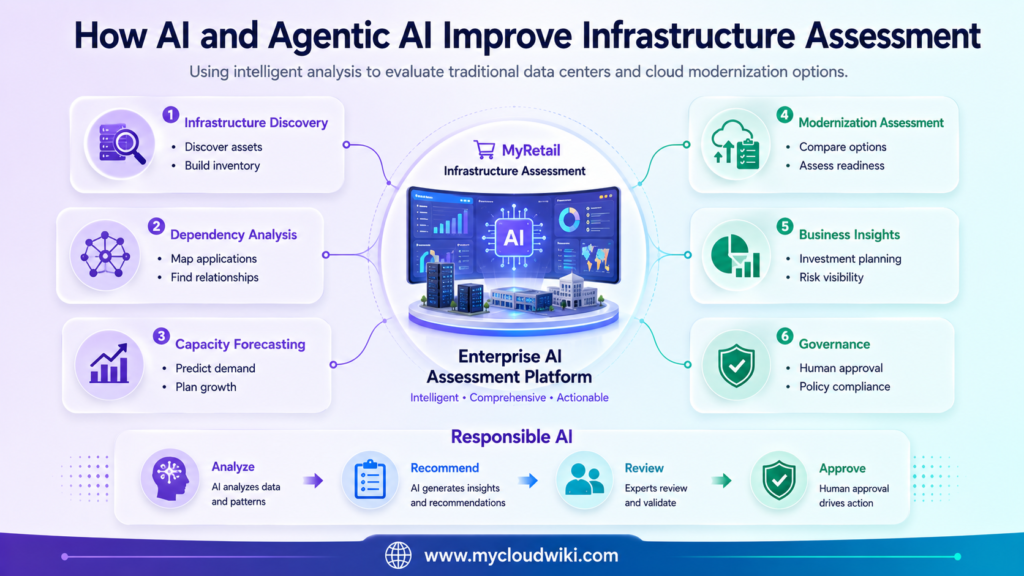
The objective is not to automate modernization.
The objective is to understand the current environment well enough to make informed technical decisions.
Agentic AI Evolution
Agentic AI builds on traditional AI by coordinating multiple assessment activities through intelligent software agents.
Instead of answering one question at a time, AI agents can work together to complete larger assessment workflows.
For infrastructure evaluation, agents can:
- Collect infrastructure inventory
- Correlate application dependencies
- Analyze utilization trends
- Compare modernization scenarios
- Prepare executive summaries
- Recommend the next assessment steps
Enterprise governance remains essential.
AI recommends. People approve.
How This Helps MyRetail
For MyRetail, this lesson is about understanding before modernizing.
The company is evaluating whether expanding its traditional data centers remains the best long-term strategy or whether a future hybrid and multi-cloud approach should be considered.
AI can help MyRetail:
- Build a complete inventory of its existing infrastructure
- Identify applications that may benefit from modernization
- Forecast future capacity requirements
- Compare infrastructure investment options
- Produce assessment reports for business and technology leaders
These insights allow MyRetail to make modernization decisions based on evidence rather than assumptions.
By combining AI-powered analysis with experienced engineering judgment and strong governance, MyRetail is better prepared to decide what should remain in the data center, what may move to the cloud, and why.
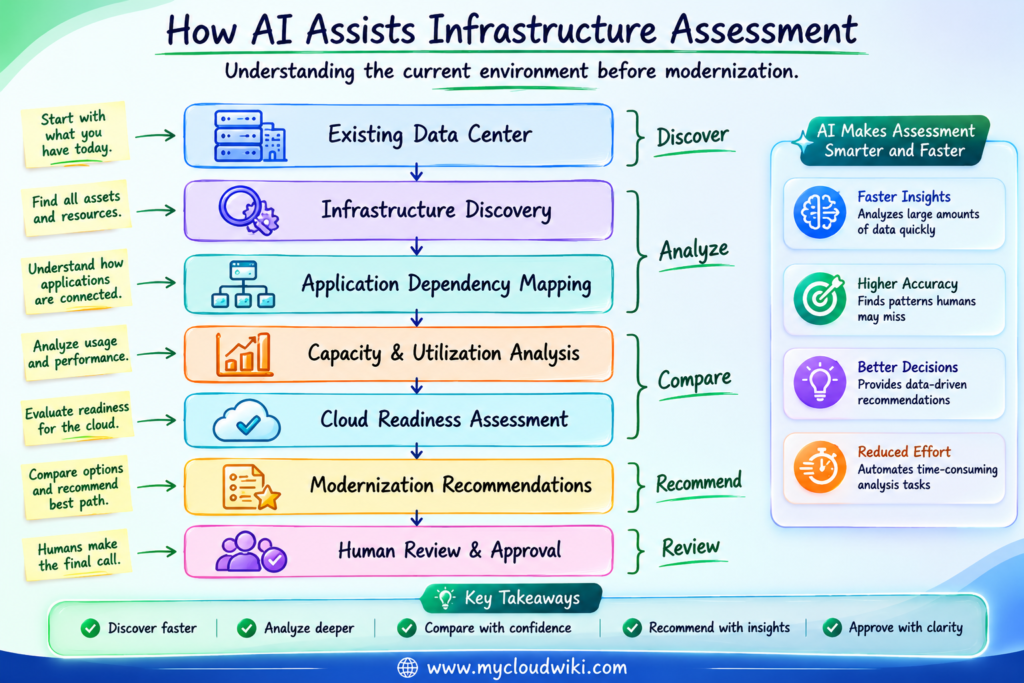
For MyRetail, AI and Agentic AI do not replace the decision-making process—they strengthen it.
At this stage of the journey, the company is evaluating whether expanding traditional data centers remains the right long-term strategy. AI can accelerate infrastructure assessments, identify modernization opportunities, and provide data-driven recommendations that help leadership compare traditional, hybrid, and multi-cloud options with greater confidence.
By combining AI-powered analysis with human expertise and enterprise governance, MyRetail can make informed modernization decisions before investing in its future infrastructure strategy. This lesson establishes the assessment mindset that will guide the company through the rest of the Multi-Cloud Fundamental Learning Series.
Architect’s Notebook
Every infrastructure modernization journey begins with understanding the current environment before making technology decisions.
One of the most common mistakes architects make is comparing technologies instead of comparing business outcomes.
This lesson is not about proving that cloud computing is better than traditional data centers. It is about understanding the strengths, trade-offs, and business implications of each operating model.
As a senior architect, these are the key observations I would record after reviewing MyRetail’s current infrastructure situation.
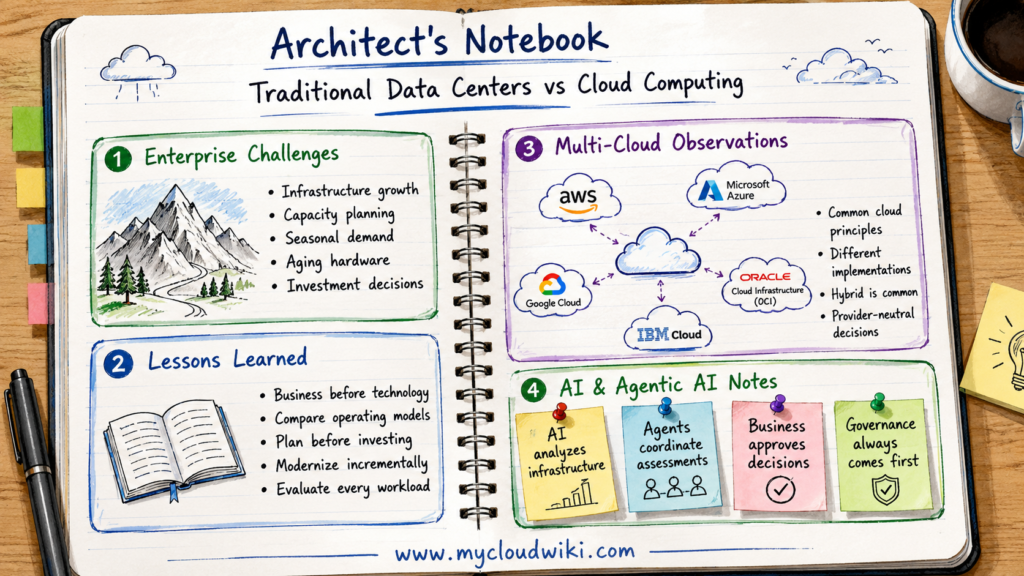
After completing this assessment, one conclusion becomes clear.
MyRetail does not need to choose between traditional infrastructure and cloud computing today. Instead, the company now has a structured way to evaluate which operating model best supports each business requirement.
That understanding provides the foundation for every decision that follows. As the Multi-Cloud Fundamental Learning Series progresses, MyRetail will continue building on this knowledge by exploring cloud service models, deployment models, networking, security, and the other capabilities needed to design a modern enterprise multi-cloud architecture.
How This Lesson Helps MyRetail
At the beginning of this lesson, MyRetail recognized that its existing data centers were becoming increasingly difficult to expand.
Business growth, seasonal shopping events, and future digital initiatives were placing greater demands on the company’s infrastructure.
Rather than immediately deciding to move everything to the cloud, MyRetail first needed to understand how traditional data centers differ from cloud computing and which operating model best supports its long-term business goals.
This lesson has provided that foundation.
MyRetail
Business Outcome
| Before This Lesson | After This Lesson |
|---|---|
| Infrastructure expansion decisions were based mainly on traditional approaches. | Leadership understands the differences between traditional infrastructure and cloud operating models. |
| Business and technology teams had limited visibility into modernization options. | The organization can objectively evaluate modernization choices before making investment decisions. |
| Cloud adoption was viewed as a technology decision. | Cloud adoption is now understood as a business and architectural decision. |
| No structured evaluation framework existed. | MyRetail now has a consistent way to compare infrastructure options before modernizing. |
Business Progress
After completing this lesson, MyRetail has not selected a cloud provider, not migrated workloads, and not built a hybrid environment.
Instead, the company has achieved something more important at this stage—it has established a common understanding of the operating models available to support future business growth.
Business leaders, engineers, and architects can now discuss modernization using the same language and evaluate infrastructure decisions using consistent architectural principles.
That shared understanding reduces uncertainty and creates a stronger foundation for future planning.
Key Takeaways
- Traditional data centers provide direct control, but they require organizations to plan, purchase, operate, and replace physical infrastructure.
- Cloud computing introduced an on-demand, software-driven operating model rather than simply moving servers to another location.
- The key differences involve provisioning speed, elasticity, automation, managed services, global reach, and financial responsibility.
- Traditional infrastructure and cloud computing both remain valuable when matched to the right workload.
- Hybrid and multi-cloud strategies allow enterprises to combine existing investments with services from multiple cloud providers.
- Engineers evaluate implementation and operational readiness, while architects evaluate workload placement, governance, risk, and long-term business value.
- MyRetail has not migrated anything yet; it now has a clearer framework for evaluating its future infrastructure direction.
- The next decision is how much of the technology stack MyRetail should manage under different cloud service models.
Lesson Summary
Remember These Principles
Compare operating models, not only technologies.
Select the environment that best supports each workload requirement.
Treat cloud as a software-driven operating model, not simply remote hosting.
Expect hybrid environments to remain part of enterprise architecture.
Make modernization decisions using business value, evidence, governance, and long-term architecture principles.
These principles give MyRetail a practical foundation for comparing infrastructure choices without assuming that every workload must follow the same modernization path.
Continue the Multi-Cloud Learning Journey
MyRetail now understands how traditional data centers and cloud computing differ.
The next question is how responsibility changes when the company consumes different types of cloud services.

