
Enterprise architecture is no longer only about standards, diagrams, and governance boards. For cloud engineers, DevOps teams, platform teams, and architects, architecture now shows up directly in daily engineering decisions: where workloads run, how platforms enforce controls, how AI agents access systems, how costs are measured, and how operations are automated.
Over the last four weeks, the strongest leadership signals have centered on five areas: AI control gaps, platform engineering as an enterprise control layer, hybrid-by-design cloud strategy, FinOps expansion into AI and platform costs, and AgenticOps for infrastructure operations.
This radar is written for teams building and operating cloud platforms. The goal is to translate leadership-level trends into practical implications for engineering, DevOps, platform operations, and architecture decisions.
Executive Summary
- AI adoption is scaling faster than many governance and control models can support.
- Platform Engineering is becoming the control layer for cloud, AI, security, and developer workflows.
- Hybrid-by-design architecture is replacing simple cloud-first thinking.
- FinOps is expanding beyond cloud bills into AI, platform, and technology value governance.
- Unified infrastructure control planes and AgenticOps are becoming important for future operations.
- Cloud engineers and architects need stronger skills in governance, cost visibility, automation, and AI-enabled operations.
Key Developments This Month
| Development | Category | Impact Level | Recommended Action |
|---|---|---|---|
| AI Control Gaps Create New Architecture Risks | AI Governance | High | Define ownership, identity, approvals, audit, and cost controls for AI systems |
| Platform Engineering Becomes the Control Plane for Cloud and AI | Platform Strategy | High | Embed governance, security, observability, and cost controls into platform services |
| Hybrid-by-Design Becomes the New Cloud Architecture Strategy | Cloud Architecture | High | Reassess workload placement across cloud, private, edge, and sovereign environments |
| FinOps Expands Into Cloud, AI and Platform Cost Governance | Cost Optimization | High | Extend FinOps practices to AI workloads, platforms, and engineering workflows |
| AgenticOps and Unified Control Planes Enter Enterprise Operations | Enterprise Operations | Medium | Evaluate human-plus-agent operations and unified infrastructure management models |
AI Control Gaps Create New Architecture Risks
What’s the Buzz?
- IBM Institute for Business Value reported a widening AI control gap among CIOs and CTOs.
- IBM’s June 2026 study found only a small percentage of surveyed technology leaders feel fully ready for large-scale AI agent deployment.
- AI agent usage is expected to grow significantly by 2027.
- Business-led AI adoption is expanding faster than many IT governance models.
- AI incidents, compliance risks, and unclear ownership are becoming architecture concerns.
Why It Matters
For engineering and architecture teams, AI governance is no longer just a policy topic. AI systems need identities, permissions, observability, approvals, data boundaries, cost controls, and audit trails. If AI agents can call tools, access systems, or trigger workflows, they must be governed like operational actors, not simple applications.
What Engineers Should Learn
✓ AI agent identity and permission models
✓ AI audit logging and observability
✓ Secure AI workflow design
✓ Human-in-the-loop approval patterns
What Architects Should Prepare For
✓ Enterprise AI control models
✓ Agent governance frameworks
✓ AI platform architecture standards
✓ Cross-functional ownership models
Platform Engineering Becomes the Control Plane for Cloud and AI
What’s the Buzz?
- Backstage and Internal Developer Platforms continue shaping enterprise platform strategies.
- Platform teams are increasingly responsible for approved workflows, golden paths, and developer self-service.
- AI tools and agents are becoming part of platform governance discussions.
- Platform Engineering is expanding beyond DevOps automation into security, compliance, cost, and AI controls.
- Golden paths increasingly include identity, observability, policy, and cost visibility by default.
Why It Matters
For DevOps and platform teams, the platform is becoming the place where enterprise standards are enforced without slowing teams down. Instead of asking every team to implement governance manually, platform teams can provide secure templates, approved pipelines, cost-aware deployment patterns, and AI-ready workflows.
What Engineers Should Learn
✓ Internal Developer Platform fundamentals
✓ Golden path design
✓ Platform automation patterns
✓ Policy-as-Code and workflow governance
What Architects Should Prepare For
✓ Platform operating models
✓ Platform product management
✓ Self-service governance architecture
✓ AI and cloud workflow standardization
Hybrid-by-Design Becomes the New Cloud Architecture Strategy
What’s the Buzz?
- Recent enterprise cloud discussions show a shift away from simple cloud-first strategies.
- Rising cloud costs, data gravity, AI infrastructure needs, and sovereignty concerns are influencing workload placement.
- Organizations are reassessing public cloud, private cloud, edge, and sovereign cloud options.
- Kubernetes, containers, and open standards remain important for consistency across environments.
- AI workloads are making data location, latency, GPUs, and egress costs more important.
Why It Matters
Cloud engineers and architects need to think beyond migration. The better question is: where should each workload run to meet cost, performance, security, compliance, and resilience goals? AI makes this harder because inference, training, data movement, and accelerator usage can quickly change the economics of an architecture.
What Engineers Should Learn
✓ Hybrid and multi-cloud deployment patterns
✓ Kubernetes portability concepts
✓ Data gravity and egress cost basics
✓ Edge and AI workload placement considerations
What Architects Should Prepare For
✓ Workload placement frameworks
✓ Hybrid-by-design reference architectures
✓ Sovereignty and compliance requirements
✓ Cost-aware AI infrastructure planning
FinOps Expands Into Cloud, AI and Platform Cost Governance
What’s the Buzz?
- The FinOps Foundation updated its framework to support broader technology value management.
- FinOps for AI guidance highlights cost drivers such as tokens, inference, GPUs, quotas, and usage tracking.
- AI workload costs are becoming harder to forecast than traditional cloud infrastructure costs.
- Platform teams are being asked to expose cost signals earlier in engineering workflows.
- Organizations are connecting FinOps with architecture reviews, platform standards, and executive value discussions.
Why It Matters
FinOps is no longer only about reducing cloud bills. For engineers, it means understanding the cost impact of design decisions. For architects, it means making cost part of architecture, not an afterthought. AI increases this urgency because small design choices around model selection, inference patterns, data movement, and GPU usage can significantly affect cost.
What Engineers Should Learn
✓ FinOps fundamentals
✓ AI cost drivers such as tokens, GPUs, and inference
✓ Tagging, quota, and ownership practices
✓ Cost-aware engineering workflows
What Architects Should Prepare For
✓ AI cost governance models
✓ FinOps integration with architecture reviews
✓ Multi-cloud cost visibility
✓ Business-value-based technology investment decisions
AgenticOps and Unified Control Planes Enter Enterprise Operations
What’s the Buzz?
- Cisco Live 2026 introduced Cisco Cloud Control for unified infrastructure management.
- Cisco described AgenticOps as an operating model where humans and AI agents work together.
- Unified control planes are becoming more important as infrastructure complexity increases.
- Model Context Protocol integration is becoming relevant for agent-to-tool connectivity.
- AI agents are increasingly being positioned for infrastructure, networking, and operational workflows.
Why It Matters
DevOps and operations teams are moving toward environments where humans supervise automated and AI-assisted workflows. This creates new requirements for permissions, approval flows, telemetry, rollback controls, and policy enforcement. AgenticOps is still early, but the direction is clear: infrastructure operations will become more automated and more agent-assisted.
What Engineers Should Learn
✓ Agentic operations concepts
✓ Infrastructure automation patterns
✓ MCP and tool-integration basics
✓ Operational telemetry and control-plane design
What Architects Should Prepare For
✓ Human-plus-agent operating models
✓ Unified infrastructure governance
✓ AI-assisted operations guardrails
✓ Cross-domain observability and control
Other Notable Updates
Workforce Transformation Through AI
- Microsoft Copilot and other AI assistants continue expanding across enterprise workflows.
- AI upskilling and role redesign remain major leadership priorities.
- Human-plus-AI operating models are becoming more practical for engineering and operations teams.
Technology Portfolio Rationalization
- CIOs continue prioritizing vendor consolidation and tool rationalization.
- Architecture simplification is becoming a cost, security, and governance priority.
- Platform standardization is increasingly used to reduce operational complexity.
Enterprise Architecture Modernization
- Architecture teams are moving from documentation-heavy governance toward decision-oriented governance.
- Product-centric and platform-centric operating models continue gaining attention.
- AI, cloud, FinOps, and platform strategies are increasingly discussed together rather than separately.
Architect’s View: The Bigger Enterprise Signal
The strongest signal this month is convergence.
AI governance, platform engineering, cloud architecture, FinOps, and infrastructure operations are no longer separate conversations. They are becoming parts of the same enterprise operating model.
AI forces organizations to rethink governance because agents can act across systems. Platform Engineering provides the delivery layer where approved workflows, security controls, observability, and automation can be embedded. Hybrid-by-design architecture provides the workload placement model for cloud, private infrastructure, edge, and sovereign environments. FinOps provides the financial discipline to connect engineering choices to business value. AgenticOps introduces a future where humans and AI agents operate infrastructure together.
For architects, this means architecture is becoming the control system of the enterprise.
The important questions are changing:
- Who or what is allowed to act?
- Where should a workload run?
- How are AI actions approved and audited?
- How are cloud and AI costs measured?
- Which workflows should be platform-owned?
- Where should humans remain in the loop?
The organizations that succeed will not simply adopt more AI tools. They will build platforms and operating models that make governed AI adoption repeatable, observable, secure, and cost-aware.
Hands-On Readiness Checklist
Engineer Checklist
✓ Map current AI tool usage
Identify which AI assistants, agents, APIs, and platforms are already used across engineering teams.
✓ Add cost visibility to AI workflows
Track tokens, inference calls, GPU usage, model routing, and data movement costs.
✓ Review platform golden paths
Confirm that approved deployment paths include identity, security, observability, and cost controls.
✓ Assess hybrid workload dependencies
Identify workloads affected by data gravity, latency, sovereignty, or egress costs.
✓ Learn agentic operations basics
Understand how AI agents may assist with infrastructure, networking, and operational workflows.
Architect Checklist
✓ Define an AI control model
Clarify ownership, governance, approvals, permissions, audit logging, and lifecycle management for AI systems.
✓ Build a workload placement framework
Evaluate cloud, private, sovereign, and edge placement using cost, control, performance, and compliance criteria.
✓ Extend FinOps into AI architecture reviews
Include token economics, GPU utilization, and data movement costs in design decisions.
✓ Review platform operating models
Ensure platform teams are positioned to govern cloud, AI, security, and developer workflows.
✓ Plan for human-plus-agent operations
Design guardrails for AI-assisted infrastructure and operations before production adoption scales.
Strategic Recommendations
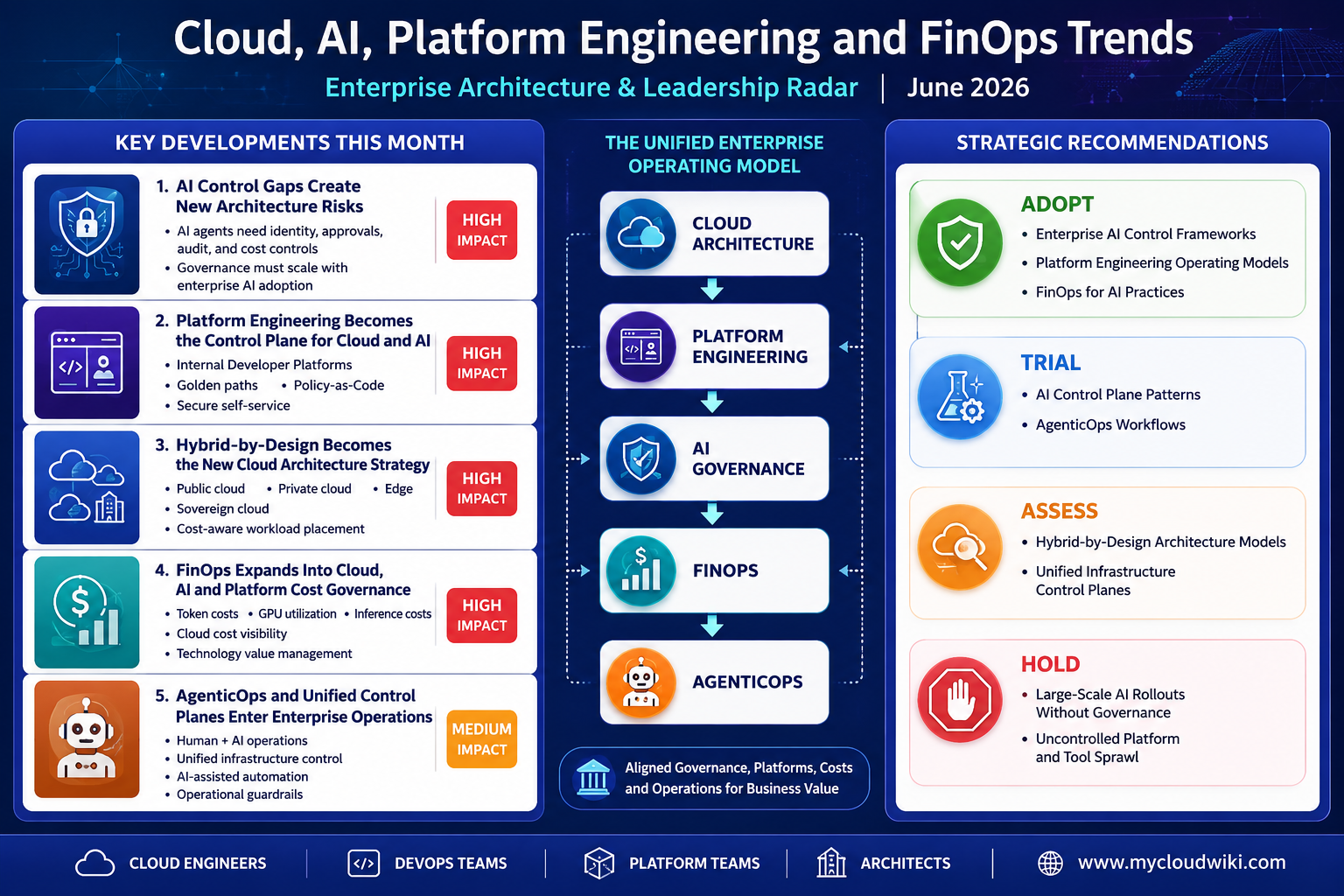
The infographic below summarizes the most important enterprise architecture trends shaping cloud, AI, platform engineering, and FinOps strategies this month. The left side highlights the developments that cloud engineers, DevOps teams, platform teams, and architects should pay attention to, while the right side translates those developments into practical actions and strategic priorities for enterprise technology leaders.
Key Takeaways
The following developments deserve the closest attention from cloud engineers, DevOps/platform teams, and architects.
- AI control gaps are becoming architecture and platform risks.
- Platform Engineering is becoming the enterprise control plane for governed cloud and AI delivery.
- Hybrid-by-design architecture is replacing simplistic cloud-first strategies.
- FinOps is expanding into AI and broader technology value governance.
- AgenticOps and unified control planes point toward the next enterprise operations model.
- Cloud, AI, platform, architecture, and cost decisions are now deeply connected
What’s Next
Watch these developments over the next 4–8 weeks.
- AI governance and control-plane announcements from major technology providers.
- Enterprise adoption patterns for AI agents and Copilot-style workflows.
- Platform Engineering maturity research and IDP adoption trends.
- FinOps Foundation guidance around AI cost and value management.
- Hybrid and sovereign cloud architecture discussions.
- AgenticOps and AI-assisted infrastructure operations announcements.
Learning Resources
Recommended resources for further exploration.
- IBM Institute for Business Value — AI control gap and agentic AI readiness research.
- PlatformEngineering.org — Internal Developer Platform and platform operating model guidance.
- FinOps Foundation — FinOps for AI and 2026 FinOps Framework guidance.
- Cisco Live 2026 coverage — Cloud Control and AgenticOps announcements.
- NIST AI Risk Management Framework — AI governance and risk management foundations.
- Team Topologies — Product-centric operating model guidance.
References
- IBM — New IBM Study Finds CIOs and CTOs Face Growing AI Control Gap as Enterprise Deployment Scales
- Cisco — Cisco Unveils Agentic Platform for Critical IT Infrastructure
- FinOps Foundation — FinOps Framework 2026: Executive Strategy, Technology Categories, and Converging Disciplines
- FinOps Foundation — FinOps for AI Overview
- ITPro — Post-cloud strategy: Architecting the next enterprise stack
- ITPro — Cisco’s infrastructure unification push aims to simplify management for the agentic era
- NIST — AI Risk Management Framework
- Team Topologies — Product-Centric Operating Model Guidance

