
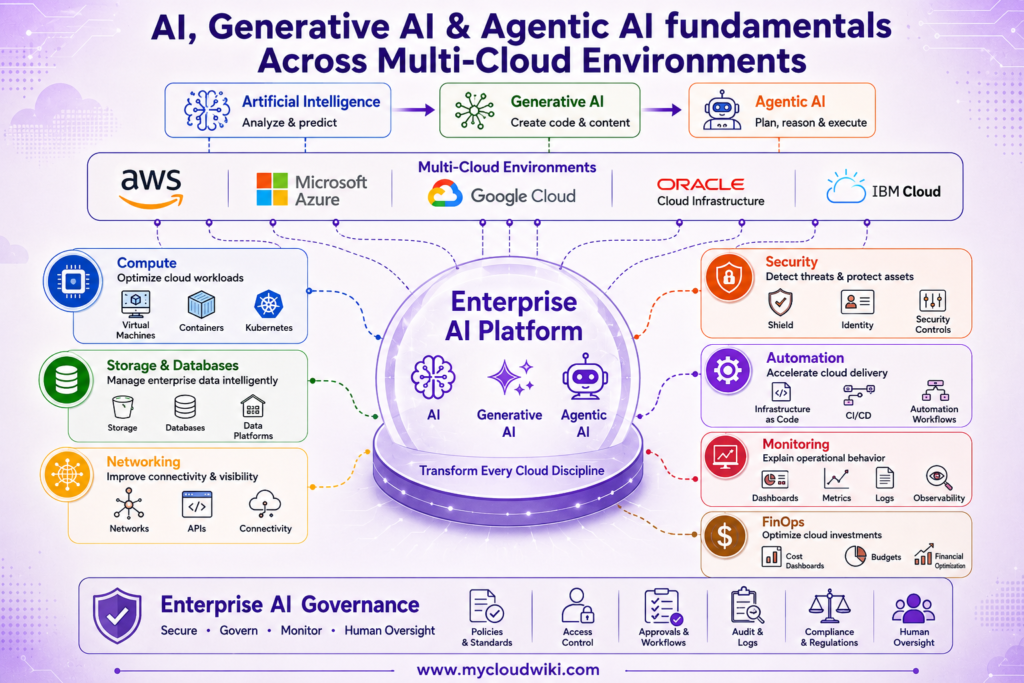
Quick Read
- ✅ Artificial Intelligence helps organizations analyze data, automate decisions, and improve operational efficiency across cloud environments.
- ✅ Generative AI creates new content such as text, code, images, and documentation, enabling engineers and architects to work more productively.
- ✅ Agentic AI extends Generative AI by planning tasks, using tools, executing multi-step workflows, and collaborating with humans under governed controls.
- ✅ Every major cloud provider offers AI capabilities, but enterprise organizations standardize governance, security, and operational practices across multi-cloud environments.
- ✅ AI accelerates cloud engineering, while human oversight remains essential for architecture decisions, security, compliance, and business accountability.
In the previous lesson, you learned how Cloud Pricing & FinOps Fundamentals Explained Across Multi-Cloud Environments helps organizations understand cloud pricing models, optimize cloud spending, and govern financial operations across the major cloud providers.
Modern cloud platforms now generate enormous amounts of operational, security, financial, and application data. As cloud environments become increasingly complex, organizations are turning to Artificial Intelligence to help engineers analyze information, automate repetitive tasks, improve decision-making, and operate cloud platforms more efficiently.
This lesson introduces Artificial Intelligence, Generative AI, and Agentic AI from a cloud engineering and enterprise architecture perspective. Rather than treating AI as a standalone technology, you will learn how it enhances every cloud building block you have studied throughout the multi-cloud learning series.
AI, Generative AI & Agentic AI Introduction
Artificial Intelligence has rapidly become one of the most significant innovations in cloud computing. Organizations no longer view AI as a specialized capability used only by data scientists. Instead, AI is increasingly embedded into cloud platforms, development tools, security services, operational workflows, and enterprise applications.
As cloud adoption has matured, three distinct categories of AI have emerged:
- Artificial Intelligence (AI) analyzes data, identifies patterns, and supports intelligent decision-making.
- Generative AI (GenAI) creates new content such as text, code, images, documents, and software.
- Agentic AI builds on Generative AI by planning tasks, interacting with tools and systems, coordinating multi-step workflows, and completing approved objectives with varying degrees of autonomy.
These technologies work together rather than replacing one another. Traditional AI provides intelligence, Generative AI creates content, and Agentic AI orchestrates intelligent actions across cloud environments.
Understanding the differences between these capabilities is essential for every cloud engineer and architect because they are rapidly becoming part of modern cloud engineering practices.
💡 Architect’s Tip
Artificial Intelligence should be viewed as an enhancement to cloud engineering rather than a replacement for engineering expertise. Organizations that build strong cloud foundations will benefit the most from AI-assisted operations and decision-making.
The following illustration introduces the relationship between Artificial Intelligence, Generative AI, and Agentic AI and shows how each capability builds upon the previous one.
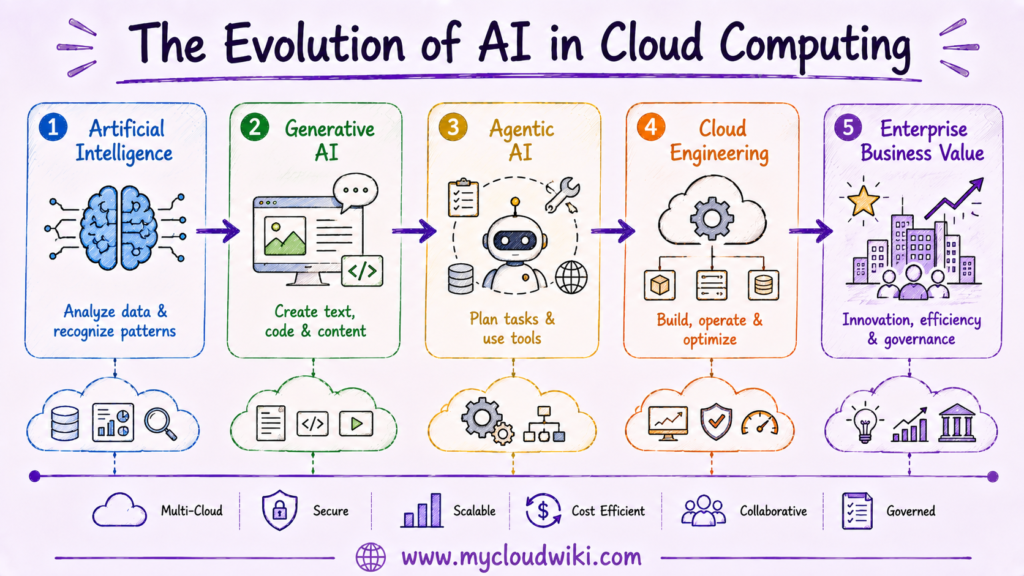
Artificial Intelligence, Generative AI, and Agentic AI represent an evolution of capabilities that increasingly assist cloud engineers and architects throughout the entire cloud lifecycle.
Learning Objectives
After completing this lesson, you will be able to:
- Explain the differences between Artificial Intelligence, Generative AI, and Agentic AI.
- Understand how AI enhances cloud engineering, operations, security, automation, monitoring, and FinOps.
- Compare AI capabilities across the major cloud providers.
- Understand the importance of governance, security, and human oversight for enterprise AI adoption.
- Explain how AI supports—but does not replace—cloud engineers and enterprise architects.
What Is Artificial Intelligence?
Artificial Intelligence (AI) is the ability of computer systems to perform tasks that normally require human intelligence. These tasks include recognizing patterns, analyzing information, making predictions, identifying anomalies, understanding language, and supporting decision-making.
Traditional AI systems are typically designed to solve specific problems using machine learning models, statistical analysis, or rule-based algorithms. In cloud computing, AI continuously analyzes operational and business data to help engineers make faster and more informed decisions.
Examples of AI capabilities in cloud environments include:
- Predicting infrastructure failures.
- Detecting cybersecurity threats.
- Forecasting cloud costs.
- Identifying unusual application behavior.
- Recommending performance improvements.
- Automating routine operational tasks.
Unlike traditional software that follows predefined instructions, AI systems continuously learn from data and improve the quality of their recommendations over time.
💡 Architect’s Tip
Artificial Intelligence provides recommendations based on patterns and data. Enterprise architects should treat AI as a decision-support capability while ensuring that critical business, security, and architectural decisions remain under human control.
The following illustration demonstrates how Artificial Intelligence transforms operational and business data into intelligent recommendations that support cloud engineering.
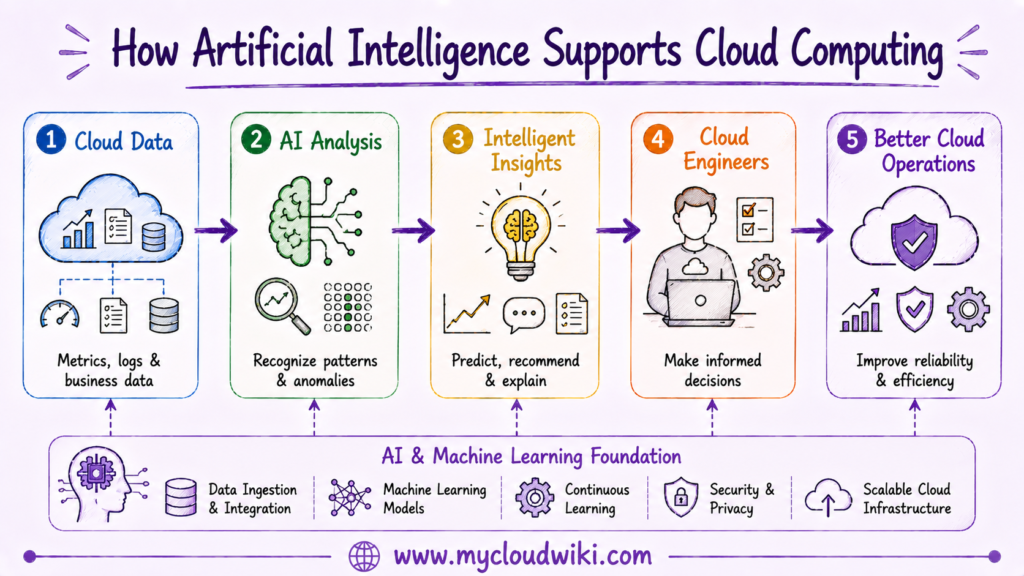
Artificial Intelligence transforms large volumes of cloud data into actionable insights that help engineers operate cloud environments more efficiently and make better architectural decisions.
What Is Generative AI?
Generative AI (GenAI) is a specialized branch of Artificial Intelligence that creates new content instead of simply analyzing existing data.
Traditional AI primarily recognizes patterns, predicts outcomes, or classifies information. Generative AI goes further by producing original outputs such as text, software code, images, presentations, audio, videos, and technical documentation.
Most modern Generative AI systems are powered by Large Language Models (LLMs) and multimodal foundation models that have been trained on vast amounts of information. These models understand natural language, recognize context, and generate responses that resemble human-created content.
For cloud engineers and architects, Generative AI acts as an intelligent assistant that accelerates many day-to-day activities while allowing humans to review and approve the final results.
Common Generative AI use cases include:
- Writing Infrastructure as Code (IaC).
- Explaining cloud architecture patterns.
- Generating documentation.
- Writing automation scripts.
- Creating Kubernetes manifests.
- Summarizing monitoring alerts.
- Explaining security findings.
- Producing technical diagrams and presentations.
Generative AI improves productivity by reducing repetitive work, allowing engineers to spend more time solving complex technical problems.
💡 Architect’s Tip
Generative AI accelerates content creation, but enterprise organizations should validate AI-generated code, documentation, and architectural recommendations before using them in production environments.
The following illustration demonstrates how Generative AI transforms user requests into useful engineering artifacts that accelerate cloud development and operations.
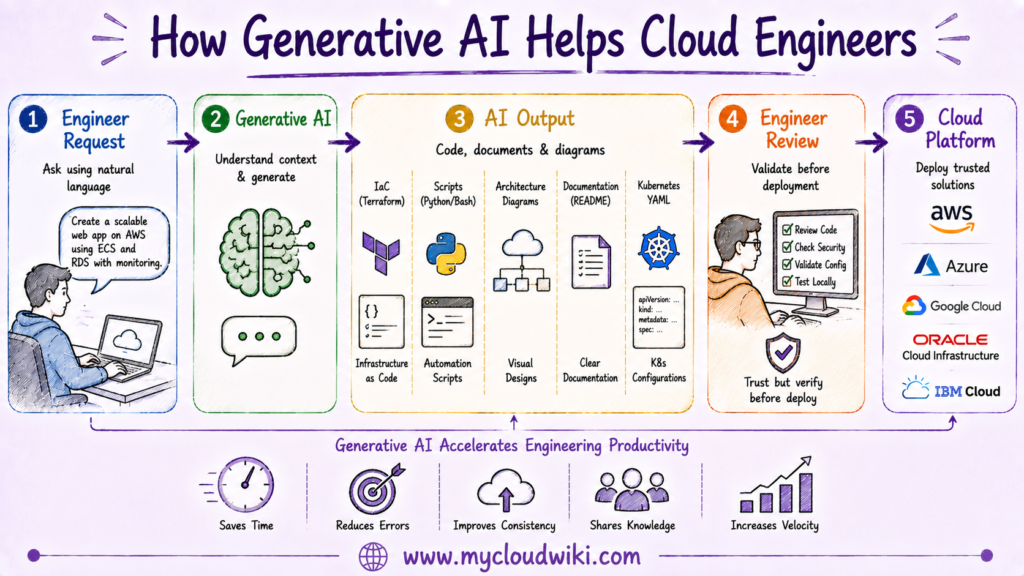
Generative AI accelerates engineering work by creating useful technical artifacts, while engineers remain responsible for validating accuracy, security, and architectural quality.
What Is Agentic AI?
Agentic AI extends the capabilities of Generative AI by enabling AI systems to plan tasks, make decisions within defined boundaries, use external tools, coordinate multiple activities, and work toward achieving specific goals.
Instead of generating a single response to a prompt, an AI agent can execute a sequence of actions while adapting to changing conditions and interacting with cloud platforms, APIs, databases, and enterprise systems.
An Agentic AI system typically performs the following cycle:
- Understand the objective.
- Develop a plan.
- Select appropriate tools.
- Execute approved actions.
- Evaluate results.
- Continue until the objective is achieved or human approval is required.
Unlike traditional automation, Agentic AI can make limited decisions during execution based on policies, context, and previous outcomes.
Examples in cloud engineering include:
- Investigating production alerts.
- Correlating monitoring data.
- Creating incident tickets.
- Provisioning approved infrastructure.
- Executing operational runbooks.
- Reviewing security configurations.
- Performing cost optimization analysis.
- Coordinating deployment workflows.
Although Agentic AI introduces greater autonomy, enterprise governance determines what actions agents may perform independently and which actions require human approval.
💡 Architect’s Tip
Agentic AI should be viewed as a governed operational assistant rather than an autonomous replacement for engineers. Enterprise policies, approvals, and auditability remain essential for responsible AI adoption.
The following illustration shows how an AI agent plans work, uses approved tools, and collaborates with engineers while operating within enterprise governance.
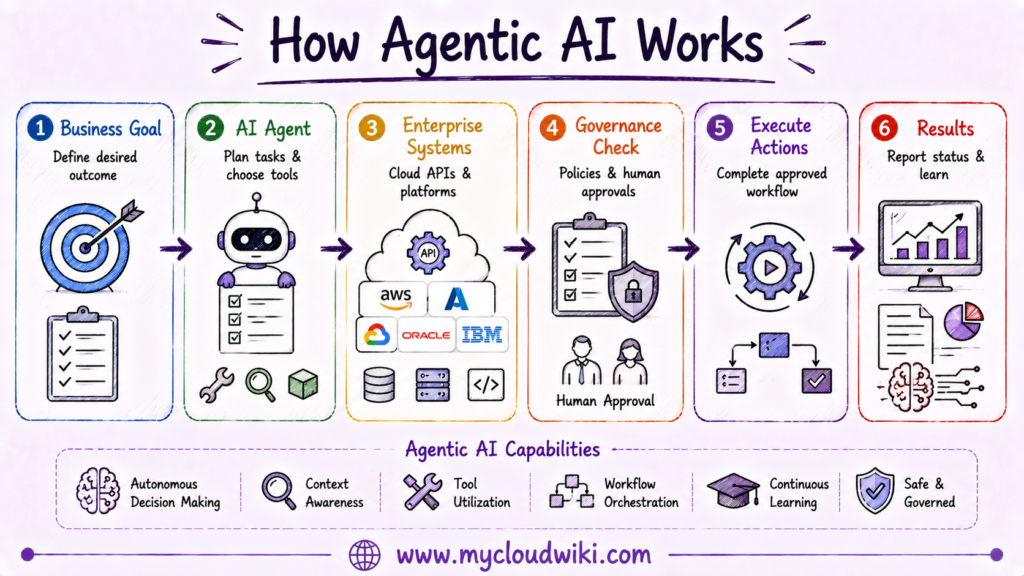
Agentic AI combines planning, reasoning, tool usage, and governed execution to automate complex cloud workflows while keeping humans accountable for important operational decisions.
AI vs. Generative AI vs. Agentic AI
Although these technologies are closely related, they solve different types of problems.
Artificial Intelligence provides analytical intelligence, Generative AI creates new content, and Agentic AI coordinates intelligent actions to achieve defined objectives.
Understanding these differences helps engineers select the right capability for each cloud engineering scenario.
The following comparison summarizes the primary characteristics of Artificial Intelligence, Generative AI, and Agentic AI.
AI, Generative AI & Agentic AI Comparison
The following illustration summarizes how Artificial Intelligence, Generative AI, and Agentic AI build upon one another to support modern cloud engineering.
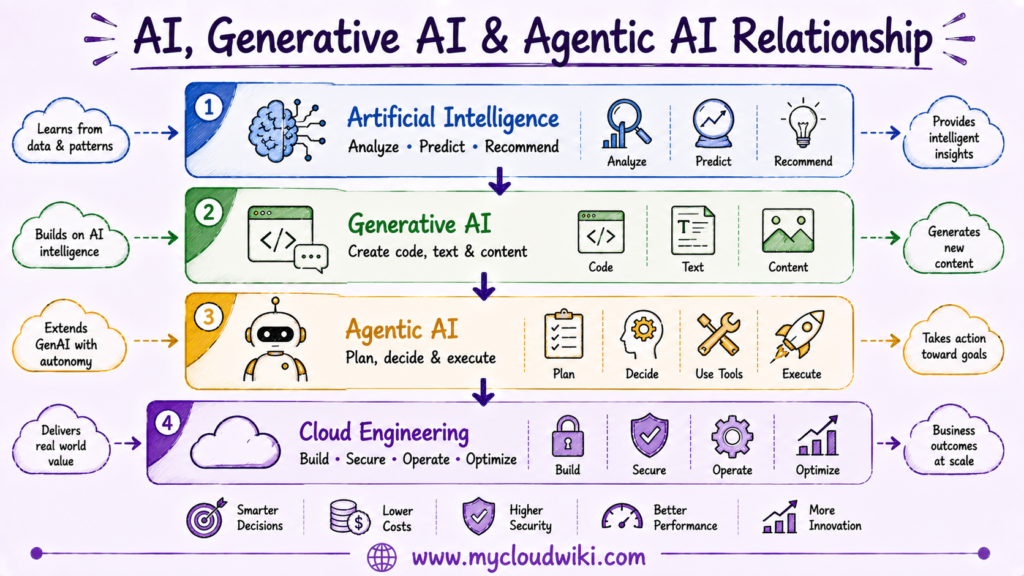
Artificial Intelligence, Generative AI, and Agentic AI are complementary technologies. Together they provide intelligence, creativity, and governed execution that enhance modern cloud engineering without replacing the expertise of cloud professionals.
AI Across the Cloud Lifecycle
Artificial Intelligence delivers the greatest value when it enhances the cloud foundations that organizations already rely on. Rather than acting as a standalone technology, AI becomes an intelligent layer that improves how cloud platforms are designed, deployed, operated, secured, monitored, and optimized.
As cloud environments become larger and more complex, AI helps engineers analyze operational data, automate repetitive activities, identify optimization opportunities, and make faster, data-driven decisions.
The following sections demonstrate how AI enhances each major cloud building block introduced throughout this learning series.
AI for Cloud Compute
Cloud compute platforms continuously generate telemetry about processor utilization, memory consumption, application performance, and workload behavior. Artificial Intelligence analyzes this information to help engineers optimize resource utilization, improve application performance, and reduce operational effort.
AI-assisted compute capabilities include:
- Recommending virtual machine rightsizing.
- Predicting future capacity requirements.
- Improving autoscaling decisions.
- Detecting abnormal resource utilization.
- Optimizing Kubernetes node placement.
- Identifying idle or underutilized compute resources.
These recommendations allow engineers to spend less time manually reviewing utilization reports and more time improving application performance.
AI-assisted compute optimization builds directly on the concepts introduced in Cloud Compute Fundamentals Explained Across Multi-Cloud Environments, where you learned how virtual machines, containers, and cloud compute services support enterprise applications.
💡 Architect’s Tip
AI should recommend infrastructure optimizations, while architects validate recommendations against performance, scalability, resilience, and business requirements before implementing changes.
The following illustration demonstrates how AI transforms operational telemetry into intelligent compute optimization recommendations.
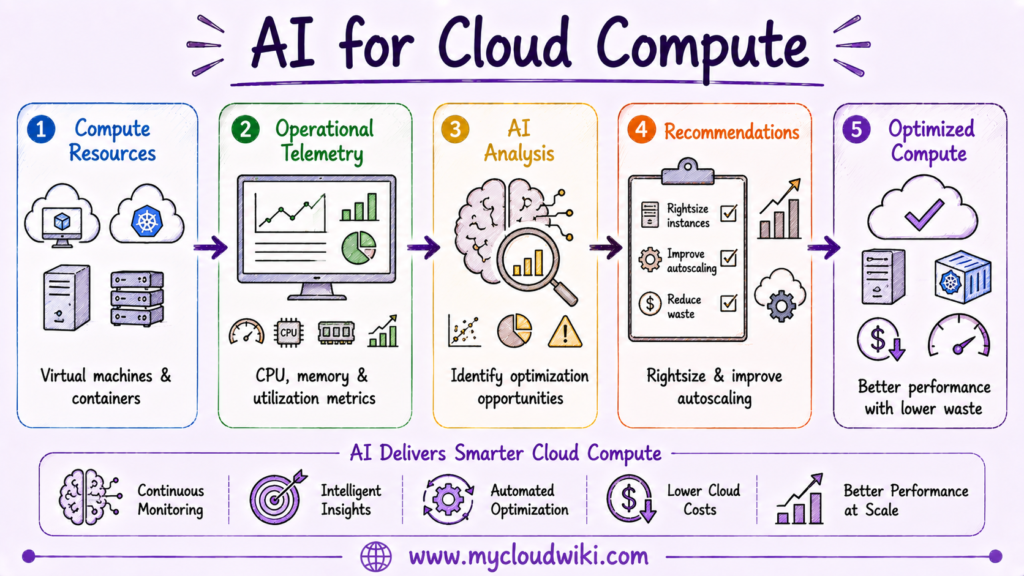
AI continuously analyzes compute behavior to improve workload efficiency, scalability, and operational decision-making.
AI for Cloud Storage & Databases
Enterprise organizations manage enormous amounts of structured and unstructured information. AI helps engineers organize, protect, classify, and optimize data throughout its lifecycle.
Typical AI-assisted capabilities include:
- Predicting storage growth.
- Identifying inactive or duplicate data.
- Optimizing database performance.
- Detecting abnormal query patterns.
- Recommending backup strategies.
- Classifying sensitive information.
- Supporting data lifecycle management.
These capabilities improve operational efficiency while helping organizations meet governance and compliance requirements.
AI extends the concepts covered in Cloud Storage Fundamentals Explained Across Multi-Cloud Environments and Cloud Database Fundamentals Explained Across Multi-Cloud Environments, where you learned how enterprise data is stored, protected, and managed across the major cloud providers.
💡 Architect’s Tip
AI can improve storage and database operations, but enterprise data governance policies should continue to determine how information is classified, retained, protected, and archived.
The following illustration shows how AI helps manage enterprise data more intelligently throughout its lifecycle.
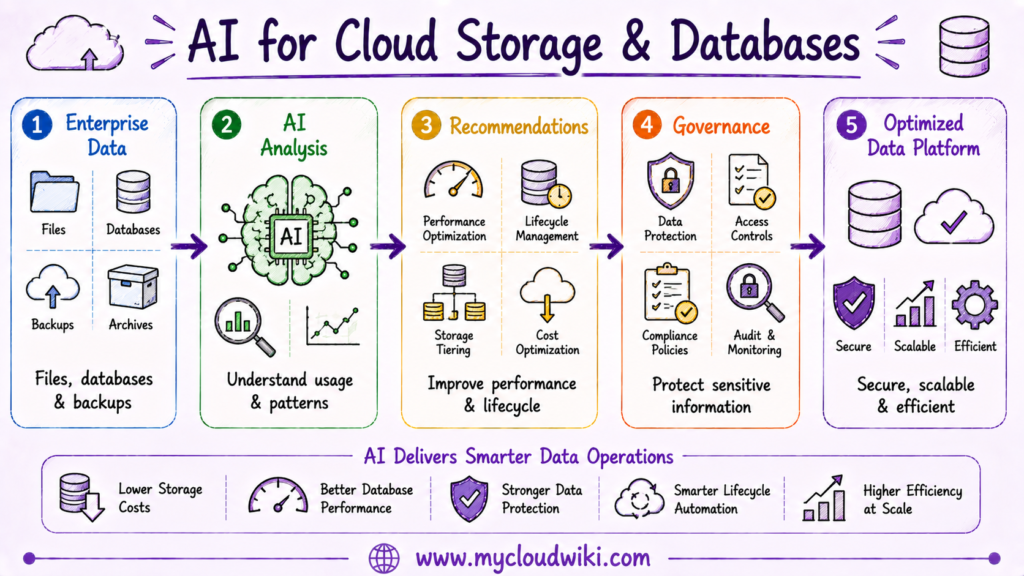
AI transforms enterprise data into actionable intelligence while improving storage efficiency, database performance, and governance.
AI for Networking & Security
Cloud networks and security platforms continuously generate telemetry from users, applications, APIs, firewalls, and cloud resources. AI processes this information in real time to identify anomalies, detect threats, and improve operational awareness.
Common AI-assisted capabilities include:
- Detecting unusual network activity.
- Identifying cyber threats.
- Recognizing malicious traffic patterns.
- Recommending firewall improvements.
- Supporting Zero Trust implementations.
- Prioritizing security investigations.
AI enhances security operations by helping engineers investigate incidents more quickly while reducing manual analysis.
These capabilities build upon Cloud Networking Fundamentals Explained Across Multi-Cloud Environments and Cloud Security Fundamentals Explained Across Multi-Cloud Environments, where you learned how cloud connectivity and layered security protect enterprise workloads.
💡 Architect’s Tip
AI strengthens threat detection and network visibility, but enterprise governance should always determine how security events are investigated and how critical remediation actions are approved.
The following illustration demonstrates how AI improves networking visibility and security operations.
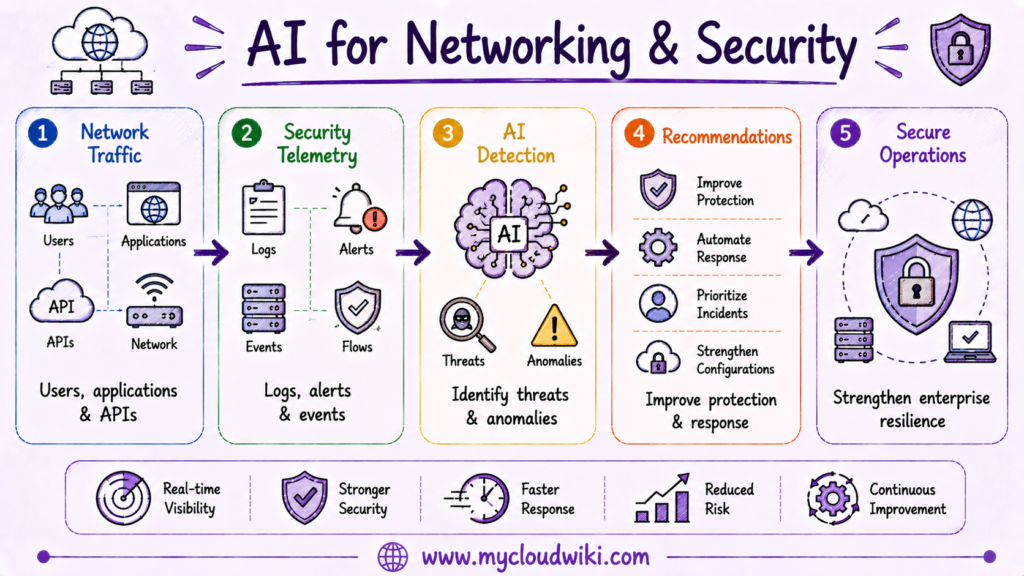
AI helps organizations detect threats faster, improve network visibility, and strengthen cloud security without replacing human expertise.
AI for Automation, Monitoring & FinOps
Cloud automation, monitoring, and financial operations generate continuous streams of operational and business data. AI helps transform this information into recommendations that improve engineering productivity and operational efficiency.
Examples include:
Automation
- Generate Infrastructure as Code.
- Explain deployment failures.
- Improve CI/CD workflows.
Monitoring
- Correlate alerts.
- Identify root causes.
- Summarize telemetry.
- Predict operational incidents.
FinOps
- Forecast cloud spending.
- Detect cost anomalies.
- Recommend rightsizing.
- Identify unused resources.
Together, these capabilities enable organizations to move from reactive operations toward intelligent, data-driven cloud management.
These AI capabilities extend the concepts introduced in
- Cloud Automation Fundamentals Explained Across Multi-Cloud Environments,
- Cloud Monitoring & Observability Fundamentals Explained Across Multi-Cloud Environments,
- Cloud Pricing & FinOps Fundamentals Explained Across Multi-Cloud Environments.
💡 Architect’s Tip
Organizations realize the greatest value when AI connects automation, observability, and FinOps into a continuous operational feedback loop instead of optimizing each capability independently.
The following illustration demonstrates how AI unifies automation, monitoring, and FinOps into an intelligent cloud operations model.
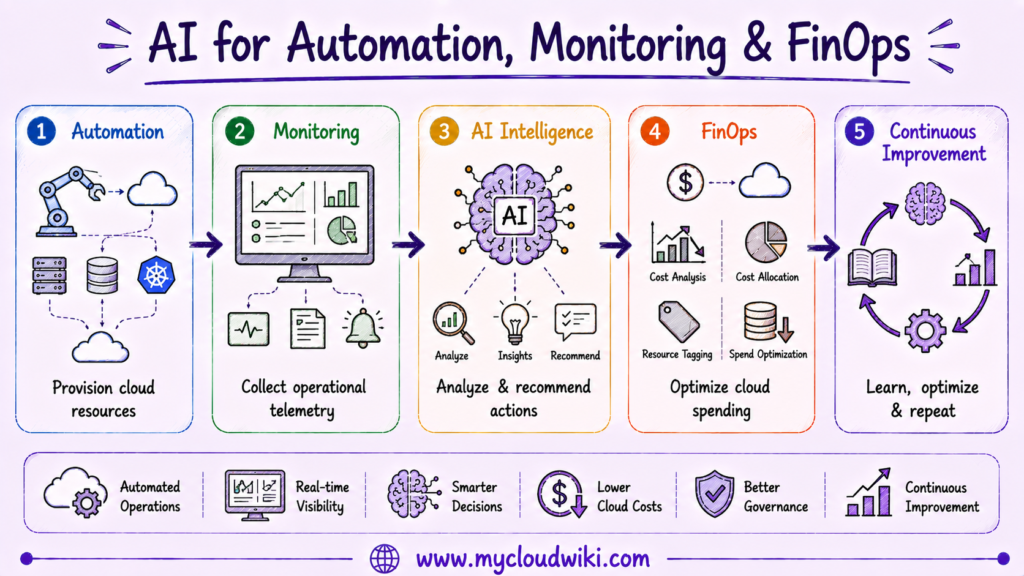
AI transforms operational and financial telemetry into intelligent recommendations that improve automation, observability, and cloud cost management.
AI Across the Entire Cloud Lifecycle
Artificial Intelligence delivers the greatest business value when it enhances every cloud discipline rather than operating as an isolated capability.
Whether optimizing compute resources, protecting enterprise data, improving security operations, automating deployments, explaining monitoring data, or forecasting cloud costs, AI continuously helps engineers and architects make faster and more informed decisions.
As organizations mature, AI becomes a foundational capability that connects cloud engineering, platform operations, governance, and business objectives into a single intelligent operating model.
The following illustration summarizes how AI enhances every major cloud building block covered throughout the Level 00 learning series.
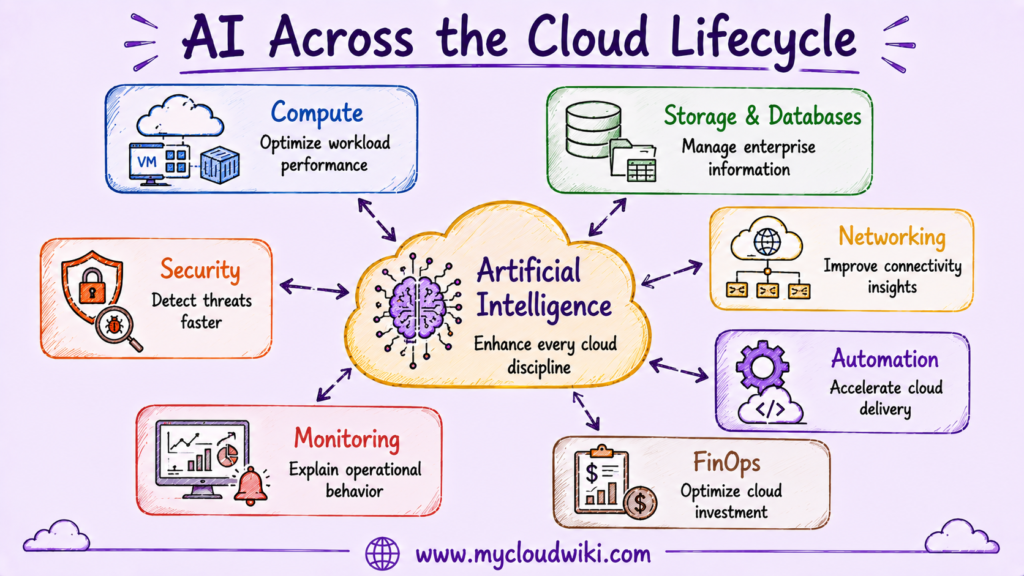
Artificial Intelligence is not another cloud building block—it is an intelligent capability that enhances every stage of the cloud lifecycle. Organizations that establish strong cloud foundations can use AI to improve productivity, strengthen governance, accelerate operations, and deliver greater business value across the major cloud providers.
Agentic AI Across the Cloud Lifecycle
Artificial Intelligence helps engineers understand cloud environments by analyzing data, recognizing patterns, and generating intelligent recommendations. Agentic AI builds on these capabilities by planning tasks, using enterprise tools, coordinating multi-step workflows, and executing approved operational activities.
Rather than acting as a conversational assistant, an AI agent becomes an operational teammate that collaborates with engineers throughout the cloud lifecycle. It can investigate incidents, provision infrastructure, analyze monitoring data, optimize cloud spending, and coordinate operational workflows while operating within enterprise governance policies.
As organizations mature, Agentic AI enables cloud platforms to become increasingly autonomous without removing human accountability. Engineers and architects remain responsible for defining objectives, establishing governance, approving critical actions, and ensuring AI agents operate safely and responsibly.
This evolution builds upon the automation concepts introduced in Cloud Automation Fundamentals Explained Across Multi-Cloud Environments, where repeatable operational tasks were automated using Infrastructure as Code and orchestration tools. Agentic AI extends those workflows by introducing planning, reasoning, tool integration, and governed decision-making.
💡 Architect’s Tip
Treat AI agents as enterprise team members with defined responsibilities rather than autonomous software. Every AI agent should operate with least-privilege access, clear approval boundaries, comprehensive audit logging, and continuous governance.
The following illustration demonstrates how Agentic AI participates throughout the cloud lifecycle by planning work, using enterprise tools, executing approved workflows, and continuously collaborating with engineers.
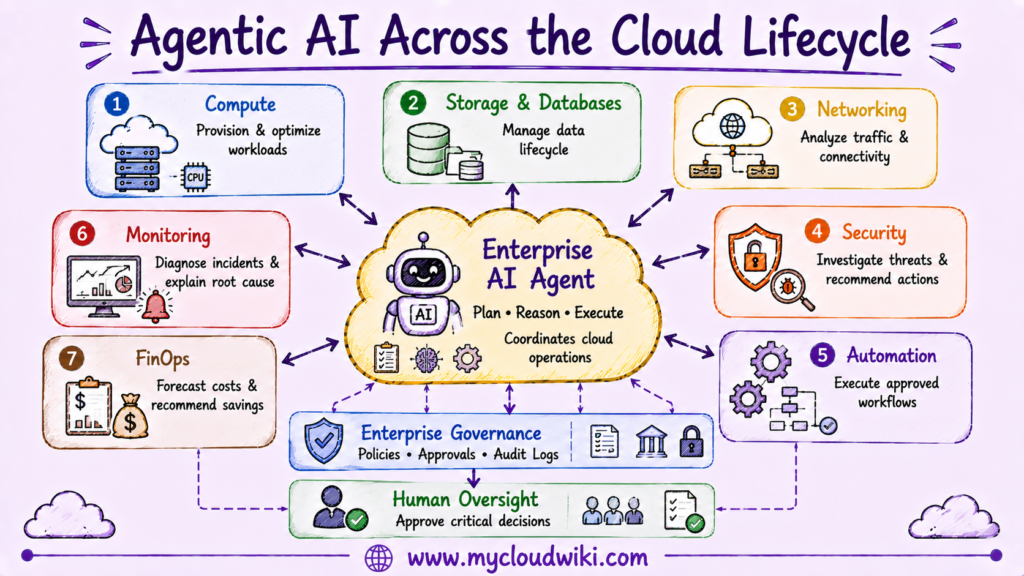
Agentic AI transforms cloud operations by coordinating intelligent workflows across compute, storage, networking, security, automation, monitoring, and FinOps. Unlike traditional automation, AI agents can plan, reason, use enterprise tools, and execute approved tasks while remaining governed through organizational policies and human oversight.
AI Services Across the Major Cloud Providers
Artificial Intelligence has become a core capability across every major cloud platform. Although each provider uses different service names and implementation approaches, they all provide services for building, deploying, and operating AI-powered applications.
Enterprise architects should understand the strengths of each platform while designing AI architectures that remain portable, secure, and governed across multi-cloud environments.
Rather than selecting a cloud provider based on a single AI capability, organizations should evaluate:
- Foundation model support
- AI development platforms
- Enterprise integrations
- Security and governance
- Data residency and compliance
- Operational maturity
- Multi-cloud interoperability
Understanding these capabilities allows organizations to build AI platforms that evolve with changing technologies while avoiding unnecessary vendor lock-in.
The following comparison highlights representative AI services available across the major cloud providers.
AI Services Across the Major Cloud Providers
Note: AI services evolve rapidly. Always validate the latest capabilities before making architectural decisions.
The following comparison illustrates equivalent AI services across the major cloud providers using their official provider and service logos.
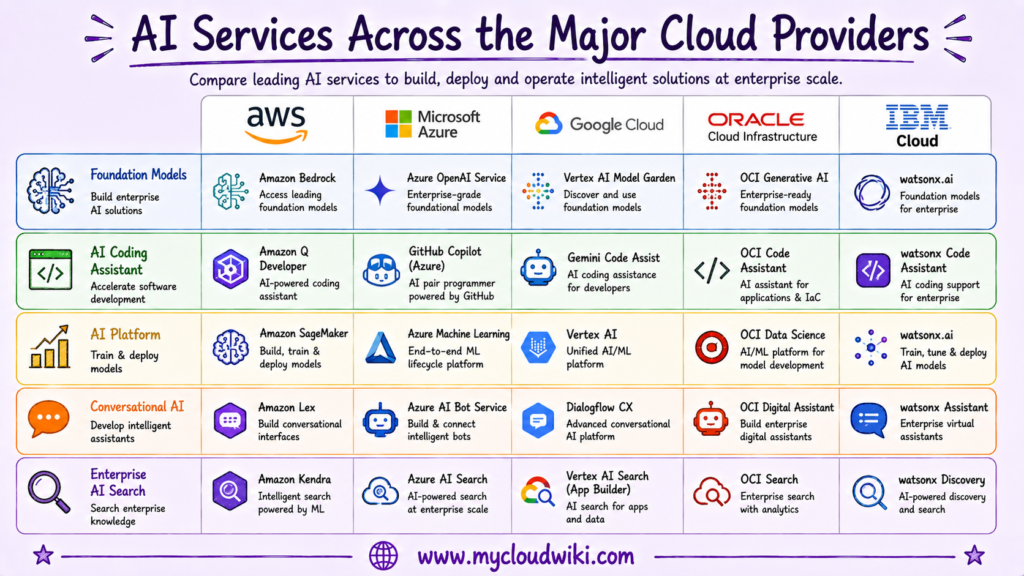
Although provider implementations differ, the underlying enterprise AI capabilities remain remarkably similar. Successful architects design solutions based on business requirements rather than provider-specific product names.
AI Through the Engineer and Architect Lens
Artificial Intelligence changes how both cloud engineers and enterprise architects work, but their responsibilities remain different.
Cloud engineers use AI to improve productivity and automate technical activities. Enterprise architects focus on designing AI platforms that are secure, governed, scalable, and aligned with business objectives.
Together, these complementary responsibilities enable successful enterprise AI adoption.
Engineer Perspective
Cloud engineers typically use AI to improve day-to-day productivity.
Typical responsibilities include:
- Generate Infrastructure as Code.
- Explain cloud errors and logs.
- Create automation scripts.
- Generate documentation.
- Troubleshoot deployments.
- Review monitoring alerts.
- Optimize cloud resources.
- Accelerate software development.
These activities build upon Cloud Automation Fundamentals Explained Across Multi-Cloud Environments, where repeatable cloud operations were standardized through Infrastructure as Code and automation workflows.
Architect Perspective
Enterprise architects focus on designing responsible AI platforms.
Typical responsibilities include:
- Define enterprise AI strategy.
- Select foundation models.
- Design AI platform architectures.
- Protect enterprise data.
- Define governance policies.
- Ensure regulatory compliance.
- Establish human approval workflows.
- Standardize AI adoption across the enterprise.
Architects ensure AI becomes a trusted enterprise capability rather than simply another technology tool.
💡 Architect’s Tip
Cloud engineers focus on applying AI effectively, while enterprise architects ensure AI is secure, governed, scalable, and aligned with long-term business strategy.
The following illustration compares how cloud engineers and enterprise architects use AI differently while working toward shared enterprise objectives.
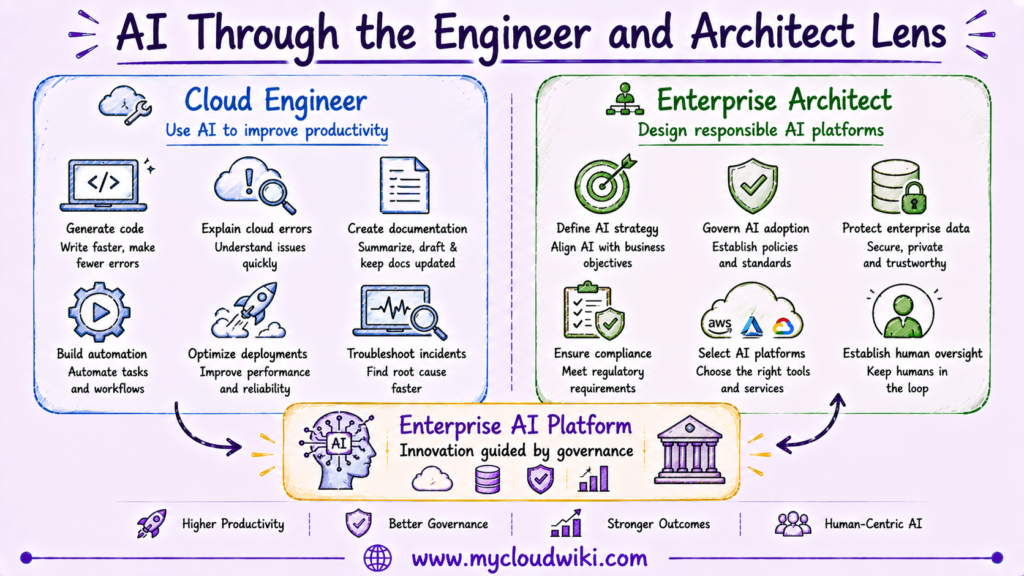
Cloud engineers accelerate delivery using AI, while enterprise architects establish the governance, security, and standards that enable AI to scale safely across the organization.
Agentic AI in Multi-Cloud Environments
As organizations adopt multiple cloud providers, AI agents must operate across different APIs, platforms, security models, and operational tools.
Unlike traditional automation scripts, Agentic AI can coordinate activities across cloud providers while remaining governed through enterprise policies and human approvals.
Examples of multi-cloud AI agent responsibilities include:
- Investigating incidents across AWS, Azure, Google Cloud, OCI, and IBM Cloud.
- Correlating monitoring data from multiple observability platforms.
- Reviewing cloud spending across providers.
- Generating Infrastructure as Code for different cloud platforms.
- Coordinating deployment workflows.
- Recommending architectural improvements.
- Escalating high-risk decisions for human approval.
This extends the operational workflows introduced in Cloud Monitoring & Observability Fundamentals Explained Across Multi-Cloud Environments and Cloud Pricing & FinOps Fundamentals Explained Across Multi-Cloud Environments, where telemetry and financial data became central to enterprise operations.
💡 Architect’s Tip
Treat AI agents as enterprise identities. Assign least-privilege permissions, define approval boundaries, maintain audit trails, and continuously monitor agent behavior across every cloud environment.
The following illustration demonstrates how an enterprise AI agent coordinates activities across multiple cloud providers while remaining governed through centralized policies and human oversight.
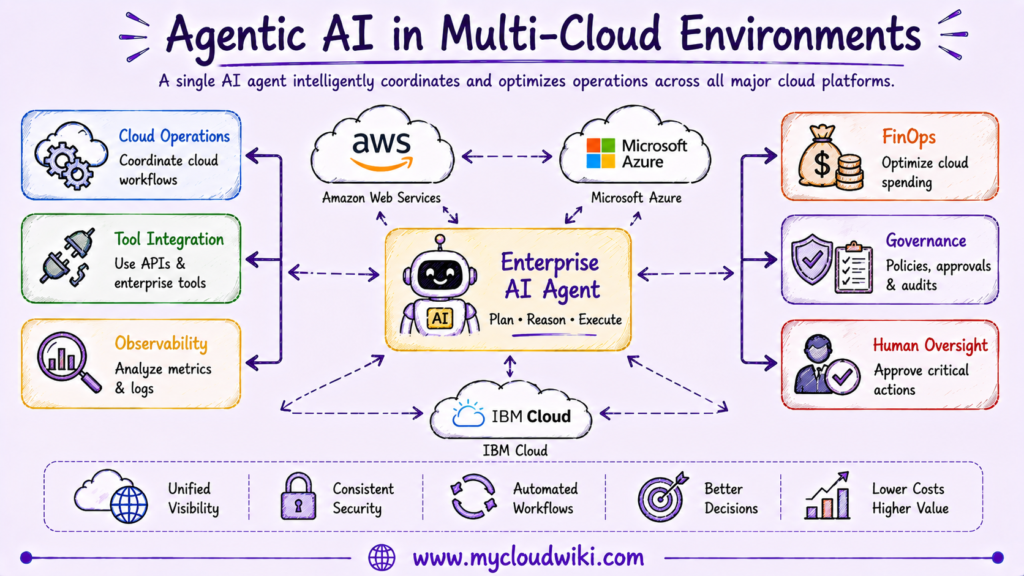
Agentic AI enables organizations to coordinate intelligent operations across multiple cloud providers while ensuring every action remains secure, governed, auditable, and aligned with enterprise objectives.
AI Governance & Human Oversight
Artificial Intelligence enables organizations to analyze information, generate content, automate workflows, and even execute approved operational tasks through AI agents. As these capabilities become embedded throughout cloud platforms, governance and human oversight become essential for ensuring AI operates responsibly, securely, and in alignment with business objectives.
AI governance establishes the policies, processes, and technical controls that guide how AI models, Generative AI assistants, and Agentic AI systems are developed, deployed, monitored, and continuously improved. Human oversight ensures that enterprise accountability always remains with people, even when AI assists or automates operational activities.
A mature enterprise AI governance strategy typically includes:
- Responsible AI principles.
- Identity and access management.
- Data privacy and protection.
- Model lifecycle management.
- Security controls.
- Regulatory compliance.
- Human approval workflows.
- Continuous monitoring and auditing.
- Risk management.
- Enterprise accountability.
Although AI can recommend actions and Agentic AI can execute approved workflows, organizations remain responsible for every business, operational, security, and compliance decision.
Strong governance becomes even more important in multi-cloud environments where AI systems interact with multiple cloud providers, enterprise applications, operational platforms, and business data.
This builds upon the governance principles introduced in Cloud Security Fundamentals Explained Across Multi-Cloud Environments and Cloud Identity & Access Management (IAM) Fundamentals Explained Across Multi-Cloud Environments, where identity, policy enforcement, and least-privilege access formed the foundation of secure cloud operations.
💡 Architect’s Tip
Successful organizations do not govern AI because they distrust it—they govern AI because they remain accountable for every business decision, operational action, and customer outcome. Human oversight should always remain an integral part of enterprise AI governance.
The following illustration demonstrates how enterprise AI governance combines security, identity, compliance, monitoring, and human oversight to ensure AI systems operate responsibly across multi-cloud environments.
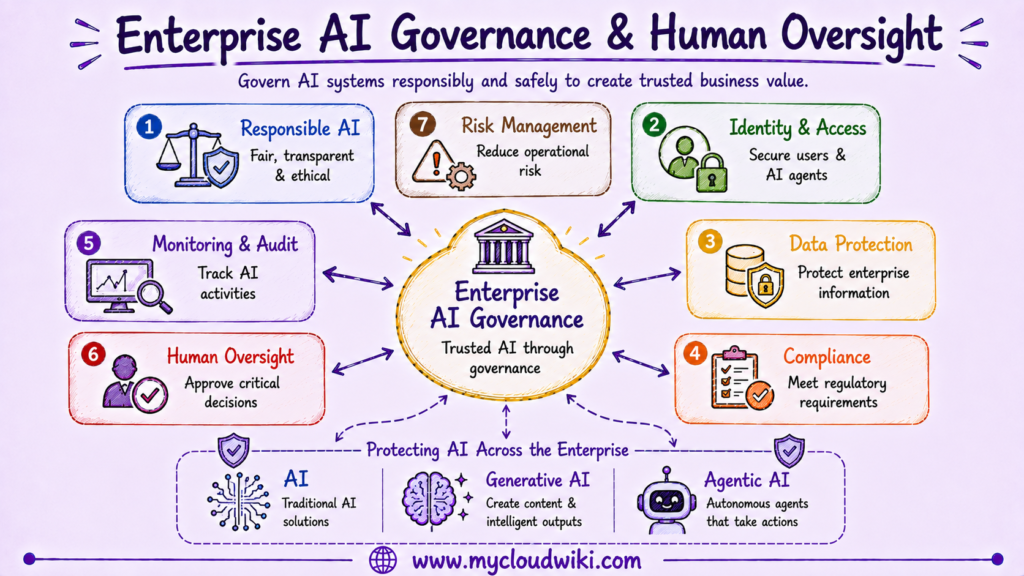
Enterprise AI succeeds when innovation is balanced with governance. Human oversight is not separate from governance—it is one of its most important controls, ensuring that AI systems remain secure, compliant, transparent, and aligned with enterprise objectives.
Well-Architected Multi-Cloud AI Strategy
A successful enterprise AI strategy balances innovation with governance, ensuring AI enhances cloud operations without compromising security, reliability, compliance, or business accountability.
Operational Excellence
- Standardize AI adoption across engineering teams.
- Integrate AI into existing cloud workflows.
- Continuously measure AI effectiveness.
- Establish repeatable AI operating practices.
- Review AI outcomes regularly.
Security
- Protect AI models and enterprise data.
- Apply least-privilege access for AI systems and agents.
- Monitor AI activities continuously.
- Secure APIs and integrations.
- Encrypt sensitive AI training and operational data.
Reliability
- Validate AI recommendations before production use.
- Design resilient AI-assisted workflows.
- Monitor AI service availability.
- Test fallback procedures.
- Prevent single points of failure.
Performance Efficiency
- Select the appropriate AI model for each workload.
- Optimize prompt design and context.
- Reuse enterprise knowledge responsibly.
- Monitor inference performance.
- Continuously improve AI quality.
Cost Optimization
- Monitor AI service consumption.
- Select cost-effective AI models.
- Optimize token usage.
- Eliminate unused AI services.
- Review AI investments regularly.
💡 Architect’s Tip
The best AI architectures balance innovation, governance, security, performance, and business value. Responsible AI adoption is a continuous architectural practice—not a one-time project.
The following illustration summarizes the Well-Architected principles for adopting AI across enterprise multi-cloud environments.
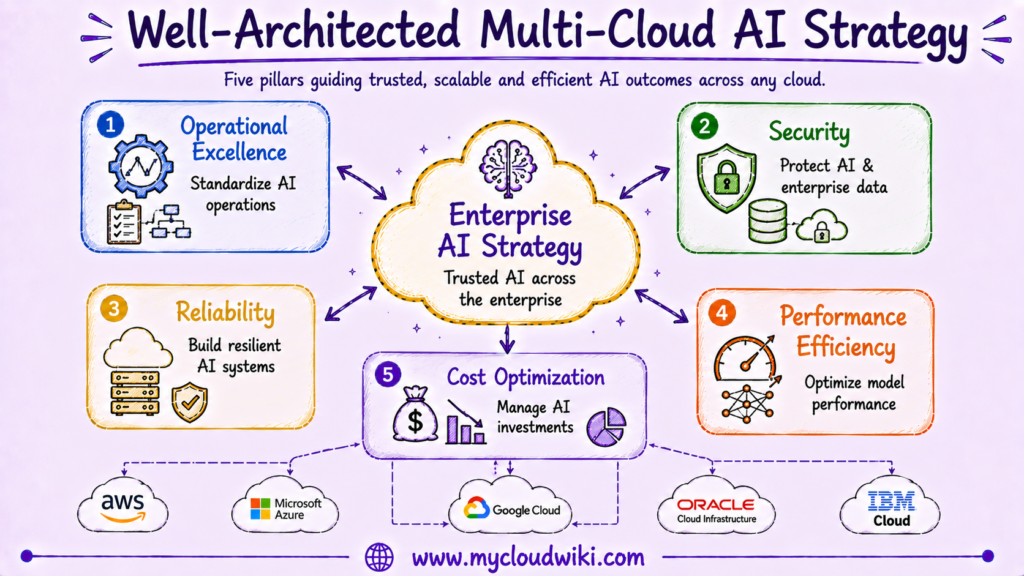
A well-architected AI strategy enables organizations to adopt AI confidently while maintaining operational excellence, security, reliability, performance, and financial sustainability.
Common AI Adoption Mistakes
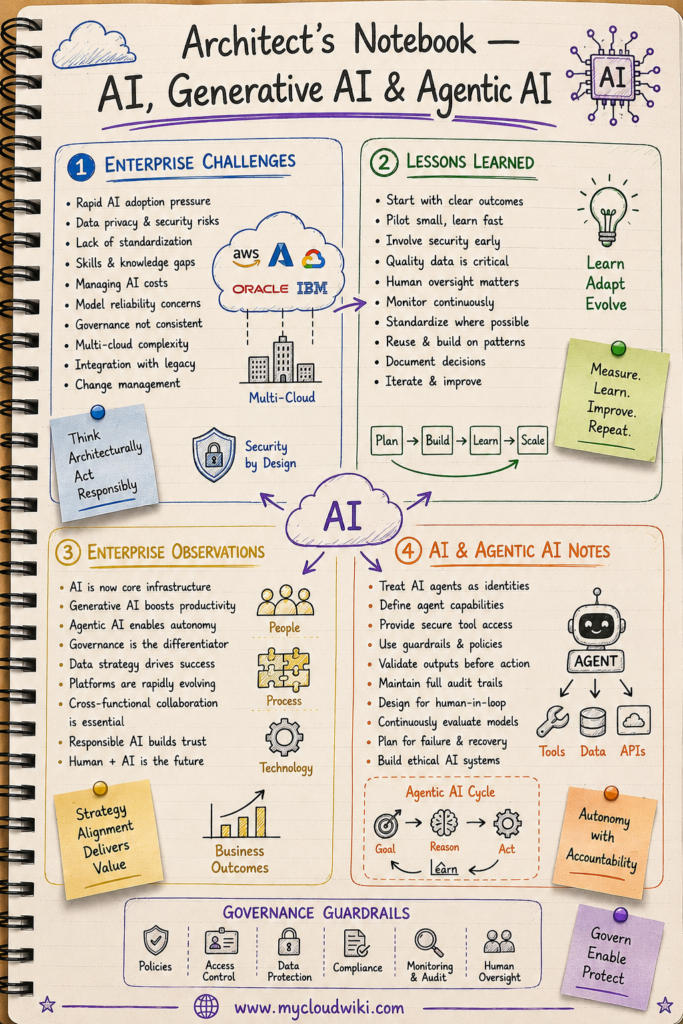
Architect’s Notebook — AI, Generative AI & Agentic AI
Enterprise Challenges
- Governing AI consistently across multiple cloud providers.
- Protecting enterprise data while enabling AI innovation.
- Balancing automation with human accountability.
- Integrating AI into established engineering workflows.
Lessons Learned
- Strong cloud foundations enable successful AI adoption.
- Governance creates trust in AI systems.
- AI agents require the same operational discipline as human users.
- Human judgment remains essential for enterprise architecture.
Enterprise Observations
- AI is becoming embedded across every cloud discipline.
- Agentic AI is shifting from experimentation to enterprise operations.
- Platform engineering increasingly incorporates AI-assisted workflows.
- Responsible AI is becoming a core architectural capability.
AI & Agentic AI Notes
- AI analyzes and recommends.
- Generative AI creates.
- Agentic AI plans and executes.
- Governance and oversight remain continuous responsibilities.
The following notebook captures practical architectural lessons that enterprise teams should remember as AI adoption continues to accelerate.
Key Takeaways
- Artificial Intelligence analyzes information and supports better decisions across cloud environments.
- Generative AI improves engineering productivity by creating code, documentation, and technical content.
- Agentic AI extends AI capabilities by planning, coordinating, and executing governed operational workflows.
- Enterprise AI adoption requires governance, security, identity, monitoring, and human oversight.
- Organizations that combine strong cloud fundamentals with responsible AI practices are best positioned to build secure, scalable, and intelligent multi-cloud platforms.
What’s Next
Congratulations! You have now completed the core technology lessons of Multi-Cloud Fundamental Lessons.
The next lesson, Build Your First Multi-Cloud Architecture Mental Model Across AWS, Azure, Google Cloud, OCI and IBM Cloud, brings together everything you have learned—from compute, storage, networking, security, automation, monitoring, FinOps, and AI—into a single architectural framework.
You will learn how experienced cloud architects think about systems, how cloud building blocks connect together, and how to transition from understanding individual services to designing complete enterprise multi-cloud architectures.

