
Quick Read
- ✅ Cloud automation enables organizations to provision, configure, secure, monitor, and manage cloud resources consistently through software rather than manual processes.
- ✅ Infrastructure as Code (IaC), CI/CD pipelines, GitOps, and orchestration help eliminate manual errors while improving deployment speed, governance, and operational consistency.
- ✅ Every major cloud provider offers automation capabilities, but successful enterprise organizations standardize automation principles rather than relying on provider-specific implementations.
- ✅ Cloud engineers build and operate automated workflows, while architects establish automation standards, governance, security controls, and reusable deployment patterns.
- ✅ AI and Agentic AI are transforming cloud automation by assisting with infrastructure provisioning, operational operations, policy enforcement, and intelligent decision-making while maintaining enterprise governance and human oversight.
Cloud Automation as a Foundational Cloud Building Block
In the previous lesson, you learned how Cloud Reliability & High Availability Fundamentals enable organizations to design resilient applications that continue operating during infrastructure failures. Reliability depends on resilient architectures, redundancy, monitoring, disaster recovery, and automated recovery mechanisms.
However, even the most reliable architecture becomes difficult to operate if every deployment, configuration change, and operational task must be performed manually. As organizations expand across multiple Regions, applications, business units, and cloud providers, manual operations become increasingly inconsistent, slow, and error-prone.
Cloud automation solves this challenge by enabling infrastructure, configurations, deployments, security controls, and operational workflows to be executed consistently, repeatedly, and securely across enterprise multi-cloud environments.
Cloud Automation Introduction
Modern cloud platforms change continuously. Infrastructure is provisioned daily, applications are updated frequently, security policies evolve, and operational tasks must be performed consistently across thousands of cloud resources.
Managing these activities manually does not scale. Manual deployments often introduce configuration drift, inconsistent environments, operational delays, and avoidable human errors.
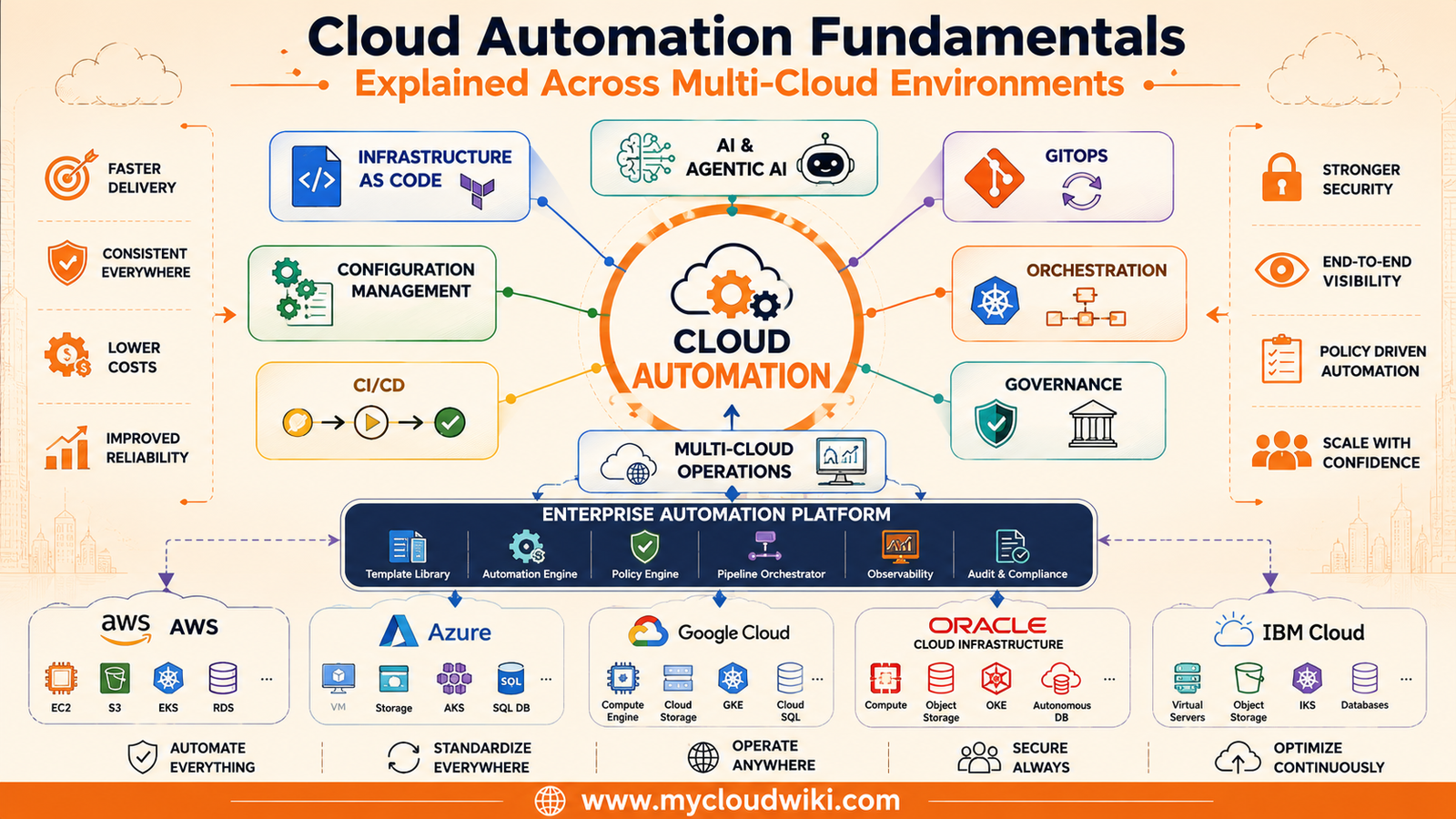
Cloud automation replaces repetitive operational activities with software-driven workflows that automatically provision, configure, deploy, secure, monitor, and manage cloud resources.
Instead of asking:
“How do we manually deploy this infrastructure?”
Enterprise organizations ask:
“How do we automate this process so every deployment is consistent, secure, repeatable, and governed?”
Automation has become a foundational cloud capability because it directly improves:
- Operational consistency
- Deployment speed
- Infrastructure reliability
- Security compliance
- Governance
- Cost optimization
- Multi-cloud operations
Rather than simply making deployments faster, cloud automation establishes a standardized operating model that enables organizations to manage cloud environments confidently at enterprise scale.
💡 Architect’s Tip
One of the biggest operational challenges in enterprise cloud environments is maintaining consistency rather than increasing deployment speed. Organizations that automate repetitive operational tasks early create standardized platforms that are easier to secure, govern, troubleshoot, and scale across multiple cloud providers.
The following illustration introduces cloud automation as the operational engine that continuously provisions, configures, secures, deploys, and manages cloud resources across enterprise multi-cloud environments.
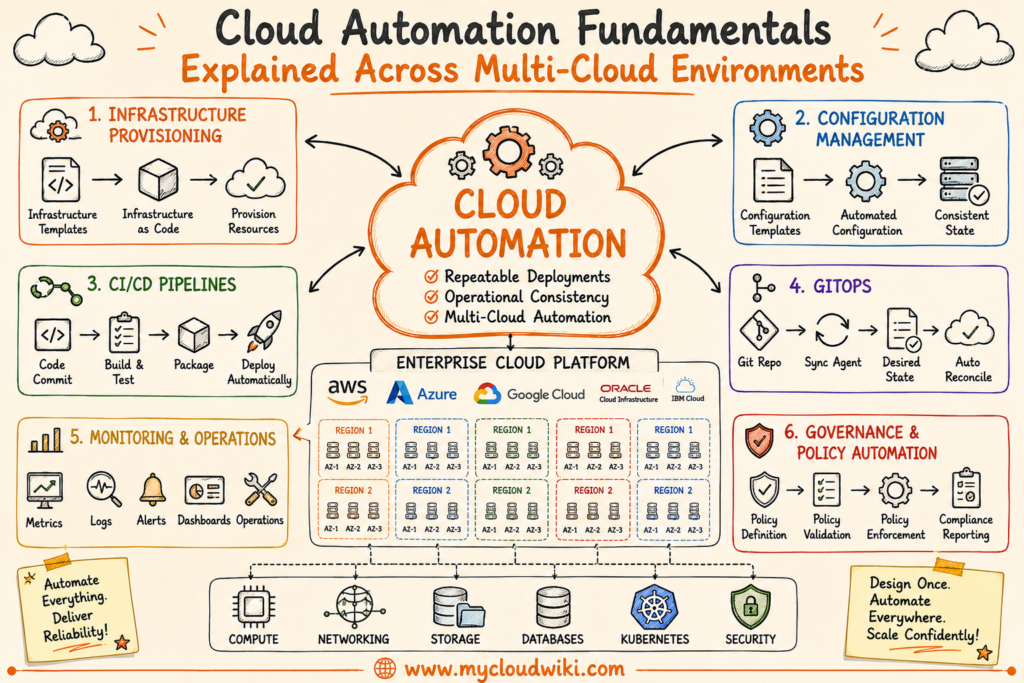
Cloud automation transforms repetitive manual operations into standardized, policy-driven workflows. By automating infrastructure provisioning, deployments, security controls, and operational activities, organizations improve consistency, governance, and scalability across enterprise multi-cloud environments.
Learning Objectives
After completing this lesson, you will be able to:
- Explain the purpose and business value of cloud automation.
- Understand how Infrastructure as Code, CI/CD, GitOps, orchestration, and policy-driven automation work together.
- Compare automation capabilities across the major cloud providers.
- Differentiate the responsibilities of cloud engineers and enterprise architects in automated environments.
- Understand how AI and Agentic AI enhance cloud automation while maintaining governance and human oversight.
What Is Cloud Automation?
Cloud automation is the practice of using software, templates, policies, scripts, and workflows to automatically provision, configure, secure, monitor, and optimize cloud resources with minimal manual intervention.
Instead of engineers manually creating virtual machines, configuring networks, or deploying applications through cloud consoles, automation enables these activities to be executed consistently using version-controlled code and predefined workflows.
Cloud automation spans the entire cloud lifecycle, including:
- Infrastructure provisioning
- Application deployment
- Configuration management
- Security policy enforcement
- Monitoring and alerting
- Backup and disaster recovery
- Cost optimization
- Operational maintenance
By automating these activities, organizations reduce manual effort, minimize human error, improve operational consistency, and accelerate the delivery of cloud services.
💡 Architect’s Tip
Automation should standardize repetitive operational work—not replace architectural thinking. Mature cloud organizations automate routine activities so engineers can spend more time designing resilient, secure, scalable, and cost-optimized cloud platforms.
Core Cloud Automation Technologies
Why Cloud Automation Matters
As organizations adopt multi-cloud strategies, the number of cloud resources grows rapidly. Managing infrastructure manually becomes increasingly difficult, leading to inconsistent deployments, configuration drift, slower delivery, security gaps, and higher operational costs.
Cloud automation addresses these challenges by enabling standardized deployments, policy-driven governance, repeatable operational workflows, and consistent infrastructure management across the major cloud providers.
Continue Learning: As you learned in How Cloud Resources Are Created Across Multi-Cloud: Console, CLI, SDK, API, IaC and Agentic AI, automation builds on Infrastructure as Code to replace manual provisioning with consistent, version-controlled deployment workflows.
The following illustration compares traditional manual operations with modern automated cloud operations to demonstrate why automation has become essential for enterprise multi-cloud platforms.
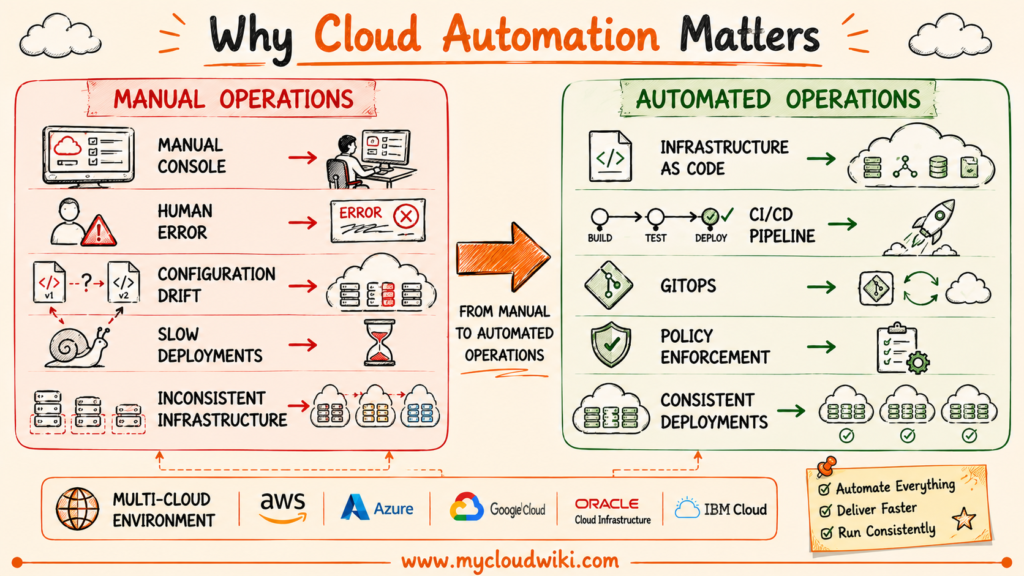
Automation replaces repetitive manual work with standardized, repeatable workflows that improve consistency, governance, security, and operational efficiency. These capabilities form the operational foundation for managing modern cloud platforms across the major cloud providers.
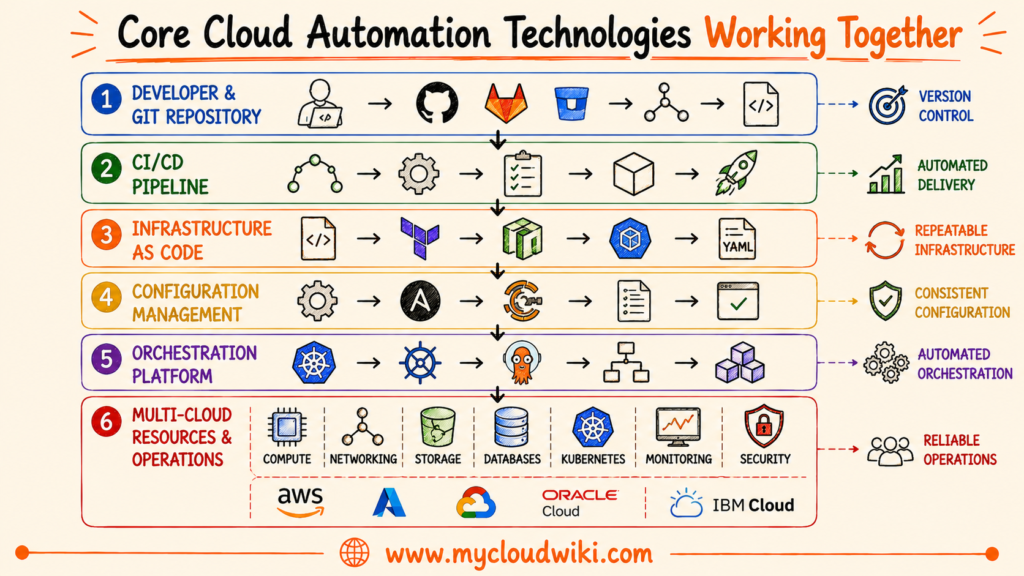
Core Cloud Automation Technologies
Cloud automation is not a single technology. It is a collection of complementary practices that work together to automate the entire cloud lifecycle, from infrastructure provisioning to application deployment and ongoing operations.
Each technology solves a different problem, but together they create a standardized, repeatable, and governed operating model for enterprise cloud platforms.
The five foundational cloud automation technologies are:
- Infrastructure as Code (IaC)
- Configuration Management
- Continuous Integration & Continuous Delivery (CI/CD)
- GitOps
- Orchestration
Understanding how these technologies complement one another is essential for designing scalable multi-cloud platforms.
Infrastructure as Code (IaC): The Foundation of Cloud Automation
Infrastructure as Code (IaC) is the practice of defining cloud infrastructure using declarative or imperative code instead of manually creating resources through cloud management consoles.
Rather than documenting infrastructure in spreadsheets or relying on manual deployment procedures, engineers define cloud environments as version-controlled code that can be deployed repeatedly across development, testing, and production environments.
Infrastructure as Code enables organizations to automate the provisioning of:
- Virtual machines
- Networks
- Storage
- Databases
- Kubernetes clusters
- Identity configurations
- Security policies
- Monitoring resources
Because infrastructure is stored as code, every deployment follows the same approved architecture, reducing configuration drift and improving governance across enterprise multi-cloud environments.
💡 Architect’s Tip
Treat infrastructure as software. Every infrastructure change should be reviewed, version-controlled, tested, and approved before deployment. Mature organizations rarely allow production infrastructure to be created manually because repeatability is one of the foundations of operational excellence.
The following illustration shows how Infrastructure as Code transforms cloud deployments from manual configuration into repeatable, version-controlled automation.
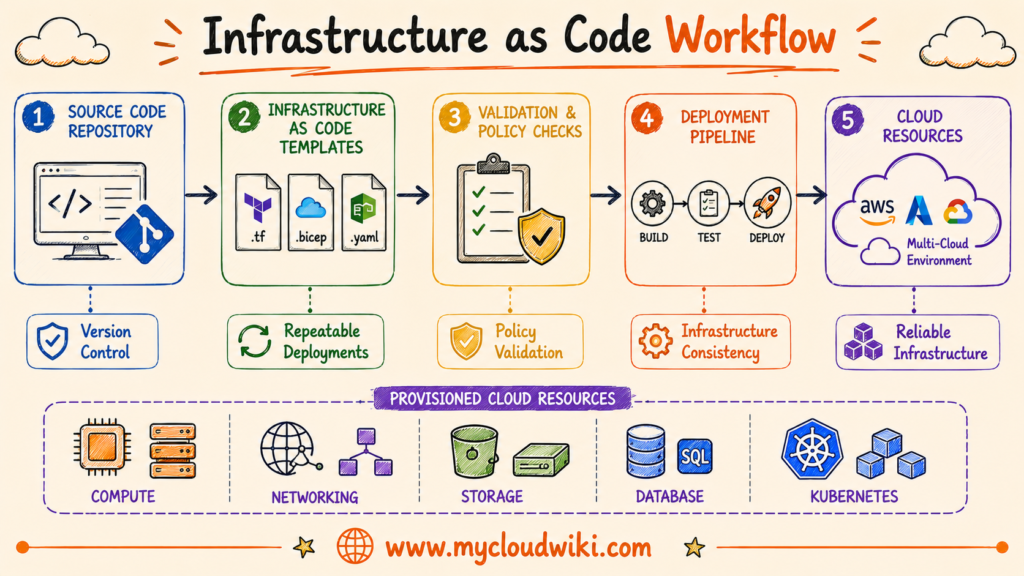
Infrastructure as Code enables organizations to deploy identical environments repeatedly while maintaining governance, security, and operational consistency across the major cloud providers.
Configuration Management
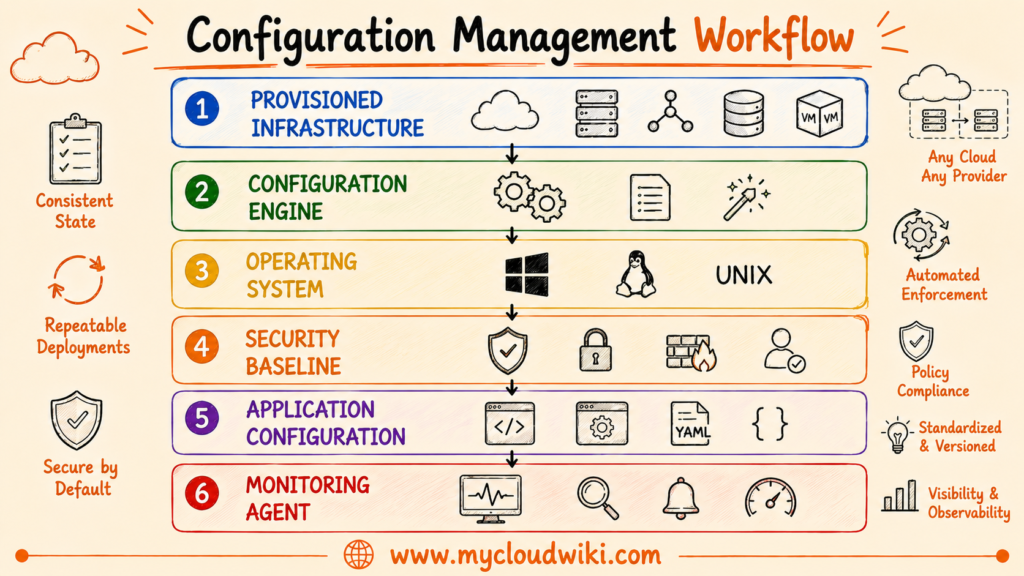
Provisioning infrastructure creates cloud resources, but those resources still need to be configured consistently. Configuration Management automates operating system settings, software installation, application configuration, security baselines, and ongoing maintenance.
Think of it this way:
- Infrastructure as Code builds the house.
- Configuration Management furnishes and maintains the house.
Typical enterprise configuration activities include:
- Installing software packages.
- Configuring operating systems.
- Applying security baselines.
- Managing certificates.
- Configuring monitoring agents.
- Standardizing application settings.
- Managing compliance policies.
- Updating system configurations.
Configuration Management ensures that every deployed resource remains consistent throughout its lifecycle.
Continue Learning: Configuration management complements Cloud Security Fundamentals by ensuring approved security baselines and compliance policies are applied consistently across enterprise cloud environments.
💡 Architect’s Tip
Provisioning infrastructure is only the beginning. Long-term operational consistency comes from automatically applying approved configurations, security baselines, and compliance standards every time infrastructure is created or updated.
The following illustration demonstrates how Configuration Management maintains consistent operating environments after infrastructure has been provisioned.
Continuous Integration & Continuous Delivery (CI/CD)
Continuous Integration (CI) automatically validates software changes, while Continuous Delivery (CD) automates application deployment into cloud environments.
Instead of waiting for scheduled release windows, organizations continuously build, test, validate, and deploy software using automated pipelines.
Typical CI/CD stages include:
- Source code validation.
- Build automation.
- Automated testing.
- Security scanning.
- Infrastructure provisioning.
- Application deployment.
- Rollback procedures.
- Production validation.
CI/CD enables engineering teams to deliver software faster while improving deployment quality and reducing operational risk.
💡 Architect’s Tip
Automation should extend beyond infrastructure. Enterprise organizations achieve the greatest operational maturity when application delivery, infrastructure provisioning, security validation, and compliance checks are integrated into a single automated pipeline.
The following workflow illustrates how CI/CD pipelines automate software delivery from source code to production deployments.
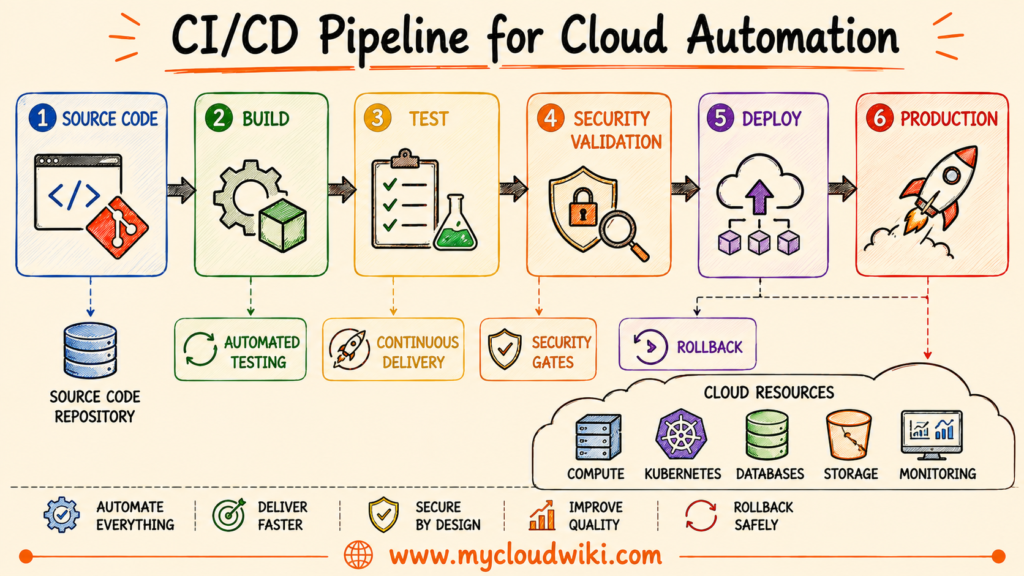
CI/CD pipelines automate application delivery while improving deployment consistency, software quality, and operational efficiency across enterprise multi-cloud platforms.
GitOps: Managing Infrastructure Through Git
GitOps extends Infrastructure as Code by making Git the single source of truth for both infrastructure and application deployments.
Rather than manually applying infrastructure changes, engineers commit approved changes to a Git repository. Automated controllers continuously compare the desired state stored in Git with the actual cloud environment and reconcile any differences.
GitOps improves:
- Version control.
- Auditability.
- Change governance.
- Rollback capability.
- Collaboration.
- Operational consistency.
- Multi-cloud standardization.
💡 Architect’s Tip
Git should become the authoritative record for infrastructure and application changes. When every approved change originates from version-controlled repositories, organizations improve governance, simplify auditing, and reduce operational risk across multi-cloud environments.
The following illustration demonstrates how GitOps continuously synchronizes approved infrastructure definitions with enterprise cloud environments.
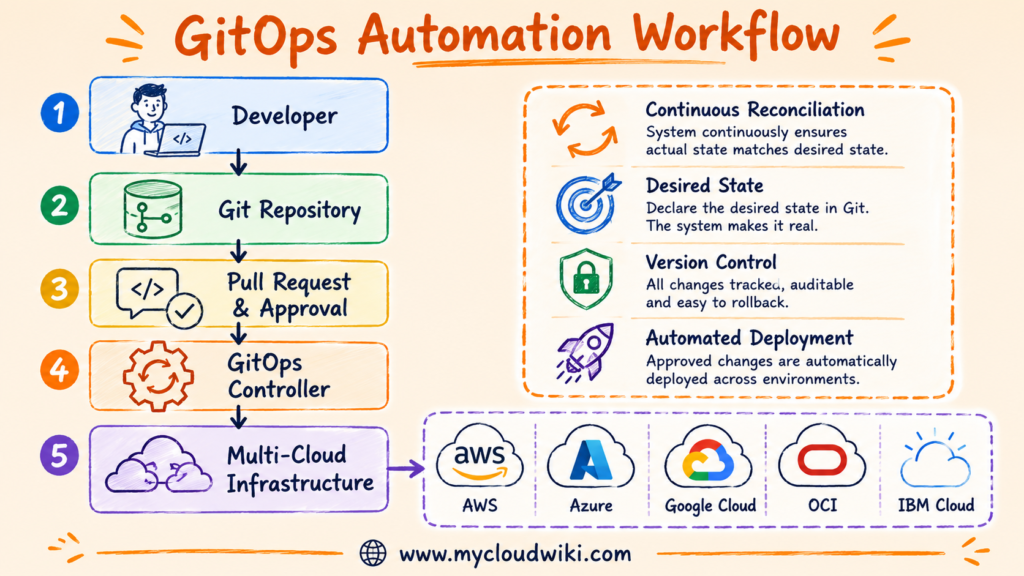
GitOps combines version control, automation, and continuous reconciliation to deliver consistent, auditable, and repeatable cloud operations across the major cloud providers.
Orchestration
Automation performs individual tasks, while orchestration coordinates multiple automated tasks into a complete business or operational workflow.
For example, a single orchestration workflow can automatically:
- Provision cloud infrastructure.
- Configure operating systems.
- Apply security policies.
- Deploy applications.
- Configure monitoring.
- Register DNS records.
- Validate deployments.
- Notify operations teams.
Orchestration enables enterprise organizations to automate complex end-to-end processes while maintaining governance and operational consistency across multiple cloud providers.
💡 Architect’s Tip
Individual automation saves time. Enterprise orchestration transforms automation into an operational platform by connecting provisioning, configuration, deployment, governance, monitoring, and validation into a single repeatable workflow.
The following illustration demonstrates how orchestration coordinates multiple automation technologies into a complete enterprise workflow.
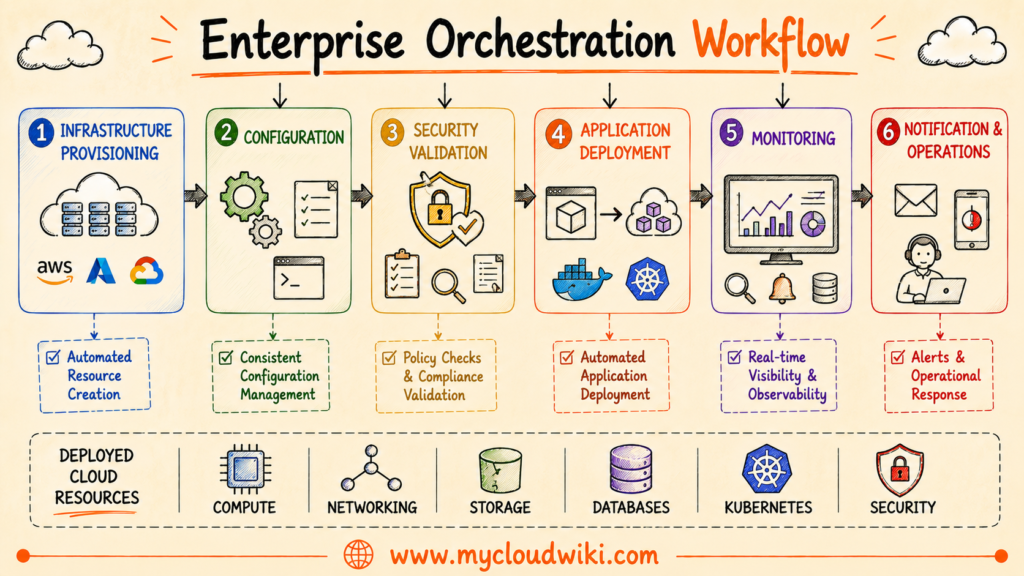
Bringing Everything Together
Cloud automation is most effective when these technologies work together as a unified operating model. Each technology addresses a specific stage of the automation lifecycle, and together they enable organizations to build secure, repeatable, and scalable cloud platforms.
- Infrastructure as Code provisions cloud resources.
- Configuration Management standardizes and maintains those resources.
- CI/CD automates application delivery.
- GitOps governs infrastructure and application changes.
- Orchestration coordinates the entire automation workflow from start to finish.
The following illustration summarizes how the five core automation technologies combine to create an end-to-end enterprise cloud automation platform.
Cloud Automation Across the Major Cloud Providers
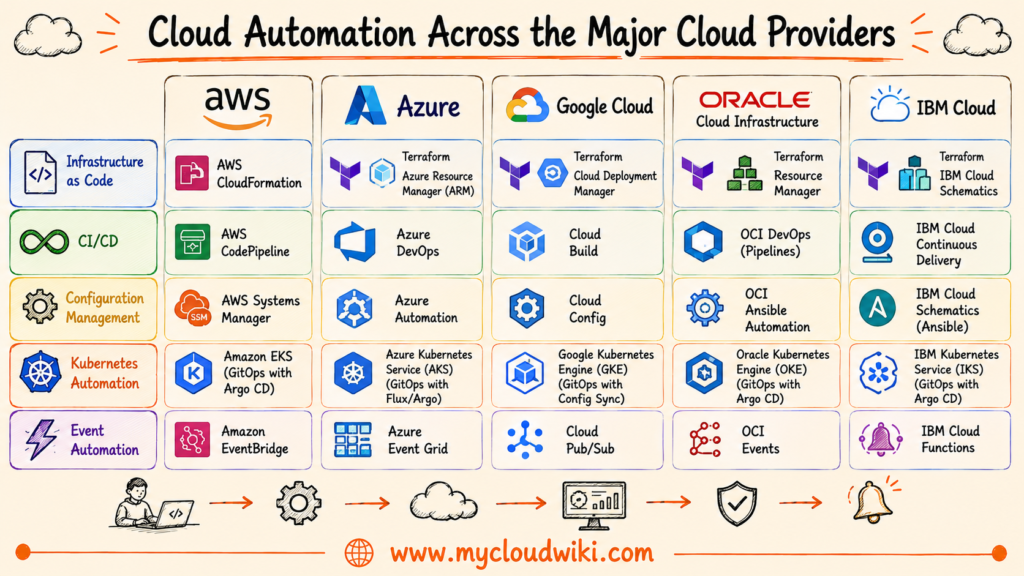
Cloud automation follows the same architectural principles across the major cloud providers, even though each provider uses different tools and service names.
Enterprise organizations should focus on common automation capabilities:
- Infrastructure as Code
- CI/CD pipelines
- Configuration management
- Kubernetes automation
- Event-driven automation
- Policy automation
- Operational runbooks
- Monitoring integration
The goal is not to make every provider identical. The goal is to create a consistent automation operating model that engineering teams can apply across cloud environments.
Continue Learning: Understanding Cloud Compute Fundamentals helps explain why automated provisioning is essential for creating, scaling, and managing compute resources consistently.
The following table maps common automation capabilities across the major cloud providers.
Cloud Automation Across the Major Cloud Providers
The following visual compares automation capabilities across the major cloud providers while emphasizing shared architectural principles.
Cloud Automation Through the Engineer and Architect Lens
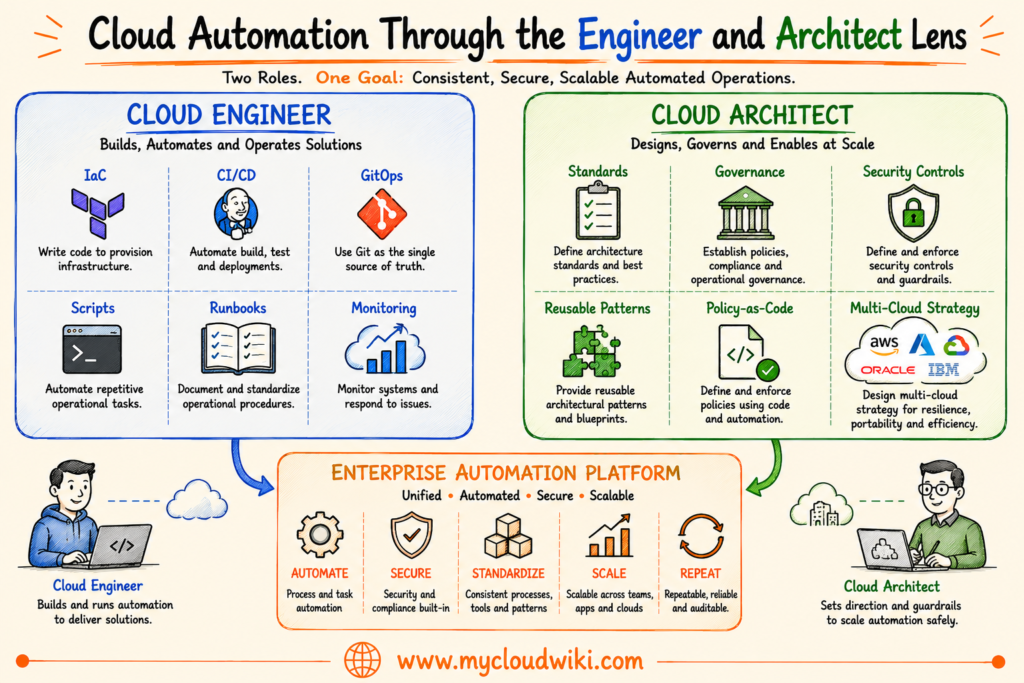
Cloud engineers and enterprise architects both work with automation, but they focus on different responsibilities.
Engineers build and maintain automation workflows. Architects define the automation standards, governance model, reusable patterns, and enterprise controls that allow automation to scale safely.
Engineer Perspective
Cloud engineers typically focus on implementation and operations.
Typical responsibilities include:
- Create Infrastructure as Code templates.
- Build CI/CD pipelines.
- Manage Git repositories.
- Automate configuration management.
- Maintain GitOps workflows.
- Troubleshoot pipeline failures.
- Automate monitoring and alerts.
- Maintain operational runbooks.
The engineer’s goal is to make cloud delivery repeatable, reliable, and easier to operate.
Architect Perspective
Enterprise architects define the automation strategy used across teams and cloud providers.
Typical responsibilities include:
- Define enterprise automation standards.
- Select approved automation platforms.
- Establish reusable IaC modules.
- Design GitOps operating models.
- Define security and compliance guardrails.
- Create policy-as-code standards.
- Standardize deployment patterns.
- Align automation with governance and risk management.
The architect’s goal is to ensure automation improves consistency without creating uncontrolled complexity.
💡 Architect’s Tip
Enterprise automation should not become a collection of disconnected scripts. The most mature organizations build reusable automation platforms that allow teams to deploy infrastructure, applications, policies, and operational workflows using approved standards.
The following visual compares how engineers and architects contribute to enterprise cloud automation.
Cloud Automation in Multi-Cloud Environments
Multi-cloud environments become difficult to manage when every provider has different deployment processes, naming standards, pipeline designs, security controls, and operational workflows.
Cloud automation reduces this complexity by creating shared operating standards across the major cloud providers.
A mature multi-cloud automation model usually includes:
- Standard IaC modules.
- Central Git repositories.
- Reusable CI/CD pipelines.
- GitOps workflows.
- Policy-as-code enforcement.
- Automated compliance checks.
- Centralized logging and monitoring.
- Standard operational runbooks.
- Approval workflows for sensitive changes.
This approach helps organizations scale cloud operations without allowing every team or provider to develop its own disconnected automation process.
Continue Learning: Cloud Monitoring & Observability Fundamentals builds on automation by showing how telemetry, alerting, dashboards, and operational insights help teams manage automated cloud platforms.
The following visual shows how an enterprise automation platform standardizes deployment and operations across multiple cloud providers.
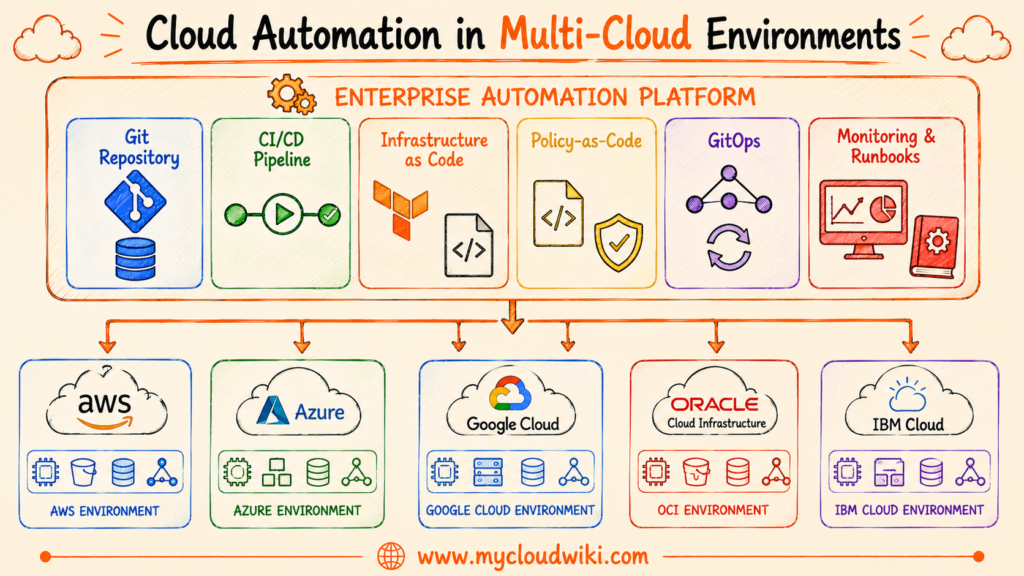
Automation becomes most valuable when it creates consistency across providers, teams, and environments. A strong multi-cloud automation strategy helps organizations move faster while improving governance, reliability, security, and operational maturity.
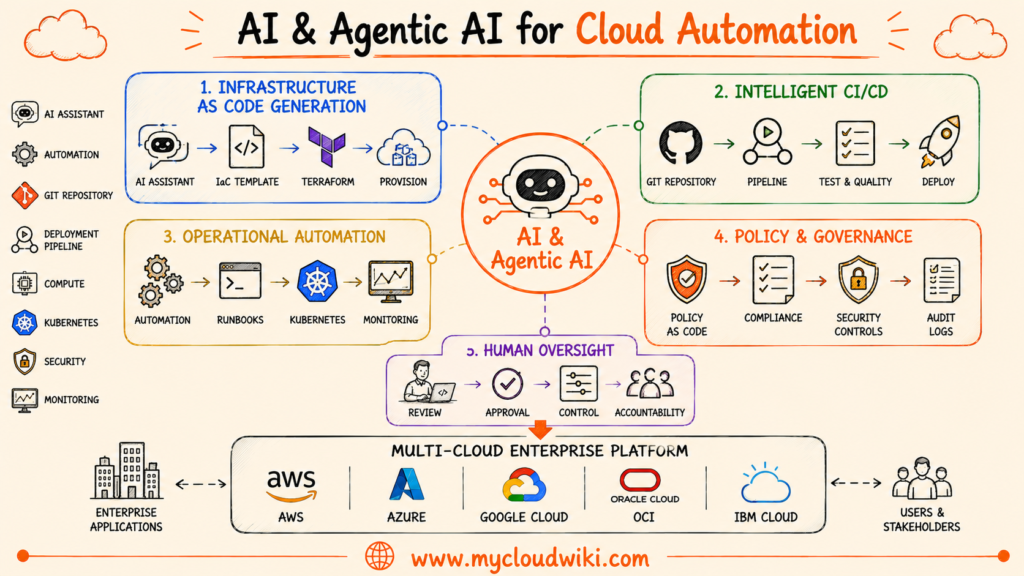
AI & Agentic AI for Cloud Automation
Cloud automation has traditionally relied on predefined scripts, templates, and workflows. While these approaches remain essential, Artificial Intelligence (AI) and Agentic AI are transforming how organizations build, operate, optimize, and govern automated cloud environments.
Rather than replacing existing automation technologies such as Infrastructure as Code or CI/CD, AI enhances automation by making workflows more intelligent, adaptive, and proactive.
As enterprise cloud environments continue to grow in size and complexity, AI enables engineering teams to automate decisions, accelerate operations, and improve platform reliability while maintaining governance and human oversight.
How AI Helps Cloud Automation
Artificial Intelligence improves cloud automation by analyzing large amounts of operational data and recommending actions that improve efficiency and reliability.
Common AI-assisted automation capabilities include:
- Recommending Infrastructure as Code improvements.
- Detecting configuration drift.
- Identifying failed deployments.
- Explaining pipeline failures.
- Optimizing deployment schedules.
- Predicting infrastructure capacity requirements.
- Identifying idle or underutilized resources.
- Recommending cost optimization opportunities.
AI enables engineers to troubleshoot and optimize automated environments much faster than manual analysis alone.
How Agentic AI Helps Cloud Automation
Agentic AI extends traditional automation by executing approved operational workflows with minimal human intervention.
Unlike rule-based automation, Agentic AI can understand objectives, evaluate multiple actions, and coordinate complex workflows while operating within enterprise guardrails.
Examples of Agentic AI in cloud automation include:
- Generating Infrastructure as Code templates from architecture requirements.
- Creating CI/CD pipelines automatically.
- Provisioning cloud environments using approved standards.
- Coordinating end-to-end deployment workflows.
- Performing automated post-deployment validation.
- Executing approved operational runbooks.
- Identifying failed deployments and initiating rollback procedures.
- Creating operational documentation and deployment reports.
As organizations mature, Agentic AI becomes an intelligent automation assistant rather than simply another deployment tool.
Governance
AI-driven automation must operate within clearly defined enterprise governance policies.
Organizations should establish governance for:
- Approved automation workflows.
- Role-based permissions.
- Policy-as-Code enforcement.
- Change approval processes.
- Audit logging.
- Security validation.
- Compliance monitoring.
- Risk management.
Governance ensures AI accelerates automation without introducing uncontrolled operational risk.
Human Oversight
Although AI and Agentic AI can automate many operational activities, enterprise architects and cloud engineers remain responsible for business-critical decisions.
Human oversight is particularly important for:
- Production deployments.
- Security policy changes.
- Disaster recovery execution.
- Compliance exceptions.
- Infrastructure architecture decisions.
- High-risk operational changes.
AI should recommend and automate approved workflows, while humans remain accountable for governance, risk management, and business outcomes.
Enterprise Perspective
Enterprise organizations increasingly combine Infrastructure as Code, GitOps, CI/CD, orchestration, and AI into unified automation platforms.
Rather than automating isolated tasks, modern cloud platforms automate the complete operational lifecycle across the major cloud providers while maintaining consistent governance, security, and compliance.
This approach enables organizations to deliver cloud services faster without sacrificing operational maturity.
💡 Architect’s Tip
The future of cloud automation is not fully autonomous infrastructure—it is governed autonomy. Successful enterprise organizations allow AI agents to automate repetitive operational activities while ensuring architects define guardrails, approval policies, and accountability for every production change.
The following illustration demonstrates how AI and Agentic AI enhance traditional cloud automation while operating within enterprise governance and human oversight.
Well-Architected Multi-Cloud Automation Strategy
Enterprise cloud automation should improve consistency across the major cloud providers rather than creating provider-specific operational models.
Operational Excellence
- Standardize Infrastructure as Code across all cloud providers.
- Build reusable CI/CD pipelines and GitOps workflows.
- Automate operational runbooks for common activities.
- Maintain centralized source control for automation assets.
- Continuously test automation workflows.
Security
- Apply least-privilege access to automation platforms.
- Enforce Policy-as-Code across every cloud provider.
- Secure automation credentials and secrets.
- Continuously validate infrastructure compliance.
- Audit every automated change.
Reliability
- Build resilient automation pipelines with rollback capabilities.
- Standardize deployment validation across cloud providers.
- Automate backup and disaster recovery workflows.
- Monitor automation health continuously.
- Eliminate manual deployment dependencies.
Performance Efficiency
- Optimize automation pipelines regularly.
- Reuse Infrastructure as Code modules.
- Standardize deployment patterns.
- Reduce unnecessary manual approvals.
- Continuously improve automation performance.
Cost Optimization
- Remove unused automation resources.
- Optimize build and deployment pipelines.
- Automate infrastructure cleanup.
- Monitor automation platform utilization.
- Apply FinOps practices across automation workflows.
The following illustration summarizes how enterprise organizations apply the Well-Architected Framework to build standardized, secure, reliable, and scalable cloud automation platforms across the major cloud providers.
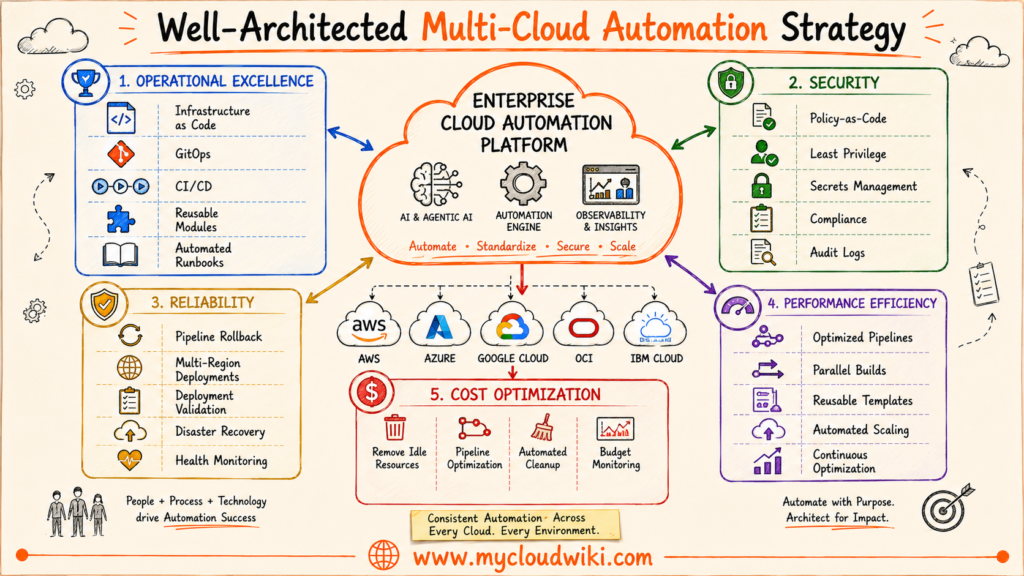
A Well-Architected automation platform enables organizations to standardize deployments, strengthen governance, improve operational consistency, and scale cloud operations confidently across the major cloud providers.
Common Cloud Automation Mistakes
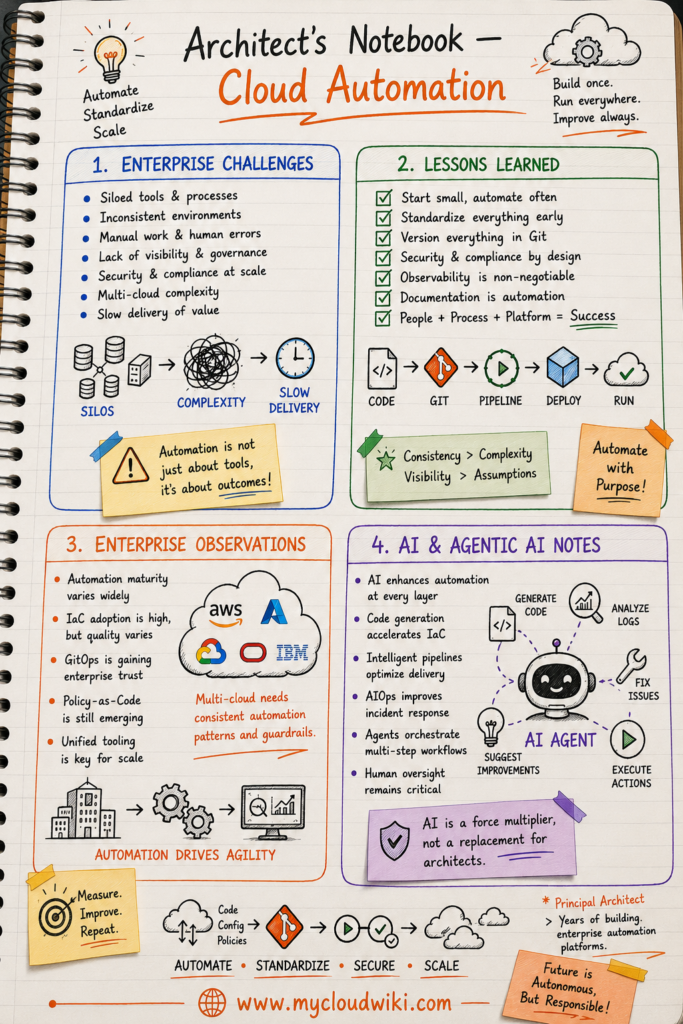
Architect’s Notebook — Cloud Automation
The following notebook captures practical lessons learned from designing and operating enterprise automation platforms across multi-cloud environments.
Key Takeaways
- Cloud automation enables consistent, repeatable, and scalable cloud operations.
- Infrastructure as Code, Configuration Management, CI/CD, GitOps, and Orchestration work together as a unified automation platform.
- Successful enterprise automation focuses on standardization across the major cloud providers rather than provider-specific tooling.
- AI and Agentic AI enhance cloud automation by improving operational intelligence while requiring strong governance and human oversight.
- Enterprise architects design automation operating models that enable engineering teams to deliver secure, reliable, and governed cloud platforms at scale.
What’s Next
Automation enables cloud platforms to operate consistently, but organizations also need visibility into what those automated systems are doing.
In the next lesson, Cloud Monitoring & Observability Fundamentals Explained Across Multi-Cloud Environments, you’ll learn how logs, metrics, traces, alerts, dashboards, and observability platforms help engineers and architects monitor, troubleshoot, and continuously improve enterprise cloud environments across the major cloud providers.

