
Quick Read
- ✅ Cloud databases provide the data layer for modern applications, enabling reliable storage, retrieval, and processing of information across multi-cloud environments.
- ✅ Different database types—including relational, NoSQL, in-memory, data warehouses, and lakehouses—are designed to solve different business and technical problems rather than competing with one another.
- ✅ AWS, Azure, Google Cloud, OCI, and IBM Cloud all offer managed database services based on the same architectural principles, making it more important to understand database concepts than provider-specific product names.
- ✅ Enterprise architects standardize database governance, security, automation, backup, and monitoring across multiple cloud providers to build scalable and resilient platforms.
- ✅ AI and Agentic AI are transforming database operations through intelligent monitoring, performance optimization, automation, and natural language access while increasing the importance of governance and data quality.
Cloud Databases as a Foundational Cloud Building Block
In the previous lesson, you learned how Cloud Storage Fundamentals provides persistent storage for objects, files, and block volumes across cloud environments. Storage ensures that data can be safely retained and recovered, but it does not organize or process information in a way that applications can efficiently use.
Modern applications require much more than persistent storage. They need to search customer records, process financial transactions, manage inventory, analyze business trends, and support millions of users simultaneously. These capabilities are provided by databases.
Whether you are building an online banking platform, an e-commerce website, a healthcare application, or an AI solution, databases become the central source of business information. They enable applications to retrieve data quickly, maintain consistency, and support analytics and intelligent decision-making.
Cloud Database Introduction
Cloud databases are managed database services that allow organizations to store, organize, retrieve, and process data without managing the underlying database infrastructure. Instead of installing, patching, backing up, and maintaining database servers, organizations consume databases as managed cloud services that automatically handle many operational tasks.
Modern enterprise applications rarely depend on a single database technology. A typical application may use:
- A relational database for business transactions.
- A NoSQL database for user profiles and session data.
- An in-memory database for high-speed caching.
- A data warehouse for reporting and business intelligence.
- A lakehouse for large-scale analytics and AI.
Selecting the appropriate database for each workload is an architectural decision that balances performance, scalability, consistency, operational effort, security, and cost.
As organizations adopt enterprise multi-cloud strategies, the goal is not to standardize on a single database product, but to standardize governance, security, automation, monitoring, backup, and operational practices across AWS, Azure, Google Cloud, OCI, and IBM Cloud.
Modern applications execute business logic before interacting with databases. To understand how applications process requests, read Cloud Compute Fundamentals.
The following diagram illustrates where cloud databases fit within a modern enterprise application architecture and how they connect applications to business data.
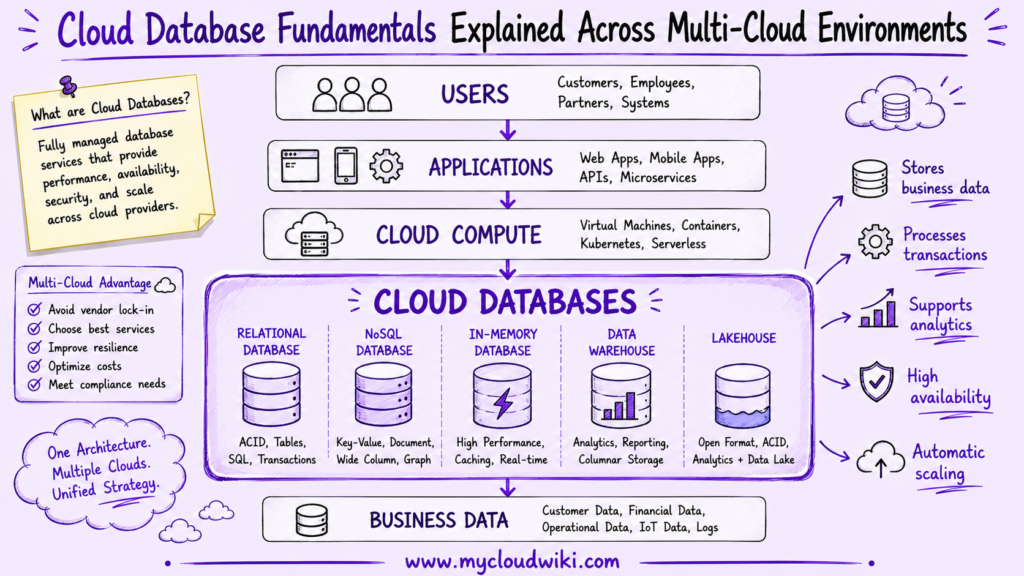
Cloud databases are the intelligence layer of modern cloud applications. They transform stored information into structured, searchable, and reliable data that applications, analytics platforms, and AI systems can use to deliver business value.
Learning Objectives
After completing this lesson, you will be able to:
- Explain why cloud databases are a foundational cloud building block.
- Differentiate between relational, NoSQL, in-memory, data warehouse, and lakehouse architectures.
- Compare managed database services across AWS, Azure, Google Cloud, OCI, and IBM Cloud.
- Understand how engineers and architects design database platforms for enterprise multi-cloud environments.
- Recognize how AI, automation, and governance are transforming modern cloud databases.
Core Cloud Database Concepts
What Is a Cloud Database?
A cloud database is a managed service that stores, organizes, retrieves, and processes application data within a cloud platform. While traditional databases required organizations to deploy and maintain physical or virtual database servers, cloud databases abstract much of that operational complexity through managed services.
Cloud databases support a wide range of enterprise workloads, including online transaction processing (OLTP), business analytics, content management, IoT platforms, AI applications, and real-time event processing. Most managed database platforms automatically handle routine operational tasks, allowing engineering teams to spend more time building applications and less time managing infrastructure.
Regardless of the provider, every cloud database performs three core functions:
- Store business information reliably.
- Organize data for efficient querying and retrieval.
- Process application requests securely and consistently.
In enterprise multi-cloud environments, architects standardize operational practices such as provisioning, backup, monitoring, security, and disaster recovery to provide a consistent database operating model across multiple cloud providers.
Every database ultimately relies on durable storage for data files, snapshots, and backups. If you’d like to understand these storage foundations in more detail, see Cloud Storage Fundamentals.
Key Characteristics of Cloud Databases
Although database services differ across providers, they share several common characteristics that make them well suited for modern enterprise applications:
- Managed provisioning and deployment.
- Automatic software patching and maintenance.
- Built-in backup and point-in-time recovery.
- High availability with automatic failover.
- Elastic scalability for growing workloads.
- Integrated monitoring and performance insights.
- Encryption for data at rest and in transit.
- Identity-based authentication and fine-grained access control.
These capabilities reduce operational overhead while improving security, availability, scalability, and consistency across enterprise multi-cloud environments.
How Cloud Databases Work
Applications communicate with databases using SQL queries, APIs, drivers, or application frameworks. The database engine validates requests, retrieves or updates information, manages transactions, and returns results to the application.
Behind the scenes, managed database services automate many infrastructure tasks, including storage allocation, replication, backups, software updates, health monitoring, and failover. This allows engineering teams to focus on application logic instead of maintaining database servers.
In multi-cloud environments, organizations typically standardize database deployment through Infrastructure as Code, centralized monitoring, consistent security policies, and governance frameworks to simplify operations across different cloud providers.
Databases depend on secure connectivity between applications and data platforms. To understand how this communication is designed and protected, explore Cloud Networking Fundamentals.
The following sketch shows how applications interact with managed cloud database services while the cloud platform automates infrastructure management, replication, and backup.
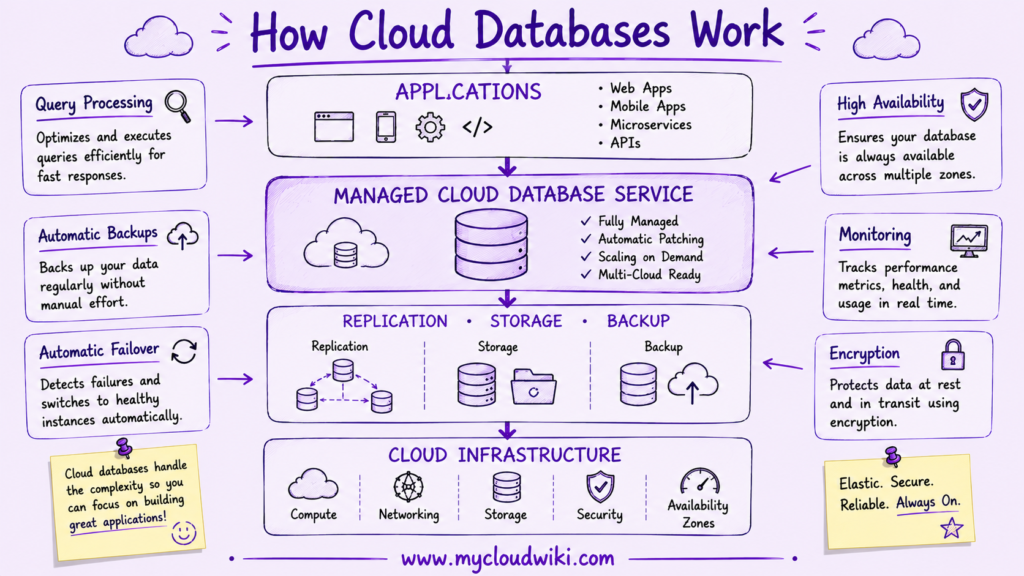
Managed cloud databases simplify database operations by automating infrastructure management while providing secure, scalable, and highly available data platforms for enterprise applications.
Types of Cloud Databases
Modern enterprise applications rarely rely on a single database technology. Instead, they combine multiple database types, with each one solving a specific business or technical problem. Understanding these database models helps engineers select the right platform for each workload while enabling architects to design scalable, resilient, and portable multi-cloud data platforms.
Rather than asking “Which database is the best?”, architects ask:
“Which database is the best fit for this workload?”
Relational Databases (SQL)
Relational databases organize data into structured tables consisting of rows and columns. They enforce predefined schemas and use Structured Query Language (SQL) to create, retrieve, update, and manage data.
Relational databases are ideal for applications requiring strong consistency, complex relationships, and ACID (Atomicity, Consistency, Isolation, Durability) transactions.
Common use cases
- Banking and financial systems
- ERP and CRM applications
- E-commerce transactions
- Healthcare systems
- Human Resource Management
Key characteristics
- Structured tables and relationships
- ACID-compliant transactions
- Powerful SQL querying
- High data consistency
- Excellent reporting capabilities
NoSQL Databases
NoSQL databases are designed for applications that require flexibility, horizontal scalability, and the ability to process large volumes of structured, semi-structured, or unstructured data.
Unlike relational databases, NoSQL platforms typically use flexible schemas that allow applications to evolve without frequent database redesign.
Common use cases
- User profiles
- Product catalogs
- IoT platforms
- Social media applications
- Content management systems
Key characteristics
- Flexible schema
- Horizontal scalability
- High throughput
- Low-latency access
- Multiple data models (document, key-value, graph, column)
In-Memory Databases
In-memory databases store data primarily in memory (RAM) instead of on disk, enabling extremely fast data retrieval and processing.
They are commonly used alongside relational or NoSQL databases rather than replacing them.
Common use cases
- Application caching
- User sessions
- Gaming leaderboards
- Real-time analytics
- AI inference caching
Key characteristics
- Extremely low latency
- High transaction throughput
- Fast application response times
- Frequently used as a distributed cache
Data Warehouses
Data warehouses are analytical databases optimized for processing large volumes of historical data rather than supporting day-to-day business transactions.
Organizations consolidate information from multiple operational systems into a data warehouse to support reporting, dashboards, and business intelligence.
Common use cases
- Executive dashboards
- Financial reporting
- Business intelligence
- Trend analysis
- Enterprise reporting
Key characteristics
- Optimized for analytics
- Large-scale historical storage
- High-performance reporting
- Complex SQL queries
- Supports decision making
Lakehouses
Lakehouses combine the scalability of data lakes with many of the management capabilities traditionally associated with data warehouses.
They enable organizations to analyze structured, semi-structured, and unstructured data using a unified platform while supporting analytics, machine learning, and AI workloads.
Common use cases
- AI and machine learning
- Data science
- Enterprise analytics
- Streaming data
- Large-scale data platforms
Key characteristics
- Unified analytics platform
- Supports multiple data types
- Highly scalable
- AI and ML ready
- Cost-efficient data storage
Modern AI platforms depend heavily on high-quality data stored in scalable analytical platforms. Later in Level 00, you’ll learn how AI systems use these foundations in AI, Generative AI & Agentic AI in Cloud Computing.
Each database technology is designed for different workloads. The following comparison illustrates when each database type is typically used within modern enterprise architectures.
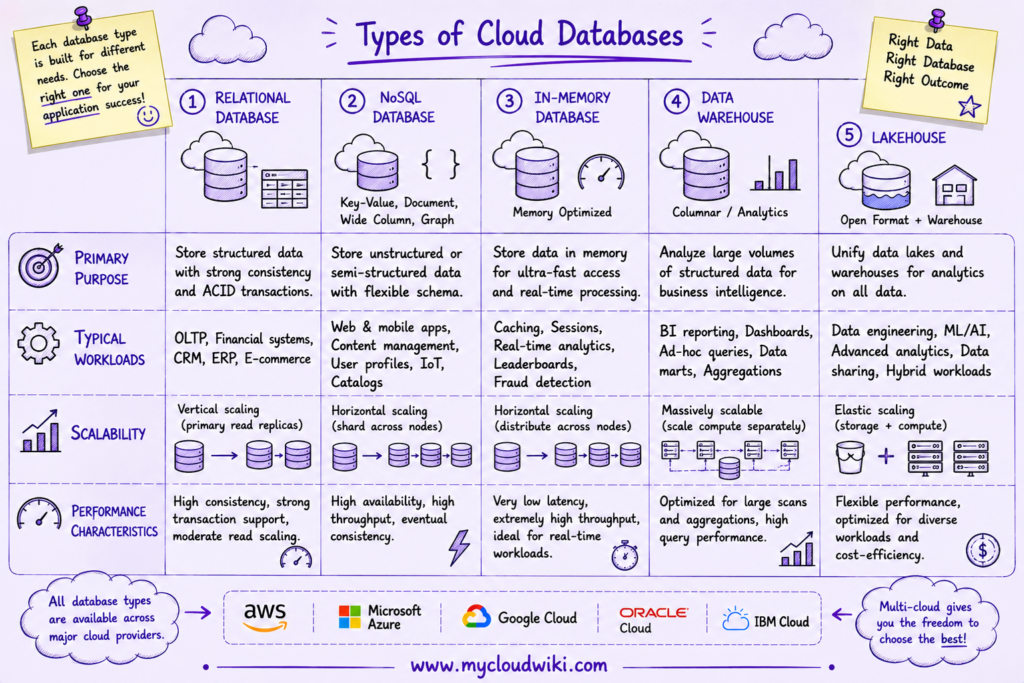
Each database type complements the others rather than replacing them. Most enterprise applications combine multiple database technologies to optimize transactional performance, scalability, analytics, and AI capabilities.
How Applications Use Different Types of Cloud Databases
Enterprise applications often use several database technologies within the same solution. This approach, known as polyglot persistence, allows each application component to use the database best suited to its specific workload.
For example, an online retail platform might use:
- A relational database to process customer orders and payments.
- A NoSQL database to store product catalogs and customer profiles.
- An in-memory database to cache shopping carts and user sessions.
- A data warehouse for business intelligence and sales reporting.
- A lakehouse to train AI recommendation models using structured and unstructured data.
Using multiple database technologies improves application scalability, performance, operational efficiency, and analytical capabilities while supporting future business growth.
Database security is equally important as database selection. As you continue through the series, you’ll learn how identity, encryption, and governance protect enterprise databases in Cloud Security Fundamentals.
The following architecture demonstrates how a single enterprise application can combine multiple database technologies to support different business functions.
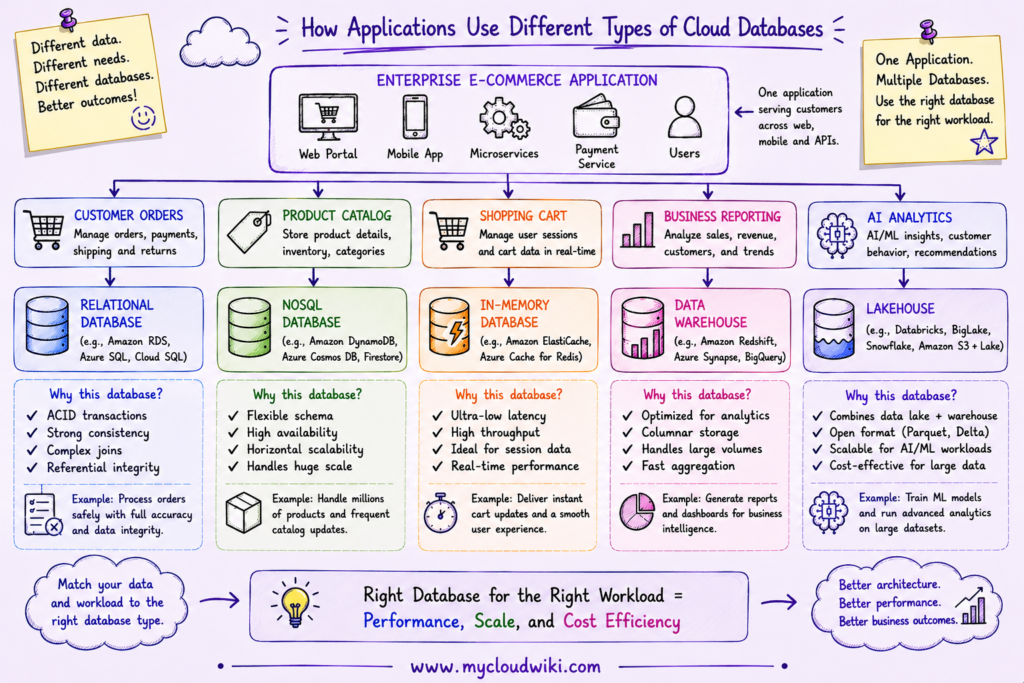
Modern enterprise systems rarely standardize on a single database technology. Instead, architects build data platforms where multiple database models work together to support transactional processing, real-time applications, analytics, and AI while maintaining consistent governance across multi-cloud environments.
How to Choose the Right Cloud Database
Selecting the right database begins with understanding the workload rather than choosing a cloud provider or a familiar technology. Different applications have different requirements for consistency, scalability, latency, reporting, and analytics.
A good database strategy balances:
- Business requirements
- Performance expectations
- Scalability needs
- Data consistency
- Operational complexity
- Security and compliance
- Long-term cost optimization
Instead of selecting one database for every application, enterprise architects match each workload to the most appropriate database model.
The following decision matrix provides a practical starting point for selecting the most appropriate cloud database based on common workload requirements.
Choosing the Right Cloud Database
The following decision tree helps engineers determine which cloud database best fits their application requirements.
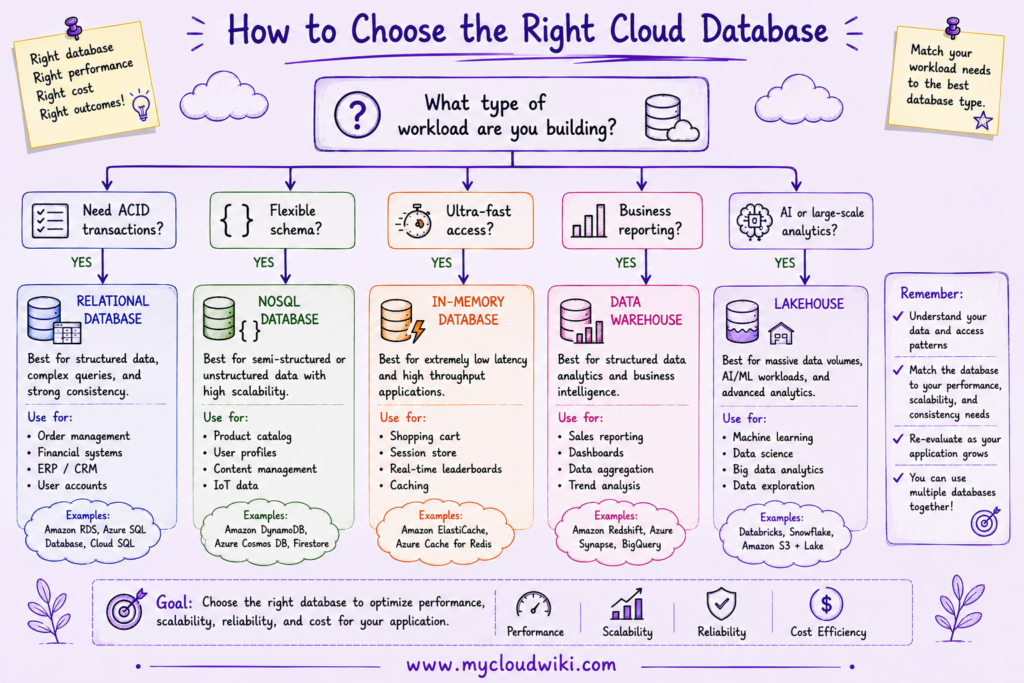
Choosing the right database is about matching the technology to the business requirement. In enterprise multi-cloud environments, architects focus on standardizing governance, automation, security, and operational practices across cloud providers while selecting the most appropriate database model for each workload.
Cloud Database Services Across Major Cloud Providers
Although every cloud provider offers managed database services, the underlying database concepts remain the same. Each platform provides services for relational databases, NoSQL databases, in-memory databases, data warehouses, and modern analytics platforms. The service names may differ, but the architectural principles are remarkably consistent.
For engineers, learning these common concepts makes it easier to work across multiple cloud providers. For architects, it enables the design of portable, governed, and scalable database platforms without becoming dependent on provider-specific implementations.
Rather than standardizing on one provider’s database service, enterprise multi-cloud strategies focus on:
- Standardizing database governance across cloud providers.
- Automating provisioning through Infrastructure as Code (IaC).
- Applying consistent security policies.
- Centralizing monitoring and observability.
- Standardizing backup and disaster recovery strategies.
As database platforms become increasingly automated, provisioning is commonly performed using Infrastructure as Code rather than manual deployment. To learn more about cloud automation and provisioning methods, see How Cloud Resources Are Created Across Multi-Cloud.
The following table compares the primary managed database services available across AWS, Azure, Google Cloud, OCI, and IBM Cloud.
Cloud Database Services Across Major Cloud Providers
Although service names differ, every provider delivers comparable database capabilities. Learning database architecture concepts rather than memorizing product names makes it easier to design consistent multi-cloud solutions.
The following comparison illustrates how the five major cloud providers implement similar database capabilities using different managed services.
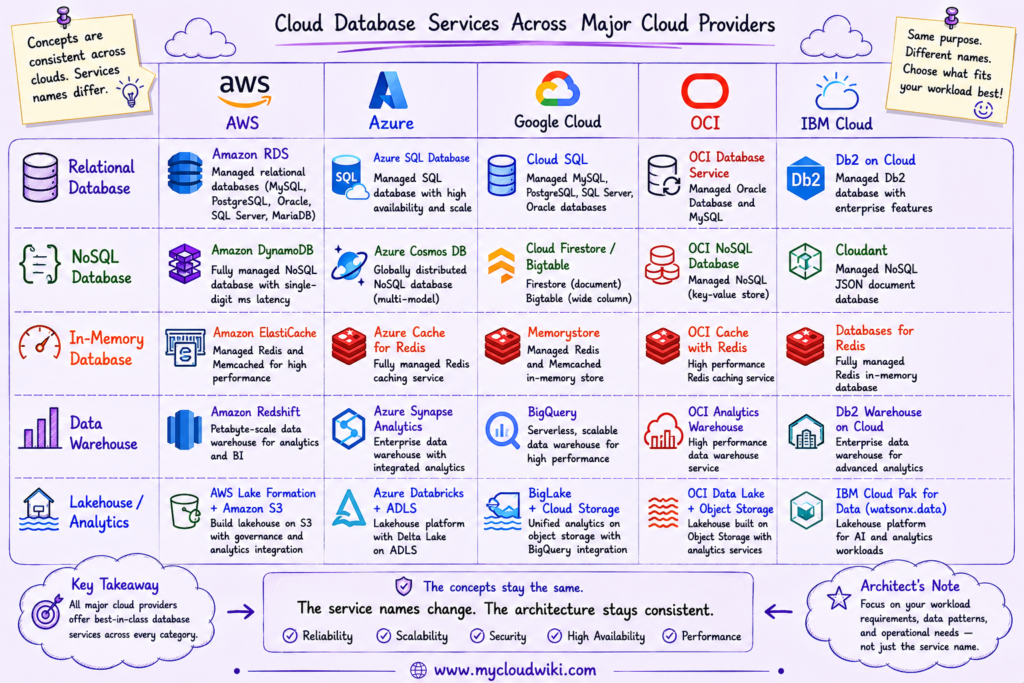
The provider names may change, but enterprise database architecture principles remain the same. Multi-cloud engineers learn the concepts first and then map those concepts to each cloud provider’s services.
Cloud Databases Through the Engineer and Architect Lens
Cloud engineers and enterprise architects work with the same database technologies, but their responsibilities differ significantly. Engineers focus on implementing and operating databases, while architects design enterprise-wide data platforms that support long-term business objectives across multiple cloud providers.
Engineer Perspective
Cloud engineers are responsible for deploying, operating, securing, and maintaining database services that support business applications.
Typical responsibilities include:
- Provision managed database services.
- Configure database networking and private connectivity.
- Implement backup and recovery policies.
- Monitor database health and performance.
- Configure replication and high availability.
- Secure databases using encryption and identity controls.
- Troubleshoot connectivity and performance issues.
- Automate deployments using Infrastructure as Code.
Their primary objective is to ensure that databases remain available, secure, performant, and operational.
Architect Perspective
Enterprise architects define the standards that enable database platforms to operate consistently across AWS, Azure, Google Cloud, OCI, and IBM Cloud.
Typical responsibilities include:
- Select appropriate database architectures for different workloads.
- Standardize database governance across cloud providers.
- Define enterprise backup and disaster recovery strategies.
- Establish security, compliance, and data protection standards.
- Design multi-region and multi-cloud resilience.
- Standardize Infrastructure as Code modules and automation.
- Optimize database costs using enterprise FinOps practices.
- Align database platforms with business and regulatory requirements.
Rather than focusing on individual database instances, architects design standardized data platforms that engineering teams can use consistently across the enterprise.
The following illustration compares how engineers and architects approach cloud databases from operational and strategic perspectives.
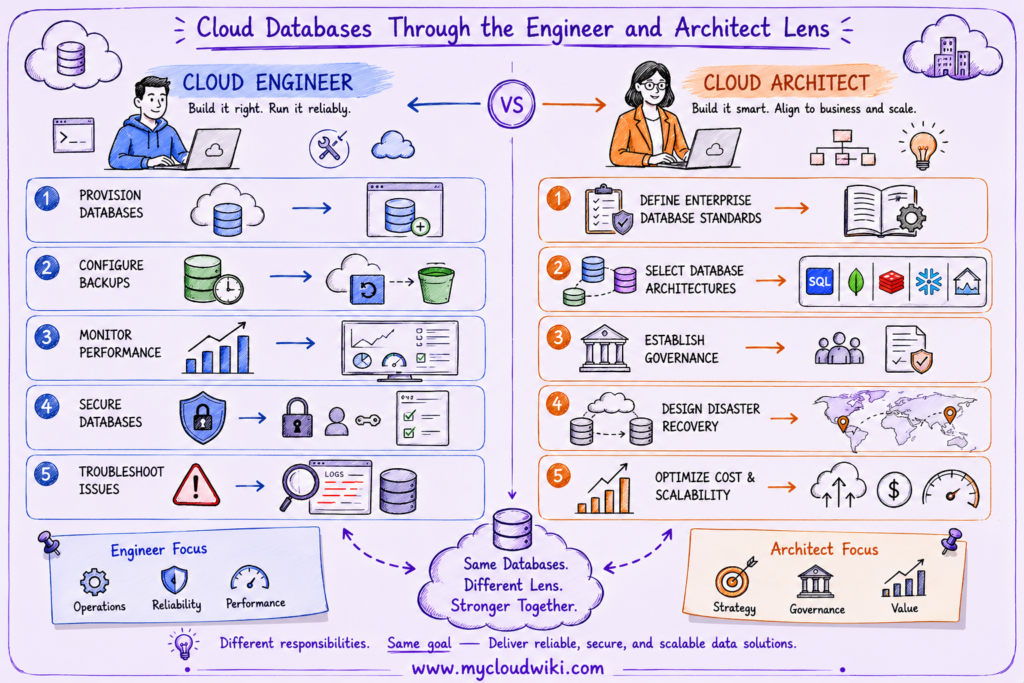
Although engineers and architects have different responsibilities, both contribute to building secure, scalable, and resilient database platforms. Engineers focus on day-to-day operations, while architects establish the standards, governance, and automation that enable enterprise databases to scale consistently across multiple cloud providers.
Multi-Cloud Reality Check
Supporting databases across multiple cloud providers introduces challenges beyond simply selecting the right database technology. Every provider offers different management interfaces, backup mechanisms, monitoring tools, networking models, and security capabilities. Without common standards, operational complexity grows quickly.
Successful organizations reduce this complexity by standardizing how databases are deployed, secured, monitored, and governed rather than attempting to make every cloud provider identical.
Common enterprise multi-cloud priorities include:
- Standardized Infrastructure as Code modules.
- Consistent identity and access management.
- Centralized monitoring and observability.
- Unified backup and disaster recovery policies.
- Common security and encryption standards.
- Enterprise-wide governance and compliance.
- Standardized tagging and cost management.
These practices create a consistent operating model that allows engineering teams to work efficiently regardless of where the database is hosted.
Cloud Databases in Multi-Cloud Environments
Enterprise organizations rarely operate a single database platform. Instead, they build a unified data ecosystem where different database technologies and cloud providers support different business requirements while sharing common governance and operational practices.
A typical enterprise may operate:
- Transactional databases in one cloud provider.
- Global customer applications across multiple regions.
- Analytics platforms in another cloud.
- AI data platforms using lakehouses.
- Disaster recovery databases in a secondary cloud.
Rather than managing each environment independently, organizations build a common platform using:
- Infrastructure as Code.
- Centralized identity.
- Unified monitoring.
- Enterprise security policies.
- Standardized backup and recovery.
- Consistent governance.
This approach improves resilience, portability, operational efficiency, and long-term scalability while allowing workloads to use the most appropriate database technologies across AWS, Azure, Google Cloud, OCI, and IBM Cloud.
The following architecture illustrates how enterprise organizations standardize governance and operations while running databases across multiple cloud providers.
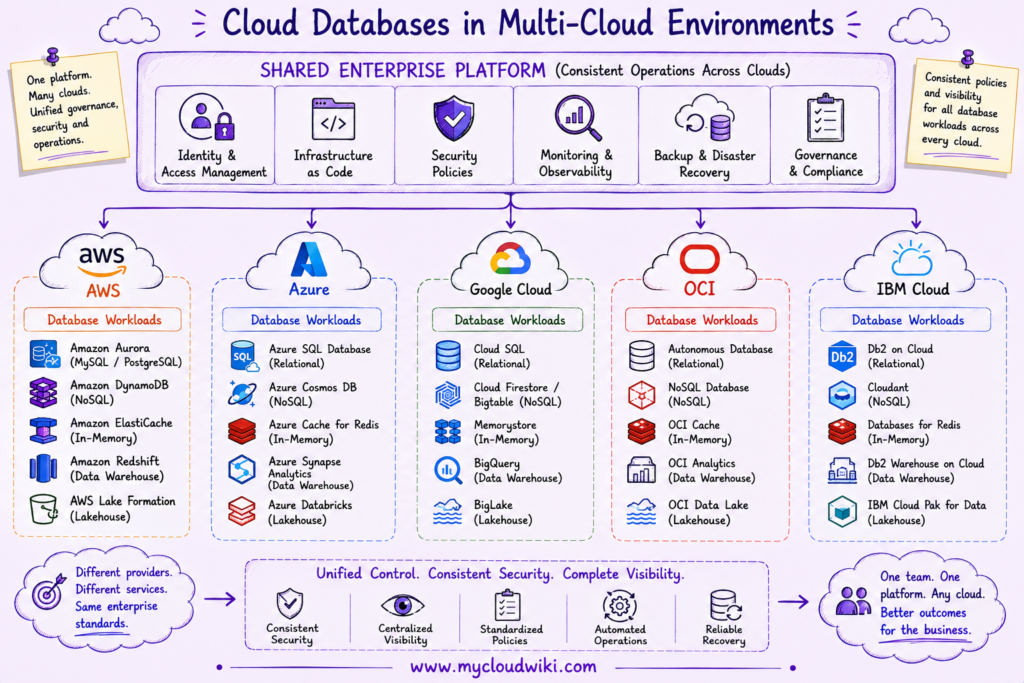
A successful multi-cloud database strategy is built on consistency. Standardized governance, automation, security, and operational practices enable organizations to manage databases efficiently while giving application teams the flexibility to choose the best database technology for each workload.
Cloud Databases with Agentic AI
Artificial Intelligence is rapidly transforming how databases are designed, managed, secured, and optimized. While databases continue to store and process enterprise data, AI is helping engineering teams operate these platforms more efficiently by automating routine tasks, identifying performance issues, and providing intelligent recommendations.
Agentic AI extends these capabilities by enabling AI agents to perform operational workflows under enterprise governance. Instead of simply recommending an action, an AI agent can provision database resources, optimize performance, execute backups, or initiate disaster recovery workflows after receiving the necessary approvals.
As organizations adopt AI across multiple cloud providers, database platforms must support both traditional business workloads and AI-driven applications while maintaining consistent governance, security, and operational standards.
Common ways AI is improving database operations include:
- Performance tuning and query optimization.
- Capacity planning and storage forecasting.
- Automated backup validation.
- Intelligent anomaly detection.
- Security and compliance monitoring.
- Cost optimization recommendations.
- Natural language database querying.
- Automated operational runbooks.
While AI improves operational efficiency, enterprise architects must ensure that AI-generated recommendations and actions remain governed through approval workflows, audit logging, least-privilege access, and organizational policies.
As AI platforms become more autonomous, cloud automation becomes increasingly important. You’ll learn how Infrastructure as Code, policy automation, and orchestration simplify enterprise operations in Cloud Automation Fundamentals.
The following architecture illustrates how AI and Agentic AI assist engineers in managing enterprise database platforms while operating within governance and security boundaries.
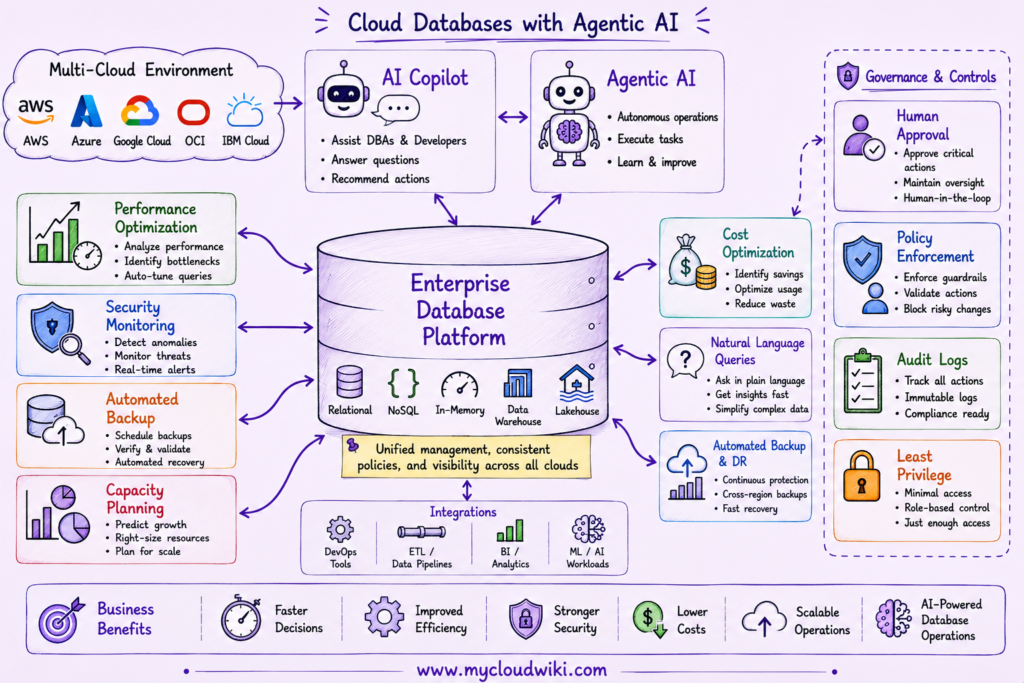
AI should augment database operations—not replace engineering expertise. The most successful enterprise platforms combine intelligent automation with strong governance, security, and human oversight.
Well-Architected Multi-Cloud Database Strategy
Designing enterprise database platforms requires balancing scalability, availability, security, operational simplicity, and cost across multiple cloud providers. Rather than optimizing each cloud independently, organizations should establish consistent standards that apply across AWS, Azure, Google Cloud, OCI, and IBM Cloud.
The following recommendations summarize multi-cloud database best practices aligned with the Well-Architected Framework.
Well-Architected Multi-Cloud Database Strategy
Consistent governance and operational standards are far more valuable than standardizing on a single database product. Enterprise multi-cloud success comes from building repeatable processes that work across all cloud providers.
The following diagram illustrates how the Well-Architected pillars guide enterprise database platform design across multi-cloud environments.
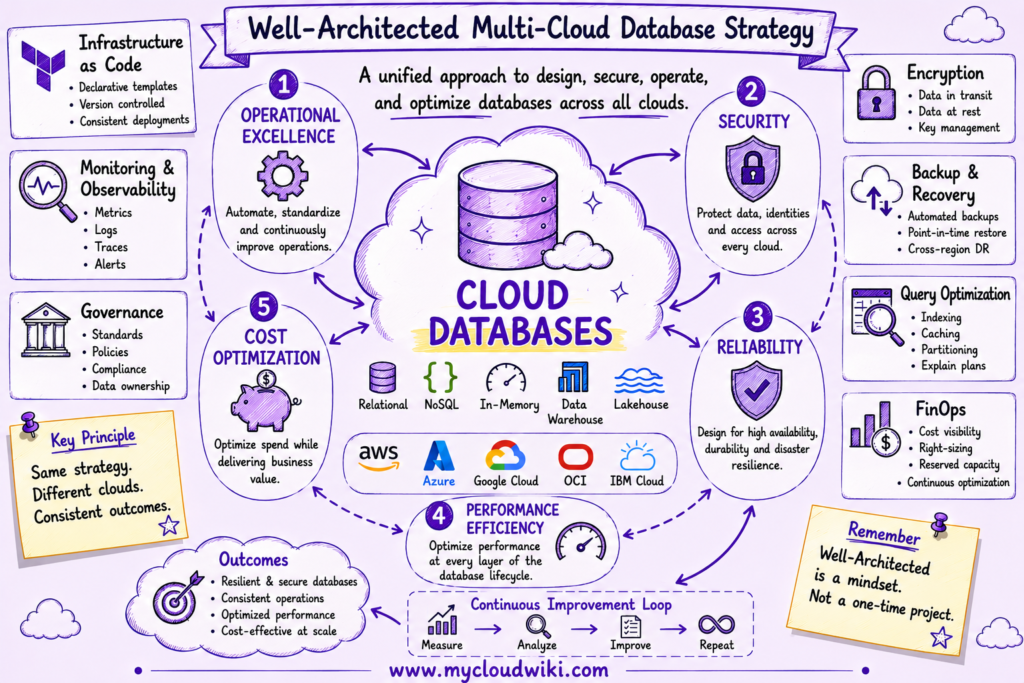
Applying these principles helps organizations build secure, scalable, resilient, and cost-efficient database platforms that support enterprise applications consistently across multiple cloud providers.
Common Mistakes and Misconceptions
Common Cloud Database Mistakes
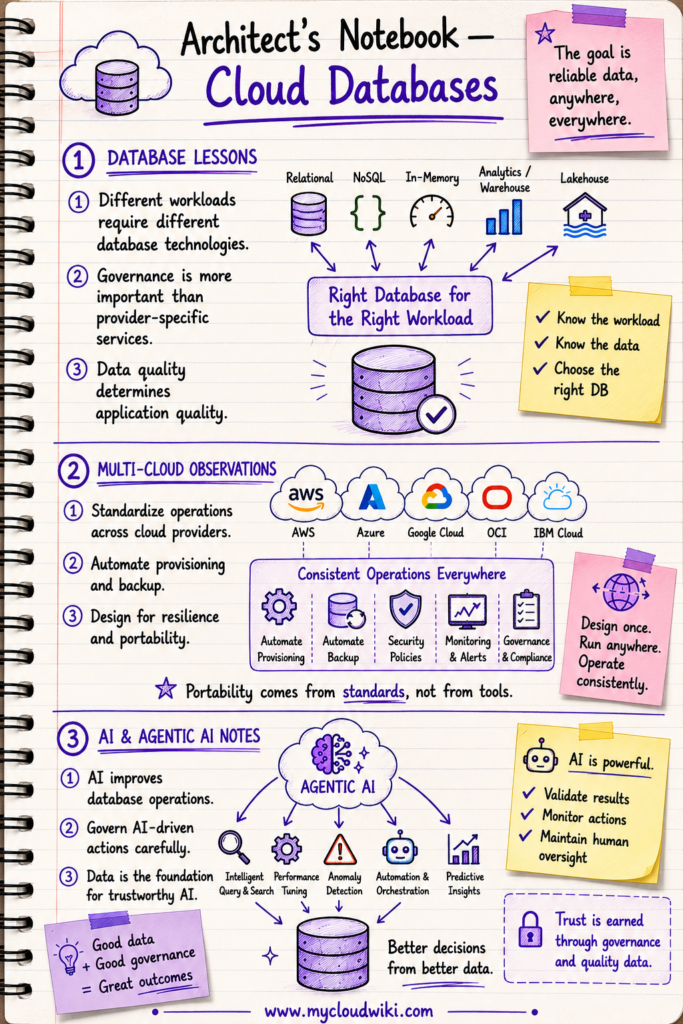
Architect’s Notebook
Introduction
Experienced architects rarely begin by selecting a database product. Instead, they first understand the business problem, application characteristics, growth expectations, operational model, and governance requirements before choosing the appropriate database technologies.
Modern enterprise platforms typically combine relational, NoSQL, in-memory, analytical, and AI-ready databases while standardizing automation, security, monitoring, and governance across every cloud provider.
The following notebook summarizes the key architectural lessons from this chapter.
Key Takeaways
- Cloud databases provide the structured data foundation for modern applications, analytics platforms, and AI solutions across multi-cloud environments.
- Relational, NoSQL, in-memory, data warehouse, and lakehouse technologies each solve different business problems and are often used together within enterprise applications.
- Every major cloud provider offers comparable managed database capabilities, making database architecture concepts more important than provider-specific service names.
- Successful enterprise database platforms emphasize standardized governance, automation, security, backup, monitoring, and operational practices across multiple cloud providers.
- AI and Agentic AI are transforming database management through intelligent automation, performance optimization, and operational assistance while reinforcing the need for governance and human oversight.
What’s Next
Cloud databases store and manage enterprise data, but organizations also need resilient platforms that remain available during failures, outages, and disasters. The next lesson explores how cloud platforms achieve business continuity through redundancy, fault tolerance, disaster recovery, and resilient architecture.
In the next lesson, you’ll learn Cloud Reliability & High Availability Fundamentals, where you’ll discover how AWS, Azure, Google Cloud, OCI, and IBM Cloud design highly available services and how enterprise architects build resilient multi-cloud solutions.

