
🎓 Multi-Cloud Fundamental Lessons
Welcome to Your Multi-Cloud Learning Journey
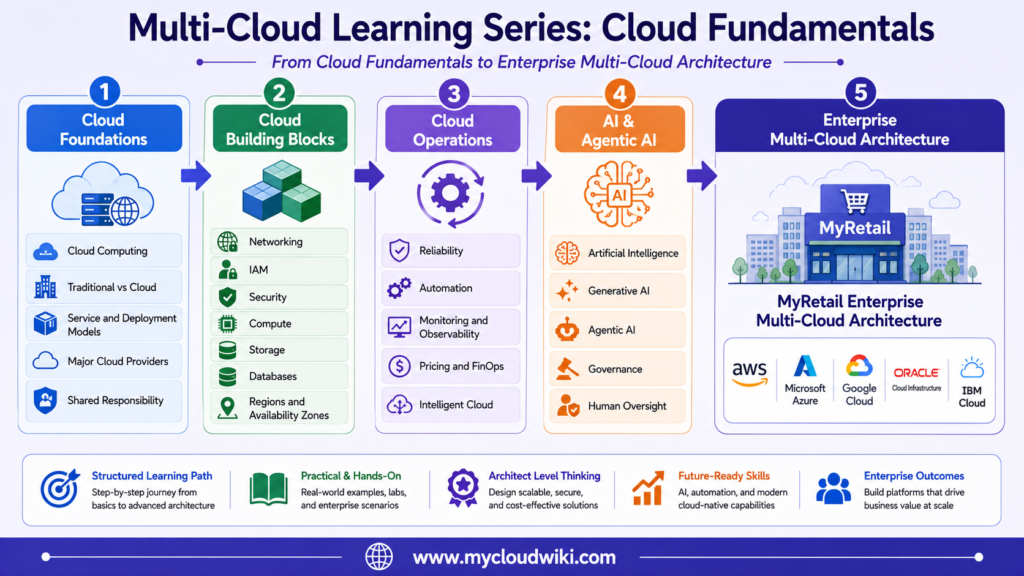
The Multi-Cloud Learning Series gives you a structured foundation in the concepts, technologies, and architectural principles used across the major cloud providers.
You will begin with the fundamentals of cloud computing, explore the core building blocks of enterprise platforms, learn how modern cloud environments are operated, and finish by designing your first intelligent enterprise multi-cloud architecture.
Why This Learning Series is important
Cloud computing is often taught one provider at a time.
That approach can help you learn individual products, but it may not explain how the same architectural ideas appear across different cloud environments.
The Multi-Cloud Learning Series takes a different approach.
You first learn the underlying capability:
- What problem does it solve?
- How does it support the business?
- How does an engineer implement and operate it?
- How does an architect evaluate its role in the larger platform?
- How is it represented across the major cloud providers?
You then map that capability to provider-specific services.
This helps you build knowledge that remains useful even as products, service names, and implementation models continue to evolve.
💡 Architect’s Tip
Do not begin your cloud journey by memorizing hundreds of service names. Begin by understanding architectural capabilities such as networking, identity, compute, storage, databases, reliability, automation, and observability. Provider-specific products become much easier to understand once the capability is clear.
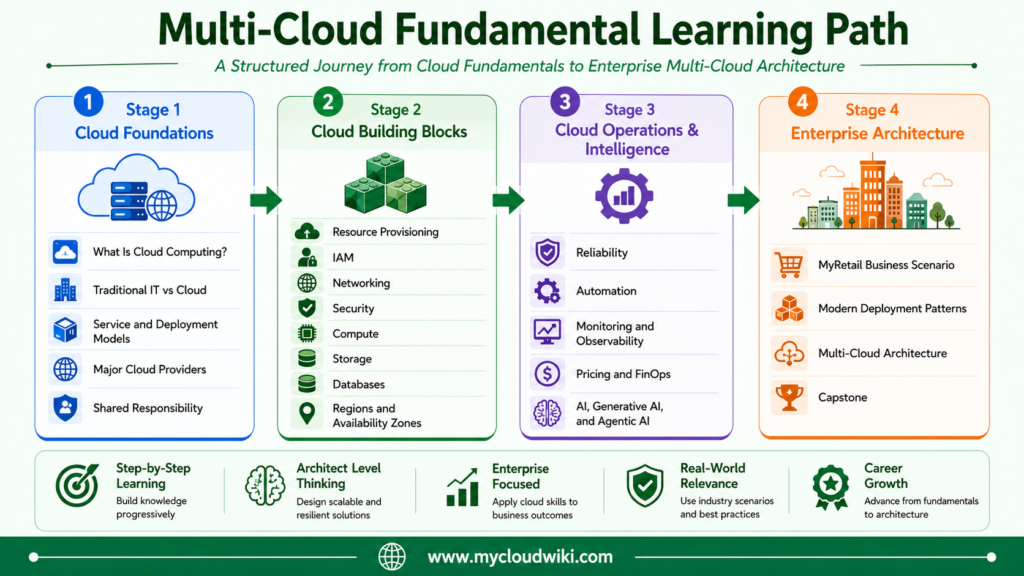
Multi-Cloud Fundamental Learning Path
The series is organized into four connected learning modules.
Each module prepares you for the next one:
You are not simply moving through a collection of articles. You are progressively building the knowledge required to understand, design, and operate a complete enterprise platform.
🎯 Your Learning Mental Model
The lessons are designed to work together. Cloud foundations explain the operating model. Building blocks create the platform. Operations keep it healthy and financially sustainable. AI enhances decision-making and workflow execution. The capstone brings everything together into one enterprise architecture.
Explore the Multi-Cloud Fundamental Lessons
The learning path is organized into four modules. Begin with the cloud operating model, continue through the core platform building blocks, learn how environments are operated and optimized, and finish by applying everything in the enterprise multi-cloud capstone.
Module 1
Cloud Foundations
Start by understanding what cloud computing changes, how services and deployment models work, how responsibilities are shared, and how the major cloud providers fit into the enterprise technology landscape.
1.
What Is Cloud Computing? A Multi-Cloud Guide
Build your first mental model of cloud computing and understand why it represents more than hosted infrastructure.
2.
Traditional Data Centers vs Cloud Computing
Compare ownership, provisioning, scalability, automation, operating models, and financial responsibilities.
3.
Cloud Service Models and Deployment Models Explained
Understand IaaS, PaaS, SaaS, containers, serverless, public cloud, private cloud, hybrid cloud, multi-cloud, and sovereign cloud.
4.
The Major Cloud Providers: AWS, Azure, Google Cloud, OCI and IBM Cloud
Learn how the major cloud providers differ while delivering many of the same architectural capabilities.
5.
Cloud Shared Responsibility Model Explained Across Multi-Cloud Environments
Understand which security, operational, and compliance responsibilities belong to the provider and which remain with the customer.
🎯 Module Outcome: You will understand the cloud operating model, major delivery choices, provider landscape, and shared responsibilities.
Module 2
Core Cloud Building Blocks
Explore the capabilities that combine to form enterprise cloud platforms. Each lesson explains the core concept, its role in the architecture, and how it appears across the major cloud providers.
🧱 Cloud Building Blocks
See how compute, networking, storage, databases, IAM, security, and operations fit together.
⚙️ Resource Provisioning
Create cloud resources using consoles, CLIs, SDKs, APIs, Infrastructure as Code, and Agentic AI.
🔐 Identity and Access Management
Control access for users, applications, services, automation tools, and AI agents.
🌐 Cloud Networking
Connect users, workloads, cloud services, regions, data centers, and business partners.
🛡️ Cloud Security
Apply layered controls to protect identities, networks, applications, infrastructure, and data.
🖥️ Cloud Compute
Run applications using virtual machines, containers, Kubernetes, serverless, and bare-metal services.
💾 Cloud Storage
Store files, application data, backups, archives, logs, images, and AI datasets.
🗄️ Cloud Databases
Manage relational, NoSQL, transactional, analytical, and distributed business data.
🌍 Regions, Availability Zones and Edge Locations
Understand how global infrastructure supports availability, performance, compliance, and business continuity.
🎯 Module Outcome: You will understand the architectural capabilities required to build a secure, connected, scalable, and data-driven cloud platform.
Module 3
Cloud Operations and Intelligence
Learn how enterprise teams keep cloud platforms available, automate delivery, observe system behavior, manage financial outcomes, and introduce AI-assisted operations responsibly.
📈 Cloud Reliability and High Availability
Design workloads that remain available during infrastructure failures, maintenance, and unexpected demand.
⚙️ Cloud Automation
Standardize infrastructure provisioning, configuration, delivery pipelines, GitOps, and operational workflows.
📊 Cloud Monitoring and Observability
Use metrics, logs, traces, events, dashboards, and alerts to understand system behavior and business impact.
💰 Cloud Pricing and FinOps
Understand cloud pricing and use FinOps practices to optimize spending, accountability, and business value.
🤖 AI, Generative AI and Agentic AI in Cloud Computing
Explore how AI supports engineering, analysis, automation, governance, and approved operational workflows.
🎯 Module Outcome: You will understand how enterprise teams operate, observe, automate, optimize, and intelligently improve cloud platforms.
Module 4
Enterprise Multi-Cloud Architecture
Complete the learning path by combining every cloud capability into one business-driven enterprise architecture.
Final Capstone
Build Your First Enterprise Multi-Cloud Architecture
Follow MyRetail from a traditional three-tier application through virtual machines, containers, Kubernetes, serverless, microservices, multi-cloud deployment, enterprise operations, FinOps, AI, and Agentic AI.
Start the Capstone →🎯 Module Outcome: You will connect the complete Multi-Cloud Fundamental Learning Path into one secure, resilient, observable, cost-aware, and intelligent enterprise platform.
🚀 Recommended Starting Point
New to cloud computing? Begin with What Is Cloud Computing? A Multi-Cloud Guide and complete the lessons in order. Each article builds the vocabulary and architectural understanding needed for the final capstone.
Begin the Learning Path →🧭 The MyCloudWiki Learning Method
Each lesson helps you understand the concept, see how it appears across the major cloud providers, apply it to the MyRetail business, and evaluate it from both engineering and architecture perspectives.
1. Cloud Concept
Understand what the capability is, why it exists, and which business or technical problem it solves.
2. MyRetail Business Example
See how the capability supports customers, employees, applications, data, and business operations.
3. Multi-Cloud Mapping
Compare how the capability is implemented across AWS, Azure, Google Cloud, OCI, and IBM Cloud.
4. Engineer Perspective
Understand implementation, configuration, automation, troubleshooting, and day-to-day operations.
5. Architect Perspective
Evaluate scalability, resilience, security, governance, cost, and long-term business impact.
6. AI & Agentic AI
Explore how AI supports analysis and how governed agents can coordinate approved workflows with human oversight.
7. Knowledge Check
Test your understanding by applying the lesson to a realistic cloud or enterprise scenario.
This approach helps you build knowledge in layers. You begin with the core concept, connect it to a business need, compare provider implementations, and then evaluate the wider architectural impact.
From Cloud Engineer to Enterprise Architect
The series is designed to help you grow beyond individual cloud tasks.
At the beginning, you may focus on creating resources, configuring services, or troubleshooting issues. As the lessons progress, you will begin asking broader questions about business value, governance, resilience, cost, and long-term platform strategy.
👨💻 Your Engineer-to-Architect Progression
Cloud Engineer
- Create and configure resources
- Automate deployments
- Monitor applications
- Troubleshoot incidents
- Implement security controls
Enterprise Architect
- Translate business goals into architecture
- Evaluate design trade-offs
- Define governance and standards
- Plan resilience and scalability
- Guide long-term platform evolution
The goal is not to stop being an engineer. It is to combine implementation knowledge with architectural thinking.
👥 Who This Learning Path Is For
Build a structured understanding without being locked into one provider.
Connect traditional infrastructure experience to cloud operating models.
Strengthen automation, operations, governance, and architecture knowledge.
Develop a provider-neutral view of enterprise cloud capabilities and trade-offs.
Build foundational knowledge that supports provider-specific study.
Understand the capabilities, risks, and decisions behind enterprise cloud platforms.
What You’ll Be Able to Do
After completing the Multi-Cloud Fundamental Lessons, you will be able to:
- Explain what cloud computing changes compared with traditional infrastructure.
- Compare service models, deployment models, and the major cloud providers.
- Describe the role of networking, IAM, security, compute, storage, databases, and global infrastructure.
- Explain how reliability, automation, observability, and FinOps support production cloud environments.
- Compare cloud capabilities across AWS, Azure, Google Cloud, OCI, and IBM Cloud.
- Recognize when virtual machines, containers, Kubernetes, serverless, microservices, and event-driven patterns may be appropriate.
- Explain how AI and Agentic AI enhance cloud engineering and operations while preserving governance and human accountability.
- Connect individual technologies into a complete enterprise multi-cloud architecture.
🏆 Your Final Outcome
You will finish the series with more than a list of cloud definitions. You will have a practical mental model for understanding how enterprise applications are designed, deployed, secured, operated, optimized, and evolved across multiple cloud providers.
Begin the Multi-Cloud Fundamental Lessons
You now have the roadmap.
Start with the first lesson and complete the modules in order. Each lesson prepares you for the next, and the final capstone brings the entire learning journey together.
Start Here
Begin Your Multi-Cloud Learning Journey
Start with What Is Cloud Computing? A Multi-Cloud Guide and progress through each module until you are ready to design your first enterprise multi-cloud architecture.
Start the First Lesson → View the Capstone →Continue into the Multi-Cloud Advanced Lessons
The Multi-Cloud Fundamental Lessons establish the vocabulary, concepts, and architecture mental model required for the next stage of your journey.
In the Multi-Cloud Advanced Lessons, you will move deeper into enterprise cloud engineering and architecture, including global infrastructure, landing zones, identity and governance, advanced networking, compute platforms, Kubernetes, DevSecOps, platform engineering, resilience, FinOps, AI platforms, and enterprise architecture blueprints.
The fundamentals are where the journey begins.
The advanced lessons are where you learn to design and operate enterprise platforms at scale.
Recent Posts
- Cloud Building Blocks: The Foundation of Every Multi-Cloud Architecture
 ⚡ Quick Read Key takeaways in 60 seconds 🧱 Cloud building blocks are reusable capabilities such as […]
 - Build Your First Enterprise Multi-Cloud Architecture: A Complete Cloud Computing Capstone
 🎓 Multi-Cloud Learning Series Capstone Congratulations on completing the Multi-Cloud Fundamental Lessons. Throughout this learning journey, you […]
 - AI, Generative AI & Agentic AI Fundamentals Across Multi-Cloud Environments
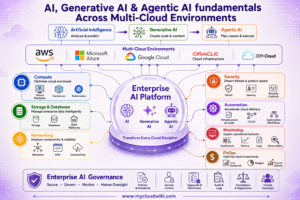 Quick Read ✅ Artificial Intelligence helps organizations analyze data, automate decisions, and improve operational efficiency across cloud […]
 - Cloud Pricing & FinOps Fundamentals Explained Across Multi-Cloud Environments
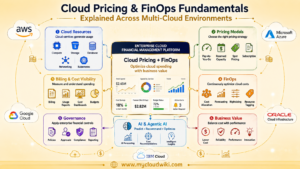 Quick Read ✅ Cloud providers charge for services using different pricing models based on resource consumption, commitments, […]
 - Cloud Monitoring & Observability Fundamentals Explained Across Multi-Cloud Environments
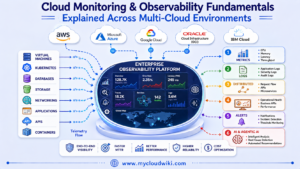 Quick Read ✅ Cloud monitoring collects operational data from cloud infrastructure, applications, and services to help engineers […]
 - Cloud Automation Fundamentals Explained Across Multi-Cloud Environments
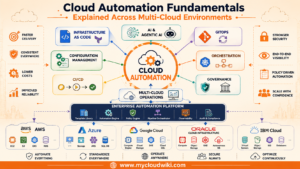 Quick Read ✅ Cloud automation enables organizations to provision, configure, secure, monitor, and manage cloud resources consistently […]